On this page6 sections
In the Taittiriya Upanishad, Bhrigu comes to Varuna Dev, his father, wanting to be taught Brahman, and that effort is what the father gives him to do in place of a direct answer.
The senses of austerity and penance arrived afterwards, and they pull the word towards suffering. Put the Upanishad beside the Bhagavad Gita and, in our reading, the tapasya meaning the two texts share sits nearer to a way of working, and the Gita goes as far as calling one harsh, self-tormenting kind of tapas demonic.
In short
The senses of austerity and penance arrived afterwards, and they pull the word towards suffering. Put the Upanishad beside the Bhagavad Gita and, in our reading, the tapasya meaning the two texts share sits nearer to a way of working, and the Gita goes as far as calling one harsh, self-tormenting kind of tapas demonic.
How did a Sanskrit word for heat come to mean steady effort?
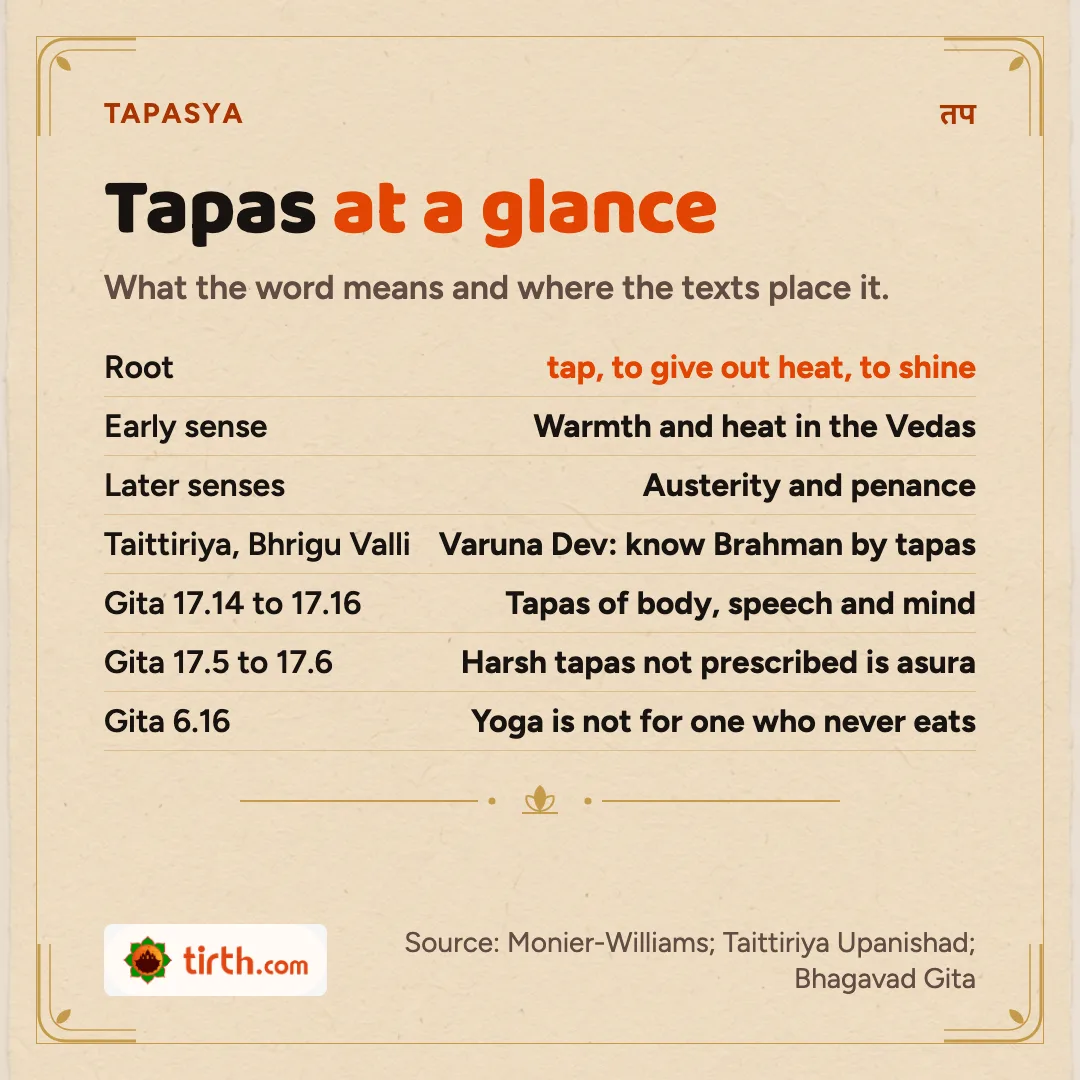
The root is tap, which Monier-Williams gives in his Sanskrit dictionary as to give out heat, to be hot, to shine. Tapas is built on it. In the Vedas the word means warmth and heat.
Over time it took on pain, suffering, religious austerity and penance as well. Penance is the one that Max Muller picked as his English for tapas when his translation of the Upanishad came out in 1884.
We would hold on to the heat while reading both texts, because to our mind the oldest sense still explains the later ones. Long effort does feel like heat.
What did Varuna Dev hand Bhrigu instead of an answer?
Ten anuvakas (short sections) make up the Bhrigu Valli, the third part of the Taittiriya Upanishad, which follows the Siksha Valli and the Ananda Valli. Its first scene is a son asking his father to teach him Brahman.
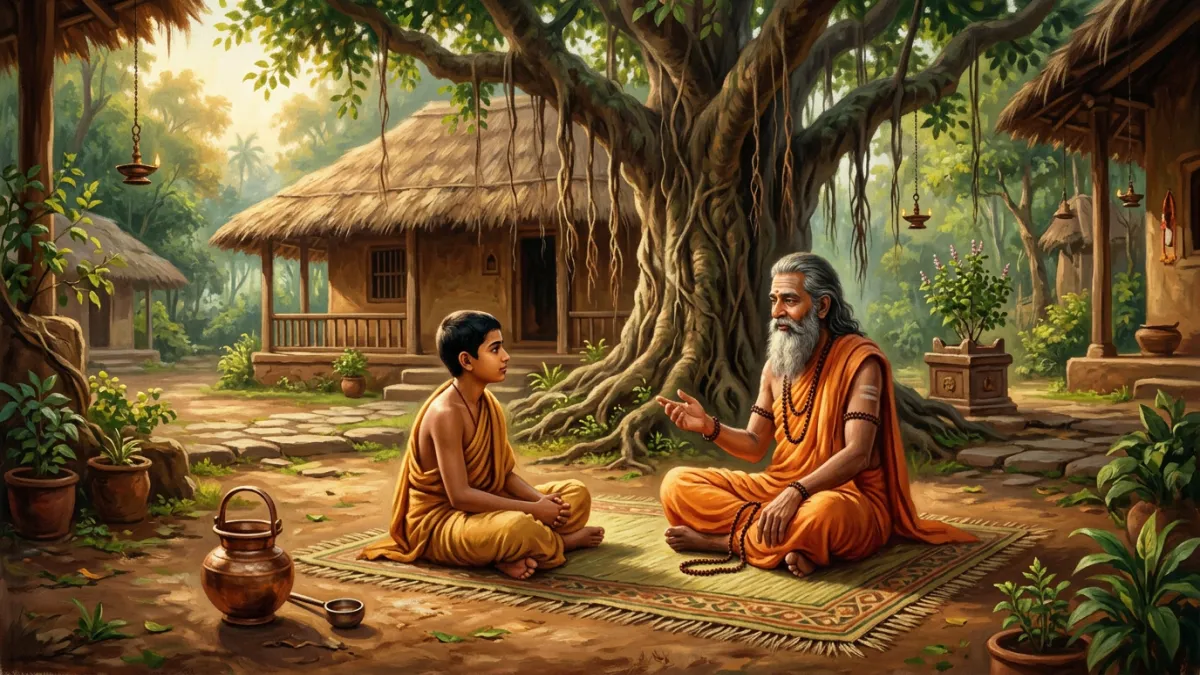
Varuna Dev’s reply is brief. He offers a few pointers and a single description of Brahman, as that from which beings are born, by which they live and into which they return, and tells Bhrigu that this is what he must know. Of how to get from those words to the thing they describe, he says nothing.
Bhrigu leaves to perform tapas. He comes back with an answer, and his father has nothing to add to it. Varuna Dev repeats one instruction, to know Brahman by tapas, and the son is out of the door again. That pattern holds through every return, each answer reaching further than the one before, until Bhrigu arrives at bliss (ananda) and the going back stops. The Upanishad gives that ending a name, the knowledge of Bhrigu and Varuna. So the son had come for an answer and was handed a method, and each time he brought an answer home, until the last, he was sent out to work again.
That repeated line, in Max Muller’s English, reads “penance is (the means of knowing) Brahman”. Penance is his word for tapas. The words in brackets are his own additions, not the Upanishad’s. Drop them, as other translators do with tapo brahma, and the line says tapas is Brahman.
Why the father kept sending him back, the Upanishad does not say, so what follows is only our reading. A reply on the first visit would have left Bhrigu a word to repeat. Because Varuna Dev held back, his son had to reach bliss by his own effort, and the answers he found on the way were his.
Nor does the text describe the penance itself. Bhrigu performed penance, it says, and moves on. What a reader does see, in our reading, is a different hardship, a son walking back to his father again and again with the work still not finished.
Readers who want to go further with that bliss can start on the Upanishadic question of non-duality and then read what liberation means.
Where does tapas fit into a family’s ordinary day?
Bhrigu’s tapas happens between a father and a son. For someone running a household, the Bhagavad Gita is the text to open, because there Bhagwan Krishna, Deity page on Tirth sorts tapas into three kinds, of the body at 17.14, of speech at 17.15 and of the mind at 17.16.
Body, tongue and mind are what these verses deal with. None names a fast. In our view that is why the word sits as easily in a family home as it did between Varuna Dev and Bhrigu, where tapas meant a son walking back with the work not yet done.
In our reading, what the Gita’s three kinds want from a person is what Varuna Dev’s one word wanted from Bhrigu. Each is a task that comes round again. Every morning brings body, speech and mind back to be looked after, as every homecoming brought Bhrigu the same instruction.
The verses belong to what the Gita says about action, and the frame around that is what dharma means in the texts.
When does the Gita call tapas harmful?
Harsh tapas that the scriptures do not prescribe, the kind that torments the body and the Lord within, is what Bhagwan Krishna calls asura (demonic) at 17.5 to 17.6.
The Lord within, says Adi Shankara in his commentary, means Me within.
If you grew up hearing that tapasya means going hungry until it hurts, as though hunger were the point, the Gita says otherwise. Its verse 6.16 says yoga is not for anyone who does not eat at all, and 17.5 to 17.6 is the line on harsh tapas given just above.
Steady work on one side and harm on the other is where the line falls, in our reading. What these texts call tapas is work on body, tongue and mind over a long stretch of time, and how much it hurts is never the measure.
If a vrat is what brought you here, that is a separate subject, and the vrat days in the Tirth Spiritual Calendar list them date by date.
Frequently asked questions
Tapasya is steady, disciplined effort. The Sanskrit root under it is tap, to give out heat, and austerity and penance were added to the word later. In the Taittiriya Upanishad it is the one instruction Varuna Dev gives his son Bhrigu, again and again.
From tap, a root that Monier-Williams gives as to be hot or to shine. In the Vedas the word means warmth and heat. Suffering, austerity and penance are later senses.
No. Fasting appears in none of the three tapas verses, 17.14 to 17.16, which deal with body, speech and mind. Gita 6.16 also says yoga is not for anyone who does not eat at all.
Body at 17.14, speech at 17.15 and mind at 17.16. In our reading these are about daily conduct, how you keep your body, tongue and mind, more than about any one special act.
The Gita says no. Harsh tapas that the scriptures do not prescribe, the kind that torments the body, is what 17.5 to 17.6 calls asura (demonic).
First a description of Brahman, then a single instruction, to know Brahman by tapas, repeated each time Bhrigu came back. The story is in the Bhrigu Valli of the Taittiriya Upanishad. Everything after that, as the story is told, Bhrigu worked out by going out and coming back until his answer was bliss.
Continue on Tirth
- The Bhagwan Krishna page, Deity page on Tirth, on who names the three kinds of tapas in the Gita.
- The karma explainer, the wider teaching on action that the tapas verses sit in.
- The Gita Jayanti page, to keep reading on the Bhagavad Gita.