On this page9 sections
The word grows out of the Sanskrit root kri, which means to do, so it names the doing and nothing more. Whatever comes back to the doer is called karma-phala, the fruit of action, and the texts hold it apart from the deed.
A lot of the muddle over karma meaning begins when the two words are folded into one. Someone says “that is his karma” and means a punishment, or a destiny already fixed. The texts say something quieter and more useful. They say it in layers. First come the Upanishads, then the Gita, then the teachers who came after both. Each layer stays separate below.
In short
Whatever comes back to the doer is called karma-phala, the fruit of action, and the texts hold it apart from the deed. A lot of the muddle over karma meaning begins when the two words are folded into one. Someone says “that is his karma” and means a punishment, or a destiny already fixed.
What counts as karma?
Teachers speak of three doors for action, and they are thought, speech and the body. A harsh word therefore counts, and so does a plan made quietly in the head. None of it is rare. It is only what a person does.
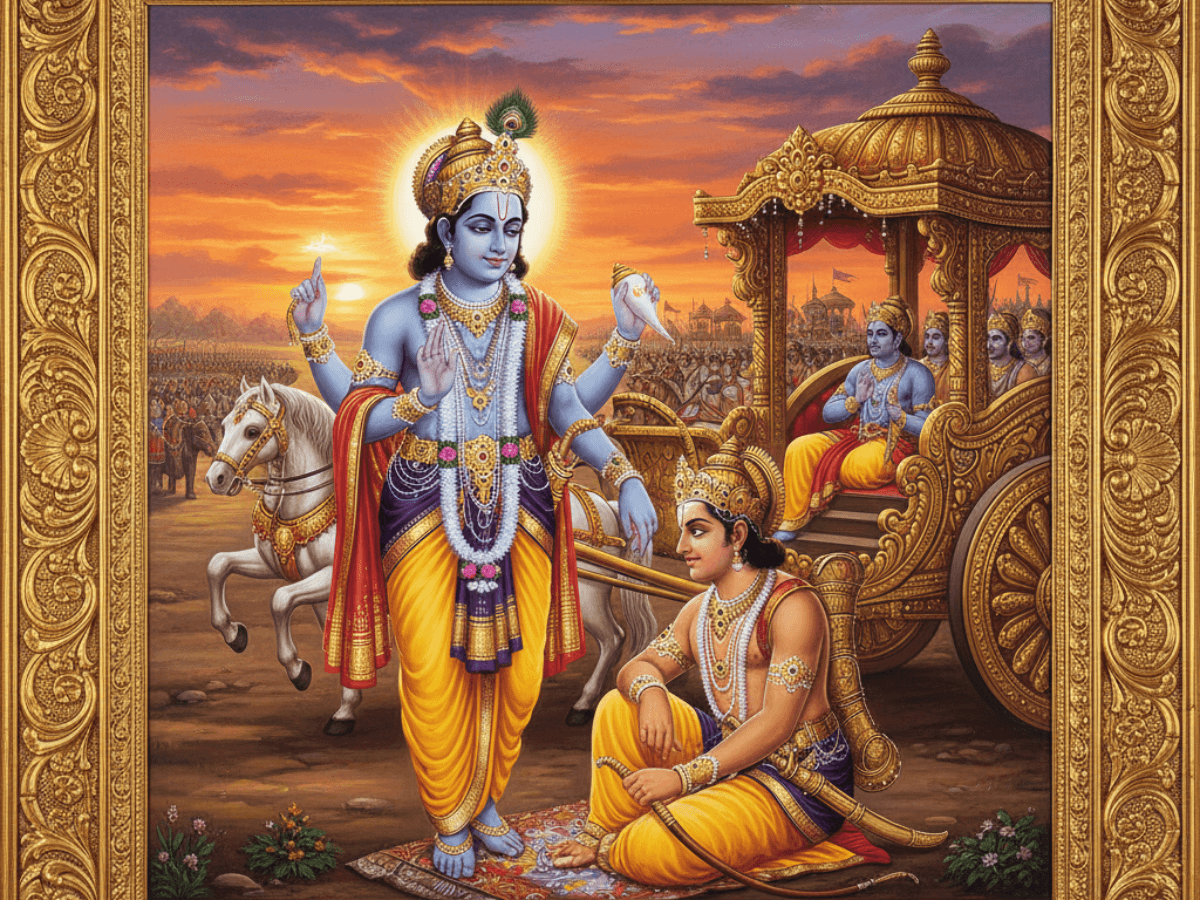
In the Vedic world, before the Upanishads, karma mostly meant ritual action, meaning the offerings and sacrifices. Thinkers then started asking a new thing, namely what an ordinary act does to the person who performs it. Bhagwan Krishna, Deity page on Tirth names the starting point in the Gita (3.5), where no one can remain without acting even for a moment, because the gunas of nature push every being into action.
So the real question was how to act, since acting itself could not be avoided. Our page on what Maryada Purushottam means for Bhagwan Ram takes up conduct through a story.
The Upanishads, where karma turns into a doctrine
The Brihadaranyaka Upanishad has a scene worth picturing (Book 3, second section, usually cited as 3.2.13). Yajnavalkya and Artabhaga withdraw to talk privately, and what they discuss is karma. Good action makes a person good, and bad action makes a person bad. Karma is taught here as a doctrine, in one of the earliest places in Sanskrit literature to do so.
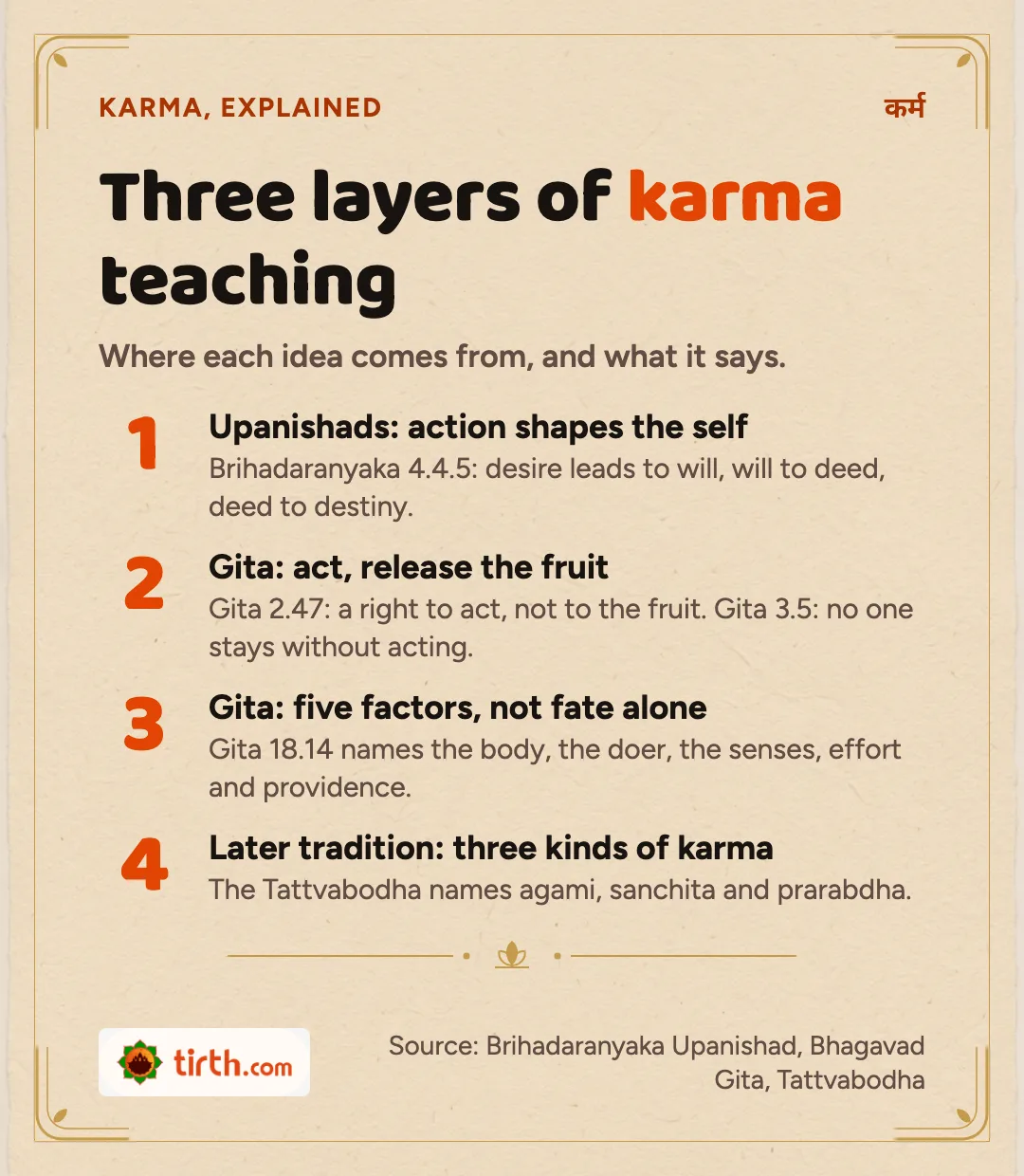
The same Upanishad gives the idea its form (4.4.5). In one well-known English rendering, you are what your deep, driving desire is. That desire becomes will, will becomes deed, and deed brings what follows.
What the Gita asks of the one who acts
The central instruction from Bhagwan Krishna is 2.47. A person has a right to act, and no right to the fruits. That single verse closes two exits. Fruit must not become the motive, and clinging to inaction is no way out either. A student who works hard and refuses to be broken by one exam result already lives this line, Gita or no Gita.
Verse 4.17 asks the listener to grasp three things. Karma is right action, vikarma is wrong or forbidden action, and akarma is inaction. The way of action, says the verse, is deep and hard to fathom. Verse 4.18 then flips the picture, and the wise one is the person who sees inaction within action and action within inaction. Commentators explain that a duty skipped out of laziness is itself an act, one with consequences of its own, and that duty done without craving for the result, and offered to God, does not bind in the same way.
The label nishkama karma, action without desire, is a later commentators’ term, though you will often see it applied here. The Gita’s own words are action without attachment to the fruit. The gap is small, yet it stops the verse being taken as advice to feel nothing at all, and no one could follow that advice anyway.
Its picture for all this is the lotus leaf (5.10). A person who acts, offering the work to God and staying free of attachment, is not stained by wrong, the way water does not wet a lotus leaf. Want to meet the Gita’s speaker through a story before the verses? Start with our Janmashtami post.

How karma connects to rebirth
Rebirth gets its best-known image in the Gita at 2.22. Just as a person puts on new clothes and leaves the old ones, the embodied soul takes new bodies. Later teachers read the Upanishad lines above alongside it: what a person has become through desire and deed goes along. Moksha means release from that cycle, and the Gita’s karma yoga is described as one path to it.
Does karma mean fate?
No. Five factors stand behind any action in the Gita (18.14), namely the body, the doer, the senses, the various efforts and daiva, often translated providence or fate. Fate is only one of the five.
Teachers who came later found a way to hold both ideas. Karma that has begun to bear fruit is called prarabdha, and it shapes the starting conditions of a life, such as where you are born, the body you have and much of what simply arrives. Present choices still create new karma, so many teachers reject strict fatalism. The Ramayana story of why Kaikeyi exiled Bhagwan Ram is told on its own page.
The four types of karma came later
Four names turn up almost everywhere. Sanchita is stored karma. Prarabdha is the part already bearing fruit, kriyamana is what is being done now, and agami is what is yet to come (popular books define agami differently from one another). The Gita does not use these four names. They come from later Vedanta and its teachers.
Even teachers do not agree on the number, and a short Vedanta primer, the Tattvabodha, attributed to Adi Shankaracharya, lists three and not four, agami, sanchita and prarabdha. Teachers often explain the scheme with a picture. The arrow already in flight is prarabdha, the arrows in the quiver are sanchita, and the one being fitted to the bow is the present action. A granary serves too, its full store being sanchita and the grain taken out for the day being prarabdha.
If you can learn only one line, make it the Gita’s own (2.47), because the four types are a later map.
Is karma a punishment?
Many teachers frame karma as consequence, not as punishment or reward handed down from above. A seed grows into whatever it is a seed of. Who administers the process is where the schools differ. Many Vedanta teachers, Vaishnava ones among them, hold that God administers the fruit of karma, while the Mimamsa school and Samkhya-leaning readings see it working on its own. We stay out of that argument, and you can too.
Chitragupta ji’s story has its own page on Tirth. Pujas are devotion, and no method for settling an account.
Frequently asked questions
It means action. The word comes from the root kri, to do. The texts keep the doing and its result apart, naming the result karma-phala. So karma is what you do, and the fruit comes after.
It tells you to do your duty without making the result your motive and without hiding in inaction (2.47). Verse 4.17 sorts action into right, wrong and none, and commentators on 4.18 say even doing nothing can be an act.
No. The Gita (18.14) lists daiva, often rendered fate or providence, as just one of five factors behind an action. Later teachers add that prarabdha sets the starting point, while what you choose now still creates new karma.
Later Vedanta teaching names sanchita, prarabdha, kriyamana and agami. You will not find these names in the Gita, and the Tattvabodha lists only three, so the count differs between teachers.
Yes. Brihadaranyaka 4.4.5 follows desire to deed to what comes next, and Gita 2.22 compares taking a new body to changing clothes. Moksha is the name for release from that cycle of rebirth.
It is acting with the fruit set aside and the work offered to God, as in Gita 5.10. You carry on with your duty and drop the clinging. Later commentators call this nishkama karma.
Continue on Tirth
- Spiritual Calendar: see the day’s tithi and the festivals ahead.
- Yatra packages, Yatra on Tirth: plan a pilgrimage with Tirth.
- Bhagwan Krishna page, Deity page on Tirth: his page on Tirth.