On this page6 sections
Shvetaketu had gone to his teacher at twelve and came home at twenty-four, having studied all the Vedas, vain and very sure of himself as a great scholar (Chandogya Upanishad 6.1.2). His father’s question is the one Advaita Vedanta answers, and the answer, the advaita meaning in a phrase, is “not two”. Your own self and Brahman are not two, and Brahman alone is real in the fullest sense.
Aruni, his father (also known as Uddalaka Aruni), put a single question to him. Had he ever asked for one particular teaching? The one by which the unheard becomes heard, the unthought becomes thought, and the unknown becomes known (6.1.3). Twelve years of study, and all Shvetaketu could do was ask what that teaching might be.
In short
His father’s question is the one Advaita Vedanta answers, and the answer, the advaita meaning in a phrase, is “not two”. Your own self and Brahman are not two, and Brahman alone is real in the fullest sense. Aruni, his father (also known as Uddalaka Aruni), put a single question to him.
Advaita meaning in plain words: you and Brahman
The two in question are you and Brahman. In Advaita Vedanta, Brahman alone is real, and the individual self (atman) is no different from Brahman. Knowing this is liberation (moksha), because the knowing removes avidya (ignorance), and avidya is what made the two look separate in the first place. Here moksha follows from knowing.
Aruni, for his part, does not open with a definition (he opens with a lump of clay). If the words are still new to you, Tirth’s piece on what “Sanatan Dharma” says in the texts is the easier door in, and the father and son will still be here when you come back.
Tat tvam asi meaning: clay, gold and salt in Aruni’s lesson
Understand one lump of clay, he tells his son, and everything made of clay is understood, since pot and plate differ only by names that come from speech. Gold works the same way, through one nugget, for everything made of gold.

And then the line the whole chapter circles back to.
First heard at Chandogya 6.8.7, tat tvam asi is rendered “That you are”, and it closes each section from 6.8 to 6.16 as a refrain. Some modern translators give “That’s how you are” instead, and Patrick Olivelle is one of them. Read the Advaita way, the line has a teacher saying straight out to his student that the student’s self and Brahman are not two.
In 6.13 it is salt. Shvetaketu cannot see it once it dissolves in the water, yet he tastes the water at the top, in the middle and at the bottom, and each time it is salty.
Aham brahmasmi (I am Brahman) gets quoted too, and it belongs to a different text, the Brihadaranyaka Upanishad, at 1.4.10. Tat tvam asi is what the teacher says to the student. Aham brahmasmi, as Advaita teachers read it, is the student’s own declaration about himself, once he has seen it.
Our advice, if you only have time for one Upanishad passage on advaita, is this sixth chapter of the Chandogya, where the teaching is laid out as a talk between a father and his son and clay and salt do the job that technical terms do everywhere else (any edition with the Sanskrit beside a plain English translation will do).
Is the world unreal in Advaita, and where does God fit?
That is the salt picture. Advaita teachers have another one, and it is a rope.
Somebody sees a rope from far off and takes it for a snake. Until the judgment “it is a rope” arrives, there is only a snake, and the fright is real for as long as it lasts. Then the judgment comes. The snake is cancelled. Advaita says the same of the world, that its appearance gives way once Brahman is known and that until then it seems real.
Behind this sit two words, maya and avidya. Maya is the creative power of Brahman, and out of it comes the appearance of a world of many separate things, real in experience but without ultimate existence. Avidya veils Brahman, and it is avidya that projects that separate world.
So for Advaita the world is real while it is experienced, the way the snake was while the fright lasted, and it has no ultimate existence of its own.
None of this shuts out God or worship, and the school spells out how they fit. Pure existence, consciousness and bliss is how Brahman is described. Without qualities it is called nirguna Brahman (the absolute). With qualities, as saguna Brahman, it is met as a personal God, Ishvara.
Maybe your mother lights the diya each evening, while you have taken to reading the Upanishads on your phone. You and she are not on opposite sides.
Gaudapada, Shankara and the four peethams
First came Gaudapada. The first complete work of Advaita, by the usual count, is his Mandukya Karika, a commentary on the Mandukya Upanishad dated to the 7th century.
Adi Shankara is the one most people have heard of. His commentaries cover the three texts known together as the Prasthanatraya, that is the principal Upanishads, the Brahma Sutra and the Bhagavad Gita. According to the Sringeri Sharada Peetham he lived from 788 to 820 CE, while many scholars, more loosely, say the eighth century. On either count, he had only 32 years.
Some popular texts credited to him, the Vivekachudamani among them, are of uncertain authorship, so scholars list them only as attributed to Shankara.
Four peethams, centres of Advaitic teaching, were founded by Shankara, with a pupil at the head of each. The Sringeri Sharada Peetham sets them out by direction.
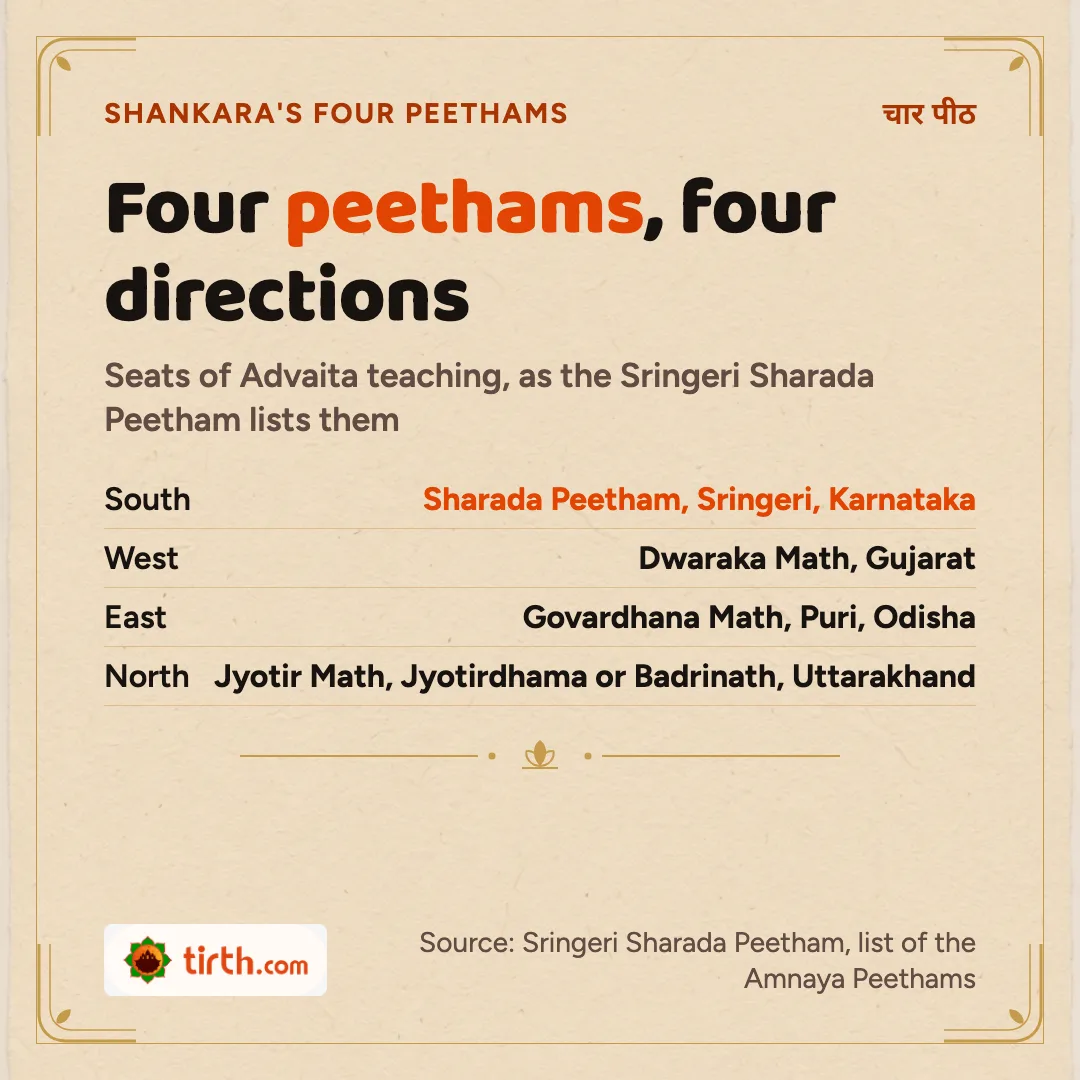
| Direction | Peetham | Place |
|---|---|---|
| South | Sharada Peetham | Sringeri, Karnataka |
| West | Dwaraka Math | Dwarka, Destination on Tirth , Gujarat |
| East | Govardhana Math | Puri, Destination on Tirth, Odisha |
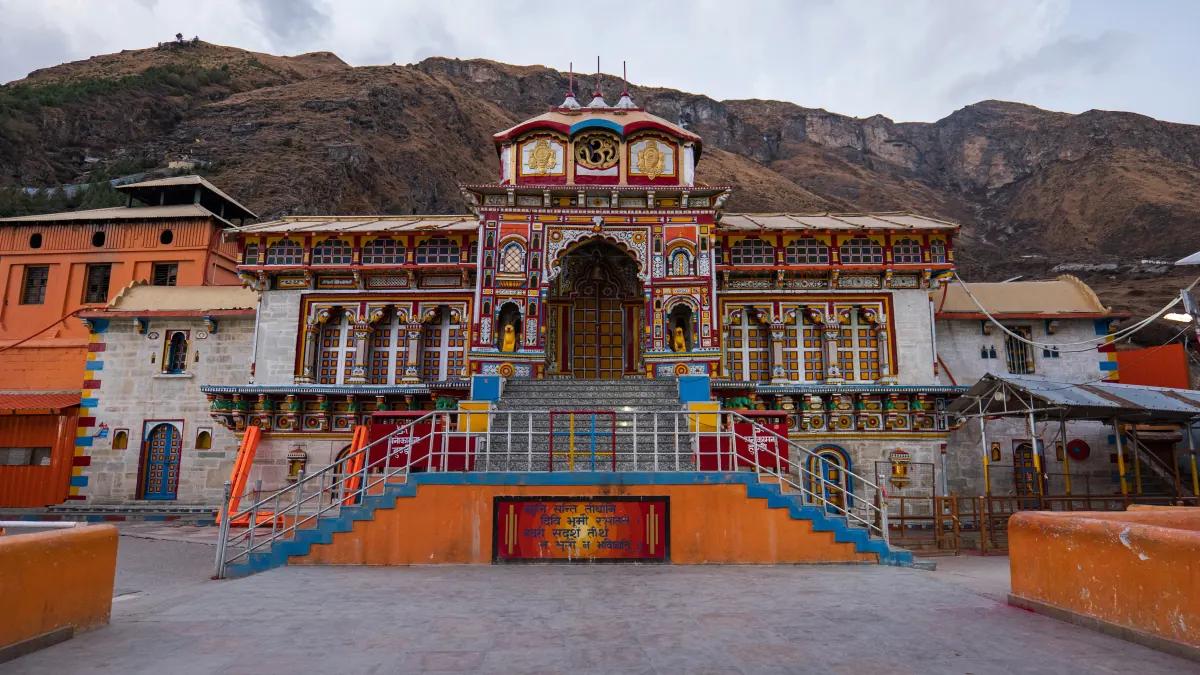
| North | Jyotir Math | Jyotirdhama or Badrinath, Destination on Tirth, Uttarakhand |
For its own seat, Sringeri names Sureshwaracharya as first head, and in the north, at Jyotir Peetham, it names Totakacharya. Who first led Dwarka and Puri is a point older accounts disagree on. Those two names stay open here.
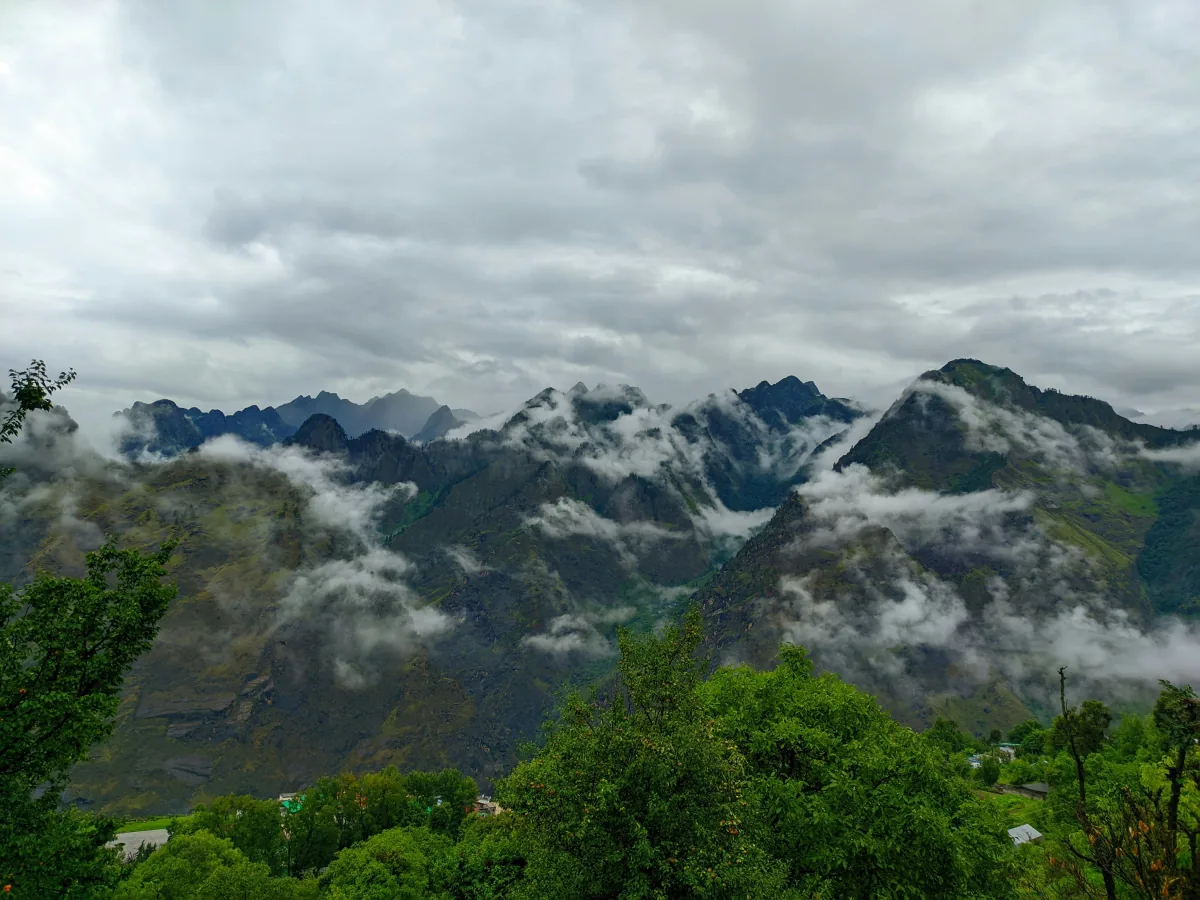
If the hills of Uttarakhand are on your family’s plan, the northern seat has a Tirth page of its own, Joshimath (Jyotirmath).
Frequently asked questions
Not two. The word joins a (not) and dvaita (duality), and in Advaita Vedanta it says your self and Brahman are not two, and that knowing this is liberation.
In English it reads “That you are”, or “That’s how you are” in some translations. Aruni says it to his son Shvetaketu again and again in the sixth chapter of the Chandogya Upanishad.
Not exactly. In Advaita the world is real in experience, though it has no ultimate existence of its own, and once Brahman is known its appearance gives way, as the snake does when the rope is seen.
As nirguna (without qualities), Brahman is the absolute, described as pure existence, consciousness and bliss. As saguna (with qualities), it is met as a personal God, Ishvara, and that is where worship comes in.
Sringeri in the south has Sharada Peetham, Dwarka in the west has Dwaraka Math, Puri in the east has Govardhana Math and Badrinath in the north has Jyotir Math, as the Sringeri Sharada Peetham lists them.
Continue on Tirth
- Joshimath (Jyotirmath), in Chamoli district, Uttarakhand.
- Char Dham yatra, to plan the trip with Tirth.
- Planning the Char Dham yatra, for families working out the days, the order and the season.
- The seven holy cities, Tirth’s guide to the Sapta Puri yatra.