On this page6 sections
The gotra meaning behind that question is your family line, traced through an unbroken male line to one founding ancestor, who in Brahmin families is a Vedic rishi. He asks because your gotra is said aloud in the sankalp along with your name, the sankalp being the spoken statement of who is doing the puja and why. Most families inherit it from the father. If nobody at home is sure of yours, there is a custom for that case, further down this page.
| Gotra at a glance | Short answer |
|---|---|
| What it is | A family line traced through the father to a founding ancestor, a rishi in Brahmin families |
| Where you hear it | In the sankalp at the start of a puja or vrat |
| If you do not know it | Ask your elders first. Kashyap gotra is the common custom, and the Pandit decides |
| Same as caste? | No. Families of different castes carry rishi gotras |
| Hindu Marriage Act, 1955 | Gotra is not one of the conditions of a valid marriage |
In short
He asks because your gotra is said aloud in the sankalp along with your name, the sankalp being the spoken statement of who is doing the puja and why. Most families inherit it from the father. If nobody at home is sure of yours, there is a custom for that case, further down this page.
Why does the sankalp need your gotra?
A sankalp is the declaration of intent made at the start of a puja or vrat, and it exists to say whose puja this is. In its fuller form it names the following, though accounts differ on the order:
- Your name, and the names of any family members the puja includes
- Your gotra
- The place
- The time, given as month, paksha, tithi and weekday
- The purpose of the puja
In one devotional source’s description the hand has its part too. The right hand holds water, rice and a flower, and lets the water go as the pledge is made.
On temple pages that explain the custom, the reason is plain enough. The Pandit wants your name and gotra (and at some, your birth star) so that the rite is offered for that particular person and that family line.
So the gotra marks whose rite it is, and it makes no promise about the result of the rite.
For the month, paksha and tithi, look at the Tirth Panchang, Panchang on Tirth (handy on the morning of a home puja, before the Pandit arrives). If you are also asked for your Rashi, that is a separate matter, and our Rashi explainer takes it up.
Seven rishis, an eighth, and the pravara
Seven rishis are named in Book 2 of the Brihadaranyaka Upanishad: Kashyap, Atri, Vasishtha, Vishvamitra, Gautama, Jamadagni and Bharadvaja. Later these seven are called the Saptarishi and counted as founders of the main Brahmin gotras, and some lineages set Agastya beside them as an eighth, which makes eight gotrakarins (gotra founders).
On the total number of gotras the texts give different answers, and some figures that get passed around turn out to be counts of pravaras. So we print no total here.
You may hear pravara too. It is the chain of famous rishis within your line, recited at ritual. A finer ceremonial marker than the gotra itself, and marriage rules in some texts look at it as well.
A tighter definition comes from Panini, the grammarian, in the Ashtadhyayi (4.1.162), where gotra means descent from the grandson onward. The word itself goes back further. Back in the Rigveda it meant a cow-pen or enclosure, and its family sense is first recorded in later texts, the Chandogya Upanishad among them.
Gotra and caste are different things. Rishi gotras are carried by families of different varnas and castes. A family that took its gotra name as a surname has two things, then, a surname and a line.
Not every family counts the line through the father, either, and Tulu-speaking families pass it through the mother. So what your own elders say outranks anything general. This page included.
For the wider frame, our piece on Sanatan Dharma meaning is the place to start. See also the meaning of namaste and the meaning of Om.
No one at home knows your gotra. Now what?
Ring round the family first. Mother and father, grandparents, an elder uncle or aunt, and the family purohit if there is one.
Our own view is that an evening of phone calls beats taking a gotra on trust, since the name only means something in a sankalp when it points at your own line.
The convention used most widely, when the calls turn up nothing, is to give Kashyap gotra. Kashyap is regarded as the father of all beings. Achyuta gotra, the family of Bhagwan Vishnu (Achyuta), is what some sources give in its place, and Shiva gotra is the other one named.
You will not find a printed text behind any of this in the sources that describe it. This is custom. The practice of the Pandit doing your puja is what settles it. That practice prevails, and it may differ from the practice one town over.
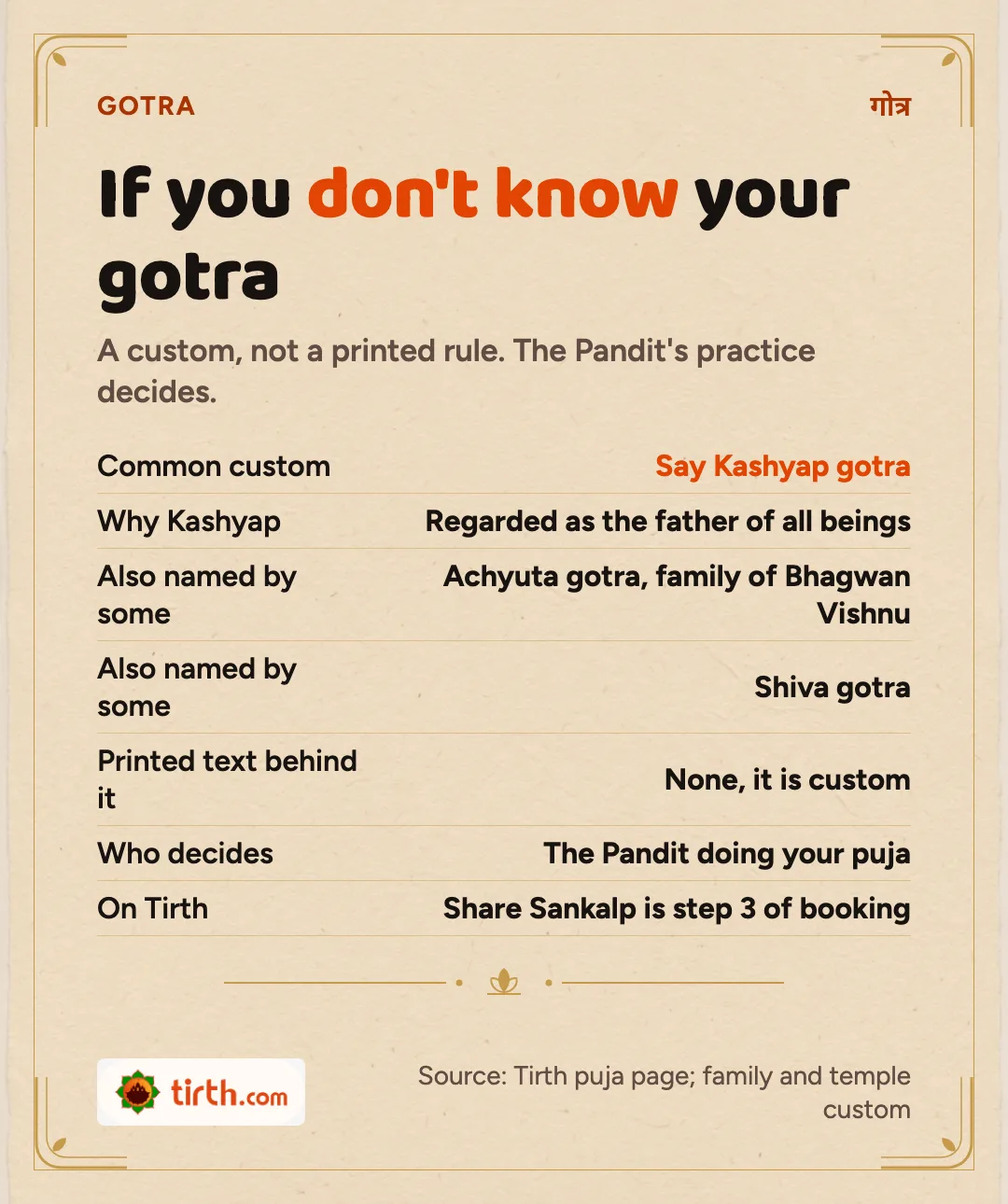
If you book through Tirth, Share Sankalp is the name of step 3 of the puja booking on Tirth, Pujas on Tirth, the step where you provide the devotee details the puja needs. This exact worry has its own FAQ on the same page (“What if I don’t know my Gotra?”). The answer given there is that the exact requirement depends on the Puja and tradition. That is how the page read in November 2026. Booking steps can change, so look again when you book. There is also a personal puja on Tirth, described there as a puja dedicated to you or your family.
| Your situation | What families usually do | Who to ask |
|---|---|---|
| Your parents or grandparents know it | Give it as they say it | Your elders |
| Nobody in the family knows it | Kashyap gotra is the common custom. Some say Achyuta or Shiva gotra | The Pandit doing the puja |
| Your family follows the mother’s line, as Tulu families do | Follow your own family’s custom | Your elders |
| You are booking a puja on Tirth | Provide the devotee details asked for at Share Sankalp, step 3 | The FAQ “What if I don’t know my Gotra?” on the Tirth puja page |
Can you marry within your own gotra?
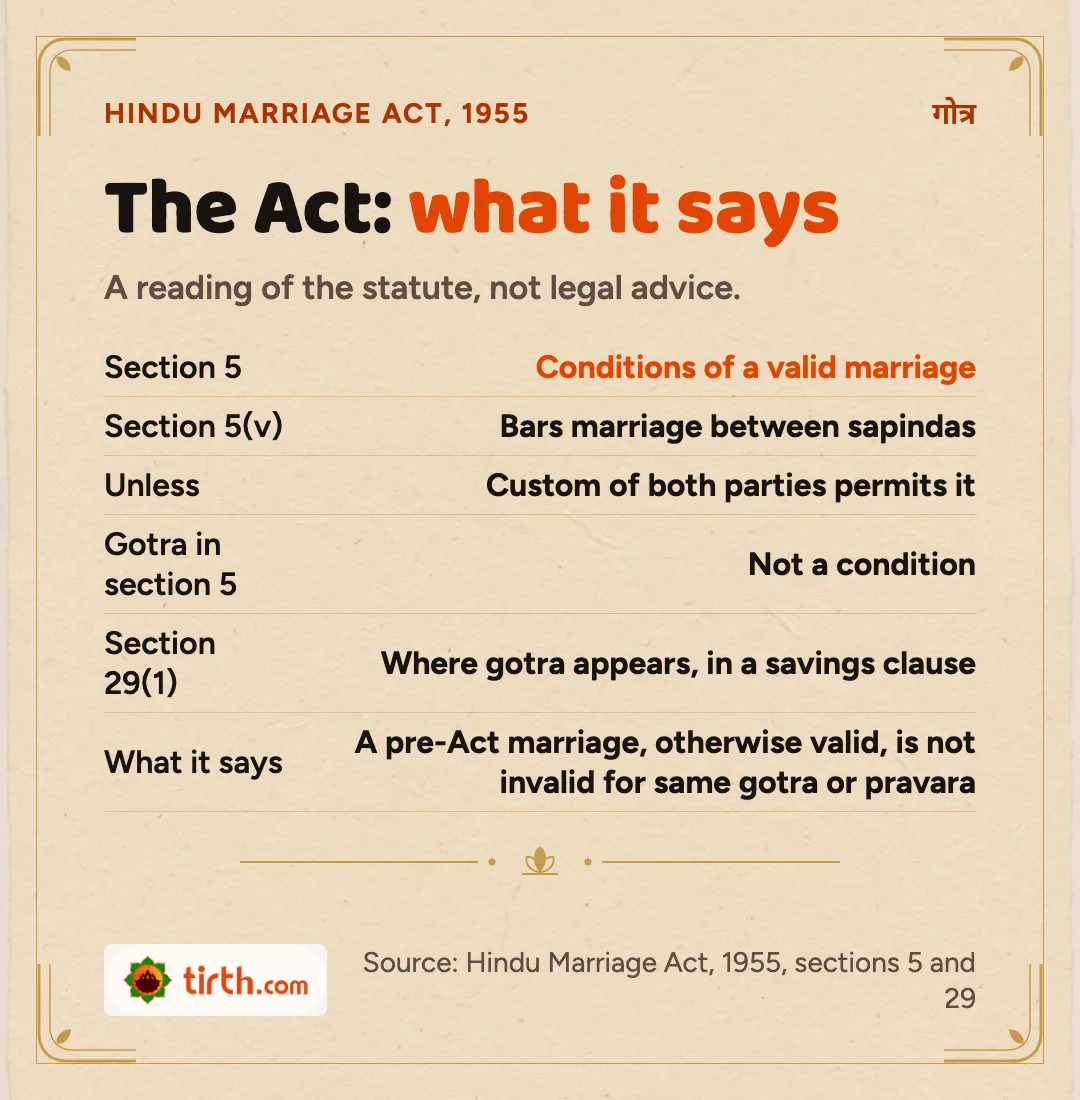
Under the Hindu Marriage Act, 1955, gotra is not among the conditions for a valid marriage. As for your own family’s expectations, those are for your family to say.
Those conditions sit in section 5. Under its clause (v), sapindas may not marry unless the custom or usage governing both people permits it, and section 3(f) counts a sapinda relationship to the fifth generation on the father’s side and the third on the mother’s side.
Gotra comes up in section 29(1), outside that list. It is a savings clause. The marriage it protects is one solemnized before the Act. If that marriage is otherwise valid, it is not invalid merely because the two people belonged to the same gotra or pravara.
We are reading the statute here, and none of it is legal advice. If a wedding really turns on this point, the Act itself or a lawyer is where to go.
Ask why marriages are kept outside the gotra and inherited disease is one reason often given. A science fact-check by The Wire Science made the point that blood relationship is measured in generations back to the nearest common ancestor, while a gotra is drawn far more loosely, so science does not support a blanket gotra ban. For a couple who are worried, genetic counselling is the better route, it says.
These sources leave open whether disease was ever the original reason.
Frequently asked questions
Gotra means the family line you are born into, followed through the father back to one founding ancestor (a Vedic rishi, for Brahmin families). The Pandit says it in the sankalp.
Start with whoever in the family would know, a parent, a grandparent or the family purohit. It usually comes down the father’s side, unless your family counts through the mother.
When nobody knows the gotra, Kashyap is the usual choice, and some give Achyuta or Shiva gotra instead. The Pandit’s own practice decides.
No. The same rishi gotra can belong to families of different castes, and a surname borrowed from a gotra name is a surname and nothing more.
Gotra is the whole line. Pravara is the chain of famous rishis inside that line, said aloud at ritual.
No single number holds, since the texts disagree. The seven rishis at the root are steadier ground, with Agastya counted as an eighth in some lineages.
Continue on Tirth
- Book a puja on Tirth, Pujas on Tirth, where Share Sankalp is step 3 of the booking.
- Personal puja, a puja dedicated to you or your family.
- Rishi Panchami Vrat Katha, the story read on that vrat.
- Tirth Panchang, Panchang on Tirth, for the month, paksha and tithi said in a sankalp.