On this page8 sections
- Arjuna in the chariot seat, and why it looks like tamas
- What does tamas mean in Sanskrit?
- Tamas in the Yoga Sutra and the Charaka Samhita
- How tamas ties a person down
- Dirgha-sutri, the Gita’s word for dragging work out
- Can tamas be overcome, or does it stay?
- Frequently asked questions
- Continue on Tirth
- Sources and review
This post goes looking for tamas in a slump: Arjuna sets down his bow and arrows and drops into the seat of his chariot, overwhelmed by grief (Bhagavad Gita 1.47).
Bhagwan Krishna’s reply comes at 2.3: cast off this petty weakness of heart, and stand up. Neither verse uses the word tamas, so tying the slump to the guna is our reading.
In short
Bhagwan Krishna’s reply comes at 2.3: cast off this petty weakness of heart, and stand up. Neither verse uses the word tamas, so tying the slump to the guna is our reading.
Arjuna in the chariot seat, and why it looks like tamas
How he falls, the verse spells out. It names the bow and the arrows he lets go, and says where he ends up, in the seat of his own chariot. Picture a warrior letting both weapons go and sitting down in his chariot. Maybe you have lived through a smaller version of it (an exam morning, say, when you were properly prepared and still could not get out of bed).
What does tamas mean in Sanskrit?
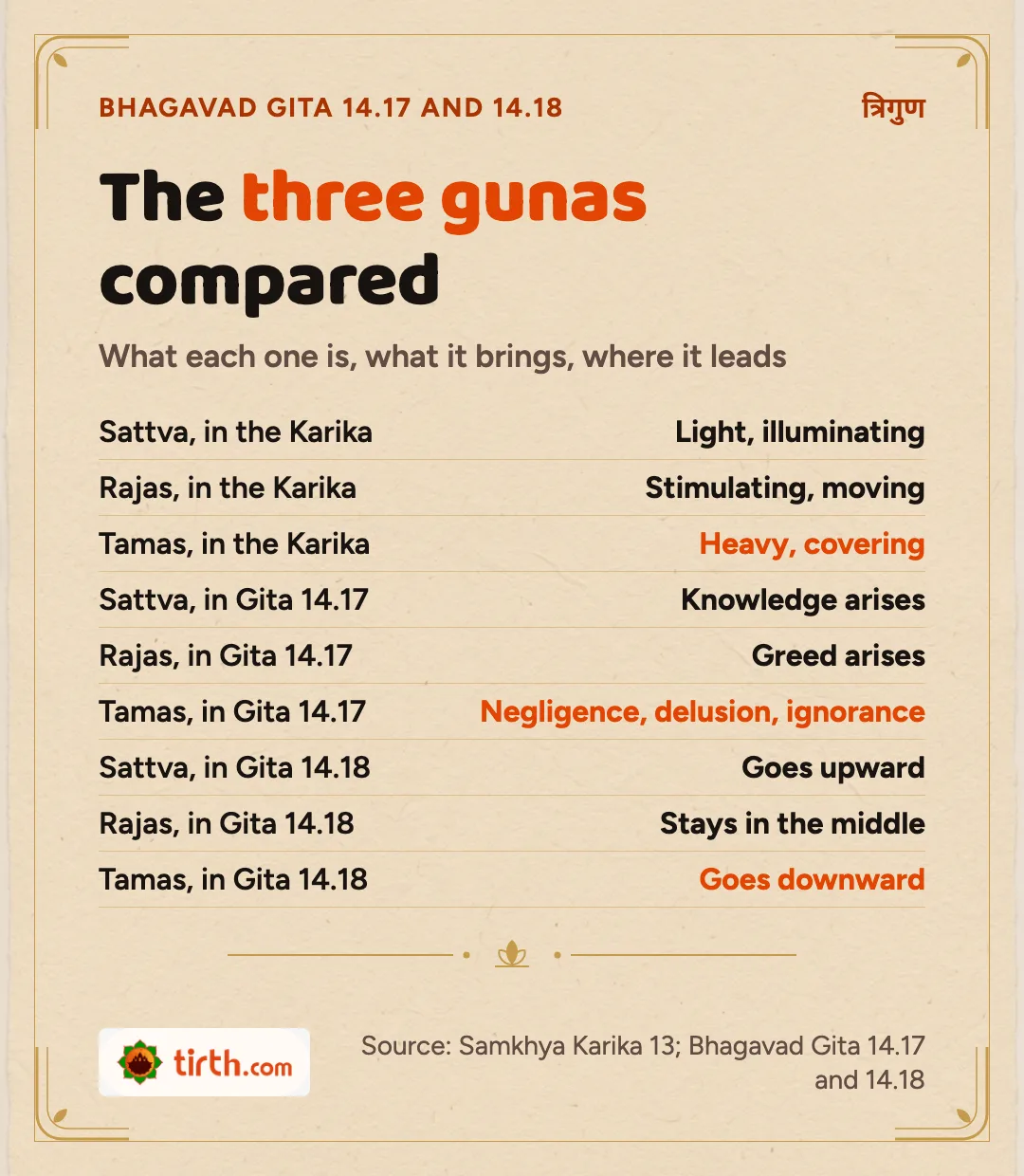
The Monier-Williams Sanskrit-English Dictionary puts darkness and gloom at the head of its entry. Mental darkness, ignorance, illusion and error follow. The same entry also records the Samkhya sense, in which tamas is one of the three qualities that, between them, make up everything in creation. Samkhya Karika verse 13 hands each quality an image. Sattva is light and rajas is moving, while tamas is heavy and covering, and the three work together like a lamp.
At 14.5 the Gita brings back the same three, sattva, rajas and tamas, saying they arise from prakriti and bind the embodied self to the body. That word, prakriti, has a dictionary story too. Monier-Williams gives the original source, nature and disposition, and in Samkhya the word means the original producer of the material world, made of exactly these three gunas. Samkhya, in other words, counts tamas among the ingredients of everything there is and so as part of how things are made.
Tamas in the Yoga Sutra and the Charaka Samhita
The English word inertia leads to the Yoga Sutra. Yoga Sutra 2.18, as J.H. Woods renders it, credits the object of sight with a disposition to brightness, to activity and to inertia. The sutra names no guna; the matching is done in Vyasa’s commentary, which pairs sattva with brightness, rajas with activity and tamas with inertia.
Tamas turns up in Ayurveda too, in the Charaka Samhita, as a matter of the mind. Sutrasthana 1.57 counts passion and delusion, rajas and tamas, as the faults of the mind, just as vata, pitta and kapha are the faults of the body.
How tamas ties a person down
The Gita’s account at 14.8 is brief. Tamas is born of ajnana (ignorance) and deludes every embodied being, and it ties them with pramada (negligence), alasya (laziness) and nidra (sleep).
All of these are small and daily. Negligence and laziness look like the bill you still have not opened or the call you never got round to returning, while sleep is simply sleep. Hold on to laziness for later, because it turns up again in the eighteenth chapter.
| Sattva | Rajas | Tamas | |
|---|---|---|---|
| Its fruit (Gita 14.16) | Pure | Sorrow | Ignorance |
Translations part here: of four in English, Shri Purohit Swami’s renders the fruit of tamas at 14.16 as darkness, while Swami Gambhirananda, Swami Sivananda and Swami Adidevananda give ignorance.
Dirgha-sutri, the Gita’s word for dragging work out
The eighteenth chapter sorts doers by guna, and the tamasic one comes at 18.28. Undisciplined, crude and stubborn, he is also deceitful, lazy and despondent, and his list closes on dirgha-sutri, the procrastinator.
Monier-Williams glosses the compound dirgha-sutra as “spinning a long yarn” and procrastinating, and gives dirghasutrin as dilatory. Taken apart, dirgha means long and sutra means thread, which leaves you picturing someone spinning while the yarn keeps on lengthening.
Of the whole list, this word matters most on an ordinary weekday, because that is where tamas shows up as putting things off (the form sent back a third time, the doctor’s visit pushed to next month).
Tirth’s guide to what the Gita says about action goes further into the Gita’s teaching on karma.
Can tamas be overcome, or does it stay?
In the Gita the gunas shift. At 14.10, whichever one prevails does so by overpowering the other two, and so tamas comes up by getting the better of sattva and rajas and can, in its turn, be overpowered itself.
The verse right after it gives the sign of sattva. According to 14.11 sattva is predominant when the light of knowledge shines through every gate of the body, meaning the senses. Put that next to the Karika’s covering guna and it is the opposite picture.
Later in the chapter, at 14.26, Bhagwan Krishna, Deity page on Tirth says that whoever serves him with unswerving devotion goes beyond the gunas altogether, and Tirth’s guide to what liberation means in Hindu thought follows that teaching to where it leads in the end.
Frequently asked questions
It means ruled by tamas, one of the three gunas, and tamasic is only the adjective. For the larger frame the gunas sit inside, read what Sanatan Dharma means.
Sattva, rajas and tamas. The Gita applies the three even to faith: early in its seventeenth chapter it says faith is of three kinds, each born of a person’s own nature.
Monier-Williams gives tamo-guna as the quality of darkness or ignorance, and the ties Gita 14.8 names for it are negligence, laziness and sleep.
The Gita describes a tamasic doer (18.28) and also calls conduct tamasic. In its seventeenth chapter, austerity done from a foolish notion, with self-torture or to harm another, is tamasic, and so is a gift given at the wrong place and time, to unfit recipients, without respect and with contempt. At 18.39 it also calls one kind of happiness tamasic, the kind that deludes the self from beginning to end.
Only in part. Alasya, laziness, is one of three ties in Gita 14.8, alongside negligence and sleep, and the dictionary senses of tamas reach further, to darkness, ignorance, illusion and error. Vyasa, commenting on Yoga Sutra 2.18, gives inertia as the disposition of tamas.
Start with Gita 17.10. Food that is overcooked, stale, tasteless, putrid, left over and impure is dear to those in tamas, and each of those words describes the state the food is in (dal reheated for the third day running, for instance).
Continue on Tirth
- Bhagwan Krishna on Tirth, Deity page on Tirth, the one who told Arjuna to stand up.
- The Bhagavad Gita Aarti, to sing at home after reading.
- Gita Jayanti, with its date in the Tirth Spiritual Calendar, Spiritual Calendar on Tirth.