On this page7 sections
The Brihadaranyaka Upanishad (4.4.6) describes a person whose vital breaths do not leave him at death, and the reason given is that the only thing he desired was the Self. That is the freedom the word points to, though the moksha meaning shifts a little with every school you ask.
Where the schools split is the destination. For Advaita the freed self is identical with Brahman. The devotional schools speak instead of eternal communion, or of service, with a personal God, and that is not at all the same claim. No single neat definition of moksha covers both.
In short
That is the freedom the word points to, though the moksha meaning shifts a little with every school you ask. Where the schools split is the destination. For Advaita the freed self is identical with Brahman. The devotional schools speak instead of eternal communion, or of service, with a personal God, and that is not at all the same claim.
Where the word moksha comes from
Moksha is built on muc, a Sanskrit root meaning to free, release or let go. Hindu usage turns it into liberation, with samsara as the usual thing left behind.
One sentence of the Katha Upanishad (2.3.14) carries the whole idea. Let every desire that dwells in the heart fall away, it says, and the mortal becomes immortal and “here attains Brahman.” Shankara takes “here” to mean “even here”, so there is no journey to another world to be made. That one word matters again when timing comes up.
The Brihadaranyaka Upanishad (4.4.7) returns to the thought with an image, the shed body lying like a snake’s slough. Verse 4.4.6 has the other side. He who clings to desire goes onward, with his actions, to the object his mind is attached to. Once the fruits are used up, he returns. Both verses turn on desire.
Is moksha one of the four aims of life, and is it heaven?
Four purusharthas, the aims of human life, are listed in Hindu thought: dharma, artha, kama and moksha. Older Vedic literature has three. Moksha is usually said to arrive with the Upanishadic ideal of liberation. Some read the early three as domains of activity and not life goals, one scholar of the early texts among them, who adds that purushartha itself seldom appears in early writing. Others point out that the Dharmashastras and epics already present all four as a set, so the dating is disputed.
People often ask whether moksha is heaven. On return, the Brihadaranyaka verse already keeps liberation apart. The verse says the one who clings to desire returns once the fruits of his actions are used up, while the one whose only desire is the Self goes to Brahman. Moksha is a different category from a reward that comes round again.
Jain teaching has a meaning of moksha that is its own, liberation after every karmic bond has been destroyed. Buddhist nirvana and Sikh teachings are traditions apart, and none should be read as the Hindu schools by another name.
How the Hindu schools define liberation
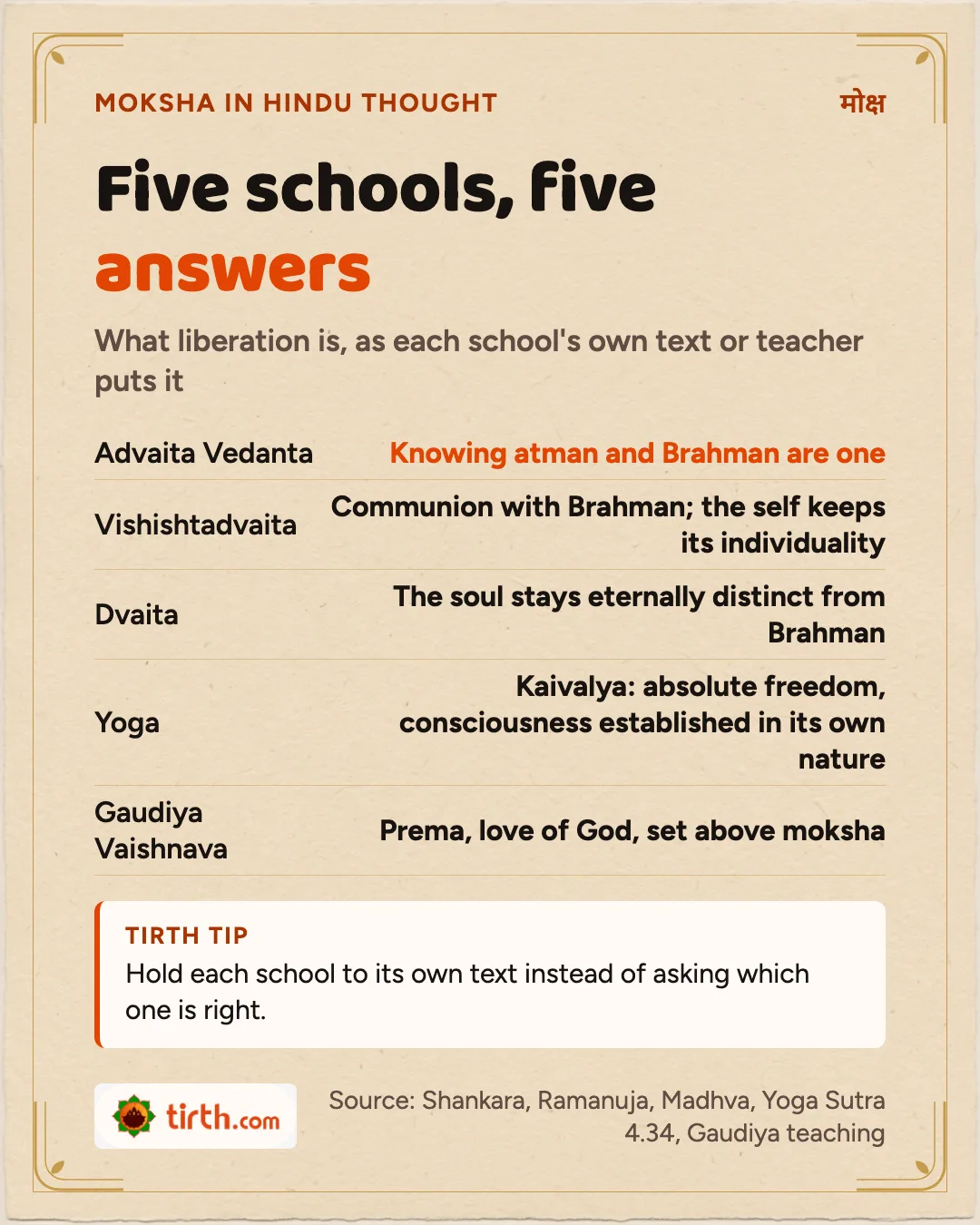
The five schools do not answer alike. A table sums up the five, and the paragraphs after it take each school to its text.
| School | What liberation is | Means it names | Text or teacher behind it |
|---|---|---|---|
| Advaita Vedanta | Knowing that atman and Brahman are identical, which removes the ignorance that causes bondage | Knowledge, with action as a way to purify the mind | Shankara and his commentaries |
| Vishishtadvaita | Communion with Brahman and the way to Vaikuntha, the self keeping its individuality as a mode of Brahman’s body | Bhakti yoga, ending in parabhakti | Ramanuja |
| Dvaita | Release in which the soul stays eternally distinct from Brahman | The grace of Bhagwan Vishnu, with devotion | Madhva |
| Yoga | Kaivalya, absolute freedom, with consciousness established in its own nature | Stilling the fluctuations of the mind | Yoga Sutra 1.2 and 4.34 |
| Devotional Vaishnava (Gaudiya) | Love of God, prema, set above moksha itself | Devotional service | Bhagavata Purana, Canto 3, and the Gaudiya teachers |
Shankara is the voice of Advaita Vedanta. For him, liberation is knowing that atman and Brahman are one. Action frees nobody by itself, since for Shankara its work is to make the mind fit for that knowledge. The Mundaka Upanishad says the knower of the supreme Brahman becomes Brahman. Advaita readings take “becomes” as realising an identity that was always there.
Communion with Brahman, and the way to Vaikuntha, is what liberation means for Ramanuja, and the freed self does not become identical with Brahman. It stays an individual, a mode of Brahman’s body. Knowledge by itself falls short. What he asks for is bhakti yoga, duty done without attachment to results joined to constant worship, and its highest form is parabhakti. The Vaikuntha Gadya describes the eternal realm of Bhagwan Vishnu. For the worship itself, see the page on Vishnu mantras with meaning.
In Madhva’s view the soul depends on Brahman for ever and is for ever distinct from it. Liberation rests on the grace of Bhagwan Vishnu, Deity page on Tirth . Devotion is essential. The post goes no further into Dvaita than this.
In Yoga Sutra 1.2 Patanjali gives yoga its definition, the stilling of the fluctuations of the mind. The Kaivalya section ends at Sutra 4.34, where kaivalya is described in these terms: the gunas return to latency once they have no purpose left for the Purusha, and consciousness stands established in its own nature. Translators render kaivalya as liberation, isolation or independence, so the word needs careful reading.
In the Bhagavata Purana (Canto 3), Kapila tells Devahuti of five liberations, salokya, sarshti, samipya, sarupya and ekatva. Devotees refuse them even when they are offered, he says, apart from devotional service. The Gaudiya Vaishnava school goes further still. Its highest goal is prema, a fifth aim standing above moksha. The school teaches this itself, and a critic from the Dvaita school disputes that scripture supports it. If your devotion runs to Bhagwan Shiva, Deity page on Tirth, the Shiva mantras are on their own page.
The schools answer different questions about what the self is, so each reads best against its own text and not as a rival to the others.
Is liberation possible during one’s lifetime?
Advaita says a person can be liberated while alive, and it gives the idea a name, jivanmukti, liberation while living. Self-knowledge, it says, wipes out the stored karma. New karma stops forming. Only prarabdha karma, the part already begun to bear fruit, is left, and that simply runs out by itself. Advaita teachers illustrate this with a potter’s wheel still turning and an arrow already released. Final freedom comes as videhamukti, liberation without the body, when the body falls.
A blindfolded traveller bound for Gandhara carries the same teaching in the Chandogya Upanishad (6.14.1 to 6.14.2). The knower, it says, faces a delay only while he is not yet freed from the body, and then he merges with the Self. For Shankara the delay is the span until the body falls, when whatever karma remains is exhausted. Since translators word the last clause in different ways, treat this as a paraphrase, not a quotation.
Not every school accepts it, since one commentator rejected jivanmukti outright.
The paths each school names to liberation
Each school points to a different means. None of the texts quoted here gives a timing. Nor does any of them treat liberation as a thing you can purchase, book a date for or have arranged on your behalf.
Advaita is where the path of knowledge mostly lives, and before anyone begins to inquire, Shankara asks for four qualifications. The first is discrimination of the permanent from the impermanent. Next comes dispassion toward results here or hereafter, then the disciplines such as calmness and self-control, and last a longing for liberation. All four come first.

Verse 3.8 of the Shvetashvatara Upanishad agrees. To pass beyond death, one must know that great Purusha, luminous like the sun and beyond darkness, and there is no other path. Advaita-leaning readings identify the Purusha with Brahman.
Devotion is what the remaining schools rely on, each in its own way. Ramanuja sets duty done without attachment beside it. For Madhva it is essential, along with the grace of Bhagwan Vishnu, and the Bhagavata verses above show devotees turning down even the five liberations. Raja yoga, as Patanjali’s route is usually called, is the stilling of the mind.
Lists of four paths, karma, jnana, bhakti and raja, are common, but that grouping is modern, popularised from the 1890s, and a book on Raja Yoga appeared in July 1896. Commentators often group the Bhagavad Gita’s teaching under karma, bhakti and jnana.
If you came looking for the Mahamrityunjaya mantra, it has its own page.
Frequently asked questions
Liberation, most often from samsara, the cycle of birth, death and rebirth, is what moksha means, and the word derives from a Sanskrit root for freeing or releasing. The schools differ over the destination. Advaita holds identity with Brahman, and the devotional schools hold eternal communion or service with a personal God.
The means vary by school. Knowledge that atman and Brahman are identical is Advaita’s answer, bhakti yoga is Ramanuja’s, the grace of Bhagwan Vishnu with devotion is Madhva’s, and stilling the mind is Patanjali’s. No timing and no outcome is promised by the texts quoted here.
Liberation stands against return in the Brihadaranyaka Upanishad, where the person who clings to desire comes back once the fruits of his actions are used up. So moksha is treated as separate from any reward that returns.
No. Jain teaching gives moksha its own meaning, liberation after every karmic bond is destroyed, and Buddhist nirvana is a separate teaching. Even among the Hindu schools, liberation is not defined one way.
Advaita says yes, calls it jivanmukti, and names the final liberation at the fall of the body videhamukti. Since one commentator rejected the idea, there is no single answer across the schools.
No, they do not agree. Five answers appear in the table above, differing on what is freed, whether the self stays distinct and what leads there.
Continue on Tirth
- Kashi Vishwanath Jyotirlinga, a Journal story on Bhagwan Shiva’s Jyotirlinga at Kashi.
- A Varanasi trip guide for planning a visit.
- Tirth temple pages, Temple page on Tirth, temple by temple, before you plan a visit.
- Tirth destination pages for the places behind the texts.