On this page8 sections
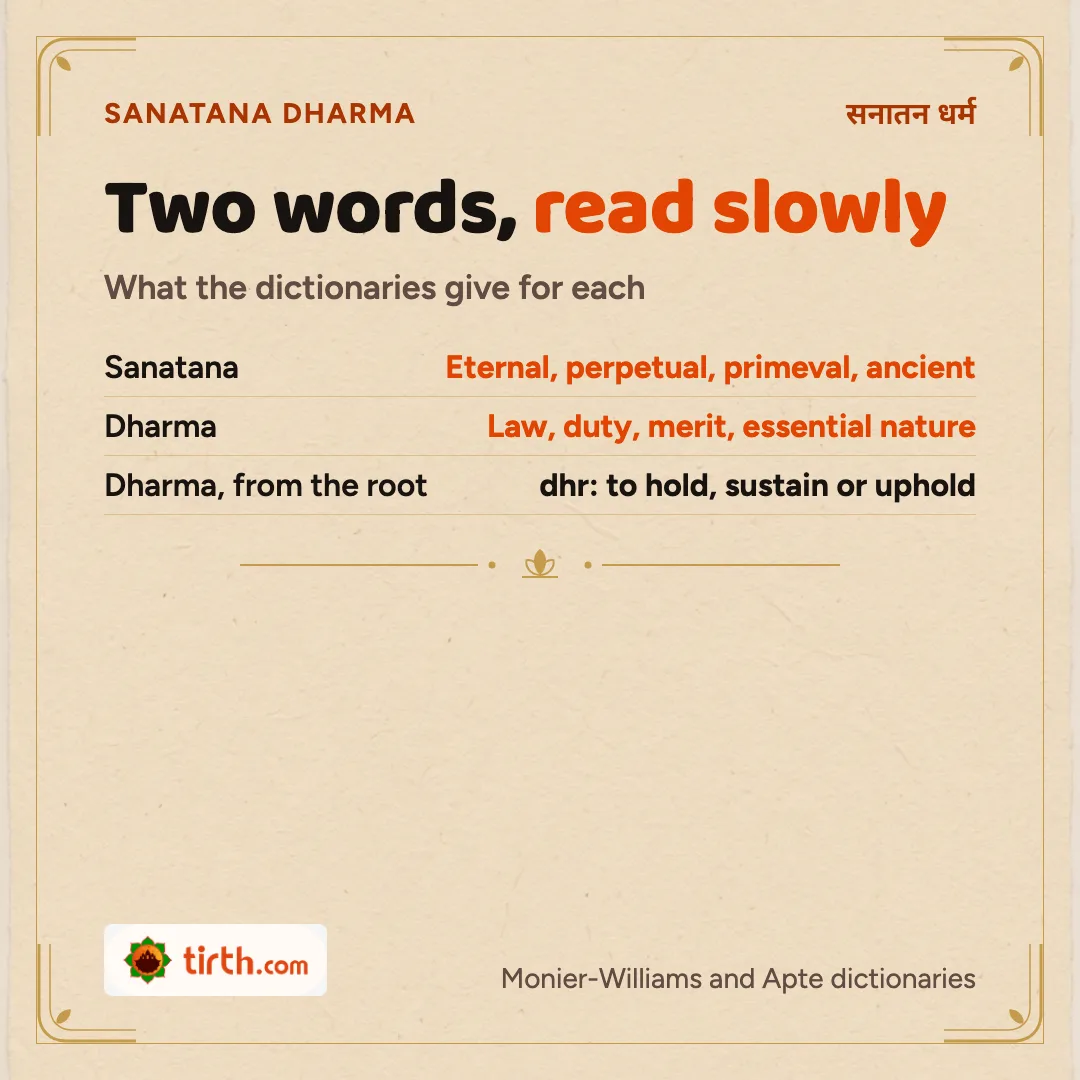
Sanatana is Sanskrit for eternal, perpetual or ancient, and dharma takes in law, duty and the essential nature of a thing.
Open the texts, though, and sanatana does different jobs in different places. The useful question is which sense a given line has in mind.
In short
Open the texts, though, and sanatana does different jobs in different places. The useful question is which sense a given line has in mind.
What does sanatana mean on its own?
Dictionaries give this word plenty of room. Eternal, perpetual, permanent, everlasting, primeval, ancient: that is Monier-Williams’s list, and Apte adds constant, firm and settled. Both point the root back to sana, meaning always, with a suffix tacked on (Benfey splits it as sana plus tana, where Monier-Williams says only that the word comes from sana).
A Hindi dictionary by Caturvedi goes two senses further, orthodox and time-honoured. It also lists sanatana dharma as a name for the orthodox Hindu religion.
Two ideas sit inside the first word, then. Time is one, a thing that has always been there, as the first gloss puts it. Steadiness, a firm thing, is the other.
What is dharma doing in the phrase?
Start from the root dhr, to hold, sustain or uphold, which is where dharma is usually derived from. The dictionaries then list law, established custom and duty, conduct, virtue and merit, right and justice, and the essential nature of a thing, and Vaishnavism reads the word as that which sustains. You need not settle on a single sense for the whole phrase. A verse about a family’s duties makes duty the working meaning, while a verse about the self leans towards nature. I would keep the root in mind, hold or uphold. The sentence supplies the rest.
For dharma worked out in one life, read what the name of Bhagwan Ram says about conduct. The people around him are in the major characters of the Ramayana.
Where does the word sanatana turn up in the texts?
Take three passages, because they stretch the meaning furthest. In the first chapter of the Bhagavad Gita, verse 40 asks what becomes of a family’s dharmas once the family falls, and the Sanskrit pairs kula-dharmah, family duties, with sanatanah. The line says that in the ruin of a family, the eternal family dharmas perish. Sanatana there qualifies a family’s duties. Nothing in the sentence is about a religion as a whole; the eternal thing is simply what a family hands down. For the scene around it, see the Gita chapter 1 story.
Chapter 2, verse 24 is the second. It ends on that same word, now describing the atman, the self, as unchanging and ever the same.
Anyone after a single clean definition will find this awkward. I think the awkwardness is the honest part: the Gita itself uses the word for two different things. If you want the Gita in devotional use, the Bhagavad Gita Aarti is one place.
Does a Buddhist text use the same words?
It does. A Buddhist text reaches for the same pair of words. Hatred is never appeased by hatred, says verse 5 of the Dhammapada in the 1985 Buddharakkhita translation, and it closes with “This is a law eternal.” The Pali words behind that line are esa dhammo sanantano, the Pali forms of dharma and sanatana.
How do you read the word in a line?
Set the three passages side by side and the pattern shows. The word stays put while what it is attached to changes.
| Passage | What sanatana is attached to | Working sense |
|---|---|---|
| Bhagavad Gita 1.40 | A family’s duties | Duties handed down |
| Bhagavad Gita 2.24 | The atman, the self | Unchanging, ever the same |
| Dhammapada 5 | A law: hatred is never appeased by hatred | A law eternal |
So when you meet the word in a line, ask what it is attached to. Duties, a self and a law each give eternal its own weight.
When did it become the name of a religion?
Writers who study the period date that turn to the late 19th century, when societies and writers started using Sanatana Dharma for the religion itself. Writers connect the revival of the phrase to responses to missionary activity and to reform movements such as the Arya Samaj and the Brahmo Samaj. One account places a Sanatan Dharma Rakshini Sabha in Calcutta in that period, though sources date these bodies differently. They disagree on exact years and on who came first, so the century is as precise as this post can honestly be, and no single founder comes out of it.
Many Hindus now treat Sanatana Dharma and Hinduism as one thing. Hindu is usually traced to the river Sindhu, whereas sanatana dharma is a phrase from Sanskrit, and some prefer it as a self-description for that reason. If you want a working rule from all this, read the sentence before deciding what eternal means in it. The first chapter’s family duties, the second chapter’s unchanging self and the Dhammapada’s law make three different eternals, and the name carries all of them.
For a next read, try this list of tirth sthal across India.
Frequently asked questions
Eternal dharma. Sanatana is a Sanskrit word for eternal, perpetual or ancient, and dharma, from a root that means to hold or uphold, is law, duty and the nature of a thing.
Plenty of Hindus use the two names for one religion, and a Hindi dictionary gives the phrase for the orthodox Hindu religion. Older texts also use sanatana dharma more narrowly, for family duties or for the unchanging self.
The texts covered here name no single founder. They use the word sanatana for family duties and for the unchanging self, and writers date its use as the name of the religion to the late 19th century.
A Buddhist text does. In verse 5 the Dhammapada says hatred is never appeased by hatred and calls that a law eternal, in the 1985 Buddharakkhita translation. The Pali words are esa dhammo sanantano.
Dharma is usually derived from the root dhr, to hold or uphold. The dictionaries give law, established custom, duty, conduct, virtue and the essential nature of a thing, and Vaishnavism reads it as that which sustains. The sentence it sits in decides which sense leads.
Continue on Tirth
- Tirth’s temple pages, Temple page on Tirth
 , for the places where such texts are read.
- Spiritual tourism in India, a Journal story on why people travel to sacred places.
- Bhagwan Ram, Deity page on Tirth, the Tirth page on the Ramayana’s hero.
- Bhagwan Krishna, Deity page on Tirth, the Tirth page on the speaker of the Bhagavad Gita.