On this page9 sections
- What does Rahu mean in Rahu Kaal?
- How is Rahu Kaal worked out from sunrise and sunset?
- Sunday, 29 November 2026: Delhi at 4:05 PM, Chennai at 4:14 PM
- Why a Delhi Sunday in June stretches to 105 minutes
- What should you not begin in Rahu Kaal?
- Who is Rahu? Svarbhanu in the row of devas
- Where to see today’s Rahu Kaal for your city
- Frequently asked questions
- Continue on Tirth
- Sources and review
Take the daylight between sunrise and sunset, split it into eight, and Rahu Kaal is one of those eight pieces. Nothing new is begun in that piece, the almanac says.
So its clock time keeps moving. Your own sunrise and sunset set it, and the weekday, the city and the season all shift it. Delhi’s window on Sunday, 29 November 2026 is 4:05 PM to 5:24 PM. For any other day or city, check today’s Rahu Kaal for your city on the Tirth panchang, Panchang on Tirth .
In short
Nothing new is begun in that piece, the almanac says. So its clock time keeps moving. Your own sunrise and sunset set it, and the weekday, the city and the season all shift it. Delhi’s window on Sunday, 29 November 2026 is 4:05 PM to 5:24 PM.
What does Rahu mean in Rahu Kaal?
Rahu belongs to the nine Navagraha a panchang keeps count of, but as a shadow graha it is only a lunar node, a point in the sky, and there is nothing there to see at night the way you can see Shani Dev or the Moon.
The word kaal just means a period of time, so Rahu Kaal is the slice of the day given to Rahu.
Rahu in a birth chart, as in Kaal Sarp Dosh, is a separate subject from this daily window.
How is Rahu Kaal worked out from sunrise and sunset?
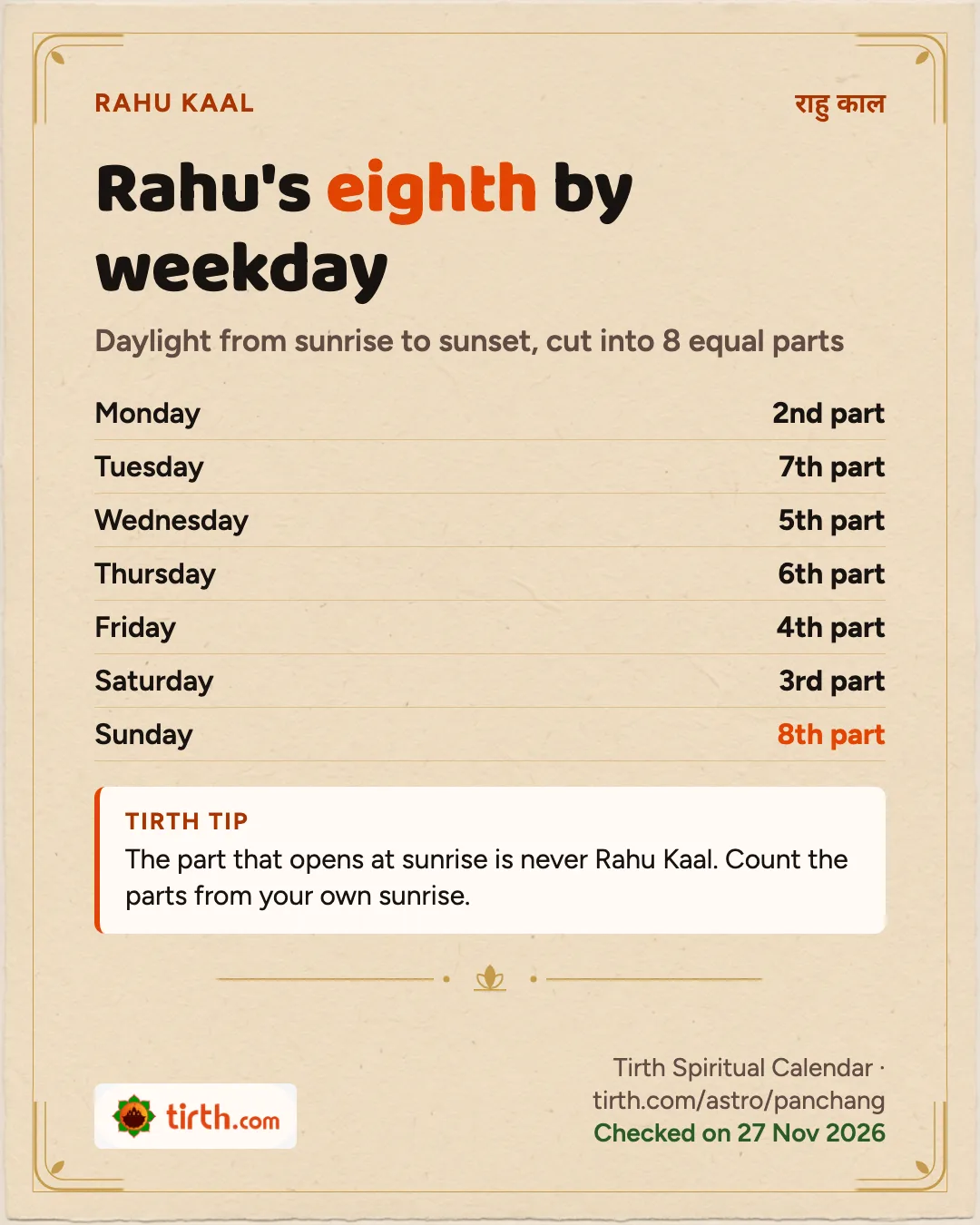
Find the length of the day first, then cut it into eight equal parts. The weekday picks Rahu’s part, with one fixed exception. The part that opens at sunrise is never his, whatever the day.
- Monday, the 2nd part
- Tuesday, the 7th part
- Wednesday, the 5th part
- Thursday, the 6th part
- Friday, the 4th part
- Saturday, the 3rd part
- Sunday, the 8th part, which ends at sunset
That is the whole rule, and you will not find a clock hour anywhere in it. A year’s table of times, pinned to the wall, is at best roughly right, and right for only one place.
Sunday, 29 November 2026: Delhi at 4:05 PM, Chennai at 4:14 PM
One real day, worked through. In Delhi on Sunday, 29 November 2026 the sun is up from 6:54 AM until 5:24 PM, which leaves 10 hours 30 minutes of daylight to share out. An eighth of that is about 1 hour 19 minutes. Sunday’s slot is number eight, the last one, which runs right up to the moment of sunset.
Count back from 5:24 PM and Delhi’s Rahu Kaal starts at 4:05 PM.
Chennai’s day that Sunday is longer. The sun is up from 6:14 AM to 5:40 PM, an eighth comes to about 86 minutes, and Rahu Kaal falls from 4:14 PM to 5:40 PM. Delhi’s window has been open 9 minutes by then. Chennai’s runs approximately 7 minutes longer.
Because the window is cut from local sunrise and sunset, the Tirth panchang asks for a city before it shows the time.
Why a Delhi Sunday in June stretches to 105 minutes
The seasons change its length as well. Delhi’s Rahu Kaal on Sunday, 21 June 2026, a long summer day, was 5:37 PM to 7:22 PM. About 105 minutes.
Come 29 November, five months on, the same weekday in Delhi gives about 79. An hour and a half, then, is an average for the year and no more. Each day sets its own, from your own sunrise and sunset.
What should you not begin in Rahu Kaal?
Almanacs have a single request for this window. Nothing new should be started in it. A wedding and a griha pravesh are the examples they usually give, and beside the time the Tirth panchang shortens all of it to three words, avoid new work. Read it closely and the rule is about beginnings. Work already under way is not mentioned, and nor is the daily puja at the home mandir. If your father is halfway through his evening prayers at 4:05 PM on a November Sunday in Delhi, that one is for the family Pandit to answer.
The panchang gives the hour. The family decides whether a wedding or griha pravesh begins in it.
Yamaganda and Gulika Kaal also appear on the panchang, each with a slot of its own.
Who is Rahu? Svarbhanu in the row of devas
So much for the almanac. For the name, go to the Bhagavata Purana, Canto 8, chapter 9, verses 24 to 26.
An asura called Svarbhanu disguises himself as a deva and sits down in their row. He drinks the amrita (the nectar that makes one immortal). Surya Dev and Chandra Dev know him for what he is, and they point him out.
Bhagwan Vishnu has taken the form of Mohini, and with the discus he cuts the head off. The amrita had gone no further than the head. The body falls. The head lives on and is accepted as a graha, the Rahu who now sits among the nine.
In verse 26 the head chases Surya Dev and Chandra Dev on full moon and new moon nights. The old telling sees an eclipse in that chase.
Tirth covers the total lunar eclipse of 2026 separately.
Those three verses say nothing of the daily eighth, which comes from the almanac alone.
Where to see today’s Rahu Kaal for your city
Rahu Kaal has a wider following in the southern states of India than in the north. The arithmetic does not care which side of the map you are on, though, and a day in Madurai gives up the same eighth of its own daylight as a day in Meerut.
Pick a city on the Tirth panchang, Panchang on Tirth and the day’s Rahu Kaal is worked out for it. The city selector changes the place. Next to it on the same page are Yamaganda, Gulika Kaal and Abhijit Muhurat.
Fixing a wedding or griha pravesh date? Open that page for the ceremony’s city, on the morning itself. We trust it over any table, since no table knows your sunrise.
Frequently asked questions
It follows the length of the day, so it moves around an average of about an hour and a half. On Sunday, 29 November 2026 Delhi has about 79 minutes and Chennai about 86. Delhi on Sunday, 21 June 2026 had about 105.
Two things move it. Sunrise and sunset change from one day to the next. And each weekday takes a different one of the eight parts of daylight.
No. Delhi’s window on Sunday, 29 November 2026 is 4:05 PM to 5:24 PM, while Chennai’s is 4:14 PM to 5:40 PM. The Tirth panchang works it out for whichever city you choose, from that city’s own sunrise and sunset.
Avoid new work is how the Tirth panchang words it. The undertakings meant are new ones, a wedding or a housewarming for example. For daily worship, or a special ceremony, the person to ask is your family Pandit.
The panchang’s own wording is avoid new work, and the undertakings it means are new ones, a wedding or a housewarming among them.
Each is a daily window with a slot of its own, and the panchang marks all three. Open the Tirth panchang for your city and you get them side by side, Abhijit Muhurat next to them, with the part of the day each one takes plain at a glance.
Continue on Tirth
- The Tirth panchang, Panchang on Tirth, with the day’s Rahu Kaal, Yamaganda, Gulika Kaal and Abhijit Muhurat for your city.
- The Navagraha mantras, the set for all nine grahas, Rahu among them.
- The Navgrah Chalisa, for the nine grahas together.