On this page6 sections
That small act holds the turmeric meaning a Hindu wedding still carries: haldi is a custom put on before the marriage, and the Shiva Purana calls it a worldly one.
Her father is Himavan, lord of the mountains. The scene comes in the Parvati Khanda, chapter 36, just after Arundhati has praised Bhagwan Shiva, Deity page on Tirth to Mena, Himavan’s wife, whose daughter Shiva is to marry. In J. L. Shastri’s English translation the text ties no Vedic rite or mantra to the turmeric.
After the yellow is on Himavan’s moustache, the sages fix the lagna (the moment chosen for the marriage).
In short
Her father is Himavan, lord of the mountains. The scene comes in the Parvati Khanda, chapter 36, just after Arundhati has praised Bhagwan Shiva, Deity page on Tirth to Mena, Himavan’s wife, whose daughter Shiva is to marry. In J.
Why did the sages put haldi on Himavan’s moustache?
That chapter belongs to the Rudra Samhita of the Shiva Purana, and it is given over to what the seven sages say. Earlier in it, Himavan offers them his body, his wife Mena, his sons and his daughter, and he adorns Maa Parvati himself.
Arundhati talks with the mother about the groom next. Then the sages act.
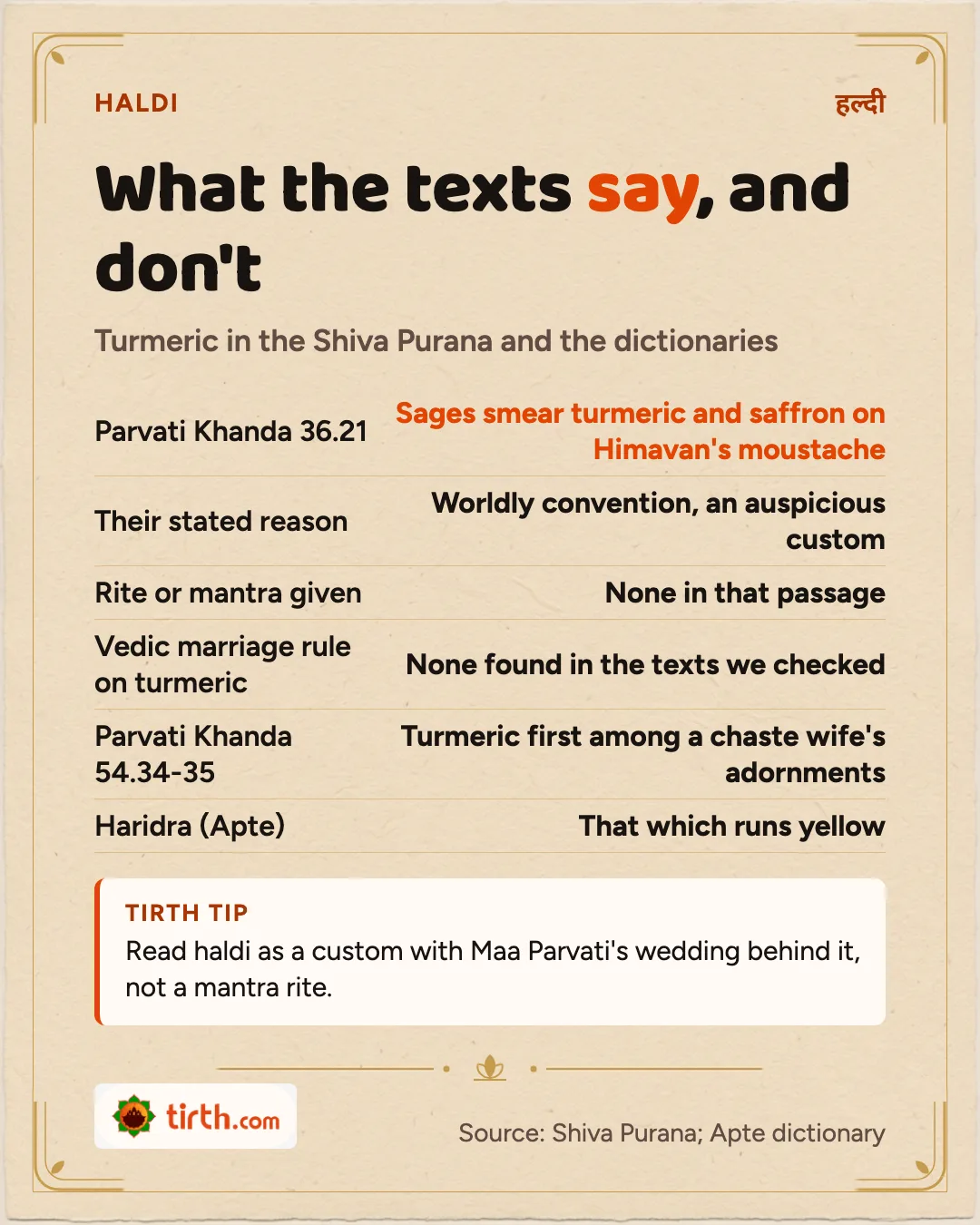
Their turmeric and saffron go on Himavan’s moustache in verse 21, as Shastri numbers it. In the Sanskrit the custom is laukikachara. The word for the turmeric is haridra, the same word the dictionaries explain.
Nothing in it claims the Vedas order this, and no verse is supplied for reciting while the paste goes on. The act is called a custom of the world and an auspicious practice. Later in the same chapter comes the line that the lord of the mountains has betrothed Parvati to Shiva.
You will see haldi called an ancient Vedic rite on some wedding pages. In the texts we checked, we found no Grihya Sutra rule and no Vedic marriage hymn that names turmeric. We would rather a family hear haldi the way the Purana tells it, as a custom with Maa Parvati’s own wedding behind it.
What does haridra mean in Sanskrit?
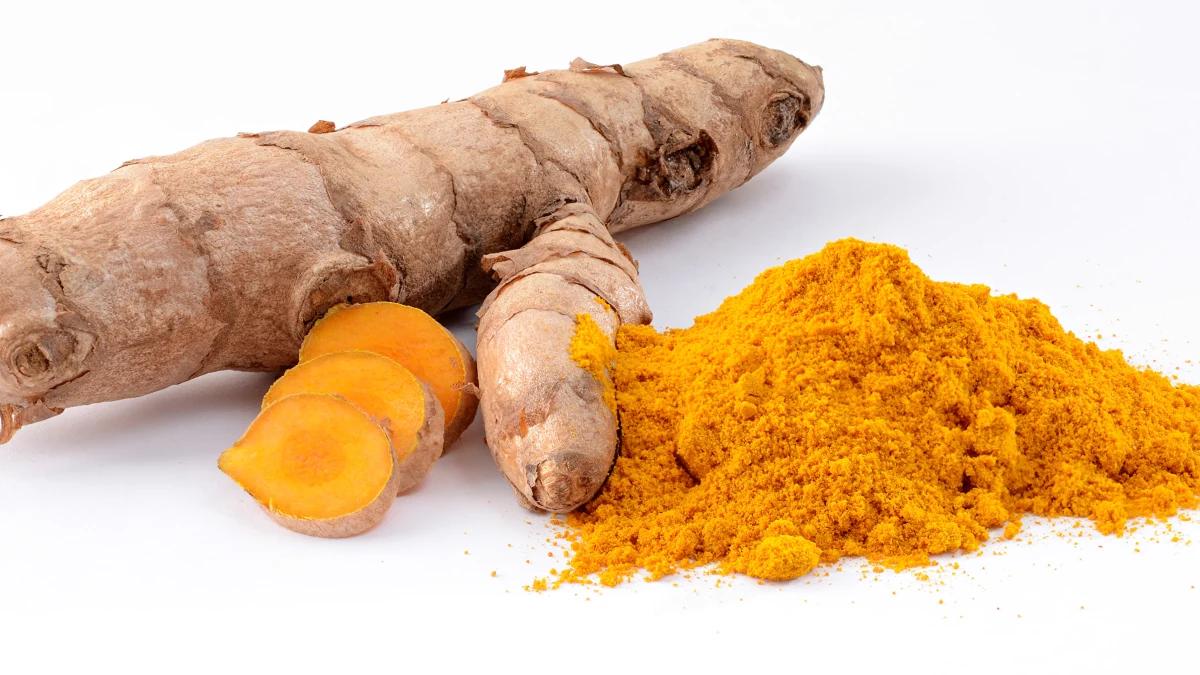
Haridra is what Sanskrit calls turmeric. Apte’s dictionary splits the word as harim pitavarnam dravati, which comes out roughly as that which runs yellow. Monier-Williams glosses it as Curcuma longa, turmeric, or its root ground to powder, and records the word in the Kaushika Sutra and the Mahabharata.
The Monier-Williams entry names no wedding use.
Where else does the Shiva Purana bring up turmeric?
Back in the Purana, turmeric turns up again later in the Parvati Khanda. This time the passage is on pativrata dharma (the duties of a chaste wife), and the one speaking is a brahmin lady, talking to Maa Parvati, Deity page on Tirth herself.
Her list, as J. L. Shastri’s translation gives it, is of things a chaste wife who wishes for her husband’s long life should not give up. Turmeric, vermilion, saffron, collyrium, a blouse, betel and auspicious ornaments, bangles and earrings among them. Turmeric comes first, in the Sanskrit too. Read that as the text’s view, spoken by one character to a bride. It is set down here as what the Purana says, and it is neither a rule for any woman reading this nor a promise of what turmeric does.
What a Hindu bride wears, piece by piece, is in Tirth’s post on solah shringar, which sets out one common list of sixteen adornments.
How do Hindu families in Bangladesh keep gatra haridra?
Outside the Purana, one written account of the custom is Banglapedia’s entry on gaye halud, which covers the pre-wedding turmeric day as Hindu and Muslim families keep it in Bangladesh. Among Hindu families there, the rite is called gatra haridra or adhivas. It takes place three, five or seven days before the wedding, separately in each family’s home, and the turmeric and other ingredients for the bride and groom are sent back and forth between the two houses.
The mother, the grandmother and the elder relatives apply the turmeric first and offer sweets, and the younger relatives and friends take their turn after them. Right up to the wedding day the bride keeps being rubbed with turmeric. On the day itself she takes a ritual bath. The groom is not left out. Banglapedia has him smeared as well, in his own family’s home, with turmeric and other ingredients.
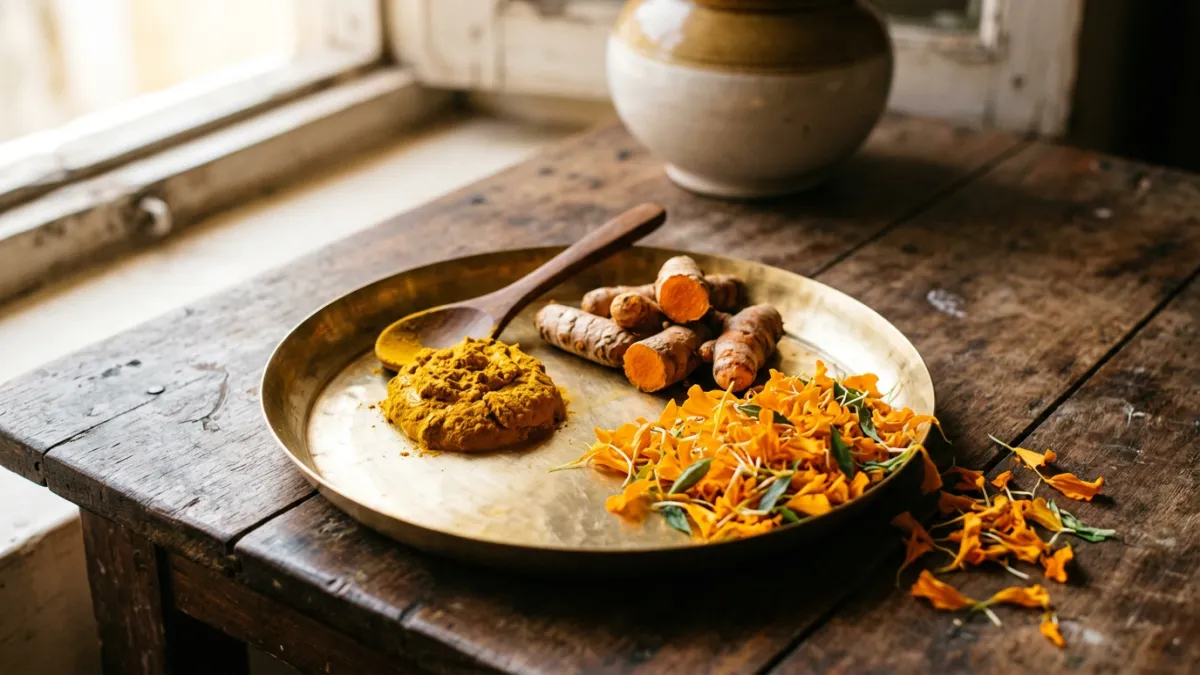
According to the same entry, a newly married couple is open to misfortune and the evil eye, and turmeric is believed to keep evil spirits away. We give that as the entry’s belief and nothing more. Under other names, gaye halud and haldi kota, Muslim families in Bangladesh keep a similar day.
In the Purana the sages do the marking, and the one they mark is the bride’s father. In the Bangladesh account the bride herself is marked, with her mother and grandmother among the first to do it.
In the Purana it goes on before the lagna is even fixed, and in Bangladesh the bride is rubbed with it right up to the ritual bath on her wedding day.
Frequently asked questions
At a wedding, turmeric is an auspicious custom, put on before the marriage. In the Shiva Purana, Parvati Khanda, chapter 36, the seven sages rub turmeric and saffron on the moustache of Himavan, Maa Parvati’s father, before her wedding lagna is fixed, and the text names this a worldly custom.
The Purana calls it a worldly custom. Banglapedia records the Hindu form in Bangladesh as gatra haridra or adhivas, held three, five or seven days before the wedding, and there the bride’s mother and grandmother put the turmeric on first.
In the texts we checked, we found no Vedic marriage hymn or Grihya Sutra rule that names turmeric. Monier-Williams cites the word from the Kaushika Sutra and the Mahabharata. His entry names no wedding use.
One of the names, along with haldi kota, that Banglapedia gives for the pre-wedding turmeric day among Muslim families in Bangladesh. Hindu families in the same country use gatra haridra or adhivas.
Continue on Tirth
- Maa Parvati, Deity page on Tirth: the Tirth page on the bride of this story.
- The swayamvar of Maa Sita: another wedding story, how Bhagwan Ram broke the bow in Janakpur.
- Solah shringar: what a Hindu bride wears, piece by piece.
- Sanatan Dharma meaning: what the texts say “eternal dharma” is.