On this page7 sections
The word agrees with the picture. Sanskrit makes it hima, snow, plus alaya, abode: the abode of snow. Hindu texts then go further than any atlas. They give the range a king’s name, make him a father, and have Bhagwan Krishna count him among his own greatest forms.
In short
Sanskrit makes it hima, snow, plus alaya, abode: the abode of snow. Hindu texts then go further than any atlas. They give the range a king’s name, make him a father, and have Bhagwan Krishna count him among his own greatest forms.
Himalaya meaning in Sanskrit, and how to say it
Cut the word in two. Hima is snow or frost. Alaya is a dwelling, the place where someone lives. The Monier-Williams dictionary gives the whole as the range that bounds India to the north, literally the abode of snow.
| Part | Meaning |
|---|---|
| hima | snow, frost |
| alaya | abode, dwelling |
| Himalaya | abode of snow |
Sir Geoffrey Corbett wrote a whole study of this one word. He notes two cousins of it. Devalaya is the abode of God, Shivalaya the abode of Bhagwan Shiva, Deity page on Tirth , and both are put together exactly as Himalaya is. Set beside them, Himalaya reads as a name of the same kind, one that says where a god or a mountain lives.
Saying it depends on the language. In Sanskrit the stress sits on the second syllable, hi-MA-la-ya. Modern Hindi ordinarily does not sound the last a, so you hear Hi-ma-lay (an older relative who says Himalay is using the Hindi form, not slipping). Nepal has its own short form too, since each snow-covered group of peaks there is called a Himal, a contraction of Himalaya.
How the Kumarasambhava opens: a mountain who is a king
Before a single person appears, the Kumarasambhava gives us a mountain. Canto 1, verse 1 sets him in the north and names him a king of mountains.
अस्त्युत्तरस्यां दिशि देवतात्मा हिमालयो नाम नगाधिराजः । पूर्वापरौ तोयनिधी वगाह्य स्थितः पृथिव्या इव मानदण्डः ।।
astyuttarasyāṃ diśi devatātmā himālayo nāma nagādhirājaḥ | pūrvāparau toyanidhī vagāhya sthitaḥ pṛthivyā iva mānadaṇḍaḥ ||
In the north lies the king of mountains, named Himalaya, divine-souled. Reaching into the eastern and western seas, he stands like a measuring rod laid across the earth.
Hold on to devatatma. It means divine-souled, so the verse gives the range more than height: it calls the mountain a being with a divine spirit. And the measuring rod hands him a task, which is to mark out the land from the eastern sea to the western.
Verse 3 turns to the snow, the very thing the name is built on. A reader might fear that all this white spoils the mountain’s looks, and the canto says it does not. Snow does not harm his beauty, just as the single spot on the moon is lost among its many rays, and a fault, if there is one, vanishes among his many virtues.
Maa Ganga and Maa Uma, the daughters of Himavan
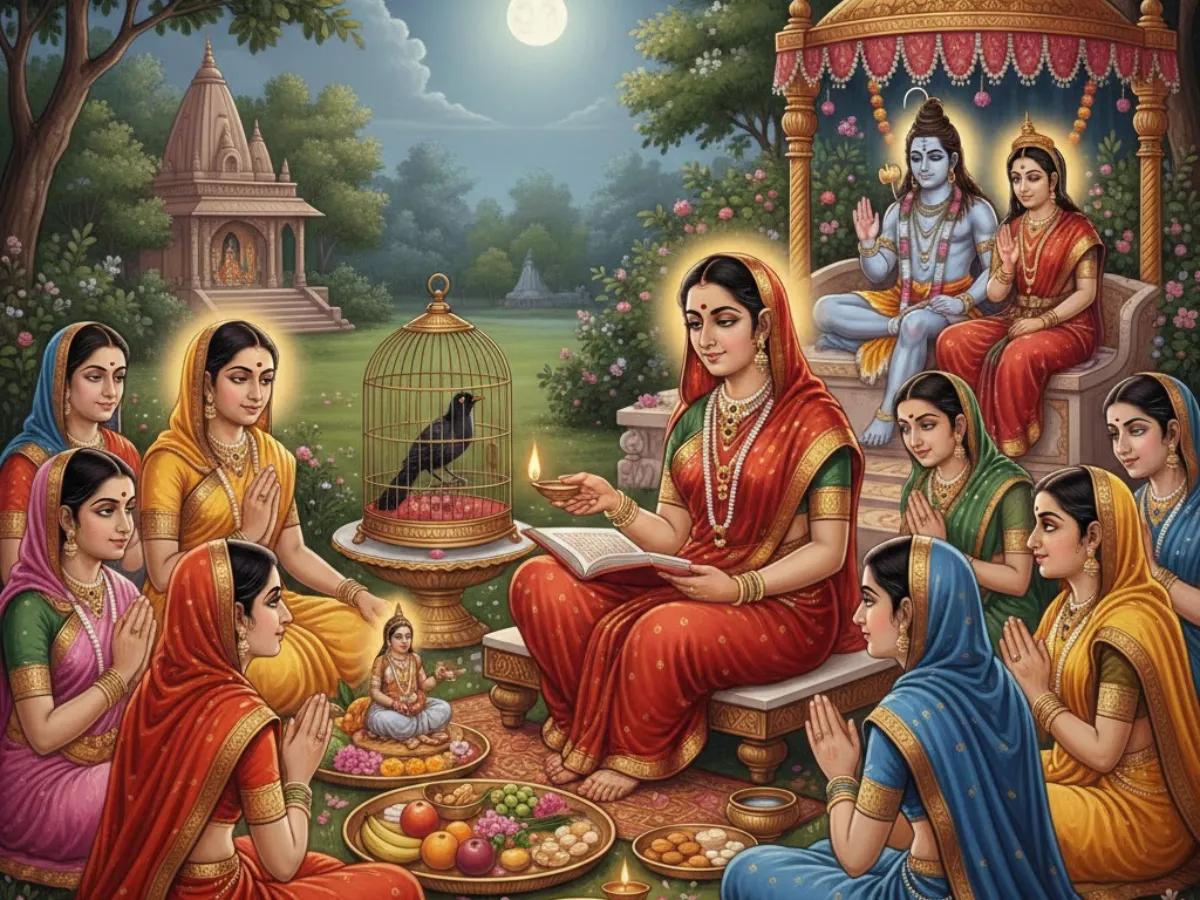
Every king has a household. Bala Kanda, sarga 35 of the Valmiki Ramayana, introduces Himavan as the treasure-house of minerals, with Mena as his wife. The gods come to him with a request for his elder daughter, Maa Ganga, for the welfare of the three worlds. He gives her willingly.
His second daughter is Maa Uma, who performs hard austerity, after which Himavan gives her in marriage to Bhagwan Rudra. Maa Ganga and Maa Uma, river and bride, come from one house. That makes them sisters in this text, Maa Ganga the elder. Monier-Williams records the same family from the dictionary side, listing Himalaya as husband of Mena (or Menaka) and father of Maa Parvati, Deity page on Tirth and of Maa Ganga, regarded as his eldest daughter. For the river’s side of it, Tirth has the Gangotri Temple page, Temple page on Tirth.
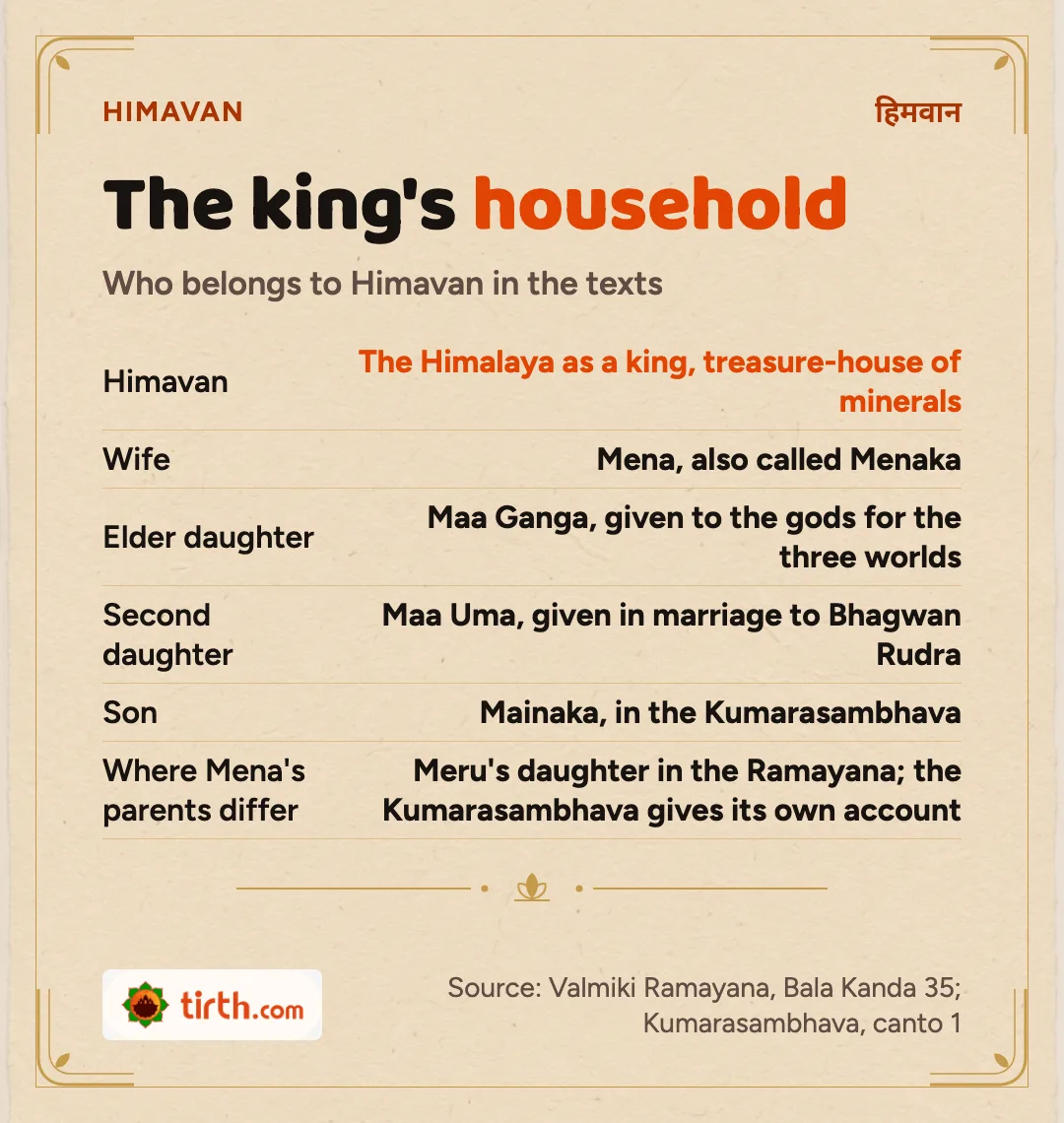
The Kumarasambhava stays longer with Maa Uma’s girlhood. A son, Mainaka, is born to Himalaya and Mena, and then a daughter, born with great celebration. Her first name is the Mountain-lady. Maa Uma’s own name comes later, and it comes from her mother, who cries out to stop her severe penance. Narada, the sage, says she is destined to be Bhagwan Shiva’s bride. The penance has a tale of its own on Tirth, the Hartalika Teej katha.
The texts do not agree on every detail of this family, and Mena’s parentage shows it. The Ramayana makes her Meru’s daughter; the Kumarasambhava gives its own account. This page leaves the question open.
What the Bhagavad Gita says about the Himalaya
The mention is short. In chapter 10, verse 25, Bhagwan Krishna says: “Among immovable things, I am the Himalaya.”
Chapter 10 is called Vibhuti Yoga, the yoga of divine manifestations. Bhagwan Krishna goes down a list. Each item is what is greatest in its kind, and for things that do not move, he names the Himalaya. The verse says that much and no more, and we would rather stop where it stops than add a meaning of our own, since a line this brief is very easy to over-read.
The Himalaya as a place to walk toward
The range is also somewhere people go. In the Mahabharata, Mahaprasthanika Parva, the Pandavas and Draupadi walk north toward the Himalaya. Yudhishthira walks on with a dog. Indra Dev asks him to abandon it, and he refuses. That story is told in full elsewhere.
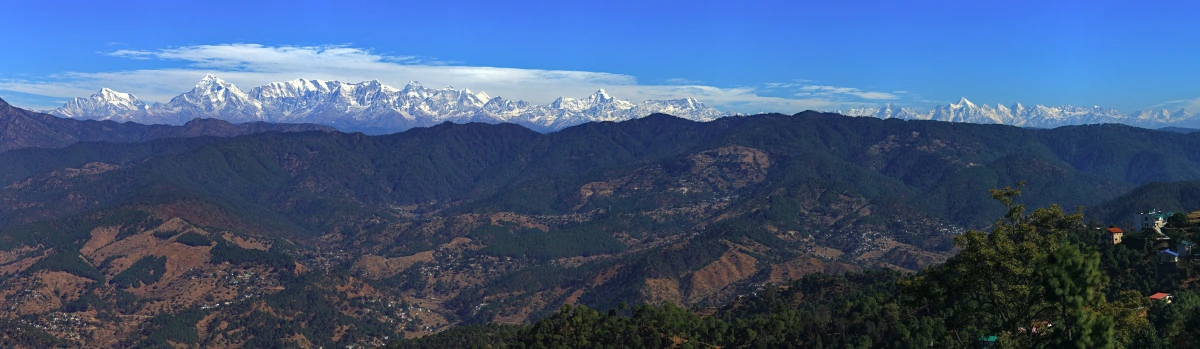
Bhagwan Shiva is never far from the range in these texts. Maa Uma, Himavan’s daughter, goes to Bhagwan Rudra in marriage. And the word Shivalaya, abode of Bhagwan Shiva, is formed the same way as Himalaya.
Frequently asked questions
The word joins hima (snow) to alaya (abode), giving the abode of snow. Devalaya and Shivalaya follow the pattern.
Himavan is the Himalaya as a king. The Valmiki Ramayana, Bala Kanda 35, makes him the father of Maa Ganga and Maa Uma, and the Kumarasambhava gives him a son, Mainaka.
Yes. In chapter 10, verse 25, Bhagwan Krishna says that among immovable things he is the Himalaya. The chapter’s name is Vibhuti Yoga.
In Sanskrit the stress falls on the second syllable, and modern Hindi usually leaves the final a silent, which gives Hi-ma-lay.
Himal is a contraction of Himalaya. Nepal uses it for each snow-covered group of peaks.
Continue on Tirth
- Char Dham yatra: the Himalayan dhams, planned with Tirth.
- Do Dham and Char Dham: the shorter and the longer Himalayan plan, side by side.
- Maa Ganga, Deity page on Tirth: the sacred river who comes from this house.
- The spiritual importance of the four Himalayan dhams: why all four places matter.