On this page8 sections
 Kings came to Mithila, and none of them could lift it, grasp it or move it. That is the Vivah Panchami story as Valmiki tells it, and it ends with Bhagwan Ram stringing the bow as the bow breaks.
Most of us call it a swayamvar, a word that points to the bride’s own choice. Valmiki’s word is viryashulka, a bride whose price is valour. I will keep saying swayamvar, since it is the name we know, but in Valmiki the whole thing rests on the vow.
Vivah Panchami falls on the fifth day of the bright half of Margashirsha. In 2026 that is Monday, 14 December, and the day for your city in the Tirth Spiritual Calendar, Spiritual Calendar on Tirth is one tap away.
In short
That is the Vivah Panchami story as Valmiki tells it, and it ends with Bhagwan Ram stringing the bow as the bow breaks. Most of us call it a swayamvar, a word that points to the bride’s own choice. Valmiki’s word is viryashulka, a bride whose price is valour.
Where did the bow come from?
Janaka was not the first to hold it. Sarga 66 of the Bala Kanda takes the bow back to the destruction of Daksha’s yajna, where Bhagwan Shiva stretched it in anger. The gods appeased him. He gave the bow to them, and they deposited it with King Devarata of Nimi’s line.
Why was the test a bow at all?
Janaka was ploughing a field for a ritual when he found Maa Sita in a furrow. Valmiki calls her ayonija, one not born of a womb. He says it in the same passage where he calls her viryashulka.
He declared her a bride to be won by valour, and the bow became the measure of it.
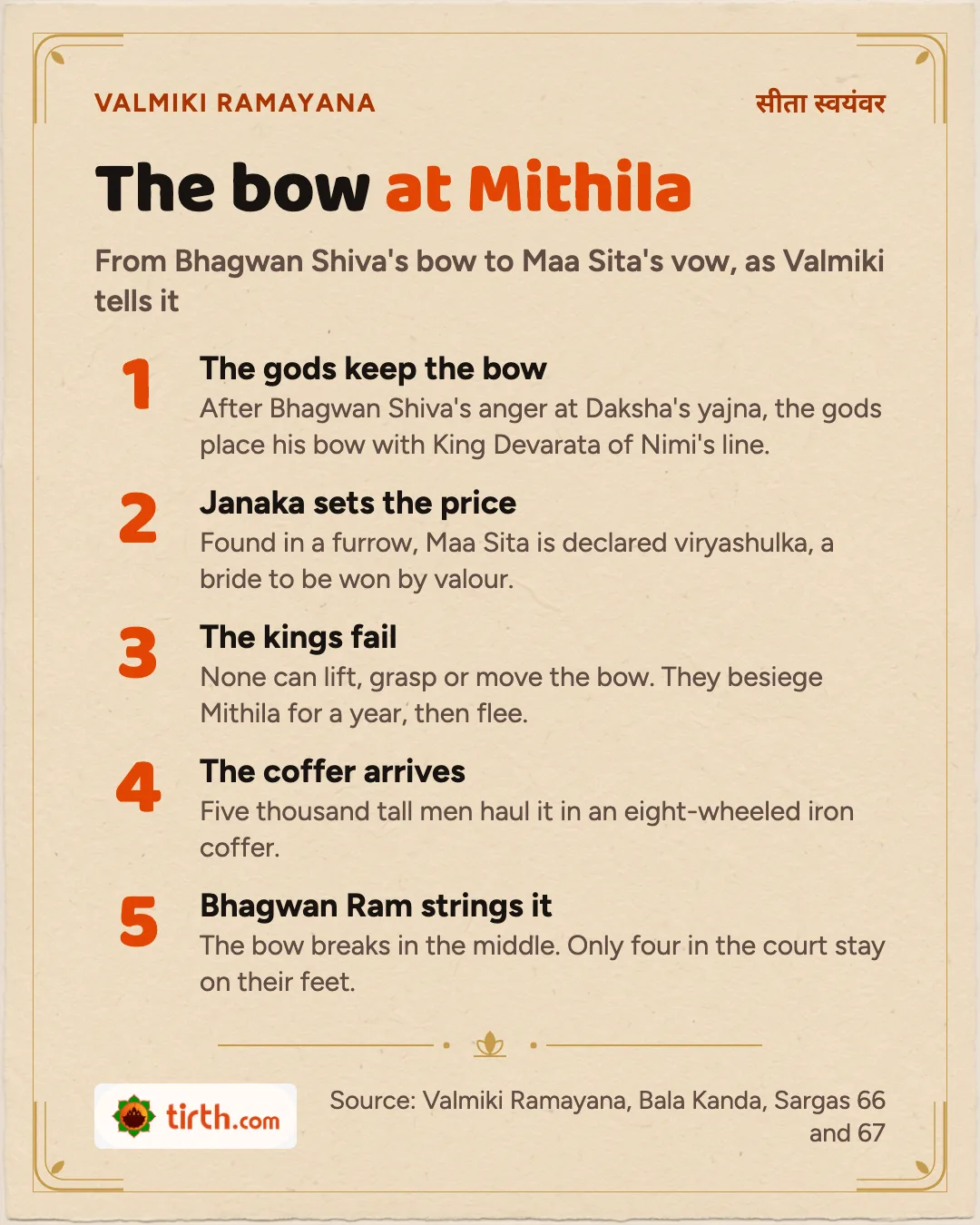
Kings gathered at Mithila. None of them could lift the bow, grasp it or move it. Janaka sent them away, and they besieged Mithila for a year. The siege ended only after Janaka won the favour of the gods through austerity and received a fourfold army, and the kings fled. For the wider cast of this scene, there is the Ramayana characters told through one Valmiki scene each.
The iron coffer and the five thousand men
Sarga 66 ends with two young guests in Janaka’s court, travelling with the sage Vishwamitra. Vishwamitra asks Janaka to show the bow to the princes. Janaka agrees, and adds that if Bhagwan Ram can string it, Maa Sita will be given to him.
In Sarga 67 the bow is brought in. It lies in an eight-wheeled iron coffer, decorated with sandalwood paste and garlands, and five thousand tall men haul that coffer into the court, which Valmiki says they manage only with great difficulty.
Then Janaka speaks to his guests. Not gods, asuras, gandharvas, yakshas or kinnaras had managed to string this bow. What could a mortal do?
What happened when the bow broke?
At Vishwamitra’s word, Bhagwan Ram opens the coffer. He says he will touch the bow and try to bend it. These are Valmiki’s own plain words (1.67.12 to 17).
Thousands are watching. Bhagwan Ram takes the bow by its middle, almost in play, strings it and draws the string, and it breaks at the middle.
It sounds like thunder, and the earth shakes as though a mountain had split. Everyone in the court faints except four: Vishwamitra, Janaka, Bhagwan Ram and Lakshmana (1.67.18 and 19).
When Janaka comes round, he says his vow of valour is fulfilled, asks Vishwamitra’s leave and sends ministers by chariot to Ayodhya to bring Dasharatha, though how long those ministers took is something Valmiki does not say. For the title Maryada Purushottam, what Maryada Purushottam means reads well beside this scene.
Valmiki vs Tulsidas at the break
The two texts do not tell the break the same way.
| Valmiki Ramayana, Bala Kanda | Ramcharitmanas, Bala Kanda | |
|---|---|---|
| Before the bow | Bhagwan Ram says he will touch it and try to bend it (1.67) | Lakshmana speaks, thrilled, as if pressing the universe down with his feet (doha 259) |
| The sound | Like thunder, the earth trembles as if a mountain split (1.67.18 and 19) | Fills the worlds, the sun’s horses leave their path, gods, asuras and munis cover their ears |
| After it | Only four stay standing, then Janaka declares his vow fulfilled | All cry Ram ki jai |
In the Ramcharitmanas the chhand after the break begins bhare bhuvan ghor kathor rav. The sound fills the worlds.
After the bow: the wedding
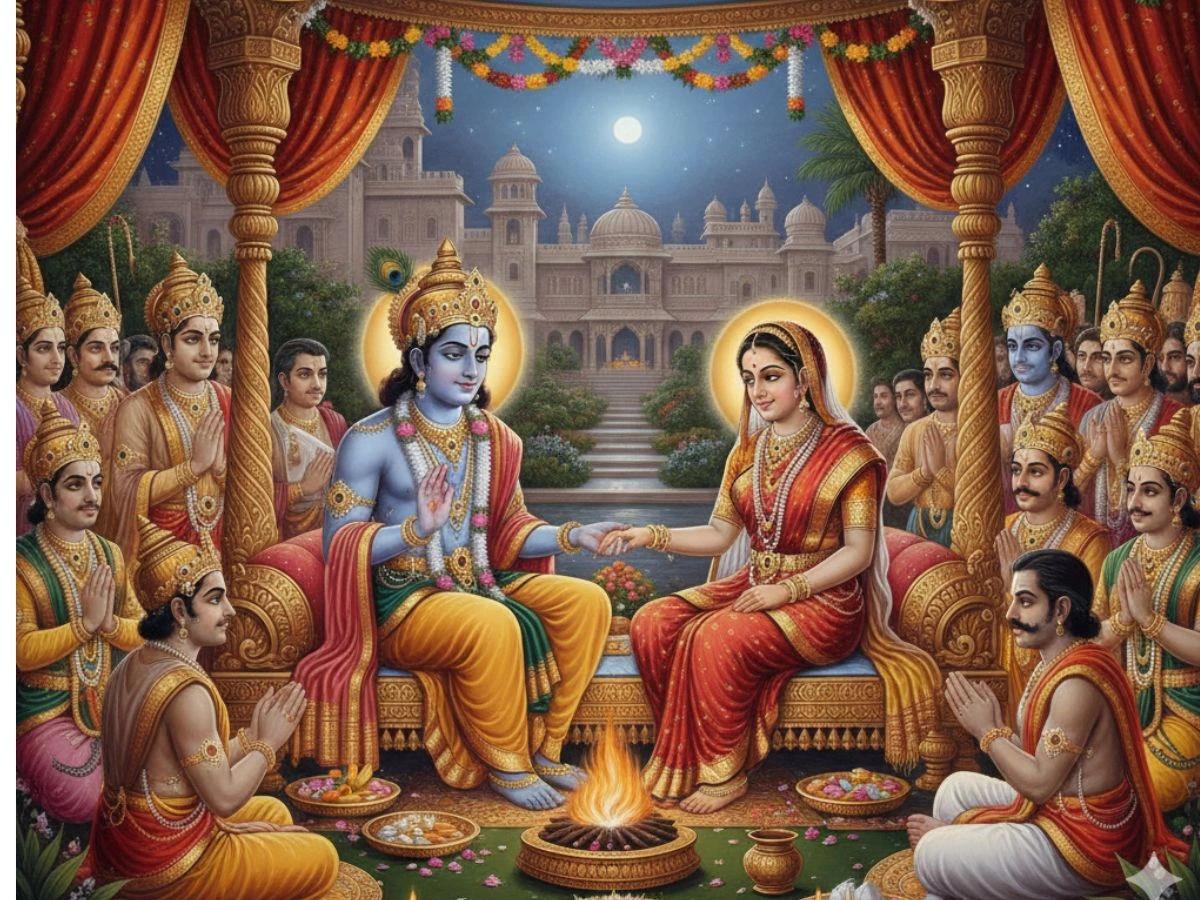
Sarga 73 is the wedding. Vashishta kindles the fire, and Janaka gives Maa Sita to Bhagwan Ram with the words “take her hand in your hand” (73.26 and 27). The other brides follow: Urmila to Lakshmana, Mandavi to Bharata, Shrutakirti to Shatrughna. All four couples then circle the fire.
Parashurama is not in the hall. In Valmiki he arrives in Sarga 74, holding Bhagwan Vishnu’s bow, once the wedding party has left Mithila and is on the road to Ayodhya (1.74.16 to 19).
For another turn in Maa Sita’s story, why Maa Sita gave the agnipariksha tells it.
How is Vivah Panchami kept today?
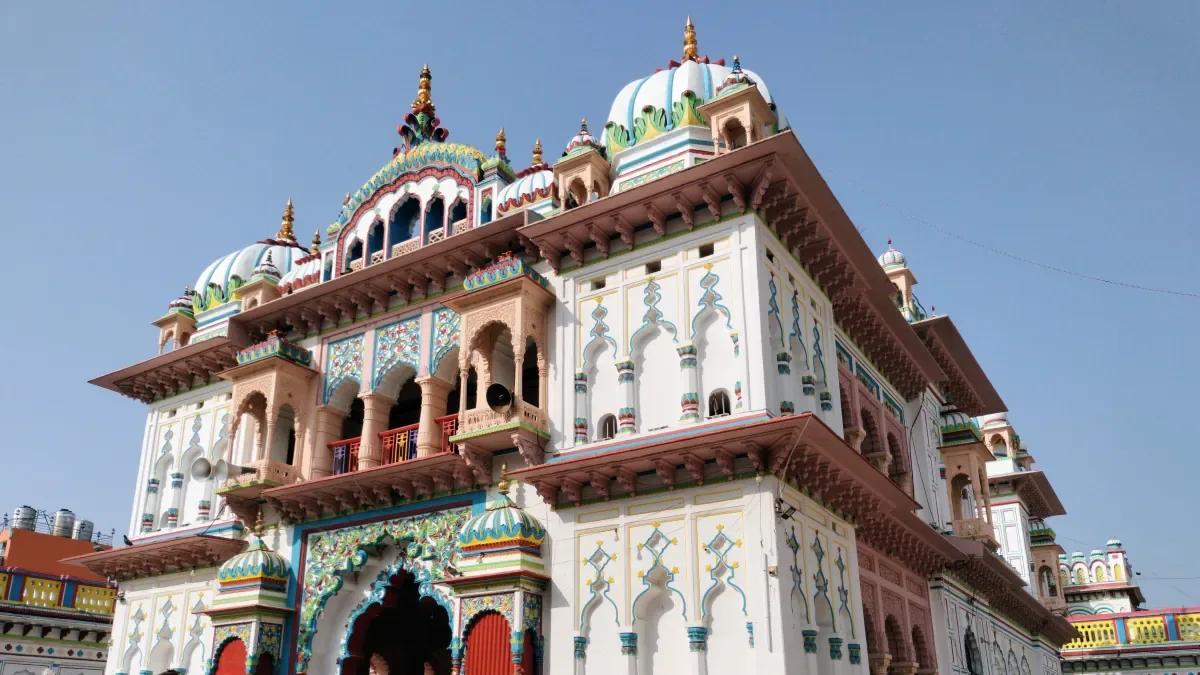
Janakpur, in Nepal, has a Vivah Mandap beside the Janaki Mandir, and locals regard it as the site of the wedding. Re-enactments and rituals are held there on the day. The Janaki Mandir itself was completed in 1910 by Queen Vrisha Bhanu of Tikamgarh, and it is popularly called Nau Lakha Mandir.
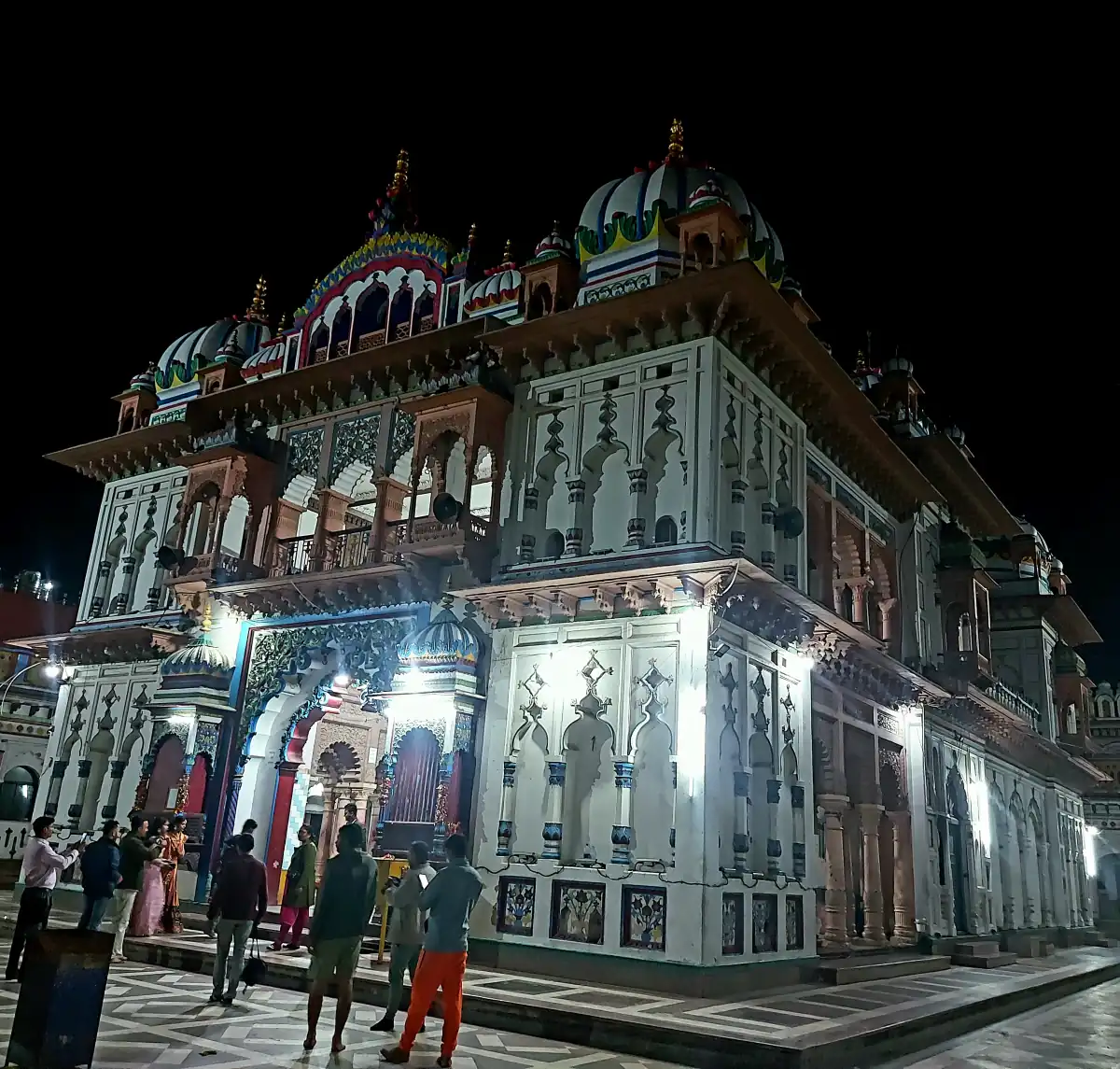
Reports from 2025 mention a wedding re-enactment, and two dolas from the Ram and Janaki temples carried round the city. They also mention a festival lasting a week and ending with Ram Kalewa. I would call that last part reported, not fixed.
In Ayodhya, the Ram Mandir held its dhwajarohan, the flag hoisting, on Vivah Panchami in 2025. For a visit there, Ayodhya, the city of Bhagwan Ram is a good place to start.
Tirth also has the Vivah Panchami vrat katha.
If you want the swayamvar in the text, read Sarga 66 and 67 of the Valmiki Bala Kanda first. Then open Tulsidas and see what is different.
Frequently asked questions
Bhagwan Shiva’s bow. Valmiki says Bhagwan Shiva stretched it in anger at the destruction of Daksha’s yajna, and the gods later placed it with King Devarata of Nimi’s line.
The Bala Kanda, in both Valmiki and the Ramcharitmanas. In Valmiki, Sarga 66 leads up to the break and Sarga 67 holds it.
Five thousand tall men, according to Valmiki 1.67. They hauled it in an eight-wheeled iron coffer, with great difficulty.
The whole court was there. Everyone but four people fainted at the sound, and those four were Vishwamitra, Janaka, Bhagwan Ram and Lakshmana.
Not in Valmiki, where he appears in Sarga 74 on the road to Ayodhya, after the wedding party has left Mithila.
Continue on Tirth
- Vivah Panchami in the Tirth Spiritual Calendar, Spiritual Calendar on Tirth shows the day and tithi for your city.
- Vivah Panchami vrat katha is the katha families tell on the day.
- Sita aarti carries the words of the aarti and their meaning.
- Ayodhya yatras on Tirth, Yatra on Tirth are there if you want to stand where the story ends and begins again.