On this page8 sections
- Linga in Sanskrit, and the formless Shiva it points to
- Why does only Bhagwan Shiva have a linga, and every other deity an image?
- How the first linga stood between Brahma ji and Bhagwan Vishnu
- The pedestal, the stone, and the Om the Puranas see in it
- Is the Shivling a phallic symbol? Reading the dictionary next to the Purana
- A Shivling in the home mandir, by Vidyeshvara Samhita chapter 5
- Frequently asked questions
- Continue on Tirth
- Sources and review
That is the plain shivling meaning, since linga is Sanskrit for a mark or a sign. (You will also see it spelt Shiva lingam or Shivalinga.)
The Shiva Purana also says when it began. Brahma ji and Bhagwan Vishnu were quarrelling when Bhagwan Shiva stood his formless self between them as a column, and from then on, the Purana says, the linga as well as the image went to him, and the image alone to the other gods.
Linga in Sanskrit, and the formless Shiva it points to
Look up linga in the Monier-Williams Sanskrit-English dictionary and the first senses are plain ones (mark, spot, sign, token, badge, emblem). A characteristic as well.
But a sign has to point at something. The Shiva Purana names what this one points at in the Vidyeshvara Samhita, chapter 5, where Bhagwan Shiva is called nishkala (without parts, formless) because he is one with Brahman, the supreme reality, and also sakala (with parts, embodied) because he has a form as well.
The linga belongs to the first of these, the nishkala side.
Why does only Bhagwan Shiva have a linga, and every other deity an image?
Because, in the Shiva Purana’s account, no other deity has a formless side.
The one doing the explaining is Nandikeshvara. His listener is the sage Sanatkumara, and we are still in chapter 5 of the Vidyeshvara Samhita. As the supreme Brahman, Bhagwan Shiva has no body, so his worship uses the nishkala linga. He has an embodied form as well. That gets worshipped too. Sacred literature mentions the two together, linga and embodied image, for him and for no one else, Nandikeshvara says. The rest of the gods have just the embodied aspect, and so an image is the one form their worship takes.
The chapter even dates it. This was in the first kalpa. Brahma ji and Bhagwan Vishnu had fallen to fighting, and Parameshvara, to break the arrogance in them, stood his formless self between them as a column and then brought the linga out of it. After that, the Purana says, linga and image together went to Bhagwan Shiva, and to the other gods the image alone.
There is one more claim in the chapter. Worship an image of another deity, it says, and it gives enjoyment only. The Shiva Purana says the linga together with Bhagwan Shiva’s embodied form gives auspicious enjoyment and liberation as well.
If a child asks why the stone in a Shiva temple has no eyes or hands, answer from this chapter. The stone stands for the nishkala side of Bhagwan Shiva, the side without form.
How the first linga stood between Brahma ji and Bhagwan Vishnu
Brahma ji himself narrates the story, in chapter 7 of the Rudra Samhita’s Srishti Khanda. It happens in the ocean of dissolution, with him and Bhagwan Vishnu in the middle of a fight. A linga appeared in front of the two. Nothing about it had a beginning, a middle or an end, it neither grew nor shrank, and thousands of flames blazed from it. At those flames Bhagwan Vishnu lost consciousness.
So they set out to find its ends. Bhagwan Vishnu took a boar’s form and went down, while Brahma ji went up as a swan, and a thousand years of searching later the root and the top were both still unfound. They bowed to Bhagwan Shiva, the two of them.
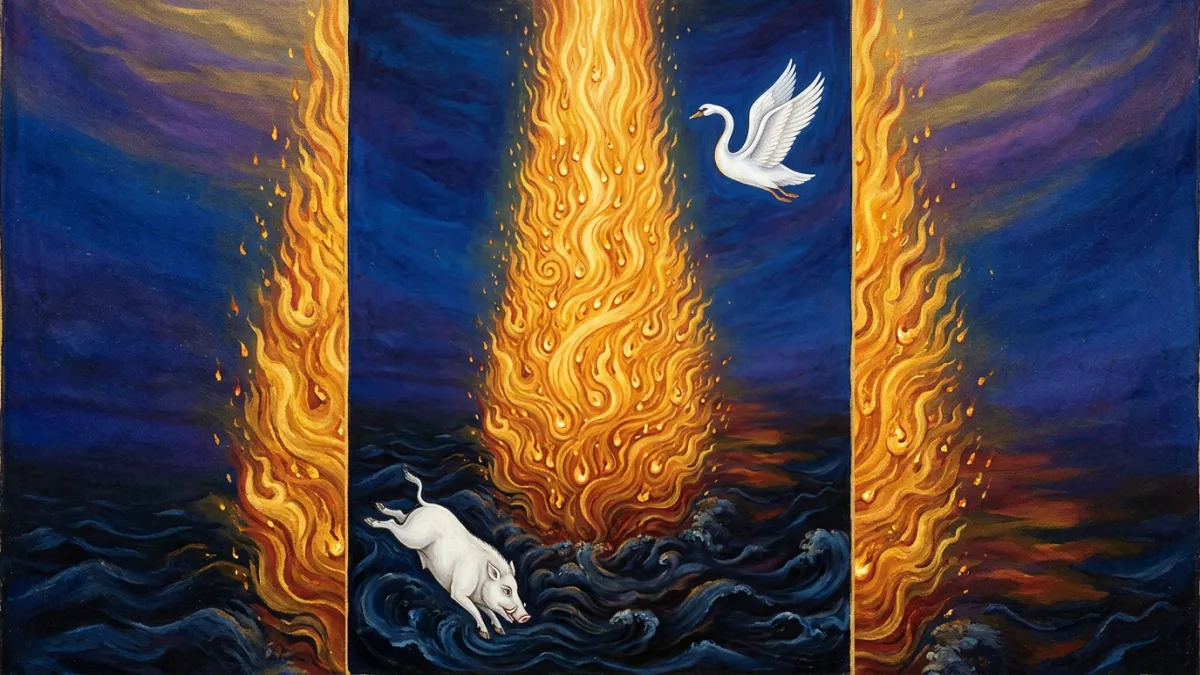
The Linga Purana has its own telling. It is in Part 1, chapter 17 (“Origin of the Linga” in the English translation). Its column also flames, stays stable and neither declines nor increases, and this Purana calls it the source of the universe. As in the Shiva Purana, Brahma ji becomes a swan (hamsa) for the climb, and this Purana says the name hamsa came to him that way. (If you tell it at home, name the Purana you are following.)
For the whole search, read our post on the pillar of light story in full.
The pedestal, the stone, and the Om the Puranas see in it
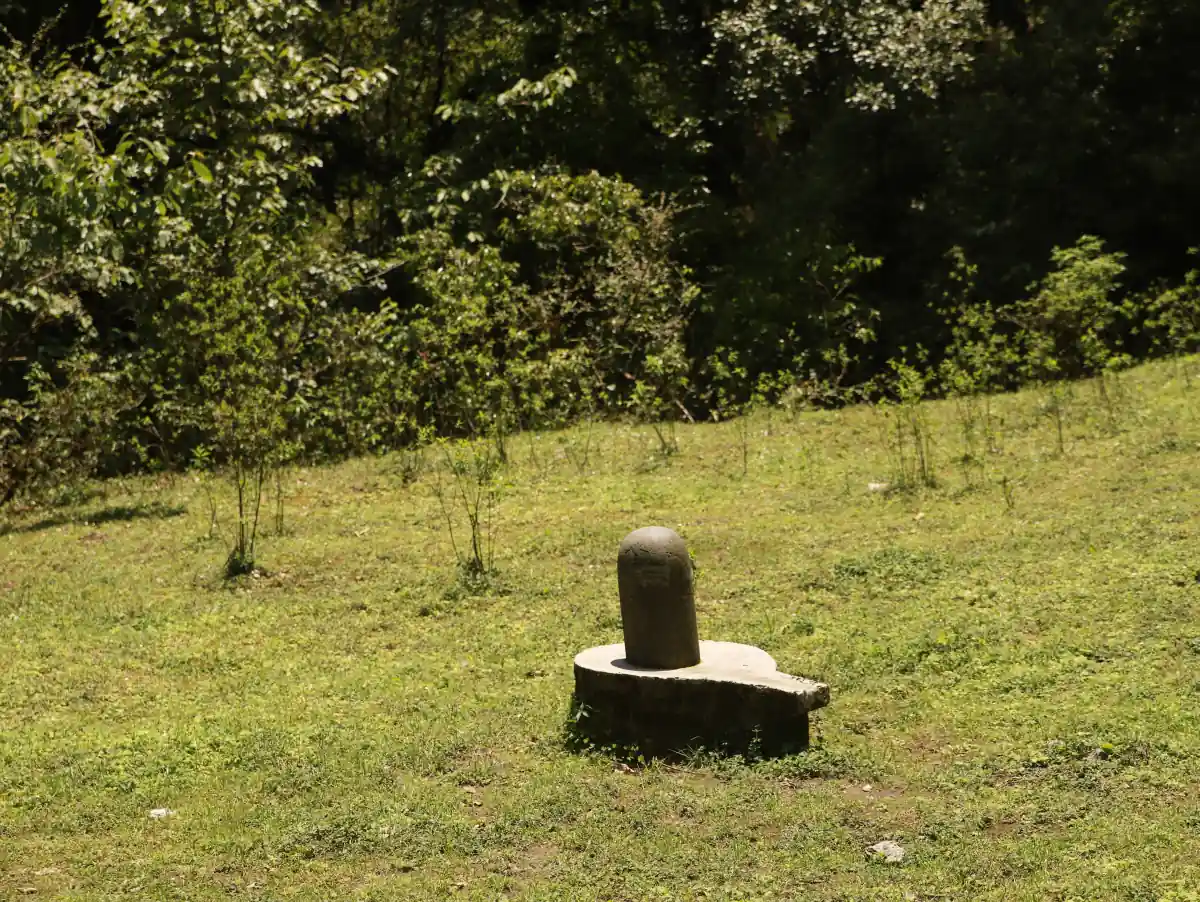
Linga worship begins after this. A few chapters past the pillar, the Shiva Purana says that from that time the rite of worshipping the linga was established in the world. Then each part gets its meaning. The great Devi is the pedestal and Bhagwan Shiva himself is the linga. The universe finally merges into it, the Purana adds, and that is why it is called linga.
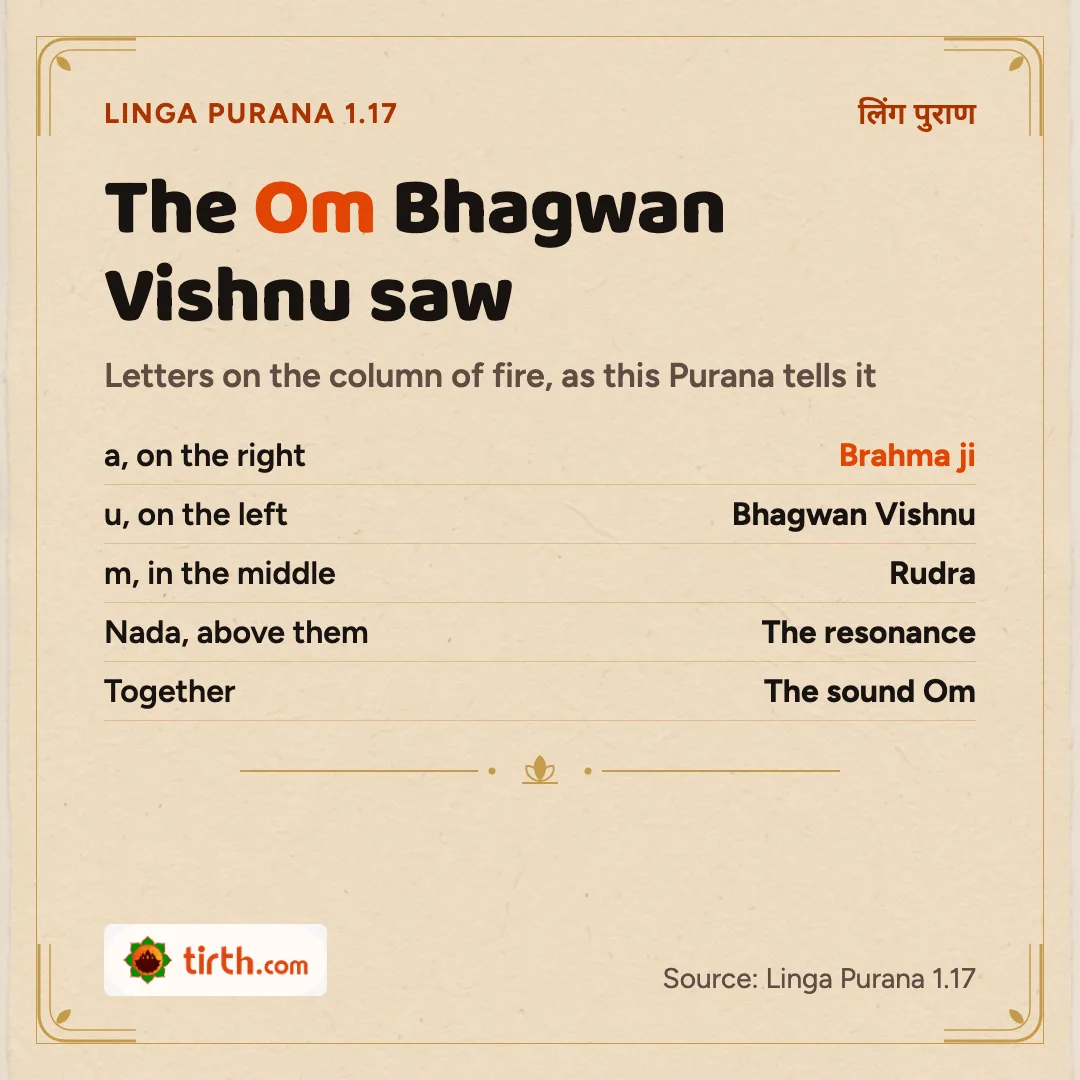
The Linga Purana, in the same chapter 17, hears sound in the linga. Bhagwan Vishnu sees the letter a on its right, u on its left and m in the middle, with the nada (the resonance) above, and together they make Om. In this Purana’s scheme a is Brahma ji, u is Bhagwan Vishnu and m is Rudra, and other Puranas share the letters out another way. Later in the Vidyeshvara Samhita the Shiva Purana calls the Pranava (Om) itself the first linga.
Is the Shivling a phallic symbol? Reading the dictionary next to the Purana
A fair question, and the calmest way to answer it is to set two sources next to each other.
That sense is in the Monier-Williams dictionary, yes. Its entry for linga goes on past mark and sign to gender or sex, the organ of generation and the male organ, naming Bhagwan Shiva’s in particular, worshipped as a stone or marble column that generally rises out of a yoni. There is “the image of a god” in the list as well.
Now set the Shiva Purana beside it, at Rudra Samhita chapter 7. The form there is beyond words and beyond the reach of meditation, and it possesses neither action nor name. It became a linga, the Purana says, and did so without any distinction of sex. When the parts are named a few chapters on, the great Devi is the base and Bhagwan Shiva himself the linga.
A Shivling in the home mandir, by Vidyeshvara Samhita chapter 5
Before any of the theology, the fifth chapter of the Vidyeshvara Samhita starts with a practical case. Say someone cannot manage the three rites that begin with shravana (hearing the texts). The Shiva Purana’s answer for that person is to install a linga or an image of Bhagwan Shiva and worship it each and every day, with devotion and whatever offerings they can manage, and it calls this a way to cross the ocean of worldly life.
If your parents keep a small Shivling in the home mandir and are unsure whether their daily worship counts, read them this chapter.
Chanting at home can begin with our page of Shiva mantras. Before an abhishek, read the Maha Rudrabhishek mantra (it helps to know the words before the water).
For more on Bhagwan Shiva himself, see Tirth’s own Bhagwan Shiva, Deity page on Tirth page.
Frequently asked questions
A mark or sign of Bhagwan Shiva, which is what linga means. The Shiva Purana makes it the form for his formless (nishkala) side, a side no other god has. It also names the pedestal as the great Devi and the linga as Bhagwan Shiva himself.
Mark, spot, sign, token, badge, emblem or characteristic, in Monier-Williams. That entry also carries the organ of generation and “the image of a god”.
The dictionary has that sense. In Rudra Samhita chapter 7 the Shiva Purana gives the form neither name nor action, and says it became a linga without any distinction of sex. Later it names the great Devi as the base and Bhagwan Shiva himself as the linga.
The Shiva Purana says no. In its Vidyeshvara Samhita, chapter 5, other gods have an embodied aspect alone and are worshipped as images, and Bhagwan Shiva is the one who has both linga and image.
Shivling is the word for any linga of Bhagwan Shiva. Jyotirlinga means a linga of light, from jyotis, light. For the shrines that carry the name, see our guide to the Jyotirlingas.
Continue on Tirth
- Bhagwan Shiva’s page on Tirth, Deity page on Tirth.
- Book the Rudrabhishek in Varanasi.
- Maha Shivratri vrat katha, on the Tirth blog.
- What Sanatan Dharma means, the wider frame for symbols like the linga.