On this page6 sections
The Mandukya Upanishad opens on it: Om ity etad aksharam idam sarvam. Om, this one syllable, is all this, and whatever has been, is or will be is Om, as is anything lying beyond time.
The sign for it is ॐ. What follows goes text by text, from the Chandogya to the Yoga Sutra, and sets down what each one says about the three sounds and the silence, nothing more.
In short
Om, this one syllable, is all this, and whatever has been, is or will be is Om, as is anything lying beyond time. The sign for it is ॐ. What follows goes text by text, from the Chandogya to the Yoga Sutra, and sets down what each one says about the three sounds and the silence, nothing more.
Om in the oldest texts
Begin with the Chandogya Upanishad (1.1.1). Its instruction is to meditate on the syllable Om, called the udgitha, and the reason is given outright: a Sama Veda chant, the udgitha, is sung beginning with Om.
In the Katha Upanishad (1.2.15), Yama Dev, who is Death, tells Nachiketa that Om is the goal declared by all the Vedas, sought through every austerity and by every student of brahmacharya. Shankara, commenting on the verse, reads Om as a pratika, which means a symbol standing for what it names.
Put the two verses side by side and the pattern is plain. The Chandogya begins a chant with Om, and the Katha makes Om the place every Veda points to. Neither text treats the syllable as decoration.
What the Mandukya counts: A, U, M and a fourth
For the syllable laid out in full, go to the Mandukya Upanishad. All this is Brahman, says mantra 2, and this Self is Brahman, in four quarters. The same Self, says mantra 8, is Om as a syllable, with quarters that correspond to the sound-elements A, U and M. Then mantra 9 gives the first one. Waking, the state called Vaishvanara, is A.
Verse numbering for the dream and deep-sleep parts differs between editions, so the table gives the states without those numbers.
| Part | State | Name in the text |
|---|---|---|
| A | Waking | Vaishvanara |
| U | Dream | Taijasa |
| M | Deep sleep | Prajna |
| Silence | The fourth, turiya | No element (amatra) |
The last row has no sound in it. The text says the fourth has no element, speech cannot deal with it, it ends the manifold, and it is auspicious and non-dual.
Read the table as a sequence and the logic shows. The three sounds map onto waking, dream and deep sleep. The fourth part is not another state added to the list. The text gives it no element at all. The Mandukya’s second mantra says all this is Brahman, and that this Self is Brahman and has four quarters.
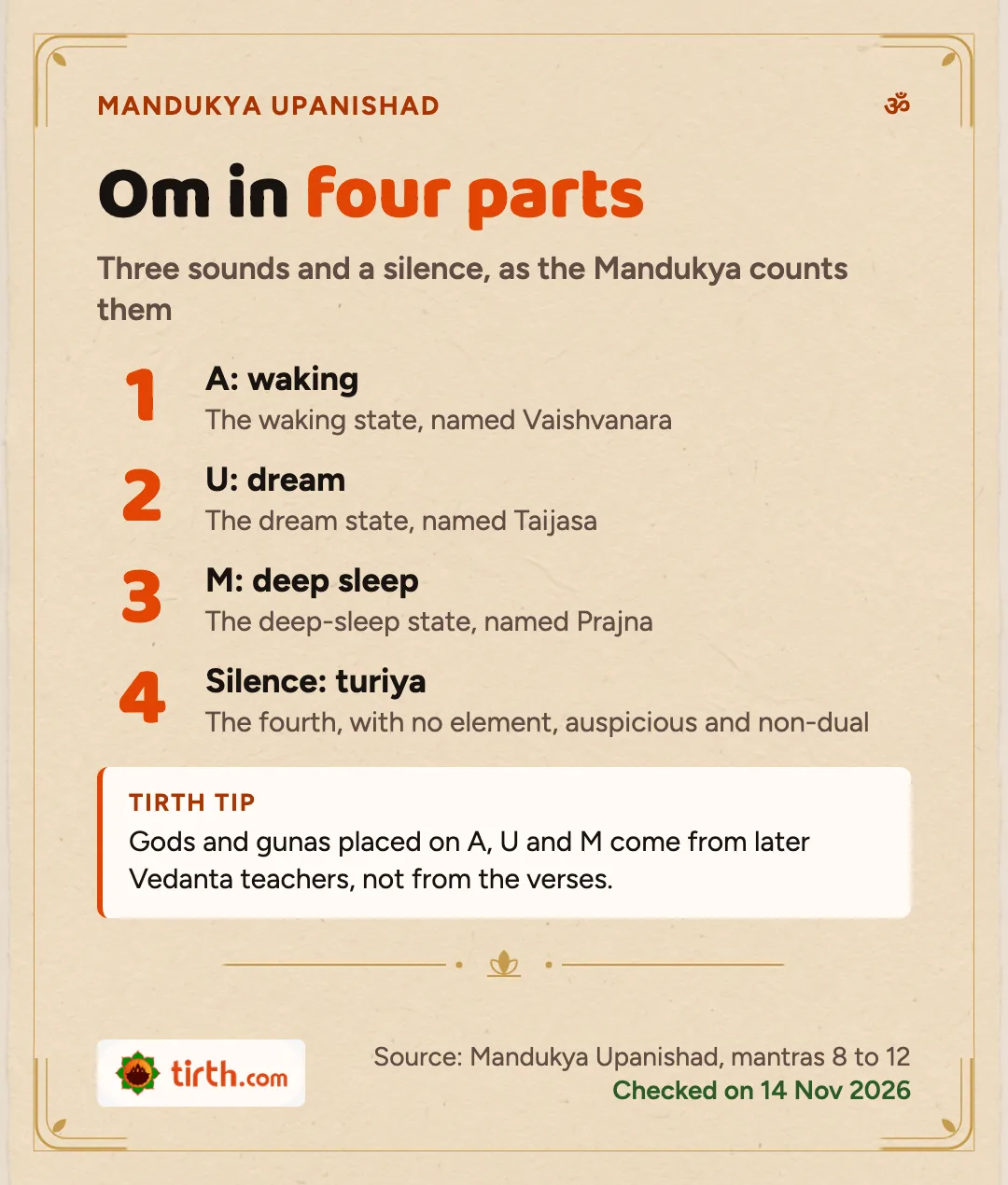
Later Vedanta gives U and M the names Hiranyagarbha and Ishvara, though the verses themselves say Taijasa and Prajna. See also the pages for Bhagwan Brahma, Deity page on Tirth , Bhagwan Vishnu, Deity page on Tirth and Bhagwan Shiva, Deity page on Tirth on Tirth.
Chanting Om: what the Gita and the Yoga Sutra say
Bhagavad Gita 8.13 is set at the last breath. Whoever leaves the body chanting the single syllable Om, which is Brahman, and remembering Bhagwan, reaches the supreme goal. Shankara reads Om as the name of Brahman, and devotional commentaries read the one remembered as Bhagwan Krishna.
Notice the two actions in the verse: chanting the syllable and remembering Bhagwan. The Sanskrit gloss gives vyaharan as uttering and anusmaran as remembering constantly, so the verse asks for sound and steady remembrance together.
The Yoga Sutra is more restrained. Its sutra 1.27 says the pranava, Om, is the word that names Ishvara, and 1.28 follows with what to do about it, which is to repeat it and dwell on its meaning. Two terms carry that, japa (repeated remembrance) and bhavana (dwelling on it with devotion). You may find artha and bhavana translated differently in different books, so small differences between them are normal.
The root of the word helps here. Vacaka, the term Patanjali uses, comes from the root vac, to speak, and means one who designates or expresses. Om is the sound that expresses Ishvara, and japa turns that into repeated remembrance with the meaning kept in mind.
The texts fix no number of times to chant it. Families keep 3, 7, 11, 21 or 108 by custom.
If you want to read on, the Journal has pages on the Gayatri Mantra, Om Namah Shivaya and the Maha Mrityunjay Mantra.
Aum, Om and ॐ: the spelling and the sign
Both spellings are in use. The Sanskrit sound rule attributed to Panini, 6.1.87, joins a short a and a following u into o, and that is the usual explanation for why Aum is written Om. The three sounds are still there in the older spelling.
The sign ॐ is a single character in Unicode, U+0950 DEVANAGARI OM, added in 1993, so it can be typed and shared the same way as any letter.
Om is not only a Hindu sign. Buddhists begin Om Mani Padme Hum with it, and Jain writing uses it in reference to the Panca-Paramesthi. Ik Onkar in Sikhism is a separate symbol and should not be mixed up with it.
Frequently asked questions
The Upanishads name it all this. Three sounds, A, U and M, then a silence, with Brahman linked to the whole. The Mandukya makes that claim in its first line.
The Mandukya gives waking, dream and deep sleep, in that order, and after them comes silence, the fourth part, turiya. Hiranyagarbha and Ishvara for U and M are later Vedanta names.
No. Buddhists start Om Mani Padme Hum with it, and in some Jain tradition it stands for the Panca-Paramesthi. Ik Onkar, from Sikhism, is something else.
Both are used. Under Sanskrit sound rules a short a followed by u joins as o, and this is the common reason Aum is written Om.
No text sets a number. Families keep 3, 7, 11, 21 or 108 as custom.
Turiya, the Mandukya’s fourth quarter. It has no element, speech cannot deal with it, and the text describes it as auspicious and non-dual.
Continue on Tirth
- Temples on Tirth, Temple page on Tirth: find a temple page and plan your visit.
- Pujas on Tirth, Pujas on Tirth: see the pujas you can book.
- The Gayatri Mantra: a Journal page on the mantra.