On this page10 sections
- What does the word jyotirlinga mean?
- What set Bhagwan Brahma and Bhagwan Vishnu against each other?
- How the column of fire appeared between them
- A boar down, a swan up, and no end in sight
- Truth praised, a false claim rebuked: what each was given
- What the story is trying to say
- Shivaratri: the name chapter 9 gives the day
- From one pillar to twelve shrines
- Frequently asked questions
- Continue on Tirth
- Sources and review
Jyotis means light, and linga a sign or an emblem. Over time the word has come to name both the fiery column in which Bhagwan Shiva, Deity page on Tirth revealed himself to Bhagwan Brahma, Deity page on Tirth and Bhagwan Vishnu, Deity page on Tirth, and the twelve shrines that carry it.
The story is built from a quarrel, a search that goes nowhere, a false claim and a flower. We keep to the Shiva Purana’s order and note what the text says and what it leaves out.
In short
Over time the word has come to name both the fiery column in which Bhagwan Shiva, Deity page on Tirth revealed himself to Bhagwan Brahma, Deity page on Tirth and Bhagwan Vishnu, Deity page on Tirth, and the twelve shrines that carry it.
What does the word jyotirlinga mean?
The standard Sanskrit dictionary, Monier-Williams, gives it as the “name of several linga temples”. In the German dictionary of Bohtlingk and Roth the entry is a proper name for temples of Bhagwan Shiva that contain a linga. Neither records anything beyond the shrine sense. Split into its two parts, though, the word reads as light and sign, and that reading points back to the legend’s pillar.
Why a linga at all? The Shiva Purana gives its answer in Vidyeshvara Samhita chapter 5, where Bhagwan Shiva is described as formless (nishkala) and as having form (sakala), worshipped in both ways. The linga marks the formless side. The same text says other deities lack a formless side.
Chapters 5, 7 and 9, which tell this story, never use the word jyotirlinga, speaking instead of a column of fire and, in chapter 9, of a linga.
What set Bhagwan Brahma and Bhagwan Vishnu against each other?
Chapter 6 of the Vidyeshvara Samhita bears the title “Battle between Brahma and Vishnu”. The two contend over which of them is supreme, and the contest of rank becomes a battle.
Why Bhagwan Shiva steps in was settled earlier, in chapter 5: he appears between the pair to humble their pride.
How the column of fire appeared between them
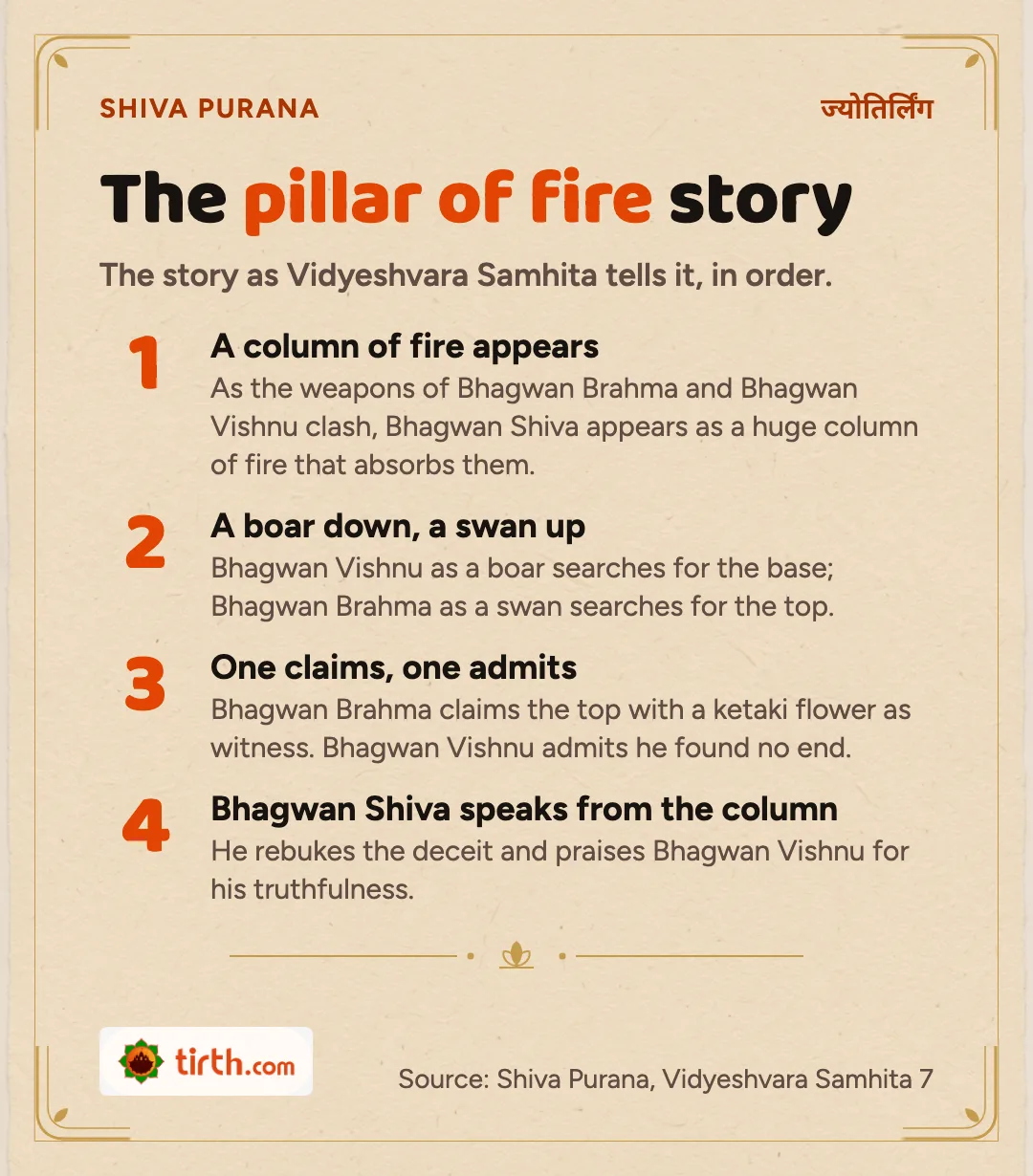
The action starts in chapter 7, verses 8 to 14, where Bhagwan Shiva disappears into the sky, and then, at the moment the divine weapons of Bhagwan Brahma and Bhagwan Vishnu clash, shows himself as a huge column of fire into which both weapons fall. The gods ask what it is.
A boar down, a swan up, and no end in sight
Bhagwan Vishnu turns into a boar and digs down to find the base, while Bhagwan Brahma turns into a swan and flies up to find the top. For how long? The text does not say. The “thousands of years” of popular retelling is not in it.
Bhagwan Vishnu cannot find the base.
In time he will say so plainly.
From above, a ketaki flower falls and Bhagwan Brahma sees it. He claims he reached the top and names the flower as his witness. The claim is false.
Truth praised, a false claim rebuked: what each was given
Bhagwan Vishnu’s own account is that the base had no end he could find. Bhagwan Brahma does not retreat from his claim, and in chapter 7 (verses 27 to 33) Bhagwan Vishnu accepts it and worships Bhagwan Brahma. Bhagwan Shiva then comes out of the column, rebukes the deceit and praises Bhagwan Vishnu for his truthfulness, granting him standing in the form of temples, images, festivals and worship.
Bhagwan Brahma’s price comes in chapter 8, titled “Shiva’s forgiveness of Brahma”. To settle it, Bhagwan Shiva creates Bhagwan Bhairava, who seizes the fifth head of Bhagwan Brahma by its tuft. Bhagwan Brahma is left trembling. Bhagwan Vishnu pleads that this was a first offence, and Bhagwan Shiva relents, stopping Bhagwan Bhairava.
Under the terms of the settlement Bhagwan Brahma receives no worship, temple or festival of his own, but presides over sacrifices. The ketaka (ketaki) flower gets a narrower place, barred from the worship of Bhagwan Shiva yet allowed on the canopy over his image and on his attendants.
(For puja at home, your family’s custom comes first, and your Pandit can advise.)
What the story is trying to say
The column exists, by the text’s own account, to humble pride, and Bhagwan Vishnu’s truthfulness is praised and rewarded, while Bhagwan Brahma’s deceit is rebuked. And the Bhagwan Shiva whom chapter 5 calls formless, with the linga as the sign of that side, takes in this story the shape of a column of fire.
What the text praises is truthfulness: Bhagwan Vishnu saying plainly that he found no end, while Bhagwan Brahma holds to his claim beside him.
Shivaratri: the name chapter 9 gives the day
Chapter 9 gives the event a day. In verse 10 Bhagwan Shiva names that day Shivaratri, and verse 12 describes fasting through day and night.
To read how the festival is kept, follow why Maha Shivaratri is kept; for the date in your city, open the Tirth Spiritual Calendar, Spiritual Calendar on Tirth.
From one pillar to twelve shrines
The Shiva Purana also gives a list of twelve jyotirlingas, in a section apart from these chapters. The sites for Vaidyanatha, Nageshvara and Bhimashankar are each claimed by more than one place.
To move from the story to the shrines, begin with Kashi Vishwanath or Somnath, or read the full list in the twelve jyotirlingas of India. For each temple’s own timings and rituals, use the Tirth temple pages, Temple page on Tirth.
Frequently asked questions
The word is made of jyotis (light, radiance) and linga (sign, emblem). It refers to the pillar of fire in which Bhagwan Shiva appeared between Bhagwan Brahma and Bhagwan Vishnu, and also to the twelve shrines that carry the name.
The Shiva Purana calls the linga the sign of formless Bhagwan Shiva, and describes him as worshipped both formless and with form. Chapters 5, 7 and 9, which tell the pillar story, never use the word jyotirlinga. The Sanskrit dictionaries give the word only as a name for linga temples.
Neither found it. Bhagwan Vishnu, in boar form, found no end of the base and said so. Bhagwan Brahma, in swan form, did not reach the top, yet claimed he had and called on a ketaki flower as witness.
After the false claim, says the Shiva Purana, Bhagwan Shiva ruled that Bhagwan Brahma would have no temple, festival or worship of his own. One role stays with Bhagwan Brahma: presiding over sacrifices.
The ketaki was the flower Bhagwan Brahma named as witness to his false claim. In chapter 8, in the same settlement that follows, the text bars the ketaka (ketaki) flower from the worship of Bhagwan Shiva. The canopy over his image may still carry it, and his attendants may wear it.
The Shiva Purana says twelve. Numbering differs between editions, and Vaidyanatha, Nageshvara and Bhimashankar are each claimed by more than one place.
Continue on Tirth
- Maha Shivaratri: how the festival night is kept today.
- The Tirth Spiritual Calendar, Spiritual Calendar on Tirth: the date of Maha Shivaratri for your city.
- Shiva mantras: what is chanted to Bhagwan Shiva, read at your own pace.
- Book a puja, Pujas on Tirth: one place to arrange worship of Bhagwan Shiva with a Pandit.