On this page7 sections
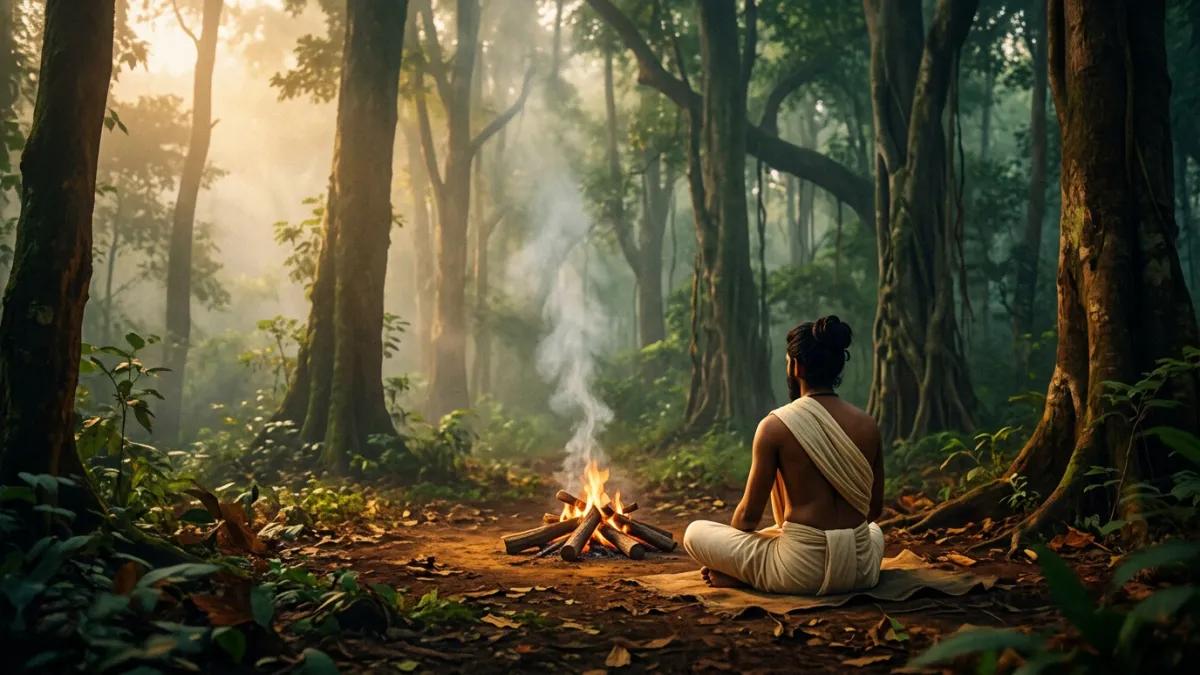
The Shiva Purana gives the longer one. Bhagwan Shiva had kept a long penance, and when he opened his eyes at its end, tears fell from lids that were still half-closed, and wherever those drops landed, rudraksha plants sprang up.
Split the word in two. Rudra is a name of Bhagwan Shiva, Deity page on Tirth , and aksha is the eye. In devotional speech people hear “Rudra’s tear” in it as well. So the bead was his long before anyone counted a face on it or asked what tree it came from.
There is a story behind the bead, and there is a tree. Three texts tell the story, each in its own way. The tree has a fruit, a stone and a botanical name, and it helps to know both before you hold a mala in your hand.
In short
Bhagwan Shiva had kept a long penance, and when he opened his eyes at its end, tears fell from lids that were still half-closed, and wherever those drops landed, rudraksha plants sprang up. Split the word in two. Rudra is a name of Bhagwan Shiva, Deity page on Tirth, and aksha is the eye.
How did Bhagwan Shiva’s tears turn into rudraksha?
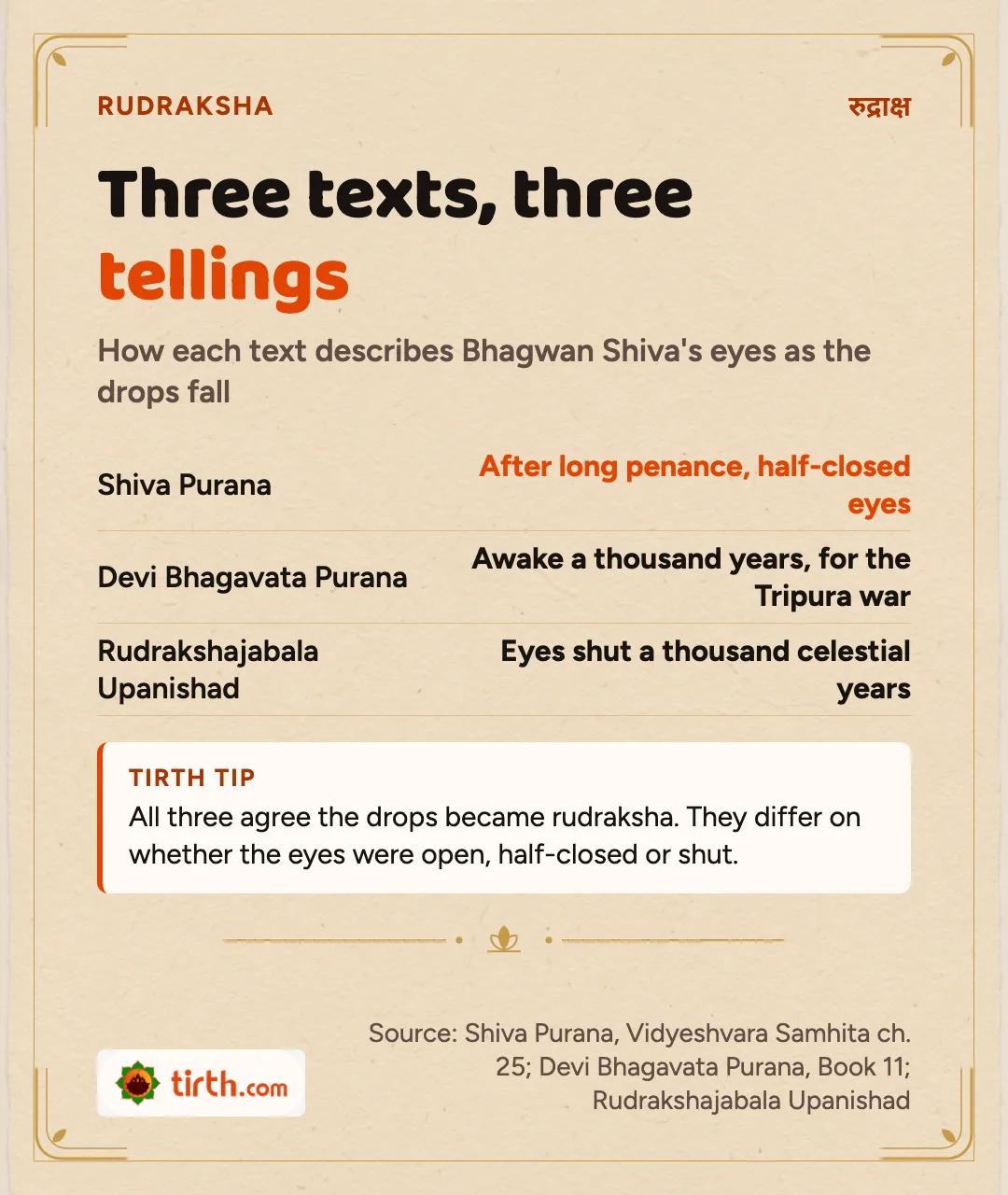
Three texts tell how the bead was born. Blend them and you lose the detail that sets them apart, the state of Bhagwan Shiva’s eyes when the drops fall, so read them one at a time.
The Shiva Purana lets Bhagwan Shiva tell it himself, in the Vidyeshvara Samhita, chapter 25. A long penance first. Then his eyes opened, the tears came from half-closed lids, and from those tears the rudraksha plants grew.
Book 11 of the Devi Bhagavata Purana sets the scene in a war instead. The gods had come to Rudra with a request, that he destroy the asura Tripura. For a thousand years he stayed awake, his mind on the Aghora weapon, and drops of water came from his eyes. From them sprang the great rudraksha tree.
Then there is the Rudrakshajabala Upanishad, a Shaiva Upanishad counted with the Sama Veda. Here it is Kalagni Rudra who teaches the sages about the bead. The Tripura setting stays. The eyes close, though. Kalagni Rudra kept them shut for a thousand celestial years to destroy the Tripura asuras, and the drops that fell from those closed eyes became rudrakshas.
| Text | What is happening | His eyes | What grows |
|---|---|---|---|
| Shiva Purana, Vidyeshvara Samhita ch. 25 | A long penance ends | Opening, still half-closed | Rudraksha plants |
| Devi Bhagavata Purana, Book 11 | A thousand years awake before the war on Tripura | Awake | The great rudraksha tree |
| Rudrakshajabala Upanishad | A thousand celestial years to destroy the Tripura asuras | Closed | Rudrakshas |
The third column is where they part company. In every one of them, though, drops come from his eyes and something grows where they fall.
If you keep a Shivling at home, that form has its own story, in what the Shivling means in the Puranas.
Which of Bhagwan Shiva’s eyes gave which colour of bead?
The Devi Bhagavata takes the story one step on. Bhagwan Shiva has three eyes. In Book 11 each of them gives its own beads.
From the right eye, the eye of the sun, came 12 yellow varieties, which the text calls pingala. The left eye is the moon’s. Its tears gave 16 white ones. The third eye, the eye of fire, gave 10 black.
In this Purana, then, the colour of a bead is traced to one of his three eyes.
Look for a face-by-face list of deities in the Devi Bhagavata and you will not find one. It names no deity for any count of faces. What it does single out are the 1, 5, 11 and 14 faced beads, as especially honoured, and that leaves the face lists to the Shiva Purana and the Upanishad.
The rudraksha tree and the stone inside its fruit
The familiar name for the tree is Elaeocarpus ganitrus. The accepted botanical name today is Elaeocarpus angustifolius, with ganitrus kept on as a synonym.
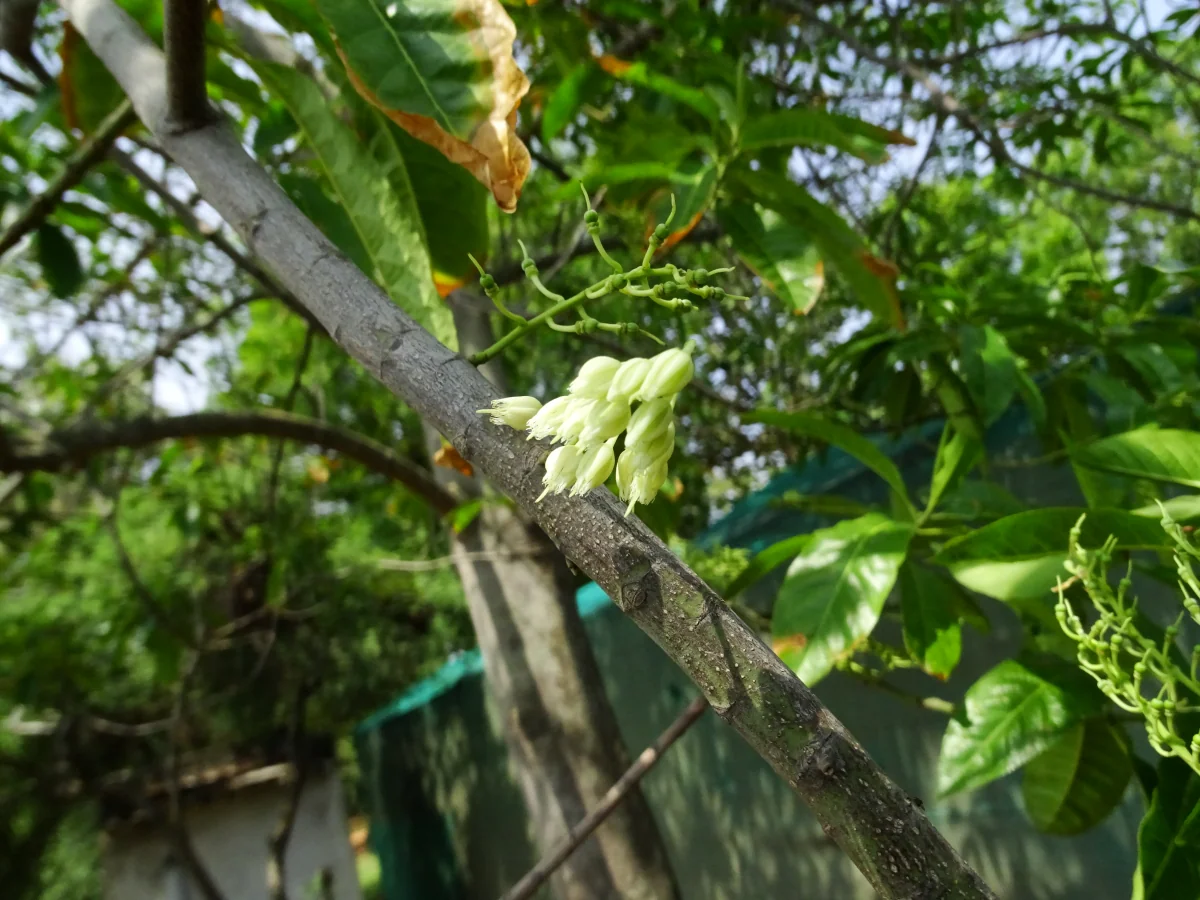
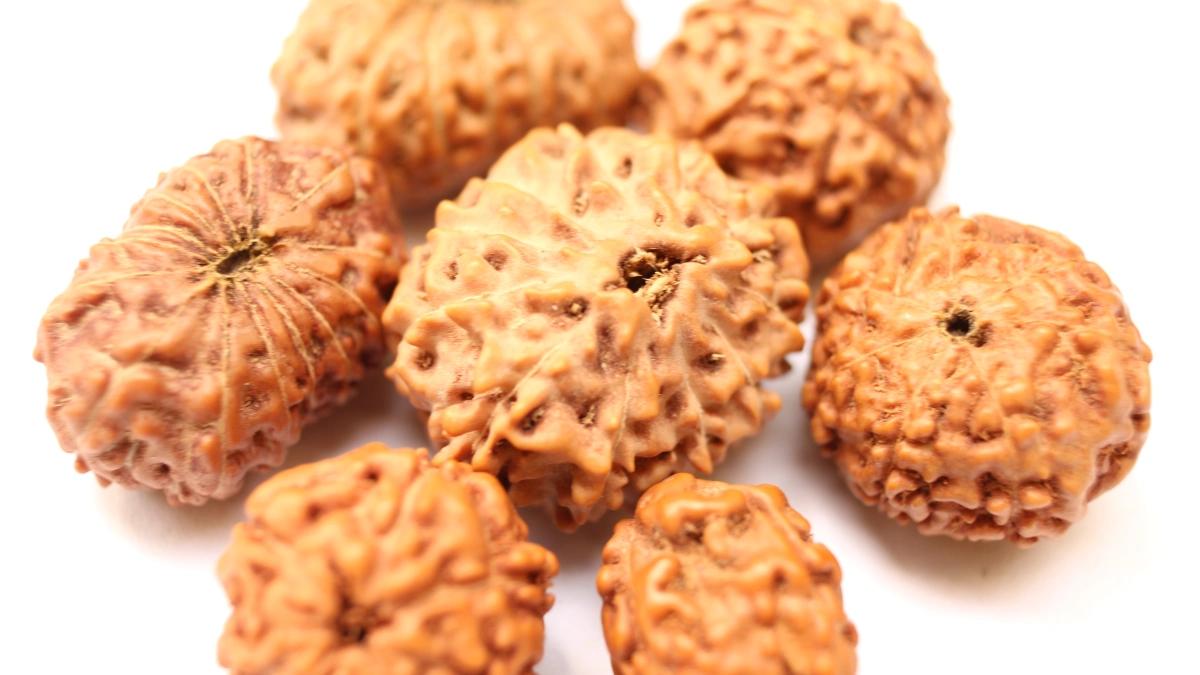
The fruit ripens into a bright blue drupe about 15 to 23 mm across. There is no pigment behind that blue. It is structural colour, a matter of how the surface is built. Take off the flesh, clean the stone underneath, and what is left in your hand is the bead.
The grooves along its length are its faces. They are called mukhi, from mukha (face), and they are natural to the stone.
Rudraksha faces 1 to 14, text by text
Only two of the three texts tie each count of faces to a deity or a principle. One is the Shiva Purana, again in Vidyeshvara Samhita chapter 25. The other is the Rudrakshajabala Upanishad. They agree on a few, 4 faces for Bhagwan Brahma among them, and go separate ways on most of the rest. Our one piece of advice is to read each column under its own text’s name, because a merged list ends up crediting one text with what only the other says.
| Faces (mukhi) | Shiva Purana, Vidyeshvara Samhita ch. 25 | Rudrakshajabala Upanishad |
|---|---|---|
| 1 | Bhagwan Shiva himself | The Supreme Truth (Brahman), no deity named |
| 2 | Isha, ruler of the devas | Ardhanarishvara |
| 3 | No named deity | The three fires |
| 4 | Bhagwan Brahma himself | Four-faced Bhagwan Brahma |
| 5 | Rudra himself, called Kalagni | Panchabrahman |
| 6 | Bhagwan Kartikeya | Bhagwan Kartikeya or Bhagwan Ganesh |
| 7 | Ananga | The seven Matras |
| 8 | Vasumurti and Bhagwan Bhairava | The eight Vasus, or eightfold Nature |
| 9 | Bhagwan Bhairava, with the nine-formed Maa Durga presiding and the sage Kapila | The Nava-Shaktis |
| 10 | Janardana (Bhagwan Vishnu) | The ten Yamas |
| 11 | Rudra | The eleven Rudras |
| 12 | The twelve Adityas | Mahavishnu (Bhagwan Vishnu) or the twelve Adityas |
| 13 | The Vishvedevas | Kama Dev |
| 14 | Bhagwan Shiva, called “the highest Shiva” | Rudra, born of his eyes |
Read across the rows and the two texts meet fully only at 4 faces, while at 6 and 12 they share a name (Bhagwan Kartikeya, the Adityas) and the Upanishad adds a second one.
How the three texts wear 108 rudraksha beads
The number 108 comes up in each of the three texts, and every time it is about how the beads are worn.
The Shiva Purana, in chapter 25, goes through many arrangements. A full wear of 1,100 beads. Another of 1,000. A string of 108 on the chest, or three strings worn the way the sacred thread is worn. It even has a single bead for the tuft of hair. A meru bead is not named anywhere in it.
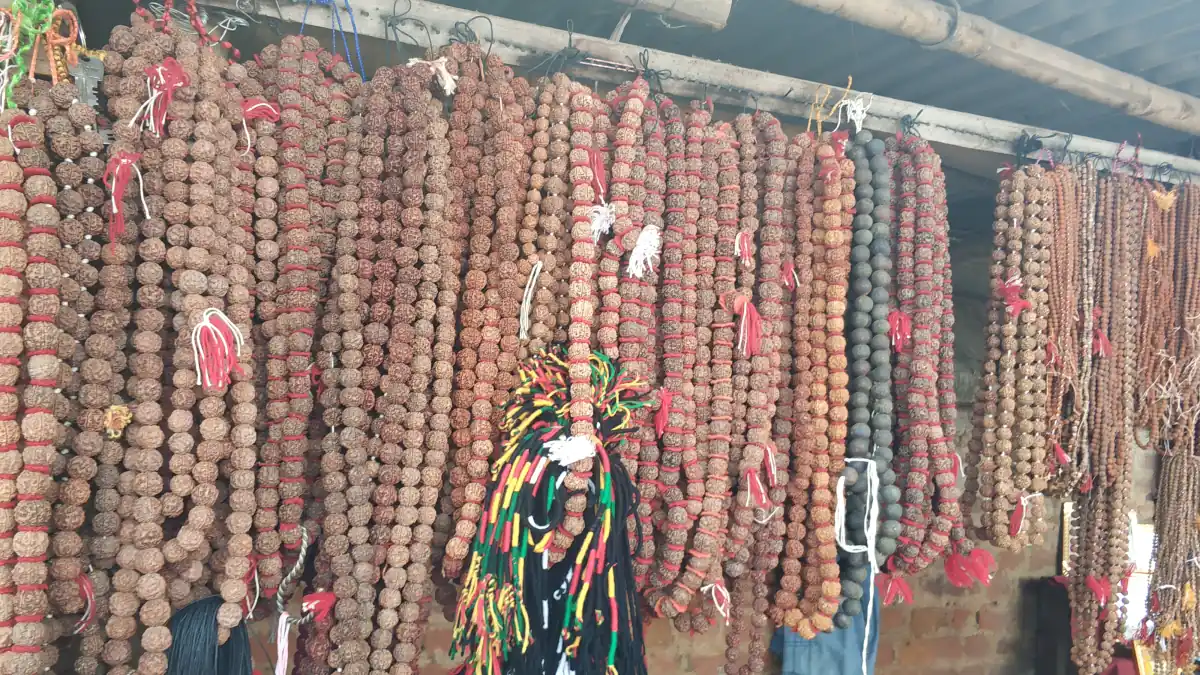
In Book 11 of the Devi Bhagavata, wearing 1,000 rudrakshas is a great vow. Not everyone can gather that many, and for them the text gives a smaller placement, with 108 on the breast. For a japa (repeating a holy name) rosary it gives no bead count at all.
The Upanishad has its own figures. A sacred thread of 108 beads, and elsewhere 36 round the neck and 16 round each arm.
For Tulsi, the other sacred plant of the Hindu home, read Tulsi meaning: Vrinda and the Shaligram, and for the wider tradition these symbols belong to, see what Sanatan Dharma means in the texts.
Text references checked against translations of the Shiva Purana, the Devi Bhagavata and the Rudrakshajabala Upanishad, November 2026.
Frequently asked questions
It means “the eye of Rudra”, from Rudra, a name of Bhagwan Shiva, and aksha, the eye. Devotional speech also calls it “Rudra’s tear”.
It is the stone, the hard pit from inside a bright blue fruit, cleaned of its flesh. The tree is Elaeocarpus ganitrus, a name botanists have now replaced with Elaeocarpus angustifolius.
Each mukhi is one of the natural grooves along the stone. The Rudrakshajabala Upanishad gives a deity or principle for each of 1 to 14 faces, and the Shiva Purana does the same for every face except the 3-faced bead, where it names none. The two lists differ, so read each one under the name of its own text.
All three, the Shiva Purana, the Devi Bhagavata and the Rudrakshajabala Upanishad, speak of wearing 108 beads. No meru bead comes up in the Shiva Purana chapter on rudraksha.
A 5 mukhi is one stone with five faces. The Shiva Purana gives it to Rudra himself, called Kalagni, and the Upanishad to Panchabrahman. Gauri Shankar appears in none of the three, the Shiva Purana, the Devi Bhagavata or the Rudrakshajabala Upanishad, so these texts give it no meaning.
Continue on Tirth
- Bhagwan Shiva, Deity page on Tirth, the Tirth page for the deity the bead is named after.
- Rudrabhishek puja at a Varanasi ghat, booked through Tirth.
- Maha Mrityunjay Jaap in Ujjain, a japa puja to Bhagwan Shiva you can book on Tirth.
- Jyotirlinga meaning: the pillar of light, another Journal story of how Bhagwan Shiva is worshipped.
- 5 Mukhi Rudraksha from Nepal on Tirth Shop.
- Gauri Shankar Rudraksha from Java on Tirth Shop.