There are certain sounds ancient, thunderous, healing that never lose their strength no matter how many centuries pass. The Maha Rudrabhishek is one such moment of sound and surrender.
It’s not just a ritual; it’s one of the most powerful ways to connect with Lord Shiva, the cosmic destroyer of negativity and the eternal stillness at the heart of all movement. When the chants begin, when the milk and honey flow over the Shiva Lingam, when the air thickens with “Om Namah Shivaya,” something indescribable happens the atmosphere itself seems to breathe.
Maha Rudrabhishek Mantra
Om Namah ShivayaMeaning:
Salutations to Lord Shiva the pure, infinite consciousness beyond birth and death.
This simple mantra, repeated through every stage of the Rudrabhishek, anchors the ritual in devotion. Every “Om” feels like the universe bowing; every “Namah Shivaya” sounds like the soul remembering where it belongs.
What is Maha Rudrabhishek?
The word Rudrabhishek combines two Sanskrit roots Rudra (a fierce, benevolent aspect of Shiva) and Abhishek (an offering or ceremonial bathing). So, Maha Rudrabhishek means the great bathing ceremony of Shiva.
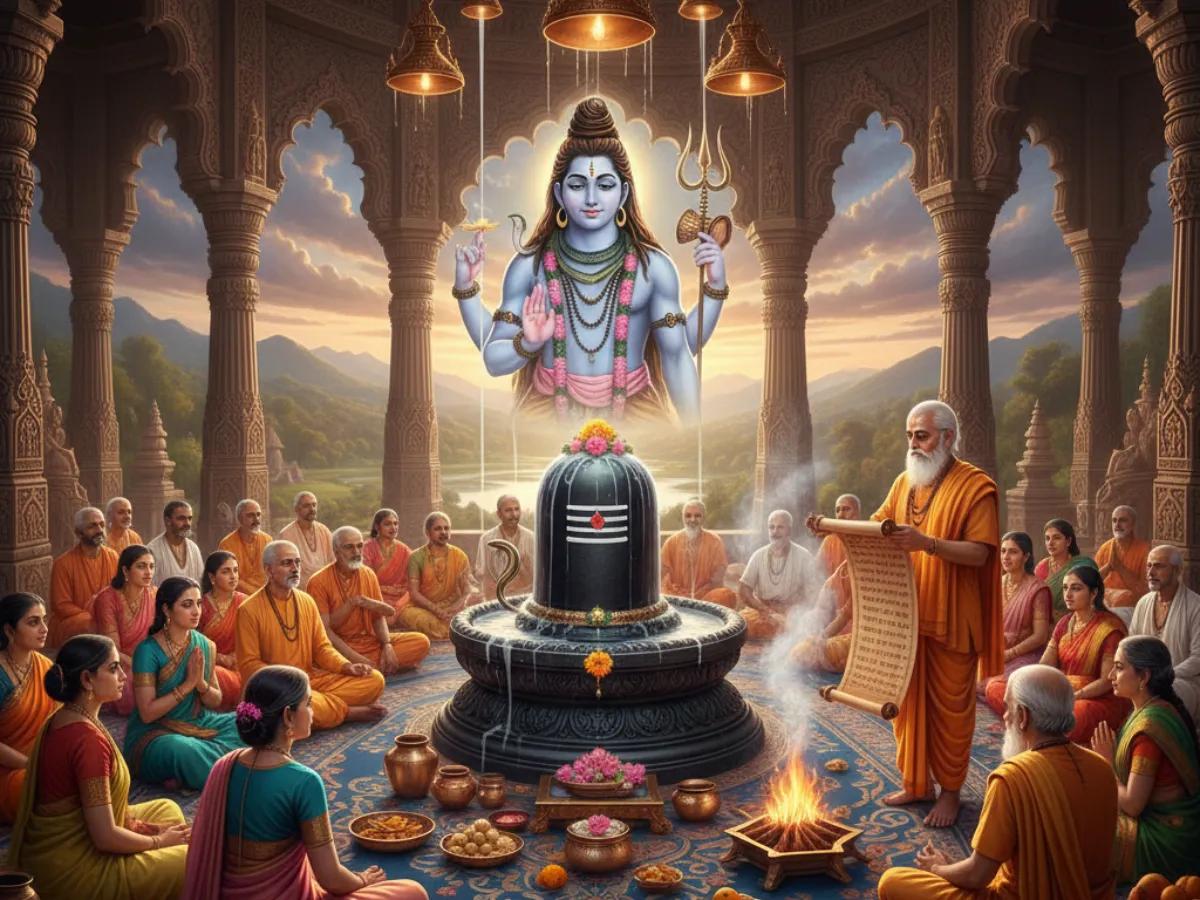
It’s one of the most auspicious and transformative Vedic rituals. The Shiva Lingam symbol of the infinite is anointed with water, milk, curd, honey, ghee, sugar, and sacred herbs, each poured with a specific mantra.
Every element you offer carries meaning: Milk for purity, honey for sweetness in speech, ghee for spiritual power, Gangajal for cosmic cleansing.
And all throughout, the soundscape of Shiva’s name vibrates through the room like steady rain on dry earth.
How the Maha Rudrabhishek Puja is Performed
Before You Begin
Pick a quiet, clean place ideally a temple or a sanctified space at home. You’ll need:
- Fresh milk, curd, ghee, honey, sugar
- Flowers, fruits, sandalwood, betel leaves, incense
- Copper or brass pot (for offering and pouring)
- Gangajal (holy water)
- And a patient, open heart.
During the Puja
- Place the Shiva Lingam in a silver, copper, or stone vessel.
- Sprinkle Gangajal to purify the space.
- Invoke Lord Shiva, saying:
Om Namah Shivayaagain and again, until you feel the calm settle in. - Begin the Abhishek bathe the Lingam slowly with each substance while reciting its mantra.
- Milk for peace.
- Yogurt for prosperity.
- Honey for sweetness and harmony.
- Ghee for strength.
- Sugar for happiness.
- Offer flowers, lamps, incense, and fruits.
- Chant sacred verses Rudrashtadhyayi, the Maha Mrityunjaya Mantra, or the Shiva Tandav Stotra each calling forth a different vibration of divine strength.
- End with an Aarti and share prasad, sealing the act of offering with gratitude.
The Sacred Materials of Maha Rudrabhishek
For the Shiva Lingam:
- Lingam of stone, mercury, or crystal
- A copper or brass vessel (Abhishek Patra)
- A Kalash filled with sanctified water
For Abhishek:
- Milk, curd, ghee, honey, and sugar
- Bilva leaves, Jasmine, Datura
- Fruits like banana, apple, and grapes
- Sandalwood paste and vermilion (kumkum)
- Rudraksha or Tulsi mala for mantra repetitions
Each item has symbolic weight together they represent earth, water, fire, air, and ether the five elements returning to their source.
The Spiritual Meaning
Maha Rudrabhishek isn’t done for Shiva. It’s done through him a ritual that reflects cleansing inside and out. As water flows over the Lingam, so do our impurities and karmic residues wash away. As the fire of incense rises, so does intention. It’s less a ritual of worship and more a state of humility: a soul remembering its place before the infinite.
When and Why to Perform the Ritual
The most auspicious times are:
- Mondays – the day devoted to Lord Shiva
- Maha Shivaratri – the night when creation pauses
- Shravan month – when Shiva’s energy fills the air
It can also be performed on occasions like birthdays, anniversaries, or to overcome specific difficulties illness, karmic blocks, or emotional heaviness.
In some temples and households, the ritual lasts eleven days, with eleven priests chanting continuously a sound current that never drops. The energy builds, echoing through body and spirit like a sacred drumbeat.
Benefits of Performing Maha Rudrabhishek
- Invokes Shiva’s grace, bringing peace and protection
- Cleanses negativity and resolves planetary afflictions (graha doshas)
- Removes financial difficulties and stabilizes family life
- Promotes health, clarity, and deep inner balance
- Strengthens spiritual resolve and awakens higher awareness
- Brings rainfall, prosperity, harmony, and fulfillment
Each element used in the Abhishek connects to a blessing:
- Water: purification
- Milk: long life and knowledge
- Honey: sweetness and joy
- Ghee: strength
- Sugar: contentment
- Bilva leaves: surrender and devotion
The Inner Offering
To perform Rudrabhishek properly is to bow beyond the spoken prayer. When the hands pour milk and the mouth chants “Om Namah Shivaya,” the heart too begins to cleanse itself. Shiva doesn’t need flowers or ghee what he accepts most quietly is sincerity.
The ritual ends outwardly with fire and aarti, but inwardly, something new begins a stillness, a spaciousness, a kind of strength that doesn’t shout.
That is the real Rudrabhishek not the pouring of liquids, but the emptying of ego.
In truth, when you chant “Om Namah Shivaya,” you’re not asking Shiva to come closer. You’re simply waking up to the fact that he was never far. He was the sound inside you all along.
Invoke Lord Shiva’s highest grace through Maha Rudrabhishek. Perform authentic Rudrabhishek and Shiva puja with Tirth.com.