On this page7 sections
- Pancha and anga: the five limbs, and what each one counts
- Sunday, 29 November 2026 in Delhi, read limb by limb
- Shashthi’s 21 hours 49 minutes, and the two karanas cut from it
- Pushya gone at 10:59 AM, Brahma yoga at 5:08 PM
- Setting the panchang to your city before a home puja
- Frequently asked questions
- Continue on Tirth
- Sources and review
Put plainly, it is the Hindu almanac, a page that reads one day through five limbs: the tithi (lunar day), the vara (weekday), the nakshatra (the Moon’s star mansion), the yoga and the karana, each with the time it begins and ends.
Take Delhi at sunrise on Sunday, 29 November 2026. Shashthi, Pushya, Brahma and Gara are the four moving readings on the page, and three of them have changed by sunset, while the vara holds all day.
Think of the page as five clocks, wound by the Sun and the Moon, each keeping its own pace. Learn to follow one real day on all five, and any other day in the year opens up the same way.
In short
Take Delhi at sunrise on Sunday, 29 November 2026. Shashthi, Pushya, Brahma and Gara are the four moving readings on the page, and three of them have changed by sunset, while the vara holds all day. Think of the page as five clocks, wound by the Sun and the Moon, each keeping its own pace.
Pancha and anga: the five limbs, and what each one counts
In Sanskrit, pancha is five and anga is limb. In its fuller form, panchangam, the word names the almanac that sets out those five limbs for a day.
| Limb | What it measures | How many |
|---|---|---|
| Tithi | The time the Moon takes to gain 12 degrees on the Sun | 30 in a lunar month, 15 in each paksha |
| Vara | The weekday, counted from sunrise to the next sunrise | 7 |
| Nakshatra | The Moon’s place among 27 mansions of 13 degrees 20 minutes each | 27 |
| Yoga | The Sun’s and Moon’s longitudes added together, cut into spans of 13 degrees 20 minutes | 27 |
| Karana | Half a tithi, the time the Moon gains 6 degrees on the Sun | 60 positions in a month |
Four of these are read off the sky, while the vara is a plain cycle of seven days, the quiet limb on any panchang page.
One more thing before the real day. A panchang is worked out for a place, so its times belong to a single city, and the times that follow are all for New Delhi, from the Tirth Spiritual Calendar.
Sunday, 29 November 2026 in Delhi, read limb by limb
The Sun comes up over Delhi at 6:54 AM that morning and goes down at 5:24 PM. It is Krishna paksha, and the month takes one of two names depending on how your family counts: Margashirsha if months run to the full moon (Purnimanta), Kartika if they run to the new moon (Amanta).
Here is how the day sits, one limb to a row. Times for New Delhi from the Tirth Spiritual Calendar.
| Limb | At sunrise, 6:54 AM | Changes at | What comes next |
|---|---|---|---|
| Tithi | Krishna Shashthi (21st of 30) | 1:45 AM, 30 November | Saptami, to 12:11 AM on 1 December |
| Vara | Ravivara (Sunday) | Monday’s sunrise | Somavara (Monday) |
| Nakshatra | Pushya (8th of 27) | 10:59 AM | Ashlesha, to 9:42 AM on 30 November |
| Yoga | Brahma (25th of 27) | 5:08 PM | Indra, to 2:27 PM on 30 November |
| Karana | Gara (41st of 60) | 2:46 PM | Vanija, to 1:45 AM; then Vishti, to 12:53 PM on 30 November |
In the third column, Pushya gives way to Ashlesha first, at 10:59 AM. The karana turns over at 2:46 PM, and Brahma yoga passes to Indra yoga at 5:08 PM, a mere sixteen minutes before the Sun goes down, while the tithi outlasts the lot of them and carries on until 1:45 AM.
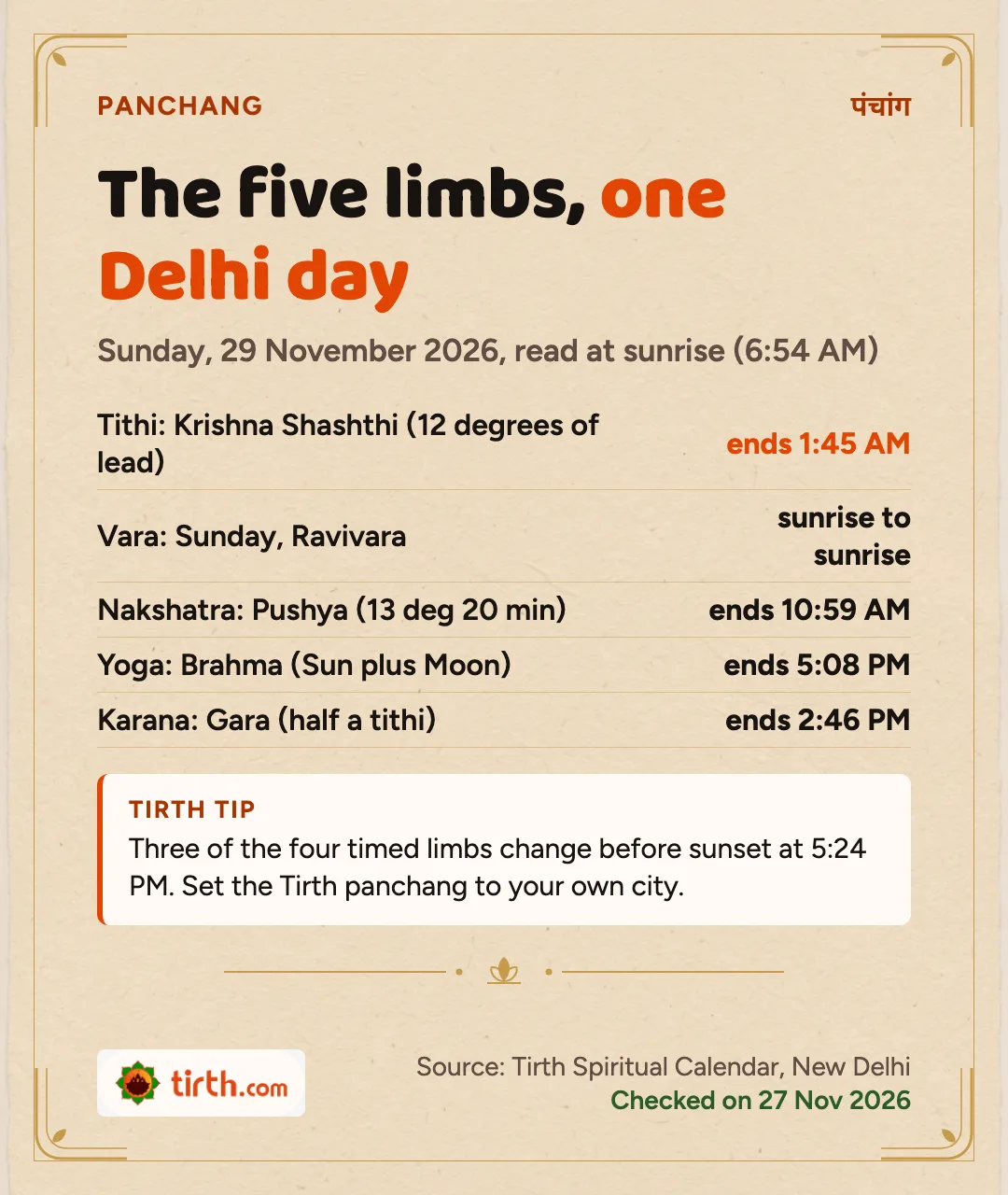
None of the spans that day runs to a full 24 hours. Shashthi lasts 21 hours 49 minutes and Pushya 22 hours 9 minutes. Brahma yoga gets 20 hours 50 minutes. Gara and Vanija, the two karanas, come in at 10 hours 50 minutes and 10 hours 59 minutes.
Ravivara alone holds steady: whatever the other four are up to, Sunday sunrise to Monday sunrise belongs to Surya Dev (the panchang day begins at sunrise, never at midnight).
Shashthi’s 21 hours 49 minutes, and the two karanas cut from it
Two of the limbs, the tithi and the karana, are measured with the same ruler, the distance between the Moon and the Sun. A tithi is the time it takes the Moon to get 12 degrees further ahead.
Krishna Shashthi is the 21st tithi of the month. It is the stretch in which the Moon is 240 to 252 degrees ahead of the Sun. On this Sunday the Moon crosses into it at 3:56 AM, while the city is still asleep, and crosses out again at 1:45 AM on Monday, so this time those 12 degrees take 21 hours 49 minutes.
A karana is half a tithi, 6 degrees of the gap, so Shashthi splits cleanly in two, and each half carries a name of its own. Its first 6 degrees go to Gara, its second 6 to Vanija, karanas number 41st and 42nd of the 60 karana positions in a month (some printed panchangs spell the first one Garaja). Gara begins with the tithi at 3:56 AM and is done by 2:46 PM. Vanija ends at 1:45 AM, on the same minute as Shashthi.
Eleven karana names are in use: Bava, Balava, Kaulava, Taitila, Gara, Vanija, Vishti, Shakuni, Chatushpada, Naga and Kimstughna. If the lunar day is what you came for, read what a tithi is and how it is counted, and for the moonless day there is what Amavasya is.
Pushya gone at 10:59 AM, Brahma yoga at 5:08 PM
The nakshatra and the yoga are read against the stars rather than the gap between Moon and Sun, and the nakshatra is simply the Moon’s place among them. Measured on the sidereal (star-fixed) zodiac, the Moon’s sky is split into 27 mansions of 13 degrees 20 minutes each, and Pushya, the 8th, covers 93 degrees 20 minutes to 106 degrees 40 minutes. At 10:59 AM on Sunday the Moon passes its far edge into Ashlesha, the 9th. It stays there until 9:42 AM on Monday.
A separate post covers the Moon’s 27 mansions in detail, and another covers what Abhijit nakshatra means.
To someone opening a panchang for the first time, the yoga looks the strangest of the five. Underneath, it is a sum. Take the Sun’s sidereal longitude, put the Moon’s on top of it, then chop the total into 27 spans of 13 degrees 20 minutes; the span you land in names the yoga. For Brahma, the 25th, that total sits between 320 degrees and 333 degrees 20 minutes. Indra is next, the 26th, in force from 5:08 PM on Sunday to 2:27 PM on Monday.
The nakshatra and yoga are read on the star-fixed zodiac. The vara needs no sky at all.
Setting the panchang to your city before a home puja
Every time above is New Delhi’s. Live in Mumbai, Kolkata or Chennai and the readings tied to sunrise (when the day starts, which tithi counts as “the tithi of the day”) will shift, so open the Tirth panchang, Panchang on Tirth and set your own city before you plan anything.
Then go through it in this order.
- Sunrise time and vara come first, because that is where the panchang day begins.
- After that, the tithi with its end time, plus the paksha and whichever of the two month names your family goes by.
- Finally the three moving limbs, nakshatra, yoga and karana, each with an end time (mark any that change during the hours you need).
For a small puja at home, we would go by the limb in force at the hour you have chosen, and not by the label printed against sunrise. The reason is in this very Sunday. Pushya nakshatra was available that day only until 10:59 AM. Plan the puja for the afternoon and it would really fall in Ashlesha, though the heading for the morning still says Pushya.
And when a Pandit is fixing a muhurat for you, it is fair to ask two things before booking: which limb is being read, and for which city.
Frequently asked questions
The Hindu almanac. Give it a day and a place, and it lists the tithi, vara, nakshatra, yoga and karana, along with the time each of them starts and ends.
Vara is simply the weekday, while the tithi, the lunar day, is 12 degrees of the Moon’s lead over the Sun. The nakshatra places the Moon among 27 mansions. The yoga adds the Sun’s and Moon’s longitudes together and reads the total in 27 spans. And a karana is half a tithi.
Pick your city first and note its sunrise time, since the panchang day starts at sunrise; after that, go limb by limb with each end time. Delhi’s Sunday, 29 November 2026 is a good test: nakshatra change at 10:59 AM, karana at 2:46 PM, yoga at 5:08 PM.
Its length is set by the Moon gaining 12 degrees on the Sun, and tithis are not all the same length. Krishna Shashthi, for one, took 21 hours 49 minutes in Delhi on 29 November 2026. Our tithi post explains how a tithi is counted.
One measures the gap between the Moon and the Sun; the other measures where the Moon stands among 27 star mansions. So they change at different times. On 29 November 2026, Pushya was over at 10:59 AM, and Shashthi held on until 1:45 AM.
Because a panchang is worked out for a place. Sunrise comes at a different time in each city, and the panchang day begins at sunrise, so the readings tied to it move as well. Set the Tirth panchang to the city you live in.
Continue on Tirth
- Tirth panchang, Panchang on Tirth: today’s five limbs for your own city, with every start and end time.
- Abhijit Muhurat: what this daily muhurat is and how a panchang lists it.
- Ekadashi: what the day is and how it is kept.