On this page7 sections
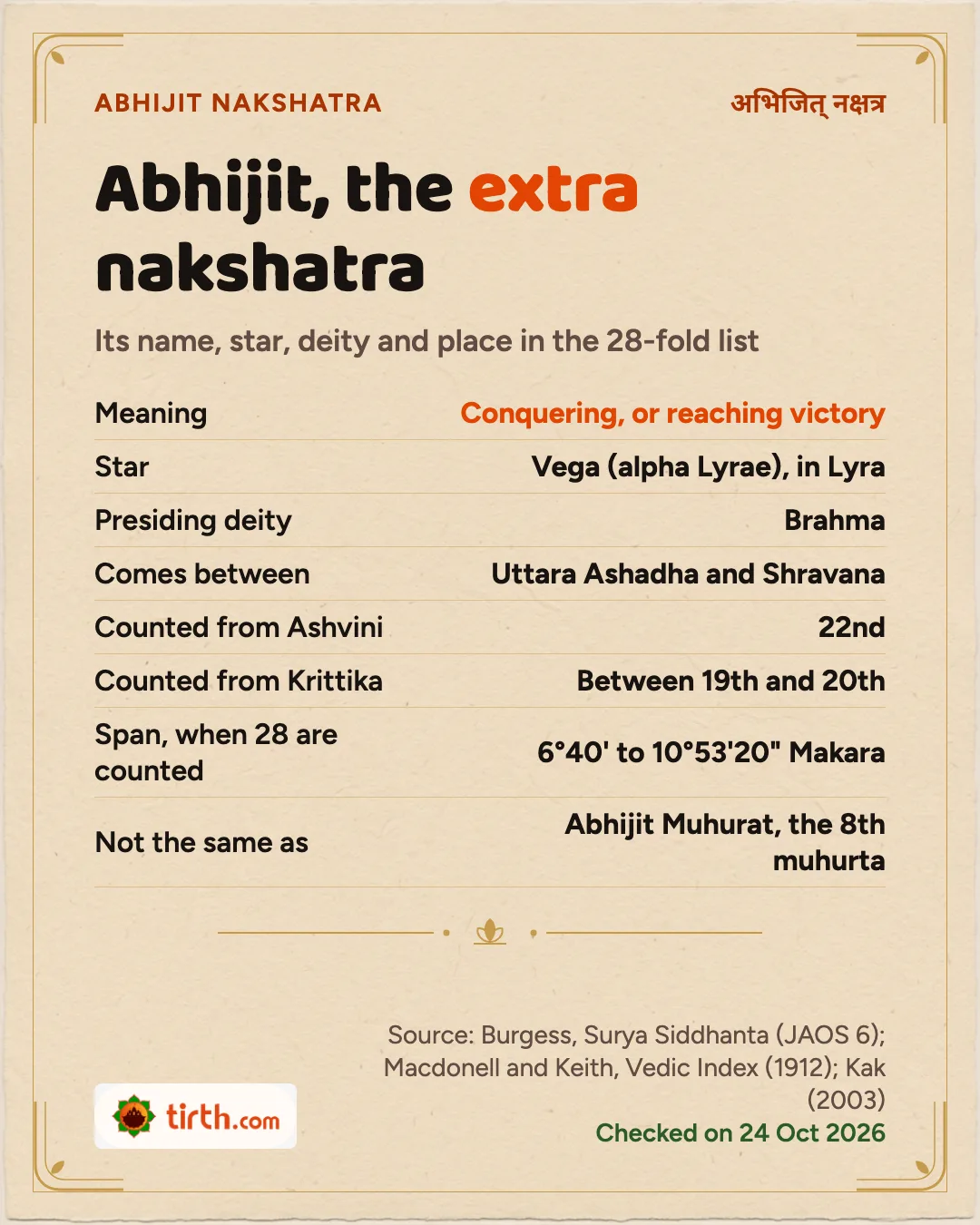
She is Abhijit, whose name scholars gloss as “conquering” or “reaching victory”, and the Abhijit nakshatra (lunar mansion) is the extra one between Uttara Ashadha and Shravana, with Vega as its star and Brahma as its deity.
Most of the Abhijit nakshatra meaning comes down to counting. The Atharvaveda counts 28 nakshatras and names Abhijit among them. The Surya Siddhanta cuts the ecliptic into 27 equal portions instead, and Abhijit is the one left without a share.
Which is where the label “the 28th nakshatra” comes from, and the 28 in it counts how many members the longer list has, not the place Abhijit holds among them.
| Abhijit at a glance | What the sources say |
|---|---|
| Meaning of the name | “Conquering” (Burgess) or “reaching victory” (Kak) |
| Star | Vega (alpha Lyrae), with two fainter companions in Lyra |
| Presiding deity | Brahma |
| Place in the 28-fold list | Between Uttara Ashadha and Shravana: 22nd counted from Ashvini, between the 19th and 20th counted from Krittika |
| Counted in | Atharvaveda 19.7 and Maitrayani Samhita 2.13.20 (28 nakshatras) |
| Left out of | Taittiriya Samhita 4.4.10, the Vedanga Jyotisha, and the 27 equal portions of the Surya Siddhanta |
In short
Most of the Abhijit nakshatra meaning comes down to counting. The Atharvaveda counts 28 nakshatras and names Abhijit among them. The Surya Siddhanta cuts the ecliptic into 27 equal portions instead, and Abhijit is the one left without a share.
What does the name Abhijit mean, and is it really 28th?
The two glosses come from two scholars. In Burgess’s Surya Siddhanta it comes out as “conquering”. For Subhash Kak it is “reaching victory”, with the name marking a satisfactory completion of the nakshatra system as a whole.
Then there is the number. In the 28-fold series Abhijit sits between Uttara Ashadha and Shravana, which makes it 22nd if you start counting from Ashvini, as Burgess does. The earliest Vedic lists open with Krittika (the Pleiades) instead. Counted their way, it falls between the 19th and the 20th. Lists headed by Ashvini are much later, from about the sixth century CE by Kak’s account. So the “28th” only flags the extra member.
If you write about Abhijit, call it “the extra 28th nakshatra”. A reader who meets a bare “28th” goes looking at the bottom of the list. Abhijit is never there.
Its star is Vega (alpha Lyrae), bright enough that Burgess counts only one or two stars in the whole sky that outshine it. Macdonell and Keith’s Vedic Index (1912) has Abhijit as “the brilliant star α Lyrae with its two companions”. Two fainter companions in Lyra, with Vega out in front.
Brahma presides over it. Burgess’s word for the role is “regent”, and Kak’s list names the same deity, Bhagwan Brahma, Deity page on Tirth . (Prayers to him are collected on the Brahma Mantra page.)
Do the Vedas count 27 or 28 nakshatras?
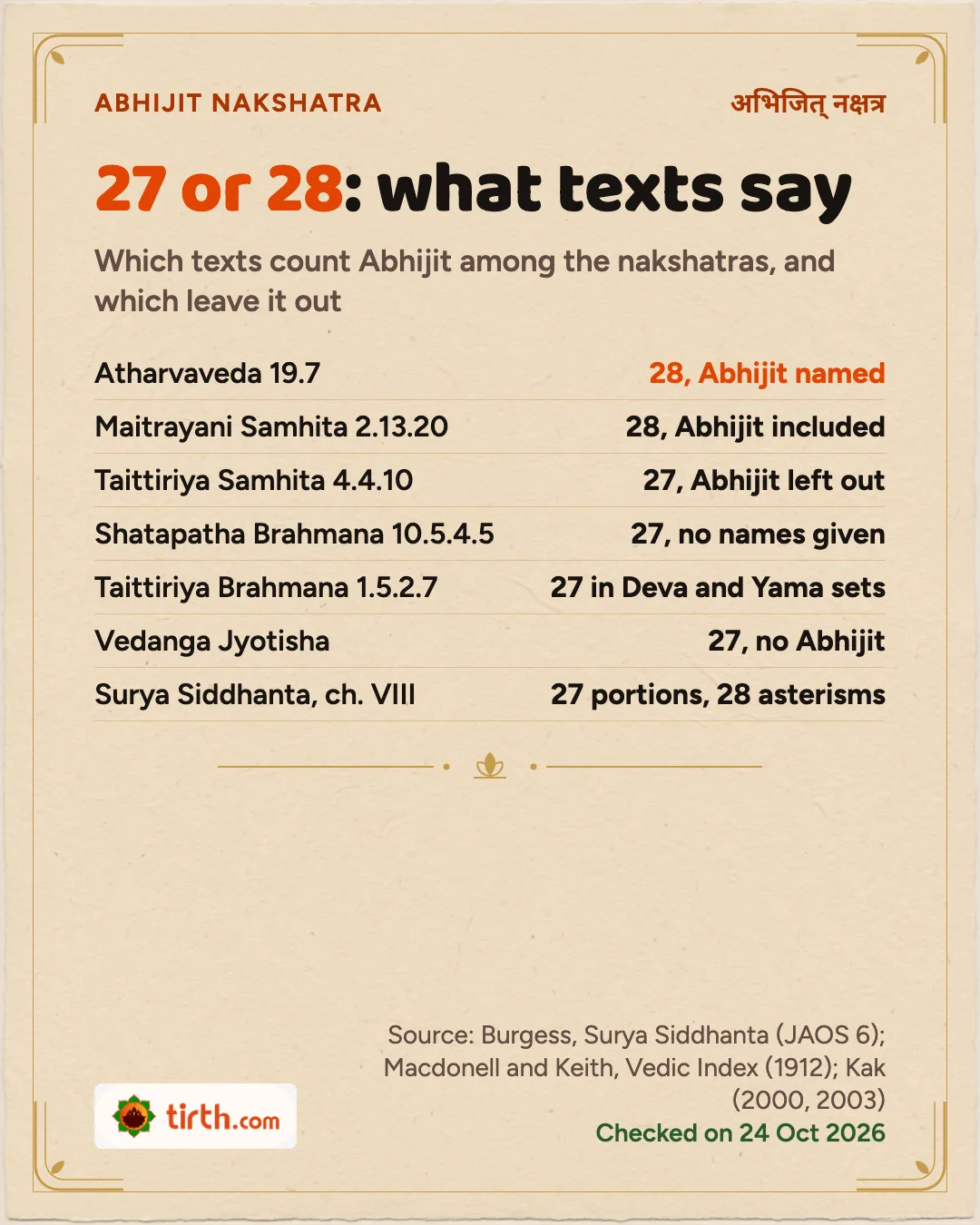
It depends on the text, and now and then on the verse. Every row below carries its reference, so you can open the book and check it.
| Text | Count | Abhijit | Reference |
|---|---|---|---|
| Atharvaveda | 28 (the hymn calls the group “Twenty-eight-fold”) | Named in verse 4, between the Ashadhas and Shravana | 19.7 |
| Maitrayani Samhita | 28 | Included | 2.13.20 |
| Taittiriya Samhita | 27 | Left out | 4.4.10 |
| Shatapatha Brahmana | 27 | Not named; the passage gives the number 27 and lists no names | 10.5.4.5 |
| Taittiriya Brahmana | Listing | Placed “over the Ashadhas, under Shrona” | 1.5.2.3 |
| Taittiriya Brahmana | 27, in Deva (1 to 14) and Yama (15 to 27) sets | Left out of the two sets | 1.5.2.7 |
| Vedanga Jyotisha | 27 | Not in the scheme, per Kak; the Vedic Index notes one verse giving 28, which it judges a later insertion | Kak 2003; Vedic Index |
| Surya Siddhanta | 27 equal portions of the ecliptic, 28 asterisms as constellations | The asterism left without a portion | Chapter VIII |
Griffith’s translation of the Atharvaveda hymn gives verse 4 as “With virtuous merit Abhijit endow me!” The Taittiriya Brahmana puts Abhijit “over the Ashadhas, under Shrona” (Shrona is Shravana), and on a first reading that sounds like a spot in the sky. Whitney thought otherwise. He took the words to describe Abhijit’s place in the list, after the Ashadhas and before Shravana, an argument the Vedic Index finds effective, and the same Index notes that in one Taittiriya Brahmana passage (1.5.2.3) Abhijit is “practically marked as a new comer”.
Nowhere does the Surya Siddhanta name the asterism that goes without a portion. Burgess works it out from verses 4 and 5 of chapter VIII, which point to Abhijit. He adds that treatises reckoning only 27 divisions still end up with 28 asterisms once they describe the star groups themselves.
Outside India the count of 28 turns up again, in the Chinese xiu and the Arabic manazil (the lunar mansions of those two systems), a match the Vedic Index calls significant.
Why do most panchangs count only 27?
Which count came first is still argued over.
Start with the Vedic Index, for which it is “perfectly possible that 28 is the earlier number”. If so, Abhijit may have dropped out because its stars were faint, or because they lay too far north. Or 27 (3 x 3 x 3) was preferred as the more mystic number. Weber disagreed. He held 27 to be the older number in India, as that same entry reports.
Whitney and Burgess are on the same side here. For them 28 was the original system, with Abhijit “as originally and truly a part” of it as any other member. Burgess argues from the sky itself. The asterisms sit well in 27 equal divisions of the ecliptic (the Sun’s apparent path through the year) and badly in 28, because between the 20th and the 23rd they bunch up, and of all the stars in that crowded stretch Abhijit lies farthest from the ecliptic, so it was the easiest one to leave out. There was an explanation from Biot as well, which Burgess rejected as insufficient.
Where is Abhijit in the zodiac, in degrees?
It gets a span only when the count is 28. In the late Muhurta-Mala, as Burgess quotes it, “the last quarter of Uttara-Ashadha and the first fifteenth of Cravana together constitute Abhijit”. The same text allows that span only when 28 asterisms are reckoned. Take each of the 27 equal portions as 13°20′ and the arithmetic gives 276°40′ to 280°53’20” sidereal. That is 6°40′ to 10°53’20” of Makara (Capricorn). (The degrees are plain arithmetic from the text’s fractions, not figures the Muhurta-Mala itself gives.)
Brahmagupta’s Khanda-Khadyaka measures it another way, by the motion of Chandra, the Moon, Deity page on Tirth. Al-Biruni is the one who reports it. The later supplement to that work, he says, gives Abhijit whatever stretch the Moon covers in the part of a day by which its revolution around the sky runs past 27 days. By Al-Biruni’s working, that comes to approximately 4°14′ of the circle. For the Moon himself there is the Chandra Dev Aarti, and for all the grahas together the Navagraha Mantras.
What is the Mahabharata story of Abhijit?
Go back to Indra and Skanda. The episode sits in the Vana Parva, inside the Markandeya-Samasya section on Skanda (Kartikeya), Deity page on Tirth, and it is chapter 229 in Ganguli’s translation (other editions number the chapters differently, so search by the episode rather than the number).
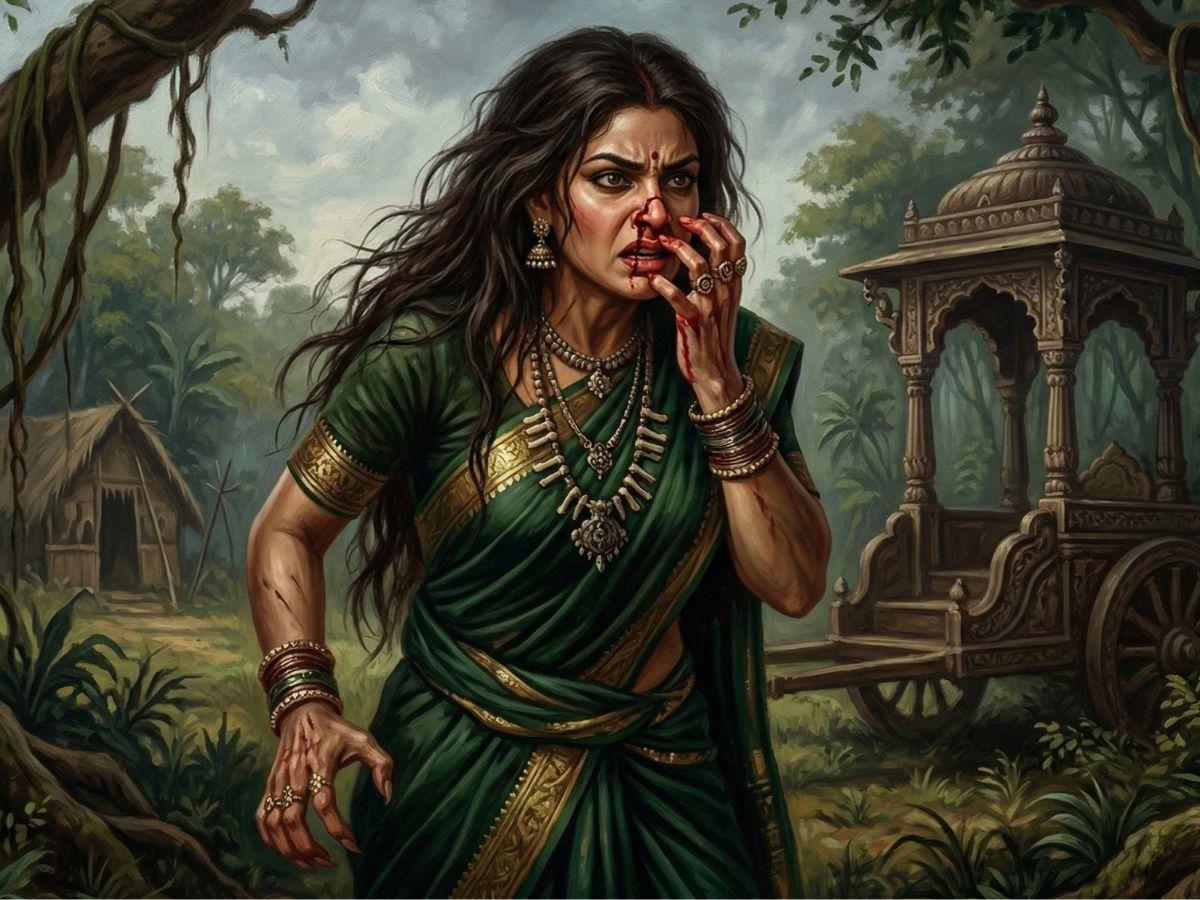
Indra’s words, as Ganguli gives them, are “The lady Abhijit, the younger sister of Rohini, being jealous of her seniority, has repaired to the woods to perform austerities.” He has no substitute for the fallen star. Or rather, he cannot find one. So he asks Skanda to take the matter to Brahma.
Krittika, on Indra’s advice, is then given a place in the heavens, and in Ganguli’s text that star, presided over by Agni, “shines as if with seven heads”. Kartikeya has his own aarti too, the Kartikeya Aarti.
The Bhagavata Purana (5.23.6) paints a different picture of the heavens altogether, the Shishumara, a great dolphin, with Abhijit at its right nostril and Uttara Ashadha at its left.
How is Abhijit Muhurat different from the nakshatra?
Same name, two different things. Abhijit Muhurat belongs to the day. Apte’s Sanskrit-English dictionary defines it as the eighth muhurta of the day, at midday, and the Mahabharata (Adi Parva, section 123 in Ganguli) has Yudhishthira born “at the eighth Muhurta called Abhijit, of the hour of noon”.
Everything else on this page is about the nakshatra, the stretch of sky. For the day’s muhurat in your city, open today’s Abhijit Muhurat on the Tirth panchang, Panchang on Tirth. The Tirth Spiritual Calendar is the other page worth keeping close.
Frequently asked questions
Two glosses are given, “conquering” by Burgess and “reaching victory” by Kak. As a nakshatra it is the extra one, sitting between Uttara Ashadha and Shravana in the 28-fold list of the Atharvaveda.
Nobody knows for certain. The Vedic Index suggests its stars were faint or too far north, or that 27 (3 x 3 x 3) was the preferred number. Burgess thought 27 equal divisions simply fit the sky better, and Abhijit, farthest from the ecliptic in a crowded stretch, was the easiest to drop.
Vega (alpha Lyrae), in Lyra. In the Vedic Index the name covers Vega and its two companions.
Brahma. He is the regent of the asterism in Burgess’s notes to the Surya Siddhanta, and Kak’s nakshatra list says the same.
You get 28, Abhijit among them, in the Atharvaveda (19.7) and the Maitrayani Samhita (2.13.20). For 27, look at the Taittiriya Samhita (4.4.10), and the Shatapatha Brahmana (10.5.4.5) has the same number.
No. One is a part of the sky. The other, the muhurat, is the eighth muhurta of the day, at midday, and the Tirth panchang shows the day’s Abhijit Muhurat for your city.
Sources and further reading
- Internet Archive: Translation of the Surya-Siddhanta, Ebenezer Burgess, Journal of the American Oriental Society volume 6 (1858 to 1860); chapter VIII and its notes on the asterisms.
- Internet Archive: Vedic Index of Names and Subjects, volume 1, Macdonell and Keith, 1912; entry “Naksatra”.
- Sacred Texts: Hymns of the Atharva Veda, Book 19, Hymn 7, Griffith translation (1895 to 1896).
- Project Gutenberg: The Mahabharata, volume 1, translated by K. M. Ganguli (Adi Parva, section CXXIII; Vana Parva, section CCXXIX).
- Vedabase: Bhagavata Purana 5.23.6, Bhaktivedanta translation.
- arXiv: Birth and Early Development of Indian Astronomy, Subhash Kak, from Astronomy Across Cultures (2000).
- arXiv: Babylonian and Indian Astronomy: Early Connections, Subhash Kak, 2003.