On this page6 sections
A nakshatra (lunar mansion) is a stretch of sky 13°20′ wide, one of 27 equal divisions of the zodiac. The Moon moves through them at roughly one a day.
For Sunday, 29 November 2026, the Tirth panchang shows Pushya as the nakshatra until 10:59 AM, with Ashlesha after it. To read a line like that properly, it helps to know why the slices are the size they are, what each name brings with it, and why a day can split in two.
In short
The Moon moves through them at roughly one a day. For Sunday, 29 November 2026, the Tirth panchang shows Pushya as the nakshatra until 10:59 AM, with Ashlesha after it.
13°20′ a slice, and roughly a day for the Moon to cross one
The arithmetic is short. Divide the 360 degrees of the zodiac by 27 and every nakshatra comes out at 13°20′, and each of those is cut again into four padas (quarters) of 3°20′. Measured against the stars, the Moon goes once round the zodiac in about 27.3 days. That works out to approximately 13.2 degrees a day on average. Very close to the width of one nakshatra. So the Moon spends about a day in each before it crosses into the next.
About a day is as exact as it gets. The Moon’s pace is uneven across the month, which means some mansions slip past quicker than others, and on 29 November 2026 Ashlesha begins at 10:59 AM and runs until 9:42 AM the following morning, a little under 23 hours in all.

The 27 nakshatras in order, with deity and ruling graha
Counting begins at Ashvini. It finishes at Revati. For the deity column, one presiding deity per nakshatra, the names below are the ones Varahamihira lists in the Brihat Samhita. The ruling graha is a separate matter altogether, used in the Vimshottari dasha (the planetary-period reckoning of jyotish).
| No. | Nakshatra | Deity | Ruling graha |
|---|---|---|---|
| 1 | Ashvini | The Ashvini Devas | Ketu |
| 2 | Bharani | Yama Dev | Venus |
| 3 | Krittika | Agni Dev | Sun |
| 4 | Rohini | Prajapati | Moon |
| 5 | Mrigashira | Soma (Chandra Dev) | Mars |
| 6 | Ardra | Rudra | Rahu |
| 7 | Punarvasu | Maa Aditi | Jupiter |
| 8 | Pushya | Brihaspati Dev | Saturn |
| 9 | Ashlesha | The Sarpas (serpents) | Mercury |
| 10 | Magha | The Pitrs (ancestors) | Ketu |
| 11 | Purva Phalguni | Bhaga Dev | Venus |
| 12 | Uttara Phalguni | Aryaman Dev | Sun |
| 13 | Hasta | Savitr Dev | Moon |
| 14 | Chitra | Tvashtri | Mars |
| 15 | Swati | Vayu Dev | Rahu |
| 16 | Vishakha | Indra Dev and Agni Dev | Jupiter |
| 17 | Anuradha | Mitra Dev | Saturn |
| 18 | Jyeshtha | Indra Dev | Mercury |
| 19 | Mula | Prajapati | Ketu |
| 20 | Purva Ashadha | Apah (the waters) | Venus |
| 21 | Uttara Ashadha | Vishvedevas | Sun |
| 22 | Shravana | Bhagwan Vishnu | Moon |
| 23 | Dhanishta | The Vasus | Mars |
| 24 | Shatabhisha | Varuna Dev | Rahu |
| 25 | Purva Bhadrapada | Aja Ekapada | Jupiter |
| 26 | Uttara Bhadrapada | Ahirbudhnya | Saturn |
| 27 | Revati | Pushan Dev | Mercury |
Keep the last two columns apart in your head. Take Pushya, the nakshatra on the morning of 29 November 2026. Its deity is Brihaspati Dev, while the graha ruling it is Saturn, and each column answers its own question.
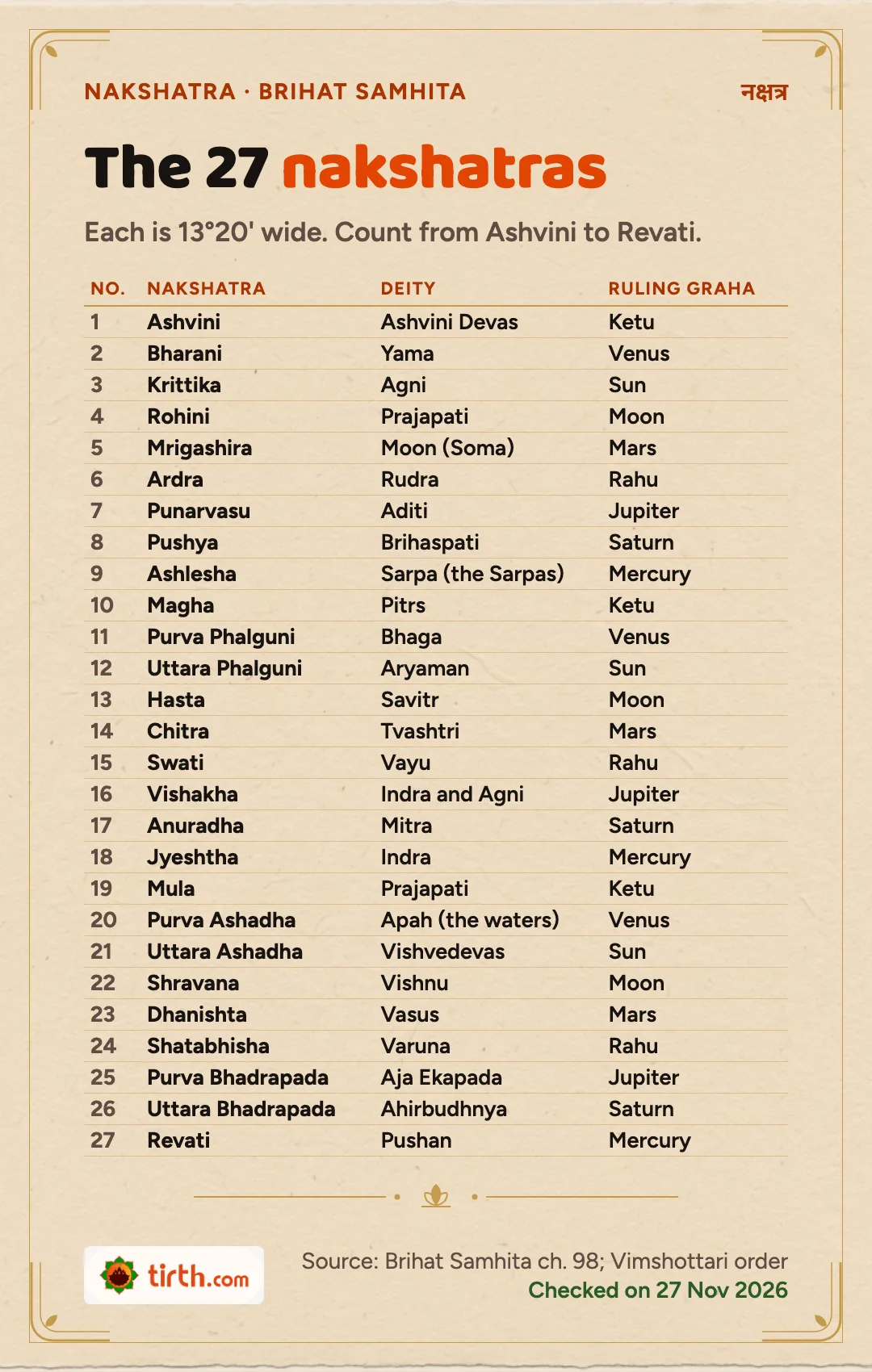
Read down the graha column and one fixed order of nine keeps coming back, Ketu, Venus, Sun, Moon, Mars, Rahu, Jupiter, Saturn and Mercury, three full times between Ashvini and Revati. Three rounds of nine. So the nine grahas fill all 27 places, nothing left over.
You will see some names travel in pairs, Purva and Uttara Phalguni, Purva and Uttara Ashadha etc. Each pair is the former and the latter part of one stretch of sky.
Not every text agrees with this list. Where your family keeps to a particular printed panchang, or to a jyotishi’s own text, that is the list to follow.
The count itself differs in the oldest texts: the Taittiriya Samhita has 27, while the Atharva Veda has 28. The extra name is Abhijit, placed between Uttara Ashadha and Shravana, and it has its own page, Abhijit, the 28th lunar mansion.
How does a nakshatra sit inside a rashi?
Twelve slices of 30 degrees each make up the rashis (zodiac signs). Nakshatras cut that same circle finer.
Lay the two over each other and every rashi holds two and a quarter nakshatras. Or, counted in quarters, exactly nine padas of 3°20′. That leaves some nakshatras straddling two rashis, beginning in one and finishing in the next.
The 12 signs themselves are on our page rashi kya hai.
Pushya in the morning, Ashlesha by lunch
Every panchang has five limbs, tithi, vara, nakshatra, yoga and karana, and the nakshatra is the mansion the Moon is in. Its times are not tied to sunrise, and they move from day to day. One civil day can therefore carry two nakshatras.
The table is that Sunday as the Tirth panchang gives it, limb by limb.
| Limb | Sunday, 29 November 2026 |
|---|---|
| Nakshatra | Pushya (no. 8) until 10:59 AM, then Ashlesha (no. 9) until 9:42 AM on Monday, 30 November |
| Tithi | Krishna Shashthi, 3:56 AM on 29 November to 1:45 AM on 30 November (New Delhi) |
| Lunar month | Margashirsha (purnimanta) or Kartika (amanta) |
| City basis | Nakshatra times are the same for Delhi, Mumbai, Kolkata and Chennai |
If you look at only one thing in the nakshatra line, make it the end time.
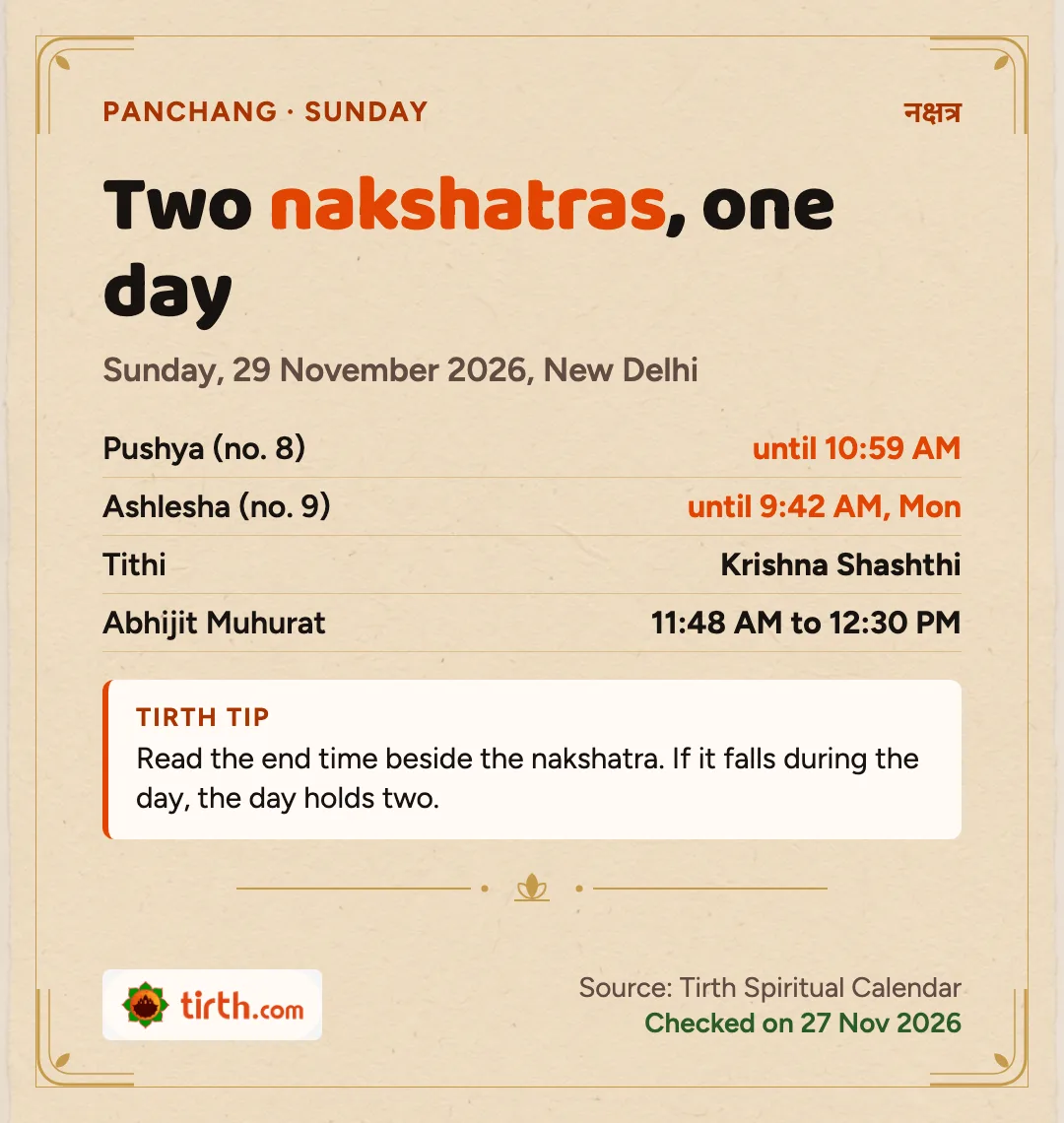
Say you check the panchang over morning tea and see Pushya. By lunch the Moon is in Ashlesha (people remember the name and forget the time, which is the part that changes).
We would rather you read one real day’s line slowly, like this, than learn the whole table above by heart. Open today’s nakshatra in the Tirth panchang, Panchang on Tirth and read it end time first. Other dates for your city are in the Tirth Spiritual Calendar.
Frequently asked questions
27 in the daily panchang, Ashvini to Revati. The Atharva Veda and some other Vedic lists make it 28, with Abhijit added between Uttara Ashadha and Shravana.
It is 13°20′ of the zodiac, for every one of them. On average the Moon moves about 13.2 degrees a day, so it stays roughly a day in each. The exact time varies, because the Moon’s own speed varies.
A quarter of a nakshatra, 3°20′ wide. There are four in every nakshatra, and a rashi of 30 degrees holds exactly nine of them.
No. The deity is the presiding devata named for that nakshatra. The ruling graha comes from the Vimshottari dasha sequence, which is a separate reckoning. Pushya shows the split well, Brihaspati Dev as deity and Saturn as ruling graha.
Find the date in the panchang, go to the nakshatra line, then read the end time beside it. When that time falls during the day, the day holds two nakshatras. Sunday, 29 November 2026 is one such day, Pushya first and then Ashlesha.
Continue on Tirth
- Today’s nakshatra in the Tirth panchang, Panchang on Tirth shows the mansion, its end time and the other four limbs.
- Abhijit nakshatra meaning follows the 28th mansion through the Vedic texts.
- Rashi kya hai explains the 12 signs the nakshatras sit inside.
- The Tirth Spiritual Calendar gives tithi and nakshatra times for your city.