On this page6 sections
It is the 30th and last tithi of the lunar month, when the Moon reaches the same longitude as the Sun and cannot be seen at night. It closes Krishna paksha, after fourteen nights in which the Moon thins a little every evening.
Families keep the day for their ancestors. Some families also hold back new beginnings on it, though that habit comes from custom more than from any text (if it is a date you need, the Amavasya dates page on Tirth lists every coming one).
In short
It closes Krishna paksha, after fourteen nights in which the Moon thins a little every evening. Families keep the day for their ancestors. Some families also hold back new beginnings on it, though that habit comes from custom more than from any text (if it is a date you need, the Amavasya dates page on Tirth lists every coming one).
Where Amavasya sits among the 30 tithis
Each tithi lasts as long as the Moon takes to pull 12 degrees ahead of the Sun.
Count thirty of those and you have a lunar month. Fifteen sit in Shukla paksha, the bright half when the Moon grows, and the other fifteen in Krishna paksha, the dark half when it wanes.
Number 30 is Amavasya. Over its span the Moon’s lead on the Sun climbs from 348 degrees to the full 360, and the tithi ends the moment the two meet.
The name follows the same picture. The Monier-Williams Sanskrit dictionary reads it as ama, “together”, and vas, “to dwell”: the night when the Sun and Moon dwell together at one longitude. A plainer reading calls it the no-moon day.
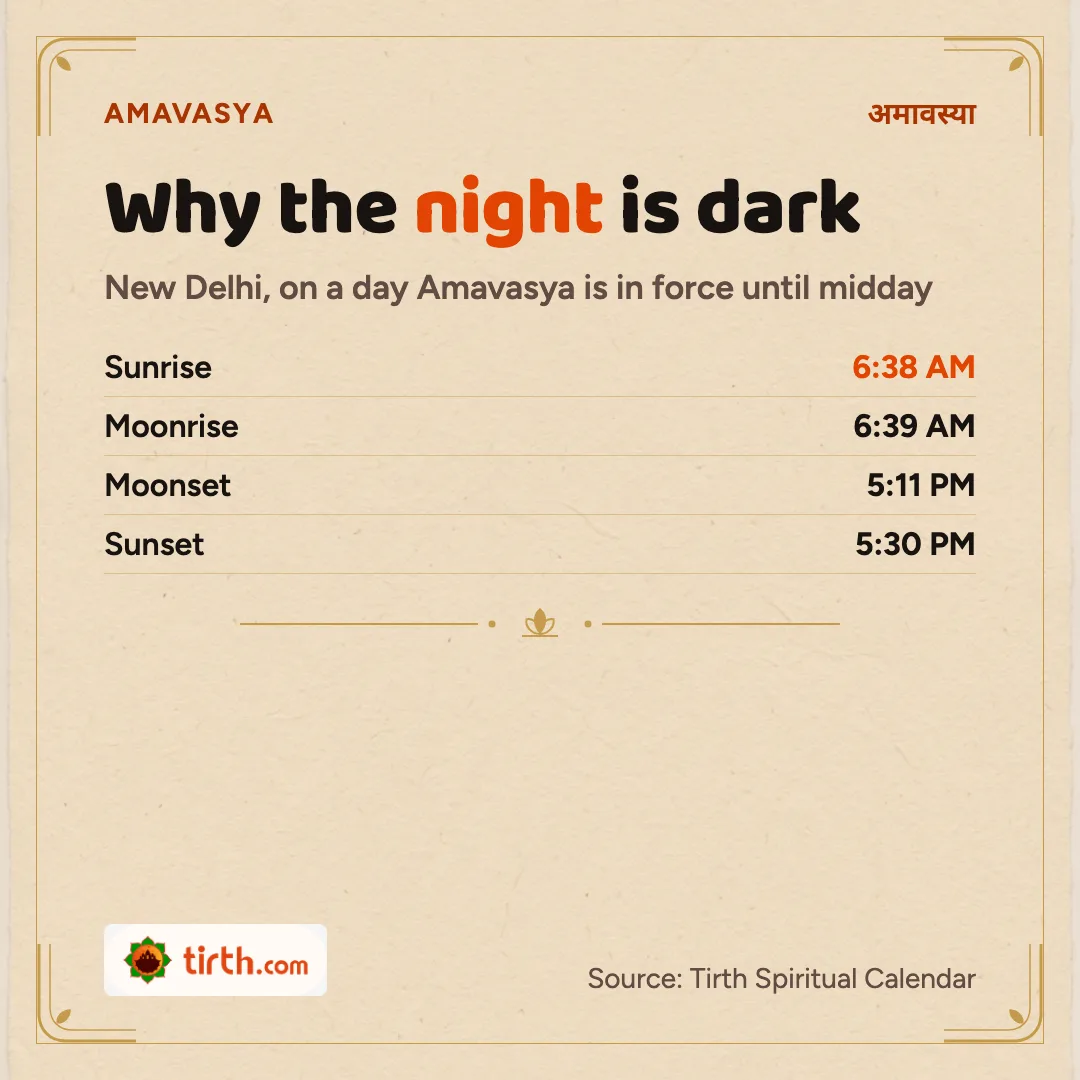
Look at one day’s times and the dark night makes sense. Take New Delhi on 9 November 2026, with Amavasya still running until 12:30 PM. The Sun rose at 6:38 AM and the Moon followed at 6:39 AM, one minute behind it, then set again at 5:11 PM, approximately twenty minutes before the Sun went down at 5:30 PM, so the Moon had spent the daylight hours travelling beside the Sun and had left the sky before dark.
That Moon is Chandra Dev, Deity page on Tirth , and Tirth keeps his aarti.
| Purnima | Amavasya | |
|---|---|---|
| Half of the month it closes | Shukla paksha, the bright half | Krishna paksha, the dark half |
| The Moon at night | Full | Not seen |
| Calendars that end the month on it | Purnimanta, mainly North India | Amanta, mainly South India |
That is why one new moon can carry two month names: the Diwali Amavasya of 8 November 2026 was Ashwin Amavasya in amanta calendars and Kartika Amavasya in purnimanta ones.
Why does Amavasya fall on two dates?
A tithi runs on the Moon’s position against the Sun, while a calendar day runs on clock time from one midnight to the next.
The Tirth panchang shows how far a tithi runs past the day boundary. Counted for New Delhi, the five new moons from November 2026 to March 2027 lasted anywhere between 25 hours 3 minutes and 26 hours 39 minutes, and each one started at some odd hour and carried on into a second calendar day.
Diwali 2026 is the one to remember. Amavasya began at 11:27 AM on Sunday, 8 November 2026 and did not end until 12:30 PM on Monday, 9 November.
For Lakshmi Puja the tithi has to be in force at dusk, in pradosh kaal (the window just after sunset). At dusk on the 8th the tithi was running.
By dusk on the 9th it had been over for hours, so the puja belonged to the 8th. A family that saw Amavasya printed against the 9th that morning and planned the evening around it would have lit its lamps a day late. Reading only the date and skipping the times makes that mistake easy.
Each observance asks its own question of the same tithi, and the Tirth Spiritual Calendar answers with a separate rule for each. Two of those rules are old ones: the Dharma Sindhu puts the ancestors’ shraddha in the afternoon and Lakshmi worship at dusk, both on the Diwali Amavasya.
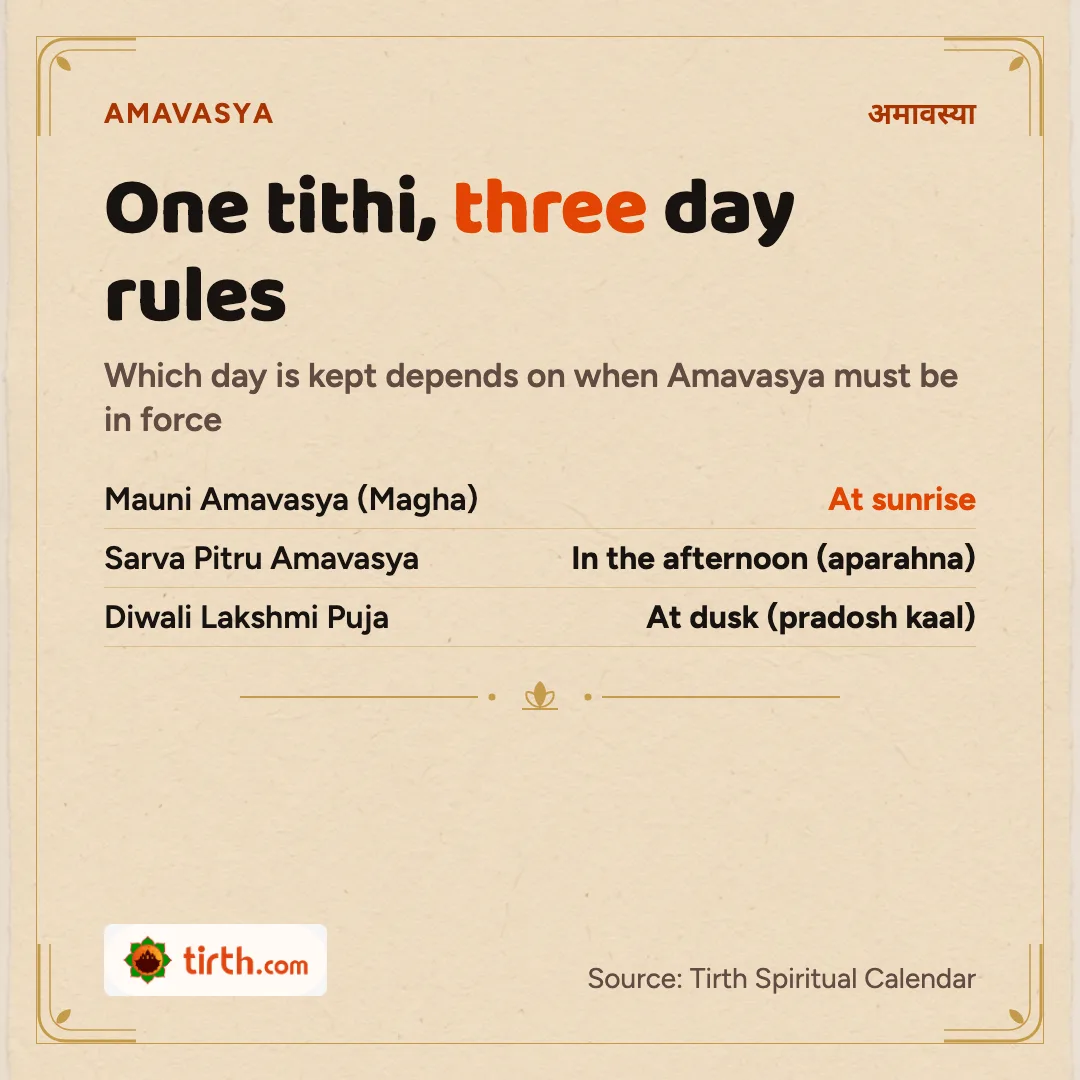
| Observance | Amavasya must be in force at |
|---|---|
| Mauni Amavasya (in Magha) | Sunrise |
| Sarva Pitru Amavasya | The afternoon (aparahna) |
| Diwali Lakshmi Puja | Dusk (pradosh kaal) |
Before you look at the date for a vrat or family puja that hangs on Amavasya, find out which rule it goes by. The Amavasya page and the Tirth panchang, Panchang on Tirth give the start and end of the tithi.
Why the new moon belongs to the ancestors
The Manusmriti, Book 3, is direct about it. It tells the Brahmana who keeps a sacred fire to offer shraddha, the monthly offering to the ancestors, on the new-moon day once the pitriyajna, the rite for the ancestors, is done. The same text calls this monthly shraddha Anvaharya.
To this day families set Amavasya aside for the ancestors. Shraddha is offered, and tarpan (water offered to the ancestors), and pind (small balls of rice or flour made with ghee and black sesame).
Once a year the ancestors are given a whole dark fortnight before Navratri. The name of that fortnight is Pitru Paksha, and it ends on Mahalaya, the new moon that closes it, also called Sarva Pitru Amavasya.
The rites differ from family to family, so take the steps from your family Purohit, who knows how your elders kept the day. One Amavasya has a page of its own on Tirth, Pithori Amavasya.
Amavasya ko kya nahi karna chahiye?
There is no one list of do-nots for Amavasya that a scripture lays down for every Hindu.
Custom is what gets passed around. Families and regions carry it, and the lists going round only partly agree with each other. Some families keep new starts off the day.
| Custom | What it covers |
|---|---|
| No new beginnings | A wedding, janeu (the sacred thread), a housewarming, a new business, a new vehicle |
| No haircut or shaving | Cutting hair, shaving, cutting nails |
| No new clothes | Buying or wearing new clothes |
| No lending or borrowing | Money given or taken on the day |
| No arguments | Quarrels in the house |
| No sleeping late | Rising late in the morning |
| Certain foods kept aside | Mustard oil, turmeric, in some regions |
Travel is different. One of these lists, strict about new ventures, new clothes and lending, still holds that a journey on the day is fine.
Then there is Diwali, which is itself an Amavasya and a night of Lakshmi Puja. Buying gold on Diwali day is a custom of its own, and it sits oddly beside any rule against new purchases. Shani Jayanti is kept on an Amavasya as well, and a Monday new moon gets a name of its own, Somvati Amavasya.
When a forwarded list and your family’s practice disagree, we would go with the family.
Ask your kul pandit (the pandit of your family line) or family Purohit, who knows what your elders kept. Region and sampradaya (the lineage a family follows) change the list far more than any message on a phone can.
Where your parents are stricter than you (haircut, nails, new clothes all kept off the day), anything done in their name follows their list.
Before you fix a day for a wedding or a housewarming, ask your Purohit whether your family keeps such things off Amavasya, then look up when the tithi starts and ends on the Tirth panchang, Panchang on Tirth, because the hour matters as much as the date, as Diwali showed.
Frequently asked questions
Keeping new beginnings off the day is a family custom, rather than a rule from the texts. The Manusmriti, Book 3, puts the monthly offering to ancestors on the new-moon day, and Diwali puts Lakshmi Puja on it. Think of it as a day set apart.
One list of Amavasya do-nots holds that travel on the day is fine. A stricter family practice comes first, though.
As a custom, some families put a new business on their Amavasya do-not list. Where the start date can shift, talk to your family Purohit, and look up on the Tirth panchang the hour the tithi ends, because it often ends partway through a day.
In the Manusmriti, Book 3, the Brahmana who keeps a sacred fire is asked to make the monthly shraddha on the new-moon day, a rite the text names Anvaharya. Tarpan and pind are still offered by families on Amavasya, and Pitru Paksha closes on Sarva Pitru Amavasya.
When Amavasya lands on a Monday, it is called Somvati Amavasya. Same tithi.
It usually touches two calendar days, since the tithi runs for more than a day, though under 27 hours in every new moon from November 2026 to March 2027. Which day is kept depends on the observance. In the Tirth Spiritual Calendar, Mauni Amavasya goes by sunrise, Sarva Pitru Amavasya by the afternoon and Diwali by dusk.
Continue on Tirth
- Amavasya dates on Tirth for every coming new moon and when its tithi starts and ends.
- The Tirth panchang, Panchang on Tirth for today’s tithi in your city before you fix a date.
- Pithori Amavasya vrat katha on Tirth.
- Ekadashi kya hai for another tithi of the lunar month.