On this page7 sections
- What makes the Moon, and not the Sun, name your rashi
- The twelve rashis in order, with their lords
- Why your horoscope sign and your rashi so rarely match
- Finding your own rashi: the Moon’s pace and your birth time
- How 27 nakshatras fit inside 12 signs
- Frequently asked questions
- Continue on Tirth
- Sources and review
It is the sign the Moon was passing through when you were born. If a Pandit names a sign from your birth details and it differs from the one printed in your newspaper, nobody has made a mistake, because a Western horoscope sign follows the Sun.
Two separate differences stack here, and the second takes a little arithmetic to see. One is the heavenly body each system follows. The other is the point from which each begins to count the zodiac.
In short
If a Pandit names a sign from your birth details and it differs from the one printed in your newspaper, nobody has made a mistake, because a Western horoscope sign follows the Sun. Two separate differences stack here, and the second takes a little arithmetic to see.
What makes the Moon, and not the Sun, name your rashi
Rashi: Sanskrit for a part or portion. Hindu astrology cuts the 360-degree zodiac belt into 12 equal slices of 30 degrees each, and every slice is a rashi.
Ask for someone’s rashi in everyday Indian use and you are asking for the janma rashi, also called the Chandra rashi: the sign holding the Moon at the moment of birth. The Sun’s sign is a different question altogether.
Why the Moon? In Jyotish, Chandra Dev, Deity page on Tirth is the graha of the mind, and the Brihat Parashara Hora Shastra gives the Moon that place. That is the tradition’s belief, and the Moon’s sign gets its weight from it.
The twelve rashis in order, with their lords
Mesha comes first. The lords below follow the classical scheme of the seven visible planets. Some modern writers give Rahu or Ketu a share of Kumbha or Kanya, and this table leaves that out.
| Rashi | Western name | Classical lord |
|---|---|---|
| Mesha | Aries | Mangal (Mars) |
| Vrishabha | Taurus | Shukra (Venus) |
| Mithuna | Gemini | Budh (Mercury) |
| Karka | Cancer | Chandra Dev (Moon) |
| Simha | Leo | Surya Dev (Sun) |
| Kanya | Virgo | Budh (Mercury) |
| Tula | Libra | Shukra (Venus) |
| Vrishchika | Scorpio | Mangal (Mars) |
| Dhanu | Sagittarius | Guru (Jupiter) |
| Makara | Capricorn | Shani Dev (Saturn) |
| Kumbha | Aquarius | Shani Dev (Saturn) |
| Meena | Pisces | Guru (Jupiter) |
Surya Dev and Chandra Dev take one sign each. Each of the other five grahas takes two. Budh, for example, has both Mithuna and Kanya, and the Budh graha page tells more about him. For all nine grahas together, start with the Navagraha mantras page.
Why your horoscope sign and your rashi so rarely match
So the Moon is one reason. A Western sign marks where the Sun was on your birthday, and the Sun spends about a month in each sign. The Moon spends about two days. No rule and no simple sum can turn the one into the other
The zodiac itself is the other reason. Western signs sit on the tropical zodiac, tied to the March equinox, whereas Hindu astrology measures against the star background, which is the sidereal zodiac. Both use the same twelve names and symbols, yet they begin counting from different points.
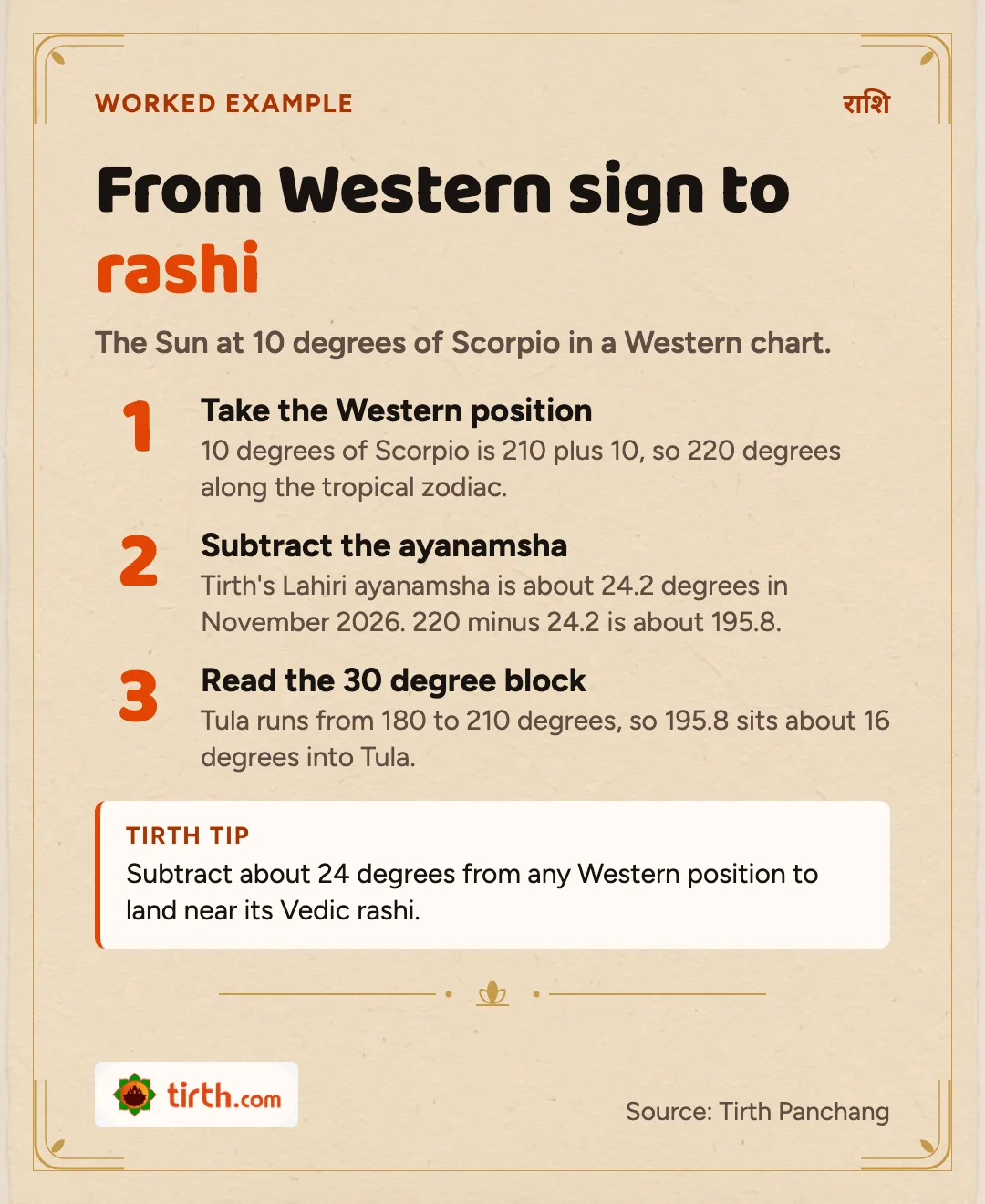
That offset between starting lines has a name, the ayanamsha. Tirth’s panchang uses the Lahiri ayanamsha, one of several schemes in use, and it stood at about 24 degrees 14 minutes in November 2026, growing by about 50 arc-seconds a year. Here is the working rule. Take a Western position, subtract about 24 degrees, and read off the 30-degree block you land in, so that a Sun at 10 degrees of Scorpio in a Western chart sits at about 16 degrees of Tula.
Watch the Sun and you can see the shift happen. Western Aries opens at the March equinox, yet in 2026 the Sun entered Mesha only on 14 April, which is Mesha Sankranti (Baisakhi). Every sankranti trails its Western twin by roughly three to four weeks, and in 2026 (New Delhi) they fell between the 13th and the 17th of the month. Makar Sankranti, the day the Sun enters Makara, came on 14 January.
Finding your own rashi: the Moon’s pace and your birth time
Because the Moon moves about 13 degrees a day, it needs roughly 2.3 days to cross one 30-degree rashi. Over 161 crossings in 2026 the mean stay was 2.27 days. The shortest was 1.96 days and the longest 2.54, against a textbook figure of about 2.25.
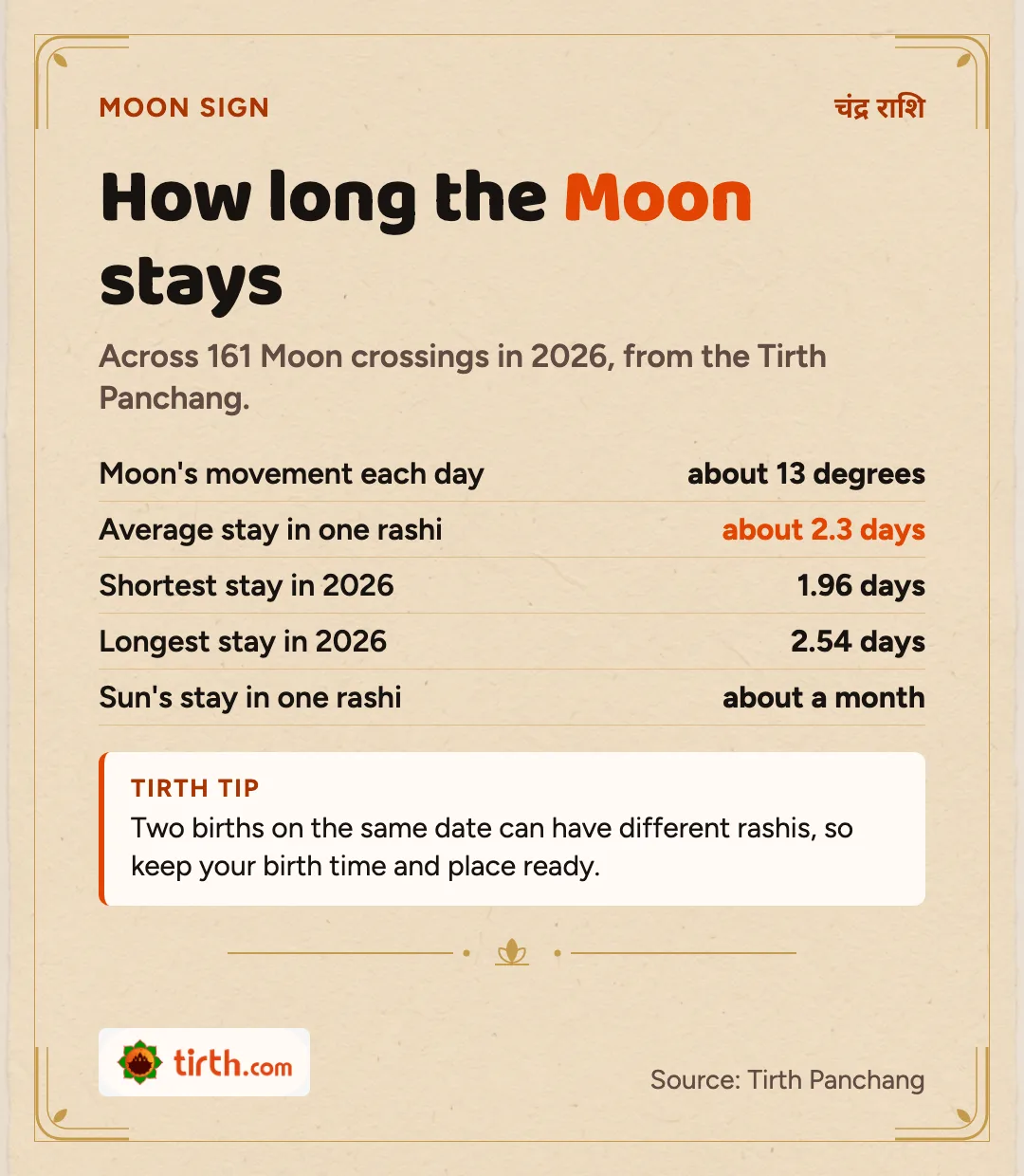
Same birth date, different rashi: it happens. A birth close to a boundary can fall on either side of it, and only the exact time and place settle which.
For a birth near a boundary you need the date, the time and the place. Be wary of a page that asks only for the date, since the Moon may have changed sign that very day.
On the Tirth Panchang, Panchang on Tirth you can read the Moon’s sign for any day, set beside the tithi and nakshatra. That is where the Moon stands on the day you pick. Your own rashi remains a separate question, one that still needs your birth time and place.
How 27 nakshatras fit inside 12 signs
Take 27 nakshatras of 4 padas each and you get 108 padas. Divide them by 12 and every rashi holds 9 padas, which is 2.25 nakshatras, so some nakshatras straddle two signs. Krittika opens in Mesha and closes in Vrishabha. Its first pada sits in the one sign and the remaining three in the other. Certain lists squeeze in a 28th, the extra nakshatra Abhijit, but this count keeps to the standard 27. As an example, Mesha holds Ashwini, Bharani and the first pada of Krittika, and Vrishchika holds the last pada of Vishakha, then Anuradha and Jyeshtha.
Frequently asked questions
One of 12 equal parts of the zodiac, each of 30 degrees. Yours is the sign the Moon was in at your birth.
Moon sign. Janma rashi is what people usually mean by rashi.
Roughly 2.3 days, and in 2026 the stay ranged from 1.96 to 2.54 days.
Only if the Moon stayed in one sign all that day. On a day it crosses a boundary, the exact time and place of birth decide your sign.
Each rashi has a classical ruler among the seven visible planets, as in the table above. Mangal, for one, rules Mesha and Vrishchika.
Continue on Tirth
- Tirth Panchang, Panchang on Tirth: the Moon’s sign, tithi and nakshatra for any day.
- Tirth Spiritual Calendar: festival and vrat dates for your own city.
- What Makar Sankranti marks: the day the Sun enters Makara.
- The 28th nakshatra, Abhijit: where it sits among the nakshatras.