On this page8 sections
Duryodhana, speaking to his teacher Drona, has started naming the heroes of the Pandava army, mighty bowmen who are a match for those two in battle, and the first three names he gives are Yuyudhana, Virata and Drupada.
Fourth verse of chapter 1, and the first of a list that runs on through verse 1.6.
The chapter’s closing line frames the whole Gita as a dialogue between Shri Krishna, Deity page on Tirth and Arjuna. Neither of them speaks in 1.4, though. The voice here is Duryodhana’s.
In short
Fourth verse of chapter 1, and the first of a list that runs on through verse 1.6. The chapter’s closing line frames the whole Gita as a dialogue between Shri Krishna, Deity page on Tirth and Arjuna. Neither of them speaks in 1.4, though.
Bhagavad Gita 1.4 in Sanskrit
अत्र शूरा महेष्वासा भीमार्जुनसमा युधि ।
युयुधानो विराटश्च द्रुपदश्च महारथः ॥१-४॥
atra śūrā maheṣvāsā bhīmārjunasamā yudhi
yuyudhāno virāṭaśca drupadaśca mahārathaḥ
Sanskrit Wikisource is where the Devanagari comes from, taken from its text of the whole chapter, and the Gita Supersite run by IIT Kanpur prints exactly the same line. The ॥१-४॥ at the close is only a number. Chapter 1, verse 4.
The Roman letters are from the IAST edition on sanskritdocuments.org, and every letter of it has been checked against the Devanagari above.
If you are learning it by heart
Break the line at the single danda (।). The Roman text breaks at exactly that point as well, and the double danda (॥) is simply the end of the verse.
Going through chapter 1 slowly (a verse a day, say)? Then we would take 1.4 to 1.6 together in one sitting. Duryodhana’s list does not stop at the end of 1.4, and it only closes two verses later on sarva eva mahārathāḥ.
What each word in Bhagavad Gita 1.4 means
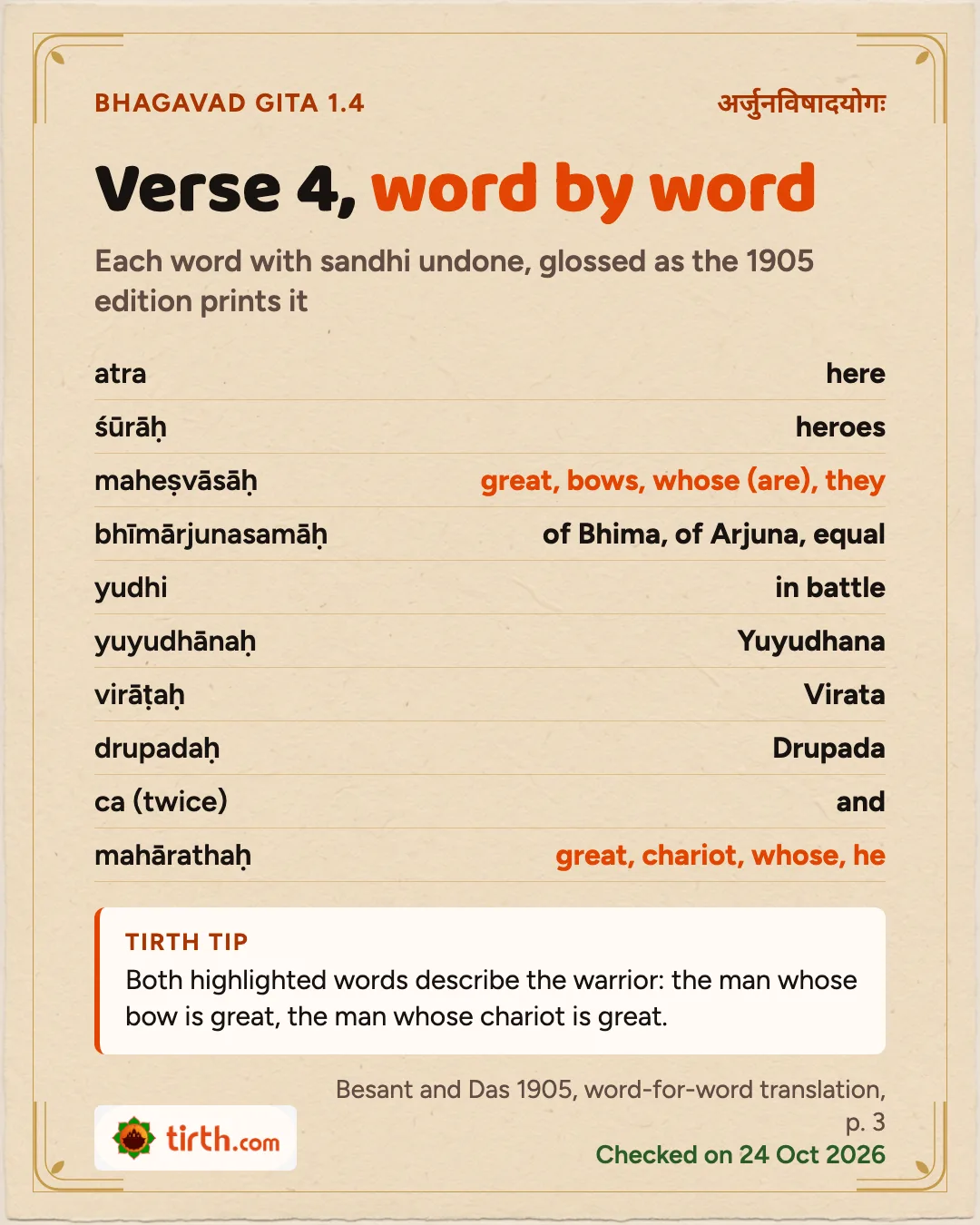
In the verse itself the words run into each other. Sanskrit changes the sounds where one word meets the next (this is sandhi), and the 1905 edition by Annie Besant and Bhagavan Das undoes those changes in its word-for-word translation on page 3, so each word stands on its own again.
The table follows that edition. Which is why śūrā in the verse turns into śūrāḥ below, and virāṭaśca comes apart as virāṭaḥ plus ca.
| As written in the verse | Word with sandhi undone | Meaning (Besant and Das, 1905) |
|---|---|---|
| atra | atra | here |
| śūrā | śūrāḥ | heroes |
| maheṣvāsā | maheṣvāsāḥ | great, bows, whose (are), they |
| bhīmārjunasamā | bhīmārjunasamāḥ | of Bhima, of Arjuna, equal |
| yudhi | yudhi | in battle |
| yuyudhāno | yuyudhānaḥ | Yuyudhana |
| virāṭaśca | virāṭaḥ | Virata |
| (virāṭaśca) | ca | and |
| drupadaśca | drupadaḥ | Drupada |
| (drupadaśca) | ca | and |
| mahārathaḥ | mahārathaḥ | great, chariot, whose, he |
Every gloss sticks to the Sanskrit order, which is a little odd in English but lets you take a compound apart piece by piece. So maheṣvāsāḥ reads “great, bows, whose (are), they”, the men whose bows are great. The edition goes one step further with iṣvāsa and splits it as “that which, the arrow, throws”. A bow, in other words.
Mahārathaḥ works the same way. “Great, chariot, whose, he” gives you one whose chariot is great.
Bhagavad Gita 1.4 in English
Besant and Das also print a free translation, on page 2 of the same 1905 book.
Heroes are these, mighty bowmen, to Bhima and Arjuna equal in battle; Yuyudhana, Virata, and Drupada of the great car
Besant and Das, 1905, page 2
K. T. Telang’s translation is the older one. He made it in 1882 for the Sacred Books of the East, and it sits on page 37 of volume 8.
In it are heroes (bearing) large bows, the equals of Bhima and Arjuna in battle, (namely), Yuyudhana, Virata, and Drupada, the master of a great car
K. T. Telang, 1882, page 37
Look at Telang’s brackets. Words like (bearing) and (namely) are his, put in so the English will run, and the 1905 version gets by without any.
His “In it” reaches back to the verse before, to the Pandava army arrayed by the son of Drupada. Duryodhana is now picking out that army’s champions for his teacher one by one. Or rather, sizing them up against Bhima and Arjuna.
What does maharatha mean?
Taken literally, one whose chariot is great, as the word table shows. Both public-domain editions go on to give the word a technical sense in their footnotes, and the number of fighters they put on it is not the same.
Note 2 on page 2 of Besant and Das reads “Technically, one able to fight alone ten thousand bowmen.” Telang, in his own note 2 on page 37, says a thousand and words it like this. “This is a literal rendering; the technical meaning is ‘a warrior proficient in military science, who can fight single-handed a thousand archers.'”
We would leave the two numbers side by side and not choose. Anyone teaching 1.4, or quoting it in a talk, does better to name the edition along with the figure.
Who were Yuyudhana, Virata and Drupada?
Yuyudhana is Satyaki. A Vrishni warrior, of Shri Krishna’s own clan, who fought for the Pandavas. The English Mahabharata on Project Gutenberg writes the name as “Yuyudhana (Satyaki)” in the Karna Parva, and earlier, in the Udyoga Parva, it calls him “Yuyudhana, the lion of the Vrishni race”.
Virata ruled the Matsyas. The Pandavas lived at his court in disguise for their thirteenth year, and the Virata Parva, which tells that whole story, calls him virtuous and powerful and says he is “attached to the Pandavas”.
Then Drupada, also called Yajnasena, king of Panchala.
Draupadi was his daughter and Dhrishtadyumna his son, as the Adi Parva has it. Which means that in 1.4 Duryodhana is naming the father of the very commander he pointed to a verse earlier, because it was Dhrishtadyumna, the son of Drupada, who arrayed the Pandava army in 1.3.
Why 1.4 to 1.6 read as one list
Verses 1.4, 1.5 and 1.6 make one unbroken list of the warriors on the Pandava side. It ends on sarva eva mahārathāḥ, “all of great cars”. Telang goes a step further and prints the three verses as a single sentence, one that starts back in verse 1.3 (Besant and Das keep them apart as verses 4, 5 and 6, spread over pages 2 and 3).
The chapter is Arjuna Vishada Yoga (the yoga of Arjuna’s despondency), 47 verses long in the common text.
Step further back and the Gita turns out to be a part of the Mahabharata, inside the Bhishma Parva, in the stretch called the Bhagavat-Gita Parva. The Project Gutenberg English Mahabharata starts chapter 1 of the Gita at Bhishma Parva Section XXV, and gives this verse in yet another wording.
There (in that army) are many brave and mighty bowmen, who in battle are equal to Bhima and Arjuna. (They are) Yuyudhana, and Virata, and that mighty car-warrior Drupada
The Mahabharata, Bhishma Parva Section XXV, Project Gutenberg
Tirth has a Gita Jayanti page too.
Read next. Verse 1.3 comes just before, with Duryodhana turning to his teacher and pointing at the Pandava army arrayed by Drupada’s son, and verses 1.5 and 1.6 carry the list of heroes on from here. On Tirth there is also the Bhagavad Gita Aarti, the Krishna Aarti and a page on the Krishna mantra.
Frequently asked questions
Duryodhana is. He starts speaking in verse 1.3 and keeps going right through the list of Pandava heroes.
Drona, the son of Bharadvaja. That is how the 1905 Besant and Das edition footnotes the word “teacher”.
No, verse 1.4 is Duryodhana’s, even though the Gita is framed as a dialogue between Shri Krishna and Arjuna. For Krishna himself, Tirth has a page on Janmashtami.
Arjuna Vishada Yoga, the yoga of Arjuna’s despondency, which runs to 47 verses in the common text and so ends at 1.47.
Sources and further reading
Both English translations quoted here are in the public domain. Annie Besant died in 1933, Bhagavan Das in 1958 and K. T. Telang in 1893, and their books were published in 1905 and 1882.
- Annie Besant and Bhagavan Das, The Bhagavad-Gita, Theosophical Publishing Society, 1905 (Internet Archive): free translation p. 2, word-for-word translation p. 3
- K. T. Telang, The Bhagavadgita, Sacred Books of the East vol. 8, Clarendon Press, 1882 (Internet Archive): chapter I, p. 37
- Sanskrit Wikisource, Bhagavad Gita chapter 1 (Arjuna Vishada Yoga)
- Gita Supersite, IIT Kanpur, Sanskrit text of 1.4
- sanskritdocuments.org, Bhagavad Gita in IAST transliteration
- Project Gutenberg, The Mahabharata, Volume 2 (Virata, Udyoga, Bhishma and Drona Parvas)
- Project Gutenberg, The Mahabharata, Volume 1 (Adi Parva) and Volume 3 (Karna Parva)