On this page11 sections
- Which part of the Manas is this?
- What happens, scene by scene?
- How does Ram get from Chitrakoot to Panchavati?
- How does Ravana come into it?
- Sita haran and Jatayu’s last fight
- Shabari’s ashram and navadha bhakti
- Desire, anger & greed, then Narada at Pampa
- What can we take from Aranya Kand?
- Conclusion
- Frequently asked questions
- Sources and further reading
- Sources and review
Ravana carries Sita ji off at doha 28, and the whole kand turns on that abduction. That, and Shri Ram’s grace to Jatayu and Shabari.
Tulsidas placed it third among the sopans of his Manas, with Ayodhya Kand before it and Kishkindha Kand after. Chitrakoot to Pampa lake is the whole route, 46 dohas long, and Shri Ram and Lakshman ji walk all of it. Sita ji only gets as far as doha 28. Late in the kand, at Shabari’s ashram, Ram teaches the nine forms of bhakti (devotion).
| Aranya Kand Ramcharitmanas at a glance | Details |
|---|---|
| Place in the text | Tritiya Sopan (Descent Three), after Ayodhya Kand and before Kishkindha Kand |
| Length | 46 numbered dohas, closing with doha 46 ka and doha 46 kha |
| Opens with | Two Sanskrit shlokas, one to Shankar and one to Ram on the forest path with Sita and Lakshman |
| Runs from | Chitrakoot to Pampa lake |
| Teaching to Shabari | The nine forms of bhakti taught to Shabari, from chaupai 4 after doha 34 to the chaupais after doha 35 |
| Month-long reading | The 22nd Masaparayan rest point falls at the end of the kand |
In short
That, and Shri Ram’s grace to Jatayu and Shabari. Tulsidas placed it third among the sopans of his Manas, with Ayodhya Kand before it and Kishkindha Kand after. Chitrakoot to Pampa lake is the whole route, 46 dohas long, and Shri Ram and Lakshman ji walk all of it.
Which part of the Manas is this?
Tulsidas calls it the Tritiya Sopan. Descent Three.
The forest years start one kand earlier. So if you want that background first, read why Ram was exiled.
At the other end it stops at Pampa lake. By then Shabari has told Ram that he will make friends with Sugriva there. That friendship doesn’t happen inside this kand, though.
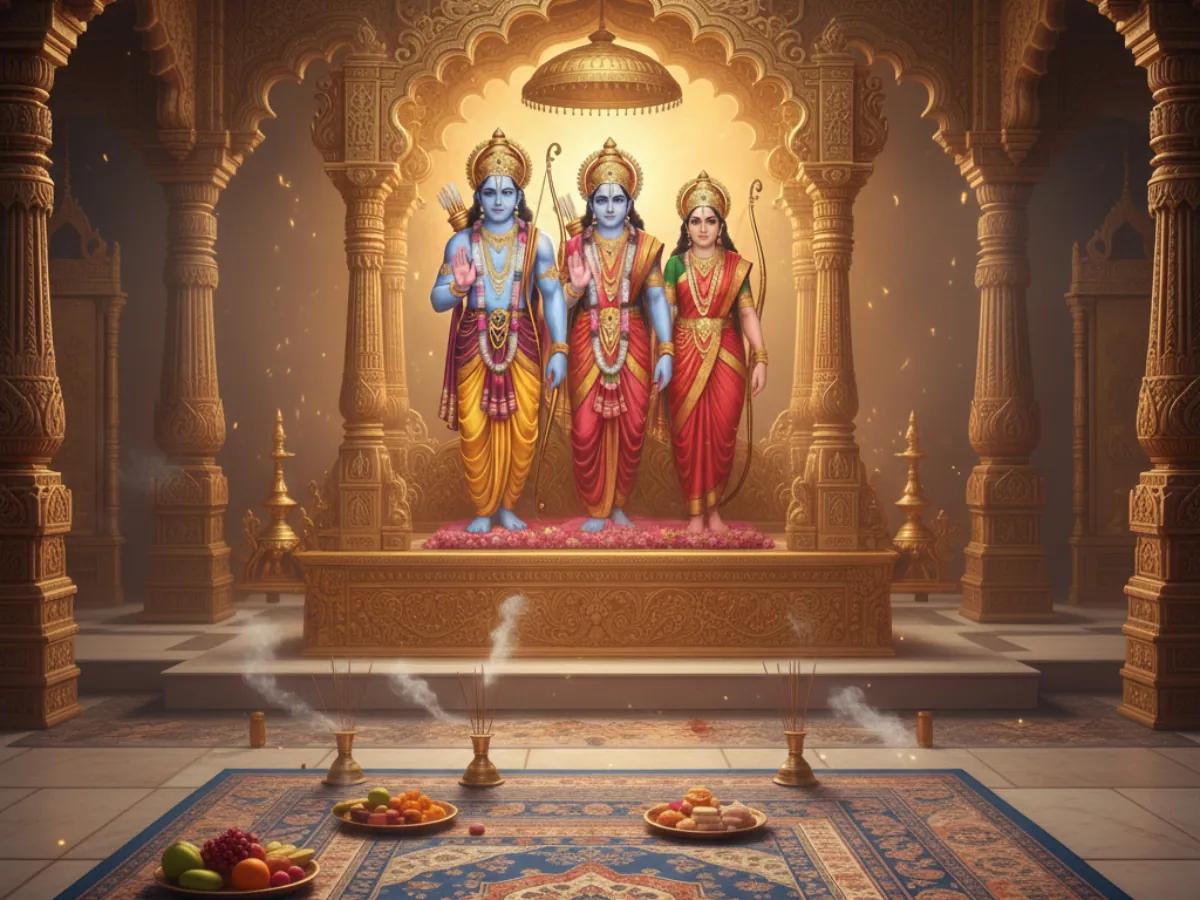
Before the first chaupai come two Sanskrit shlokas. One is for Shankar. The second shows Ram walking the forest path, with Sita ji and Lakshman ji. Nearly every scene that follows happens out on that same path, so you could say the second shloka gives you the entire kand in one small picture before a single chaupai starts.
A small note on numbers.
Every doha (couplet) number here is the Gita Press number, so it should match a printed copy. A chaupai gets named by the doha it sits before or after (“chaupai 4 after doha 34”). Reading the Manas over a month in Masaparayan? Then the 22nd vishram (rest point) comes right at the end of Aranya Kand.
Some names below may be new to you. Keep the main characters of the Ramayana open in another tab while you read.
What happens, scene by scene?
Every episode in order. And where each one sits in the text.
That middle column is for your own copy. Katha tellers jump from one episode to another all the time, and sometimes you just want to read the lines yourself. Small scenes get a row too. Which is why Jayant, whom many summaries drop, is up near the top.
| Episode | Where in Aranya Kand | What to notice |
|---|---|---|
| Opening shlokas | Shlokas 1 and 2 | Shankar first, then Ram on the forest path |
| Jayant and the crow at Chitrakoot | Chaupais before doha 1 to doha 2 | Jayant is spared only after he seeks refuge with Ram |
| Atri and Anasuya | Chaupai 2 after doha 2 to doha 5 kha | Anasuya explains the dharma of a pativrata to Sita |
| Viradh and Sharabhanga | Chaupais before doha 7 to doha 8 | Viradh regains a beautiful form; Sharabhanga gives up his body before Ram |
| Ram’s vow | Doha 9 | Arms raised, Ram vows to rid the earth of rakshasas |
| Sutikshna and Agastya | Chaupais after doha 9 to the chaupais before doha 13 | Agastya sends Ram to Panchavati in the Dandak forest |
| Jatayu and the leaf hut | Doha 13 | Ram settles near the Godavari |
| Lakshman’s questions at Panchavati | Chaupais before doha 14 to doha 16 | Jnana, vairagya, maya, bhakti, Ishvar and jiva |
| Surpanakha | Doha 17 | Her mutilation is a challenge sent to Ravana |
| Khar, Dushan and Trishira | Doha 18 to doha 20 ka | The fallen die saying “Ram Ram” and attain nirvana |
| Surpanakha at Ravana’s court | Doha 21 ka to doha 22 | Ravana cannot sleep that night |
| Sita enters fire | Doha 23 and chaupais 1 to 3 after it | Her reflection stays in her place |
| Marich and the golden deer | Doha 24 to doha 27 | Marich is granted Ram’s own abode |
| Sita’s abduction | Doha 28 to doha 29 ka | Ravana keeps her under an Ashoka tree |
| Jatayu’s fight and last rites | Chaupais after doha 28 to doha 32 | Ram performs his last rites with his own hands |
| Kabandh | Chaupai 3 after doha 32 to chaupai 3 after doha 33 | Kabandh tells Ram his own story |
| Shabari | Doha 34 to the chhand before doha 36 | The nine forms of bhakti |
| The spring forest and Pampa lake | Doha 37 ka to doha 40 | Desire, anger and greed, taught on the way to the lake |
| Narada at Pampa | Doha 41 to the chhand before doha 46 | Ram guards those who rely on him alone |
| Closing phalashruti | Doha 46 ka and doha 46 kha | The fruit of singing or hearing Ram’s glory, in Tulsidas’s words |
How does Ram get from Chitrakoot to Panchavati?
It starts with a crow, at Chitrakoot.
Jayant, Indra’s son, turns himself into a crow to test how strong Ram is, and pecks Sita ji’s foot. A reed comes flying after him. Ram has charged it as a Brahmastra.
No world will give Jayant shelter, not until Narada sends him back to seek refuge with Ram. Ram lets him live. Or rather, lets him off with one eye.
Remember this crow. Much later, at Pampa lake, the same idea comes back in what Ram tells Narada.
The sage Atri’s ashram is next, chaupai 2 after doha 2 to doha 5 kha in your copy. Anasuya meets Sita ji there and explains the dharma of a pativrata. A wife devoted to her husband.
On the road after that Ram kills the asura Viradh, who gets back a beautiful form and is sent to Ram’s abode, and the sage Sharabhanga gives up his body right there in Ram’s presence (chaupais before doha 7 to doha 8).
Further on there are heaps of bones. Sages, killed by the rakshasas (the night-wandering demons of the story). Ram lifts his arms. Then the vow.
निसिचर हीन करउँ महि भुज उठाइ पन कीन्ह। सकल मुनिन्ह के आश्रमन्हि जाइ जाइ सुख दीन्ह॥9॥
Nisichara hina karaun mahi bhuja uthai pana kinha, sakala muninha ke ashramanhi jai jai sukha dinha.
Meaning: Raising his arms, he vowed, “I will rid the earth of the night-wanderers”, and he went to the ashram of every sage and gave each of them comfort. (Aranya Kand, doha 9)
Agastya’s disciple Sutikshna meets Ram and is beside himself with devotion. Off they go to his teacher. Kumbhaj, the text calls him too.
It’s Agastya who sends Ram on to Panchavati, in the Dandak forest. All of this runs from the chaupais after doha 9 to the chaupais before doha 13, and doha 13 is where they settle.
गीधराज सै भेंट भइ बहु बिधि प्रीति बढ़ाइ। गोदावरी निकट प्रभु रहे परन गृह छाइ॥13॥
Gidharaja sai bhenta bhai bahu bidhi priti badhai, Godavari nikata prabhu rahe parana griha chhai.
Meaning: He met Jatayu, the king of vultures, and their friendship grew in many ways; the Lord made a hut of leaves and lived near the Godavari. (Aranya Kand, doha 13)
That is all the geography Tulsidas gives. Near the Godavari. I’d rather leave Panchavati exactly where the doha leaves it.
Lakshman ji’s questions at Panchavati
Lakshman ji wants Ram to explain jnana (knowledge), vairagya (dispassion), maya (illusion) and bhakti. Also the difference between Ishvar, the Lord, and jiva, the individual soul.
Why does he ask. Doha 14 has it, so that grief, delusion and confusion go and love for Ram’s feet grows.
Doha 14 to doha 16 is Ram’s answer. Short, but heavy going. Take it slowly in your own copy first, and hear a katha on it after that.
How does Ravana come into it?
Through his sister, Surpanakha. She comes to Panchavati. Lakshman ji cuts off her nose and her ears, and in doha 17 that cut is a challenge, addressed to Ravana. (Her part in the bigger story is in our post on Surpanakha’s role.)
Then Khar, Dushan and Trishira. Their whole army too. Ram kills them by himself (doha 18 to doha 20 ka).
Stop at doha 20 ka for a second. The rakshasas who fall die saying “Ram Ram”, and they attain nirvana.
Surpanakha’s next stop is Ravana’s court. She laments there, doha 21 ka and kha. Ravana is troubled. Can’t sleep that night (doha 22).
Why does Sita ji go into the fire first?
Many summaries skip the scene that comes next. Tulsidas slips it in between Ravana’s sleepless night and his visit to Marich. Lakshman ji has gone for roots and fruits, and with him away, Ram speaks to Sita ji.
सुनहु प्रिया ब्रत रुचिर सुसीला। मैं कछु करबि ललित नरलीला॥ तुम्ह पावक महुँ करहु निवासा। जौ लगि करौं निसाचर नासा॥1॥
Sunahu priya brata ruchira susila, main kachhu karabi lalita naralila. Tumha pavaka mahun karahu nivasa, jau lagi karaun nisachara nasa.
Meaning: Listen, beloved, faithful to your vows and gentle in conduct. I am going to play out a charming human lila. Live in the fire until I have destroyed the night-wanderers. (Aranya Kand, chaupai 1 after doha 23)
So Sita ji goes in. Her reflection (pratibimb) takes her place, and not even Lakshman ji knows.
The Sita who gets carried off a few dohas later? In the Ramcharitmanas, that is the reflection. The other, later fire scene has its own post, Sita’s agnipariksha.
Doha 24 takes Ravana to Marich. Marich becomes the golden deer, a deceit from the start, and Ram kills him. Like Viradh before him he is granted Ram’s own abode (doha 27).
Sita haran and Jatayu’s last fight
Doha 28. Ravana’s chariot carries Sita ji away through the sky. Threats first. Then coaxing. Neither works, so he keeps her under an Ashoka tree (doha 29 ka), and that is where the story leaves her until the later kands.
Jatayu fights Ravana. He falls.
When Ram finds him, Jatayu asks him not to tell Dasharatha that Sita ji has been taken. Ravana himself will tell it, he says (doha 31). Then he asks Ram for unbroken bhakti and goes to Hari’s abode. And Ram does his last rites. With his own hands (doha 32).
Dasharatha’s son, doing the last rites of a vulture himself. Honestly I don’t think the kand has a plainer or more moving scene than this one, and Tulsidas tells it in barely three dohas.
Shabari’s ashram and navadha bhakti
Ram kills Kabandh on the way. Kabandh tells Ram his own story. Shabari’s ashram comes after that, and all of it sits between chaupai 3 after doha 32 and chaupai 3 after doha 33.
Roots and fruits, that’s Shabari’s offering. Ram’s response is to eat with love and praise them, over and over (doha 34).
Lowly, she calls herself. Here’s what Ram says back.
कह रघुपति सुनु भामिनि बाता। मानउँ एक भगति कर नाता॥2॥
Kaha Raghupati sunu bhamini bata, manaun eka bhagati kara nata.
Meaning: Raghupati said, “Listen to my words, good lady. I recognise only one bond, the bond of bhakti.” (Aranya Kand, chaupai 2 after doha 34)
High caste, family, wealth, skill. A person with any of that and no bhakti, he says, is like a cloud without water. After that the actual teaching starts.
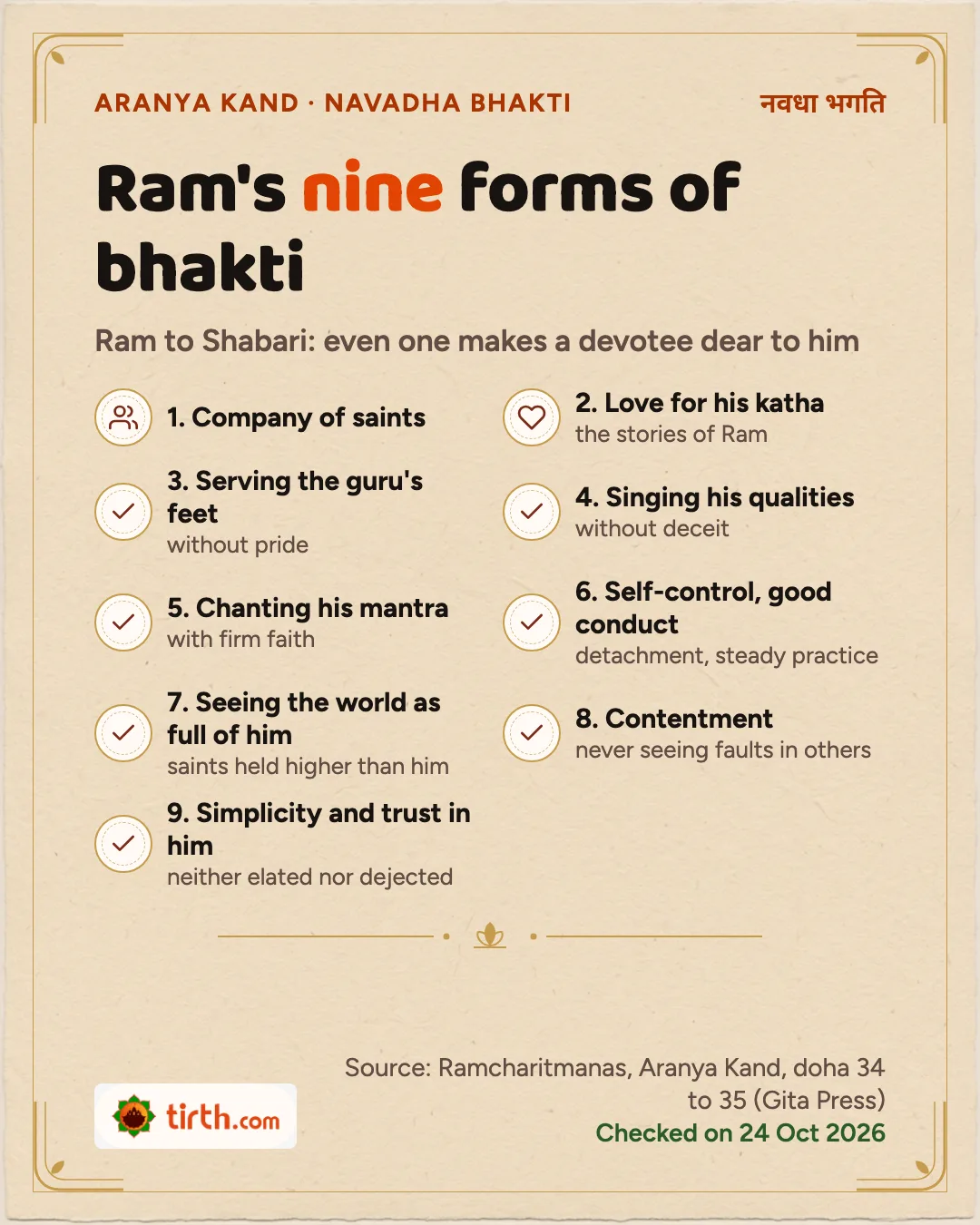
नवधा भगति कहउँ तोहि पाहीं। सावधान सुनु धरु मन माहीं॥
Navadha bhagati kahaun tohi pahin, savadhana sunu dharu mana mahin.
Meaning: I will tell you the nine forms of bhakti. Listen carefully and hold them in your mind. (Aranya Kand, chaupai 4 after doha 34)
We’ve kept the Gita Press order and put each one into our own English. Learning them by heart? Some lists give the third or fourth one differently, so check yours against the text first.
- The company of saints.
- Love for his katha, the stories of Ram.
- Service of the guru’s lotus feet, without pride.
- Singing his qualities without deceit.
- Chanting his mantra with firm faith.
- Self-control, good character, detachment from many activities, and steady practice of the conduct of the good.
- Seeing the world as full of him, and holding saints higher than him.
- Contentment with whatever comes, and never seeing faults in others, even in dreams.
- Simplicity, no deceit with anyone, trust in him, and a mind that is neither elated nor dejected.
Woman or man, it makes no difference. Have even one of these, Ram tells Shabari, and you are very dear to him. Want the words for the fifth one, the mantra? They’re on our Ram mantra page.
Pampa lake is where Shabari sends him next, and she tells him he will make friends with Sugriva there. Then, in yogic fire, Shabari leaves her body. She merges in his feet (chhand before doha 36).
If you read only one passage of the kand slowly, read this one, doha 34 to the chhand before doha 36. Here Ram lays out, in nine numbered points, what bhakti asks of a person, and he says all of it to a woman who had just called herself lowly.
Desire, anger & greed, then Narada at Pampa
Spring, and the forest on the way to Pampa lake. Ram is grieving for Sita ji. He still talks to Lakshman ji about desire, anger and greed (doha 37 ka to doha 39 kha), and reaches the lake soon after.
Doha 38 ka names the three as very strong villains, and says they can shake even a sage’s mind, a mind that is a home of wisdom, in the blink of an eye.
A sage, shaken in a blink. So what about the rest of us householders. We have even more reason to keep an eye on these three.
Then Narada comes. First a boon, that Ram’s name be the greatest of all names (doha 42 ka). Then a question. Why did Ram stop him from marrying?
Like a mother guarding her child, Ram says, that’s how he guards the ones who rely on him alone. After this Ram turns to the qualities of saints. Narada stays for all of it, and only then leaves for Brahmalok (chhand before doha 46).
Which takes us right back to Jayant at Chitrakoot. Spared once he came to Ram for refuge.
What can we take from Aranya Kand?
Tulsidas never lists lessons. The episodes make them plain enough.
One. At Shabari’s ashram, bhakti is the only bond Ram counts. Without it, caste or family or wealth or skill is a cloud with no water.
Two. This one is everywhere in the kand. In the Manas even those who wronged Ram or fought him can take refuge in him. Jayant is spared. The rakshasas who die saying “Ram Ram” attain nirvana, and Marich is granted Ram’s own abode. Our Bhagwan Ram page, Deity page on Tirth has his mantra, chalisa and aarti.
Three, service. Jatayu fought for Sita ji, and his last rites were done by Ram himself.
Four. That warning on the road to Pampa is for everyone, wise or not. Desire, anger and greed can shake even a sage.
Five. Think back to the raised arms at doha 9. There Ram stands as the sages’ protector, and he goes from one ashram to the next to comfort them. People give Ram many titles, and our post on what Maryada Purushottam means looks at one of them.
Tulsidas ends with a phalashruti. A verse on what comes of singing or hearing the kand.
रावनारि जसु पावन गावहिं सुनहिं जे लोग। राम भगति दृढ़ पावहिं बिनु बिराग जप जोग॥46 क॥
Ravanari jasu pavana gavahin sunahin je loga, Rama bhagati dridha pavahin binu biraga japa joga.
Meaning: Those who sing or hear the pure glory of Ravana’s enemy gain firm bhakti for Ram, without dispassion, japa or yoga. (Aranya Kand, doha 46 ka)
Tulsidas is stating his own faith about his kand there, and that is the spirit to read it in, as faith and never as a promise. One more doha, 46 kha, and you’re at the 22nd Masaparayan rest.
Conclusion
That’s Aranya Kand. From a crow at Chitrakoot all the way to Narada at Pampa lake, with Sita ji taken somewhere in between and Ram’s grace reaching Jatayu and then Shabari along the way.
Finishing a reading at home? The aarti of Shri Ramayana ji is on our page, words and all. If a priest doing a puja for your family is what you want, book a puja, Pujas on Tirth with Tirth.
Hope this helps next time you open the Manas.
Frequently asked questions
Chitrakoot first, then the ashrams of Atri, Sutikshna and Agastya, then Panchavati near the Godavari, and that is the route Ram, Sita ji and Lakshman ji take through the first part of the kand. At Panchavati Surpanakha is punished and Khar and Dushan are killed. Marich becomes the golden deer. Ravana abducts Sita ji. After that come Jatayu’s last rites, done by Ram, then Shabari, then Pampa lake, where Narada visits him.
Count by the Gita Press numbering and you get 46 numbered dohas. Doha 46 ka and doha 46 kha close the kand, and that end is also where the 22nd Masaparayan rest point falls.
First the company of saints, then love for his katha. Third is service of the guru’s feet without pride, and fourth singing his qualities without deceit. Then chanting his mantra with firm faith, self-control with the conduct of the good, and seeing the world as full of him. The last two are contentment without seeing faults in others, and simplicity with trust in him. Even one of them, Ram says, makes a person very dear to him.
Chaupai 1 after doha 23 has it. A human lila is about to begin, Ram tells Sita ji, and he asks her to live in fire until he has destroyed the rakshasas. Her reflection takes her place when she enters the fire. Not even Lakshman ji knows.
Indra’s son. At the start of Aranya Kand he takes the form of a crow to test Ram and pecks Sita ji’s foot. Ram sends a reed charged as a Brahmastra after him. When Jayant finally seeks refuge, Ram spares him, with the loss of one eye.
Jnana, vairagya, maya, bhakti, and how Ishvar differs from jiva. Those are Lakshman ji’s questions, and Ram answers him across doha 14 to doha 16.
Sources and further reading
- Ramcharit.in: Ramcharitmanas Aranya Kand with English meaning, the full text of the kand with doha numbers and Masaparayan markers.
- Bharatkosh (Bharat Discovery): the navadha bhakti chaupai, from the Gita Press Gorakhpur text.
- Bharatkosh (Bharat Discovery): doha 35 and the Aranya Kand episode list, from the Gita Press Gorakhpur text.
- Bharatkosh (Bharat Discovery): chaupai 1 after doha 23, Sita entering fire.
- Bharatkosh (Bharat Discovery): doha 46 ka, the closing phalashruti.