On this page8 sections
Bhagavad Gita 1.3 is what he says, and the 1905 translation by Besant and Das gives it as “Behold this mighty host of the sons of Pandu, O teacher, arrayed by the son of Drupada, thy wise disciple.”
That son of Drupada is Dhrishtadyumna. He laid out the army Duryodhana is looking at, and he learned his weapons from Drona himself, although the Mahabharata says he was born to destroy Drona.
In short
He laid out the army Duryodhana is looking at, and he learned his weapons from Drona himself, although the Mahabharata says he was born to destroy Drona.
The verse
पश्यैतां पाण्डुपुत्राणामाचार्य महतीं चमूम् ।
व्यूढां द्रुपदपुत्रेण तव शिष्येण धीमता ॥१-३॥
paśyaitāṃ pāṇḍuputrāṇām ācārya mahatīṃ camūm |
vyūḍhāṃ drupadaputreṇa tava śiṣyeṇa dhīmatā || 1.3 ||
Written Sanskrit joins words where they meet, so the Devanagari runs पुत्राणामाचार्य together as one unit. The transliteration breaks it at ācārya (teacher), the way scholarly editions do, so you can see where one word ends and the next begins.
Which is why the first Devanagari line looks a word short next to the IAST (the pair pāṇḍuputrāṇām and ācārya is printed there as a single unit).
What Bhagavad Gita 1.3 says
In 1905 Annie Besant and Bhagavan Das gave the line in English as “Behold this mighty host of the sons of Pandu, O teacher, arrayed by the son of Drupada, thy wise disciple.” on page 2 of Discourse the First, and their order keeps very close to the Sanskrit.
K. T. Telang had got there first, in 1882.
“O preceptor! observe this grand army of the sons of Pandu, drawn up in battle-array by your talented pupil, the son of Drupada.” That is how his version runs in the Sacred Books of the East (vol. VIII, Chapter I, p. 37), and you can hear at once that the address has been pulled right to the front.
Mostly the difference between them is a matter of order.
In the 1905 version “O teacher” lands in the middle, in the same place ācārya has in the Sanskrit line. Telang saves “the son of Drupada” for last.
What each word in Bhagavad Gita 1.3 means
Column three is the 1905 edition in its own words, its brackets and its comma order left exactly as printed. The last column is ours. Tirth wrote those case notes in plain English, and nothing in them is quoted from the edition. If you have never met Sanskrit cases before, start there, and only come back to the glosses in column three once the endings make some sense to you.
| Sanskrit | IAST | Meaning (Besant and Das, 1905) | Case note |
|---|---|---|---|
| पश्य | paśya | behold | imperative, 2nd person singular |
| एताम् | etām | this | accusative feminine singular, agrees with camūm |
| पाण्डुपुत्राणाम् | pāṇḍuputrāṇām | of Pandu, the sons | genitive plural; 1905 resolves it as पाण्डोः पुत्राणाम् |
| आचार्य | ācārya | O teacher | vocative singular |
| महतीम् | mahatīm | great | accusative feminine singular |
| चमूम् | camūm | army | accusative feminine singular |
| व्यूढाम् | vyūḍhām | arrayed | accusative feminine singular, past participle |
| द्रुपदपुत्रेण | drupadaputreṇa | of Drupada, by the son | instrumental singular; 1905 resolves it as द्रुपदस्य पुत्रेण |
| तव | tava | thy | genitive of tvam |
| शिष्येण | śiṣyeṇa | (by) disciple | instrumental singular |
| धीमता | dhīmatā | (by) wise | instrumental singular of dhīmat |
Run your eye down the last column and the words split into two groups. Camū (army) is a feminine noun, and the army is the thing Drona is being told to look at, which is why etām, mahatīm, camūm and vyūḍhām all come out feminine accusative. The other group is about the man who arranged it. Instrumental, singular, “by” someone. Tava (thy) is the one genitive among them, and all it does is say whose disciple he is. So dhīmatā, wise, goes with the disciple, and the grammar settles that on its own.
The two compounds are where most readers trip. Pāṇḍuputrāṇām is “of the sons of Pandu”, which the 1905 edition opens out as पाण्डोः पुत्राणाम्, and drupadaputreṇa is “by the son of Drupada”, opened out as द्रुपदस्य पुत्रेण. Once you see the joins, the grammar is simple. A first-year student could parse the line with this table and a little patience.
Who is speaking, and to whom
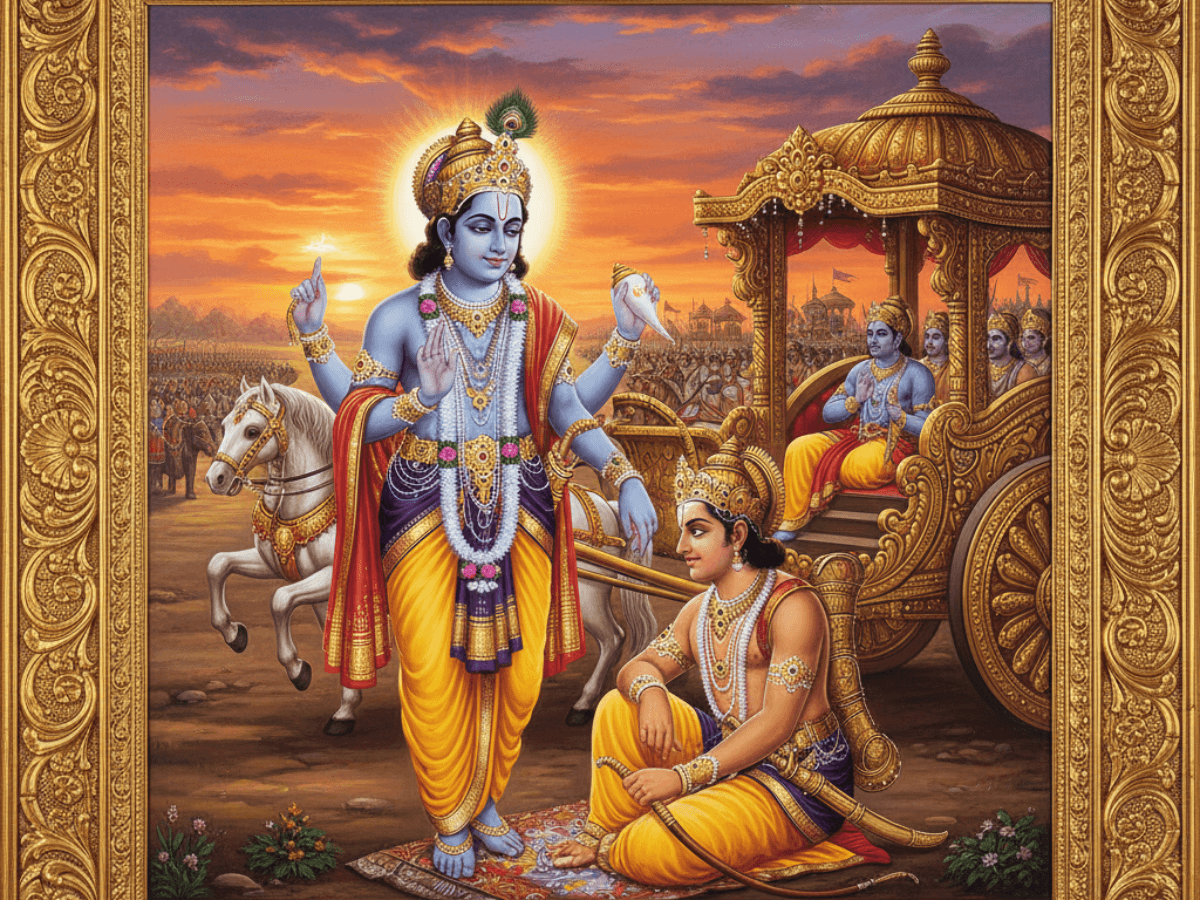
Sanjaya does the telling in chapter 1, speaking to Dhritarashtra, and the whole thing starts because Dhritarashtra asked him about Kurukshetra. Verse 1.2 has Duryodhana going up to his teacher to speak. A footnote in the 1905 edition settles who that is (Drona, the son of Bharadvaja). Bhagwan Krishna does not say a word in this verse, and Tirth keeps a separate page on Bhagwan Krishna, Deity page on Tirth for anyone who came looking for him.
So Duryodhana points at two things at once.
The army, and the man who drew it up. The second one hurts, and the reason lies in three earlier episodes of the Adi Parva, all of them in K. M. Ganguli’s English.
First the quarrel, in Section CXL. Drona had been insulted by Drupada, the king of Panchala, and his answer was to send out his pupils the Pandavas to seize Drupada in battle and bring him back. Half of Drupada’s kingdom (the territory south of the Bhagirathi) went back to Drupada after that, and Drona asked to be his friend again.
Drupada wanted a son “capable of slaying Drona”. He had the brahmana Yaja perform a sacrifice for it, with Upayaja assisting, and Dhrishtadyumna rose out of that fire while a voice declared, in Ganguli’s words, “This prince hath been born for the destruction of Drona” (Section CLXIX). Out of that same sacrifice came Draupadi too, the one called Panchali. And Drona still took the boy on. Ganguli’s text says he “taught him all weapons in requital of half the kingdom he had formerly taken from Drupada”. It adds that Drona, “regarding destiny to be inevitable, did what would perpetuate his own great deeds.”
Go back to the second line of 1.3 with all of that in mind, to tava śiṣyeṇa dhīmatā (by your wise disciple). In this verse Duryodhana calls the enemy commander only Drupada’s son and Drona’s own wise pupil, and the small word tava (your) is what pins him on Drona. We read it as blame. Or rather blame said politely, by a prince to his own teacher, about a student Drona trained himself and who was born to kill him.
If you are learning it by heart
We would rather nobody read 1.3 by itself as part of a daily path (a regular recitation or reading of a text), even if a few verses a day is all the time there is. Say it after 1.2, which is where you find out who “acharya” is. Then carry on to 1.11. The speech is nine verses long, and its shape only comes through once you have heard the whole of it.
The word table works as a drill. Cover the meaning column, say each IAST word aloud, and try to give its sense and its case prior to checking (the Sanskrit and IAST columns stay open, so the sounds are always in front of you). Go to Telang’s freer English only after the Besant and Das line, since the 1905 one keeps to the Sanskrit order.
Chapter 1 is narrative. It sets the scene for the teaching that follows, and if your habit is to close a reading with an aarti, the words of the Bhagavad Gita Aarti are on Tirth.
Duryodhana’s speech, from 1.3 to 1.11
Duryodhana does not stop at 1.3. This is the opening verse of a speech that runs all the way to 1.11, and Sanjaya only takes the story back at verse 12, so for nine verses straight the narrator steps aside and you hear Duryodhana in his own voice. All of it falls inside Arjuna Vishada Yoga (the yoga of Arjuna’s despondency), the first chapter, which has 47 verses.
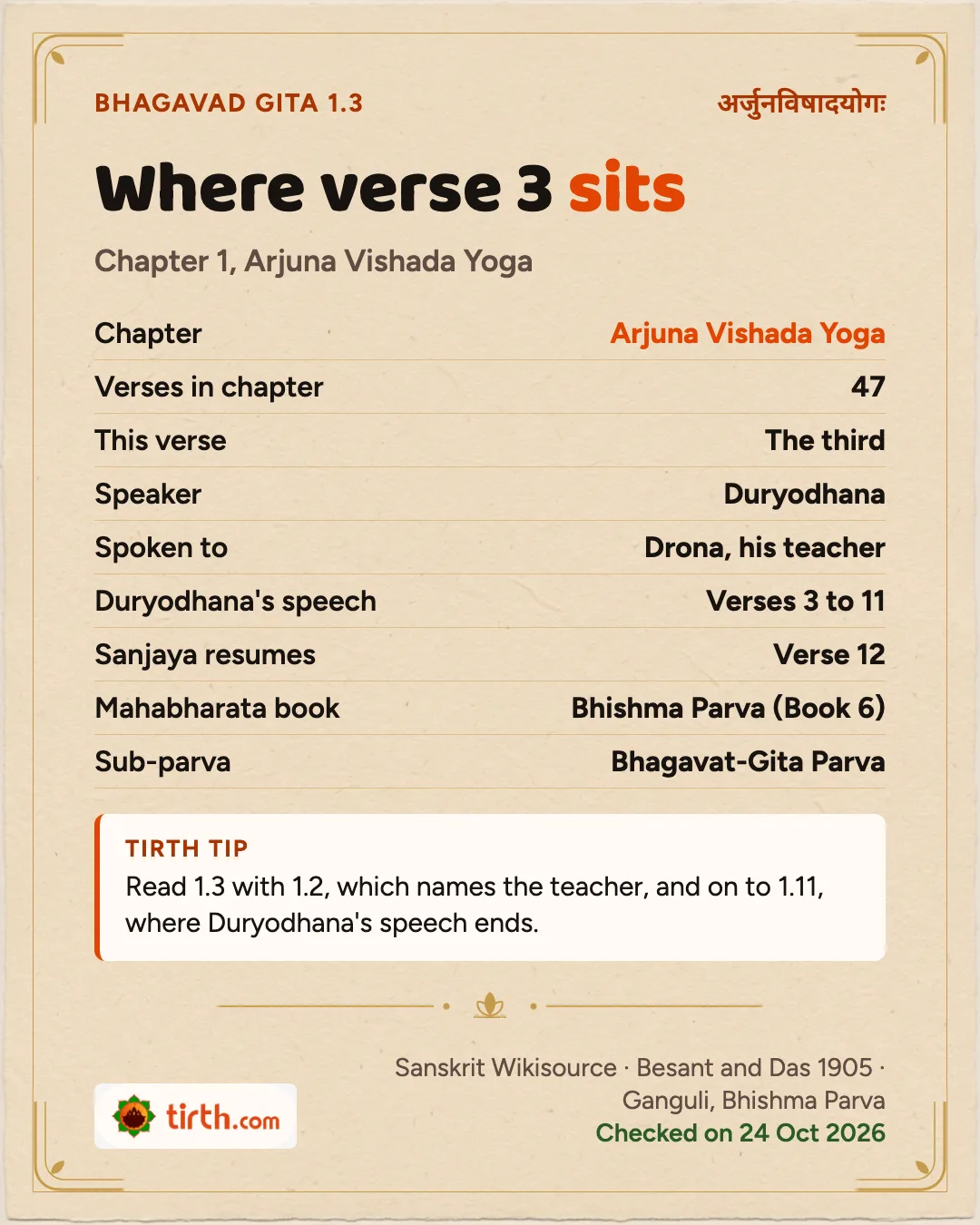
Step back again and you are in the Mahabharata. The Gita belongs to its Bhishma Parva (Book 6), inside a sub-parva called the Bhagavat-Gita Parva. Ganguli’s translation makes the Gita’s first chapter Section XXV of the Bhishma Parva and gives this verse as “Behold, O preceptor, this vast army of the son of Pandu, arrayed by Drupada’s son (Dhrishtadyumna), thy intelligent disciple.”
Edition to edition, the chapter numbers inside the Bhishma Parva do not agree. The Pune critical edition numbers this verse 6.23.3, for instance, while Ganguli files it under Section XXV. So with a printed Mahabharata in your hands, go by the name Bhagavat-Gita Parva and forget about a fixed chapter number.
More on this: the Krishna mantra, the Krishna Aarti, Gita Jayanti and Janmashtami, Bhagwan Krishna’s birth festival.
For a puja done by a priest for your family, book a puja with Tirth, Pujas on Tirth.
Frequently asked questions
It is Duryodhana, and the ācārya he is addressing is Drona, his teacher. The words reach us through Sanjaya, who reports them to Dhritarashtra along with the rest of the chapter.
Dhrishtadyumna. He was the son of King Drupada, who ruled Panchala, and Ganguli prints his name in brackets in his version of this verse. His birth from Drupada’s sacrificial fire is told in the Adi Parva (Section CLXIX).
Because it was true. A voice at Dhrishtadyumna’s birth had announced that he was born for Drona’s destruction, and Drona still taught him all weapons. The phrase “your wise disciple” makes Drona face the fact that his own student drew up the army opposite.
Wise. Dhīmatā is the instrumental singular of dhīmat, which is why the 1905 edition glosses it “(by) wise”, and in their full translation Besant and Das make the phrase “thy wise disciple” where Telang has “your talented pupil”.
The name of chapter 1 is Arjuna Vishada Yoga, which in English comes out as the yoga of Arjuna’s despondency. It has 47 verses. Duryodhana’s speech starts with the third of them, 1.3.
Inside the Mahabharata it sits in Book 6, the Bhishma Parva, and the sub-parva that holds it is named after it, the Bhagavat-Gita Parva. Look in Ganguli’s English under Section XXV of that parva and you reach the Gita’s first chapter.
Sources and further reading
All three translations used here are in the public domain. Annie Besant (1847 to 1933) and Bhagavan Das (1869 to 1958) published their edition in 1905, and this page quotes that 1905 printing only. K. T. Telang (1850 to 1893) published his in 1882, and K. M. Ganguli’s Mahabharata appeared from 1883 to 1896.
- Wikisource (Sanskrit): Bhagavad Gita, Arjuna Vishada Yoga, the Devanagari text of chapter 1
- Internet Archive: Annie Besant and Bhagavan Das, The Bhagavad-Gita with Samskrit text, free translation into English, a word-for-word translation, and an introduction on Samskrit grammar (Theosophical Publishing Society, 1905), Discourse the First, p. 2
- Internet Archive: K. T. Telang, The Bhagavadgita with the Sanatsugatiya and the Anugita, Sacred Books of the East vol. VIII (Clarendon Press, 1882), Chapter I, p. 37
- ibiblio: K. M. Ganguli, The Mahabharata, Bhishma Parva, Section XXV
- GRETIL: Mahabharata, Bhishmaparvan, Pune critical edition text (Bhandarkar Oriental Research Institute), verse 6.23.3
- Wikisource: K. M. Ganguli, The Mahabharata, Adi Parva, Section CXL, Drona and Drupada
- Wikisource: K. M. Ganguli, The Mahabharata, Adi Parva, Section CLXIX, the birth of Dhrishtadyumna