On this page7 sections
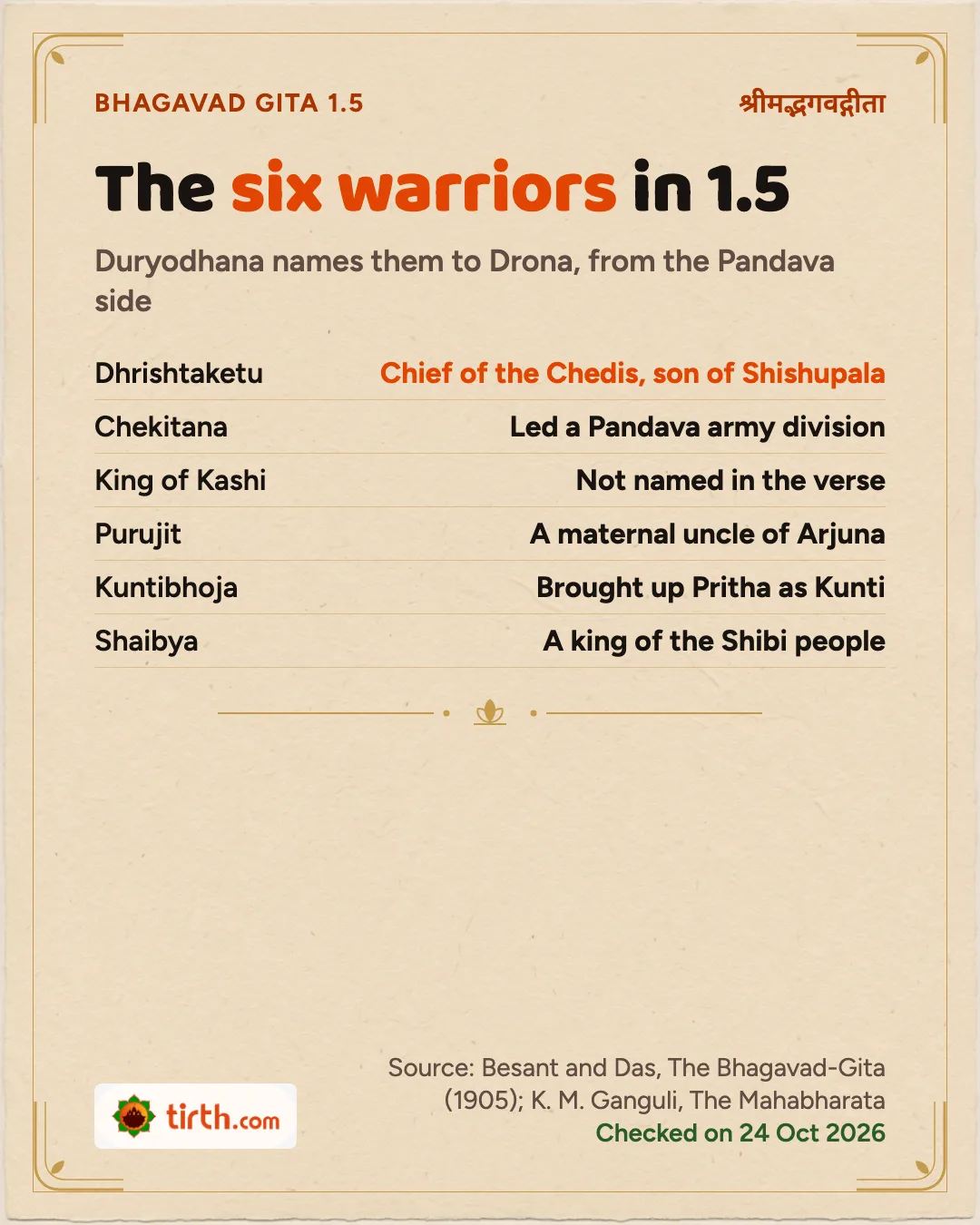
Duryodhana gives it to Shaibya, last in a line of six Pandava warriors he points out to his teacher Drona. The other five are Dhrishtaketu, Chekitana, the valiant king of Kashi, Purujit and Kuntibhoja.
That roll call of the opposing army runs from verse 1.4 to 1.6, early in Arjuna Vishada Yoga, the first of the Gita’s 18 chapters.
Anyone after the sung text wants the aarti of the Bhagavad Gita, which has a page of its own.
In short
The other five are Dhrishtaketu, Chekitana, the valiant king of Kashi, Purujit and Kuntibhoja. That roll call of the opposing army runs from verse 1.4 to 1.6, early in Arjuna Vishada Yoga, the first of the Gita’s 18 chapters. Anyone after the sung text wants the aarti of the Bhagavad Gita, which has a page of its own.
Reading Bhagavad Gita 1.5 aloud
धृष्टकेतुश्चेकितानः काशिराजश्च वीर्यवान् ।
पुरुजित्कुन्तिभोजश्च शैब्यश्च नरपुङ्गवः ॥१-५॥
dhṛṣṭaketuś cekitānaḥ kāśirājaś ca vīryavān |
purujit kuntibhojaś ca śaibyaś ca narapuṅgavaḥ || 1.5 ||
The Devanagari is the Wikisource text of chapter 1, character for character. Set it beside the IIT Kanpur Gita Supersite and only the spacing of the closing mark is different. Learn it with its neighbours. We would rather you read 1.4, 1.5 and 1.6 in one breath than 1.5 alone, because the three verses are a single sentence and this one, cut loose, is a list of names with nothing to hold it. 1.4 names Yuyudhana, Virata and Drupada. And 1.6 carries on to Yudhamanyu, Uttamauja, Saubhadra (Abhimanyu, the son of Subhadra and Arjuna) and the sons of Draupadi.
Which is why you will find no verb in 1.5 at all. Just names and words of praise, strung together on “ca” (and).
If you are reading with a parent who knows the Devanagari and you do not, keep your eye on the italic line under it, where the single bar (a danda) closes the first half of the verse and the double bar closes the whole verse.
Mind one letter. In this scheme “c” is said like the “ch” in “church”, so cekitānaḥ comes out as Chekitana.
What each word in Bhagavad Gita 1.5 means
Annie Besant and Bhagavan Das printed these word-for-word meanings on page 3 of their 1905 edition, and the third column keeps their wording, minus the accent marks on the names. The last column is ours. Plain words.
| Sanskrit | Transliteration | Besant and Das (1905) | Plain gloss |
|---|---|---|---|
| धृष्टकेतुः | dhṛṣṭaketuś | Dhrishtaketu | A warrior’s name; the Mahabharata makes him chief of the Chedis |
| चेकितानः | cekitānaḥ | Chekitana | A warrior’s name |
| काशिराजः | kāśirājaś | of Kashi, the King | The king of Kashi, one word in Sanskrit |
| च | ca | and | And |
| वीर्यवान् | vīryavān | valiant | Full of valour; it describes the king of Kashi |
| पुरुजित् | purujit | Purujit | A warrior’s name |
| कुन्तिभोजः | kuntibhojaś | Kuntibhoja | A king’s name |
| च | ca | and | And |
| शैब्यः | śaibyaś | Shaibya | The king of the Shibi people |
| च | ca | and | And |
| नरपुङ्गवः | narapuṅgavaḥ | among men, bull | A bull among men, a title of honour given to Shaibya |
A few words in the second column end in “ś”. That is how the line sounds when it is recited. Before a word that starts with “c”, a final “ḥ” turns into “ś” (dhṛṣṭaketuś cekitānaḥ, śaibyaś ca), and the second column copies the sound, while the Devanagari column keeps each word in its bare dictionary form.
The word that puzzles most first-time readers is the last one. The 1905 edition explains it in a footnote that is worth reading slowly, “The bull, as the emblem of manly strength and vigour, is often used as an epithet of honour.” So the word honours Shaibya.
Two old translations of Bhagavad Gita 1.5
First, page 3 of the Theosophical Publishing Society’s 1905 edition, The Bhagavad-Gita by Besant and Bhagavan Das:
“Dhrishtaketu, Chekitana, and the valiant Raja of Kashi; Purujit and Kuntibhoja, and Shaibya, bull among men;”
Telang’s rendering is older. It is on page 37 of The Bhagavadgita in the Sacred Books of the East (volume 8, Clarendon Press, Oxford, 1882):
“and Dhrishtaketu, Kekitana, and the valiant king of Kasi, Purugit and Kuntibhoga, and that eminent man Saibya;”
Telang uses the spelling scheme of his day, so Chekitana is Kekitana, Kashi is Kasi, Purujit and Kuntibhoja become Purugit and Kuntibhoga, and Shaibya is Saibya. He writes the Gita as running prose, too. No verse numbers. The accent marks both books print are left out of the quotes above. And each stops on a semicolon, because 1.6 finishes the sentence.
In plain English, Dhrishtaketu, Chekitana and the brave king of Kashi, and Purujit, Kuntibhoja and Shaibya, foremost among men.
Only the last epithet splits them. Telang’s “that eminent man” is gentler on a modern ear than “bull among men”. Or rather, he lets the bull go and keeps the honour. For learning to recite, though, the Besant and Das word list is the one to keep open, because it walks through the Sanskrit a word at a time and every sound has its meaning right beside it.
Who were Dhrishtaketu, Chekitana and Shaibya?
Neither Gita edition stops to comment on any of the six. For that you go to the Mahabharata, which has something on most of them. The notes below come from K. M. Ganguli’s English Mahabharata, and book and section are given each time so the passage is easy to find and check.
Dhrishtaketu
Shishupala’s son, and chief of the Chedis. The Udyoga Parva (Section XIX) calls him “the powerful chief of the Chedis” and has him come to the sons of Pandu with an akshauhini (a full army of chariots, elephants, horse and foot, whose make-up the Adi Parva sets out in Section II). In the Sabha Parva (Section XLIV), once Shishupala has died at the Rajasuya, Yudhishthira installs Shishupala’s son as king of the Chedis. That section leaves the son unnamed. The Drona Parva (Section CXXIV) does not, and calls Dhrishtaketu “the son of Sisupala” where it tells how Drona killed him.
Chekitana
He led one of the seven divisions of the Pandava army. The Udyoga Parva (Section CLI) names the seven leaders prior to the war, and Chekitana stands there beside Drupada, Virata, Dhrishtadyumna, Shikhandi, Satyaki and Bhimasena.
The king of Kashi
His name is missing from the verse and from every source we used. Besant and Das gloss the word simply as “of Kashi, the King”. Ganguli’s Bhishma Parva gets no closer than “the ruler of Kasi endued with great energy”, so if a page hands you a personal name for him, ask where it came from, because it did not come from this verse.
Purujit and Kuntibhoja
They come as a pair in the verse, and the epic pairs them too.
Drona kills them both, according to the report in the Karna Parva (Section VI), where Ganguli’s text calls them “the two maternal uncles of Savyasaci”, which means Arjuna.
Much earlier in the epic, in the Adi Parva (Section CXI), Sura gives Pritha, his firstborn daughter, to Kuntibhoja, a cousin and friend who had no children of his own, and she grows up as Kunti, the mother of the Pandavas. We have not tried to square the two. The Mahabharata gives both, and so both stay on this page exactly as it gives them.
Shaibya
The name means a king of the Shibi (Saivya) people. Which king, neither translation says. There is a Govasana of the Saivya tribe in the Mahabharata, father of Devika, who was Yudhishthira’s wife (Adi Parva, Section XCV), and the Gita never says he is the Shaibya named here.
Maharatha (great car-warrior) is not in 1.5. It turns up on both sides of it, in 1.4 and again in 1.6, and the 1905 edition defines it in a footnote to 1.4 as “one able to fight alone ten thousand bowmen”.
Verse 5 in chapter 1 and the Bhishma Parva
The Gita has 18 chapters, and the first, Arjuna Vishada Yoga (प्रथमोऽध्याय: अर्जुनविषादयोगः, the yoga of Arjuna’s despondency), has 47 verses. Verse 5 comes early, when Duryodhana approaches his teacher Drona, the son of Bharadvaja, and speaks.
Step further back and the whole Gita sits inside the Mahabharata, in the Bhishma Parva. The sixth book. According to Telang, writing in his 1882 introduction, the Gita lends its name to a subdivision of that book, the Bhagavadgita Parva. That holds the 18 Gita chapters and 12 other chapters besides. Look up Section XXV of the Bhishma Parva in Ganguli’s translation and you are in Gita chapter 1. Which is where Sanjaya reports Duryodhana naming these same warriors. Our Bhagwan Krishna, Deity page on Tirth page covers who Krishna is away from this battlefield.
To finish with a short prayer, try the Krishna mantra page, which has the common ones along with what each means. A priest can also do a path for your family, a Vishnu Sahasranam path for example, and Tirth’s puja booking, Pujas on Tirth is where you arrange it.
Frequently asked questions
In the verse Duryodhana is pointing out to Drona six of the fighters in the Pandava army, and he calls the last of them “bull among men”. They are Dhrishtaketu, Chekitana, the valiant king of Kashi, Purujit, Kuntibhoja and Shaibya. The 1905 translation by Besant and Das reads “Dhrishtaketu, Chekitana, and the valiant Raja of Kashi; Purujit and Kuntibhoja, and Shaibya, bull among men;”.
Duryodhana is. He is talking to his teacher Drona and going through the strongest fighters on the Pandava side, in a list that starts at verse 1.4 and ends at verse 1.6.
He goes unnamed. Besant and Das give no name either, Telang gives none, and Ganguli’s Mahabharata only says “the ruler of Kasi endued with great energy”.
Arjuna’s two maternal uncles, in the Karna Parva, which reports that Drona killed them both. Kuntibhoja is also the king who, in the Adi Parva, brought up Pritha. She became Kunti, the mother of the Pandavas.
It translates as “bull among men”. The 1905 edition says in a note that the bull, as the emblem of manly strength and vigour, is often used as an epithet of honour. Telang leaves the animal out altogether and writes “that eminent man”.
It is in the first chapter, Arjuna Vishada Yoga, a chapter of 47 verses. In the Mahabharata, that puts it in the Bhishma Parva, book six of the epic.
Sources and further reading
- Wikisource (Sanskrit): भगवद्गीता, अर्जुनविषादयोगः, the Sanskrit text of chapter 1
- IIT Kanpur Gita Supersite: chapter 1, verse 5, Sanskrit text
- Annie Besant and Bhagavan Das, The Bhagavad-Gita, Theosophical Publishing Society, London and Benares, 1905 (Internet Archive), Sanskrit text with word-for-word and free translation
- K. T. Telang, The Bhagavadgita, Sacred Books of the East volume 8, Clarendon Press, Oxford, 1882 (Internet Archive)
- K. M. Ganguli, The Mahabharata, Bhishma Parva, Section XXV (ibiblio)
- K. M. Ganguli, The Mahabharata (ibiblio): Udyoga Parva, Section XIX, Udyoga Parva, Section CLI, Sabha Parva, Section XLIV, Drona Parva, Section CXXIV, Karna Parva, Section VI, Adi Parva, Section II, Adi Parva, Section CXI and Adi Parva, Section XCV
The translations quoted on this page are in the public domain. The Besant and Das edition was published in 1905; Besant died in 1933 and Bhagavan Das in 1958, so under Indian copyright (the author’s life plus 60 years) it entered the public domain on 1 January 2019. Telang’s translation was published in 1882, and he died in 1893.