On this page6 sections
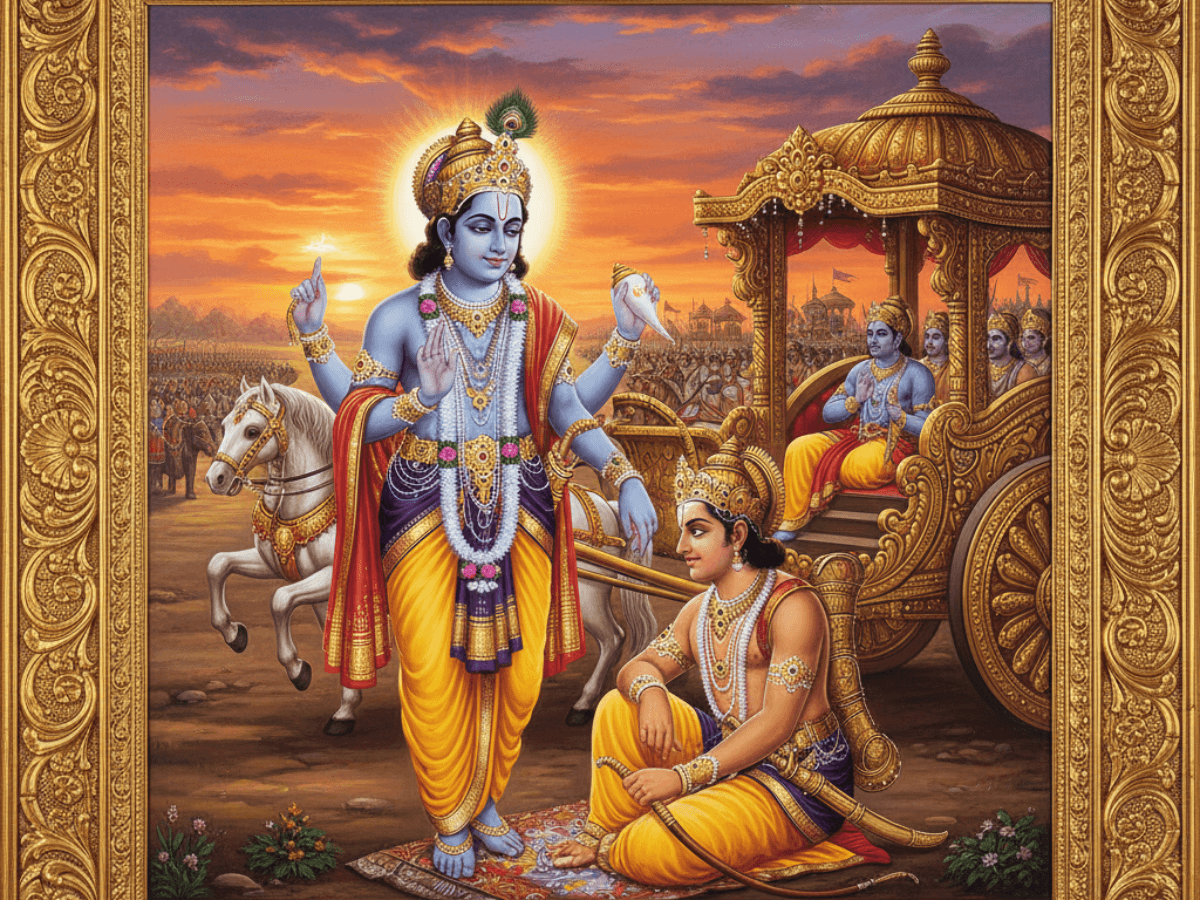
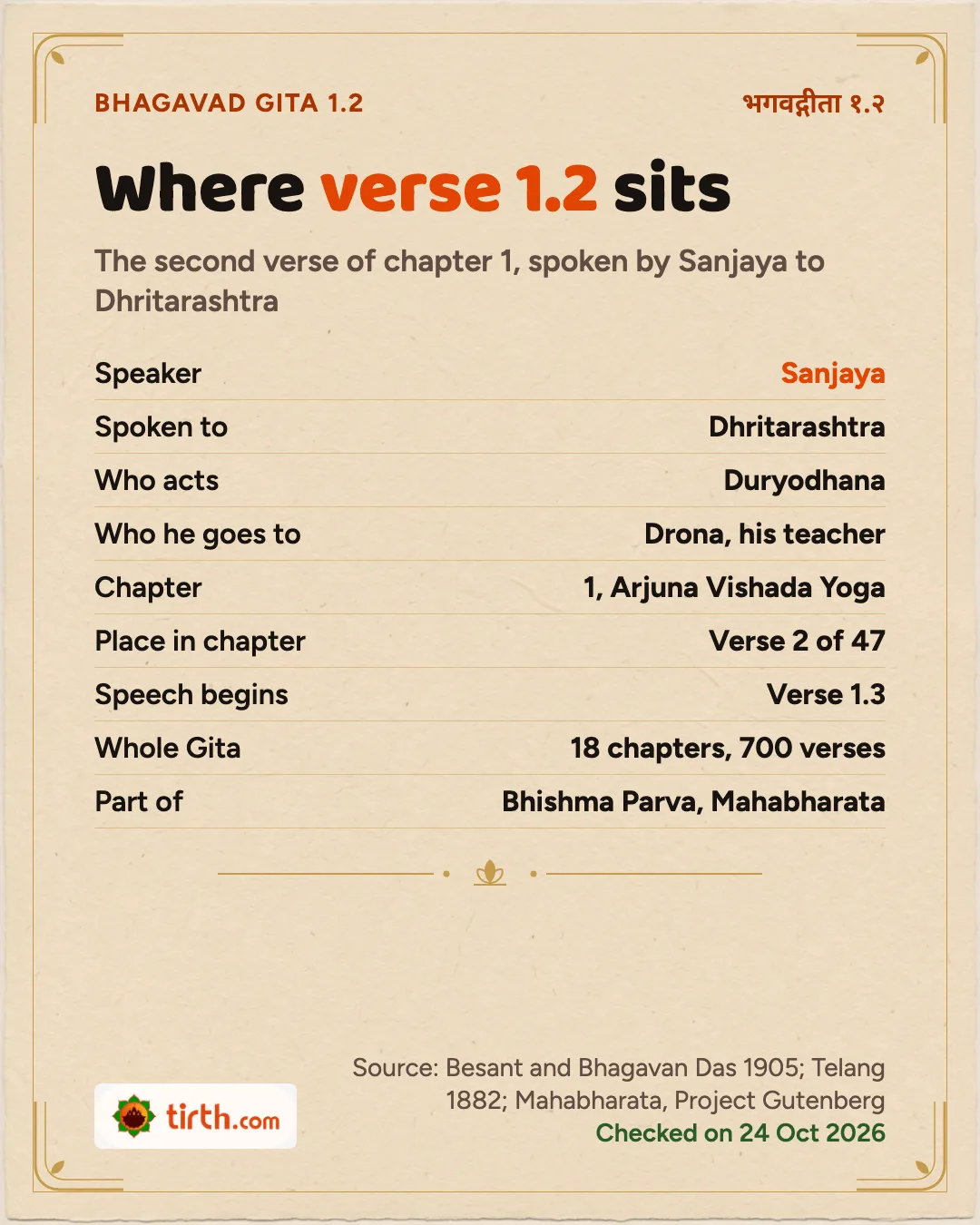
That is all that happens in Bhagavad Gita 1.2, and the one telling it is Sanjaya, reporting to the blind king Dhritarashtra.
Two lines of verse. They are Sanjaya’s first answer to the question Dhritarashtra asks in 1.1, and they set the stage for Duryodhana, whose own words begin with the very next verse, 1.3.
In short
Two lines of verse. They are Sanjaya’s first answer to the question Dhritarashtra asks in 1.1, and they set the stage for Duryodhana, whose own words begin with the very next verse, 1.3.
Reading Bhagavad Gita 1.2 aloud
Sanjaya’s name comes first, on a line of its own.
| Devanagari | Transliteration | Meaning |
|---|---|---|
| सञ्जय उवाच | sañjaya uvāca | Sanjaya said: |
| दृष्ट्वा तु पाण्डवानीकं व्यूढं दुर्योधनस्तदा । | dṛṣṭvā tu pāṇḍavānīkaṃ vyūḍhaṃ duryodhanastadā | Then Duryodhana, having seen the army of the Pandavas drawn up in array, |
| आचार्यमुपसंगम्य राजा वचनमब्रवीत् ॥ | ācāryamupasaṅgamya rājā vacanamabravīt | the king went up to his teacher and spoke these words. |
Pulled apart into separate words, the same two lines read dṛṣṭvā tu pāṇḍava-anīkam vyūḍham duryodhanaḥ tadā | ācāryam upasaṅgamya rājā vacanam abravīt.
Say sañjaya uvāca by itself, prior to the verse proper, the way you would read out a heading. Breathe once, at the single daṇḍa after duryodhanastadā where the first line ends, and let the double daṇḍa close the second.
Three sounds in it are worth slowing down for. The ṣṭ of dṛṣṭvā and the ḍh of vyūḍhaṃ are retroflex, said with the tip of the tongue turned up and drawn back. The ḍh has breath behind it as well, so it comes out as a voiced d with air in it. And the ñ of sañjaya is the palatal nasal, an n made at the spot where the j after it is made (it only ever comes before a palatal sound such as j).
Two old translations of Bhagavad Gita 1.2
On page 2 of their 1905 edition, Annie Besant and Bhagavan Das write “Sanjaya said: Having seen arrayed the army of the Pāṇḍavas, the Rājā Duryodhana approached his teacher, and spake these words:”
K. T. Telang’s version is older, from 1882, in volume 8 of the Sacred Books of the East, and on page 37 it reads “Sañgaya said: Seeing the army of the Pāṇḍavas drawn up in battle-array, the prince Duryodhana approached the preceptor, and spoke (these) words:”
That is Telang’s spelling of the narrator’s name. Sañgaya, with a g. At “battle-array” Telang adds a footnote, and it sends you to the Laws of Manu (chapter VII, verse 187), which lists several modes of drawing up an army.
Neither book is under copyright now. Telang died in 1893, Besant in 1933 and Bhagavan Das in 1958, and each book was in print before 1930.
What each word in Bhagavad Gita 1.2 means
The word meanings below are from the 1905 edition by Annie Besant and Bhagavan Das, which gives a word-for-word rendering of this verse on page 2. The Devanagari in this table is as that edition prints it. It uses the anusvara forms (संजयः, पांडवानीकं, व्यूढं, उपसंगम्य), so a few letters look slightly different from the verse above. The sound and the meaning are the same. The last column is our own short note.
| Devanagari | Transliteration | Meaning (1905 edition) | Note |
|---|---|---|---|
| संजयः | sañjayaḥ | Sanjaya | The narrator, speaking to Dhritarashtra |
| उवाच | uvāca | said | Opens his report |
| दृष्ट्वा | dṛṣṭvā | having seen | Duryodhana sees first, then acts |
| तु | tu | indeed | A small word of emphasis |
| पांडवानीकं = पांडवानां अनीकं | pāṇḍavānīkam = pāṇḍavānām anīkam | of the Pāṇḍavas, the army | One compound, two words: the Pandavas’ army |
| व्यूढं | vyūḍham | arrayed | Drawn up in battle formation |
| दुर्योधनः | duryodhanaḥ | Duryodhana | The subject of the verse |
| तदा | tadā | then | At that moment |
| आचार्यम् | ācāryam | the teacher | Drona |
| उपसंगम्य | upasaṅgamya | having approached | He goes up close to him |
| राजा | rājā | the King (Duryodhana) | A title meaning king, used here for Duryodhana |
| वचनम् | vacanam | speech | What follows from 1.3 |
| अब्रवीत् | abravīt | said | He spoke |
If you are learning 1.2 for a class or an exam, work from this table and keep the English version as a check. One compound is the reason. Read as a single block, pāṇḍavānīkam is a long word that tells a new reader very little, but split the way the 1905 edition splits it, into pāṇḍavānām anīkam, it turns into “the army of the Pandavas”, and everything else in the line settles around those two words.
Duryodhana turns up twice in these lines, first by name and then as rājā (king).
Which is where the two old translations part ways.
The 1905 edition glosses rājā as “the King (Duryodhana)”, while Telang in 1882 has “the prince Duryodhana” at that same spot.
Why Duryodhana says this now
He has just seen the other side, the Pandava army. Or rather the army vyūḍham, arrayed, already drawn up in battle formation, and only tadā (then) does he walk up to Drona and begin to speak.
So the verse has three people in it. Sanjaya tells it. Duryodhana acts, Drona is the one he walks up to, and the speech itself starts at 1.3. Neither Bhagwan Krishna, Deity page on Tirth nor Arjuna is named here, even though the whole Gita is their dialogue and the closing line of chapter 1 says exactly that.
Sanjaya, who tells the king
At Dhritarashtra’s court Sanjaya was a suta (charioteer and bard) and a minister the king trusted, known as the son of Gavalgana, and Udyoga Parva, Section XXIII, uses exactly those words for him, with Yudhishthira addressing him there as “O Sanjaya”. Before the war Vyasa gave him celestial vision. The Mahabharata tells it in the Bhishma Parva, Section II, and the purpose was plain enough, so that a blind king could still have the battle described to him.
Every verse of the Gita reaches Dhritarashtra by that route. This one is Sanjaya’s reply to what the king asked in 1.1.
Duryodhana, the rājā of the verse
He leads the Kaurava side at Kurukshetra, and of the hundred sons Gandhari bore Dhritarashtra he is the eldest. Yudhishthira is older than him, though. Adi Parva, Section CXV, puts Yudhishthira first in the order of birth.
Drona, the teacher he goes to
In the verse he is only the ācārya (teacher). His name is Drona, or Dronacharya, and the 1905 edition supplies it in a footnote at that word: “Drona, the son of Bhāradvāja.”
Adi Parva, Sections CXXXI and CXXXIII, fill in the rest. The sage Bharadwaja’s son learns the Vedas and the science of arms until he has mastered both, and Bhishma himself goes to him to make him preceptor of the Kuru and Pandava princes. (If you are checking these in another edition, the section numbers here are those of the English prose translation of the Mahabharata on Project Gutenberg.)
Where 1.2 sits in Arjuna Vishada Yoga
The chapter’s name points the way.
It is Arjuna Vishada Yoga (the yoga of Arjuna’s despondency), it runs to 47 verses, and 1.2 is only the second of them.
Step back further. The Gita, as the manuscripts and the Mahabharata itself carry it, has 18 chapters and 700 verses, and it sits inside the Bhishma Parva, where it even lends its name to a subdivision, the Bhagavadgita Parvan, made up of the Gita’s 18 chapters and 12 other chapters.
To keep reading and reciting on Tirth, try the Bhagavad Gita Aarti, the Krishna mantra or the Krishna Aarti.
Frequently asked questions
Sanjaya. He is answering the question Dhritarashtra put to him in 1.1, and what he reports is that Duryodhana saw the Pandava army drawn up and went to his teacher Drona. Duryodhana starts speaking for himself only in 1.3.
“Having seen, indeed, the army of the Pandavas”. In the 1905 edition’s word-for-word glosses dṛṣṭvā is “having seen” and tu is “indeed”, while pāṇḍavānīkam breaks into pāṇḍavānām anīkam, “of the Pāṇḍavas, the army”.
Dhritarashtra’s minister, a suta at his court and the son of Gavalgana. Vyasa gave him celestial vision, the Bhishma Parva says, so that he could narrate the war to the blind king, and it is through him that every verse of the Gita reaches the king.
Rājā means king, and Sanjaya uses it for Duryodhana, who leads the Kaurava side and is Dhritarashtra’s eldest son. The old translations differ here. Besant and Das in 1905 gloss it “the King (Duryodhana)”, and Telang’s 1882 version has “the prince Duryodhana”.
Arjuna Vishada Yoga, meaning the yoga of Arjuna’s despondency. Of its 47 verses, 1.2 comes second.
No. Only Sanjaya and Duryodhana are named, and even Drona appears just as “the teacher”, with his name supplied by the 1905 edition’s footnote. For more on Bhagwan Krishna himself, there is the Janmashtami guide.
If your family would like a path or puja done, the puja page, Pujas on Tirth is the place to start.
Sources and further reading
- Wikisource (Sanskrit): Bhagavad Gita, chapter 1, Arjuna Vishada Yoga, the Devanagari text of verse 1.2.
- Internet Archive: The Bhagavad-Gîtâ, with Samskrit text, free translation into English, a word-for-word translation, and an introduction on Samskrit grammar, Annie Besant and Bhagavan Das, Theosophical Publishing Society, London and Benares, 1905; verse 1.2 on pages 1 to 2.
- Internet Archive: The Bhagavadgîtâ with the Sanatsugâtîya and the Anugîtâ, K. T. Telang, Sacred Books of the East volume VIII, Clarendon Press, Oxford, 1882; verse 1.2 on page 37.
- Project Gutenberg: The Mahabharata, volume 1 (Adi Parva, Sections II, CXV, CXXXI and CXXXIII).
- Project Gutenberg: The Mahabharata, volume 2 (Udyoga Parva, Section XXIII; Bhishma Parva, Sections II, XIII and XXV).
- Internet Archive: A Sanskrit Grammar, William Dwight Whitney, second edition, Leipzig, 1891; sections 37, 42 and 45 on the sounds in the recitation notes.
- The Online Books Page, University of Pennsylvania, catalogue entry for the 1905 edition.