On this page8 sections
- A silent hermitage on the road to Mithila
- While Gautama Rishi was away
- Gautama Rishi’s sentence, with a way out written into it
- Who bows first, and what does Ahalya do?
- The stone: Skanda Purana, Tulsidas and the later books
- A temple to Ahalya in Darbhanga, Bihar
- Frequently asked questions
- Continue on Tirth
- Sources and review
Not in Valmiki’s Ramayana. The rock that wakes at the touch of Bhagwan Ram’s foot is the Ahilya story as later books tell it, the Skanda Purana and the Ramcharitmanas of Tulsidas among them.
Valmiki keeps her alive through every year of it, fasting, still, and seen by nobody in an empty hermitage, until two young princes walk in and bend down to touch her feet.
The stone version lost that bow.
In short
The rock that wakes at the touch of Bhagwan Ram’s foot is the Ahilya story as later books tell it, the Skanda Purana and the Ramcharitmanas of Tulsidas among them.
A silent hermitage on the road to Mithila
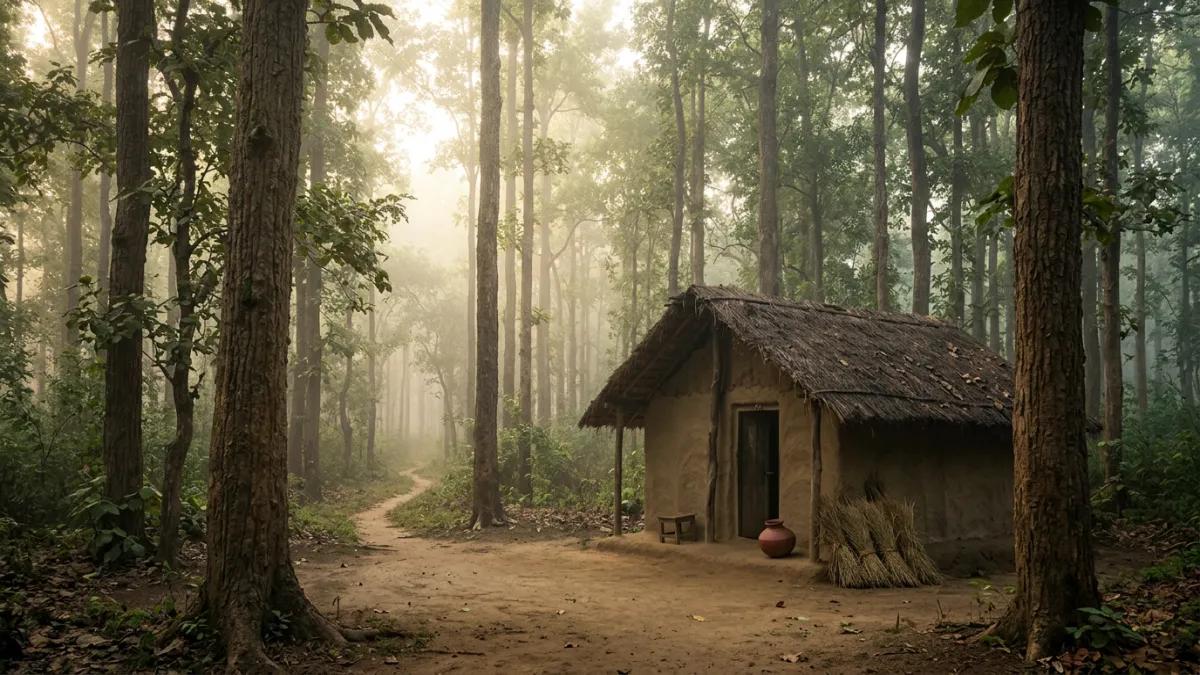
Vishvamitra is taking Bhagwan Ram and Lakshman ji to Mithila, and on the way the three of them reach a hermitage where nothing moves at all.
Vishvamitra tells the princes whose it was. Gautama Rishi had lived here with his wife Ahalya, and for thousands of years he did tapas (austerity) in this one spot.
That is a vast store of tapas. It can be spent in an afternoon.
Tirth’s piece on who Bhagwan Ram was follows the rest of his life. Here we stay at one doorway.
While Gautama Rishi was away
One day Gautama Rishi was away. Indra Dev came to Ahalya while he was gone, wearing Gautama’s own form. She knew it was Indra Dev, Valmiki says, and she agreed.
Valmiki tells it that plainly, and so do we.
Gautama was already on his way home, radiant with the power of his tapas and carrying samidh (sticks for the sacred fire) and kusha grass. Indra Dev, still leaving the hut, walked straight into him.
One look at the rishi and the colour drained from Indra Dev’s face.
Gautama Rishi’s sentence, with a way out written into it
Indra Dev was punished first. It took hold at once, and he lost his virility on the spot.
Then Gautama turned to Ahalya.
Her sentence ran far longer than his. She would stay in this hermitage for thousands of years, living on air, never moving, lying there like dust or ash, and no creature would be able to see her.
But the same words held a door. Her freedom was tied to one guest: on the day Bhagwan Ram, son of Dasharatha, came to this forest and she received him, she would be free, back in her own form and back with Gautama.
So the punishment and the promise of its end were spoken in one breath.
After that Gautama Rishi left for penance on a Himalayan peak, and the hermitage went quiet for a very long time.

Go back over Valmiki’s words for her sentence and you’ll find dust and ash in them, but no stone anywhere.
Who bows first, and what does Ahalya do?
Now, the road again. Vishvamitra stops at the hermitage and asks Bhagwan Ram to free her.
Valmiki slows down here. Gods, demons and humans alike had been unable to see her. The moment she sees Bhagwan Ram she can be seen again, and Valmiki uses three pictures for her light.
A full moon with mist across it, the sun as a reflection in water, a fire covered in smoke.
Each is a bright thing with something in front of it. She had been shining all along.
Bhagwan Ram bows, and so does Lakshman ji. Both of them touch Ahalya’s feet, the opposite of the stone picture, where his foot touches her. Ahalya, remembering Gautama’s words, bows back and gives them the welcome a household gives its guests, rites and all.
Flowers fall from the sky. Gandharvas and apsaras (celestial singers and dancers) celebrate, and Gautama Rishi learns through his tapas what has happened.
He comes back, glad to see her restored. The two of them worship Bhagwan Ram together and return to their austerity, and Bhagwan Ram goes on to Mithila, the city of King Janaka and his daughter Maa Sita, Deity page on Tirth . Tirth’s Vivah Panchami story picks up from there.
In Valmiki the scene closes on two princes at a woman’s feet, and the flowers come after.
The stone: Skanda Purana, Tulsidas and the later books
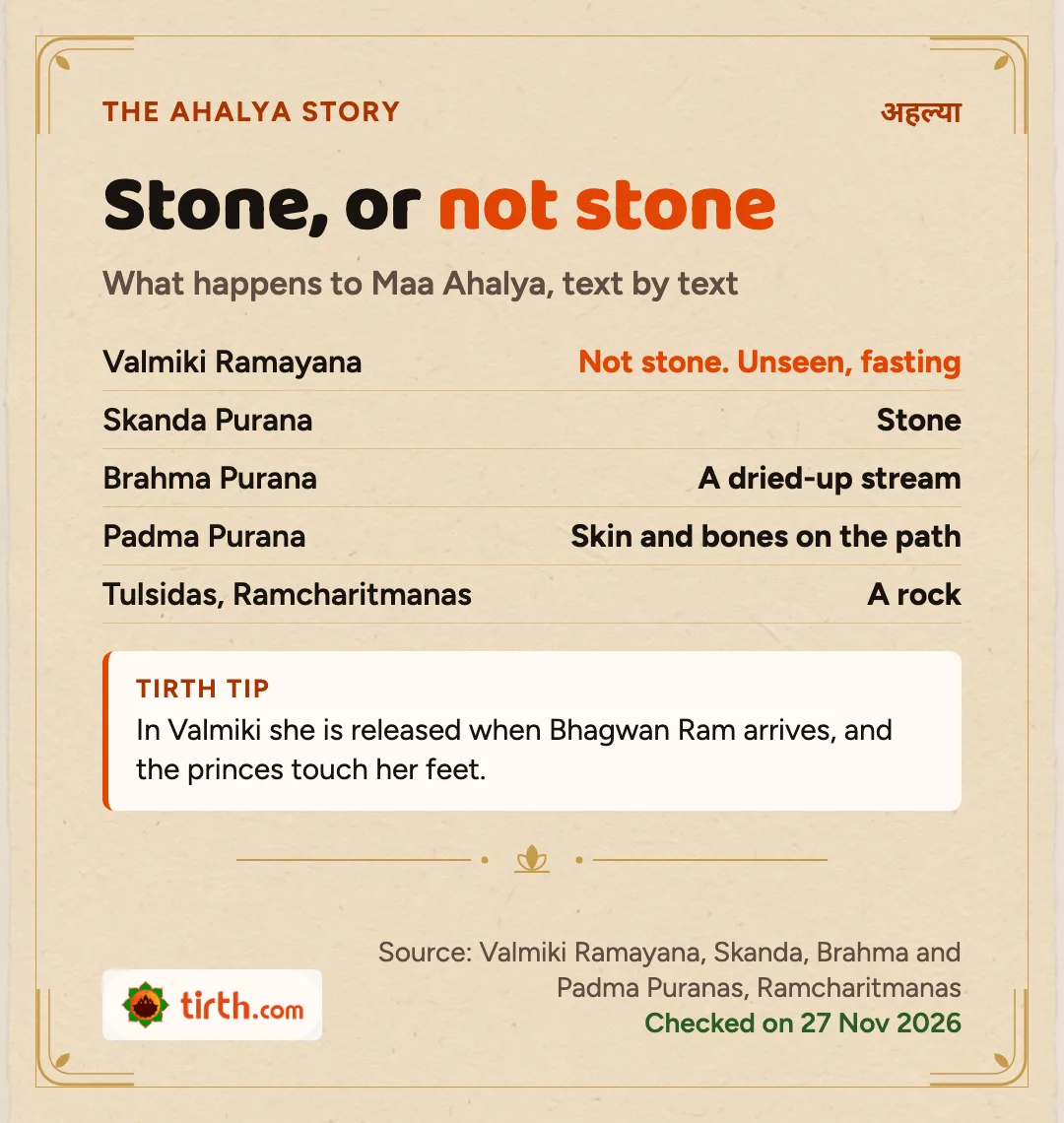
The stone comes from texts that came later. The Skanda Purana has it, and so does the Ramcharitmanas of Tulsidas, and each tells the meeting with Bhagwan Ram its own way, with its own idea of what Ahalya did. The Brahma and Padma Puranas give her a defence. She says she was deceived in the first, and in the second she pleads that she acted in ignorance.
| Who tells it | Stone? | Ahalya’s side of it | How it ends |
|---|---|---|---|
| Valmiki Ramayana, Bala Kanda | No. Unseen, fasting, living on air | She knew it was Indra Dev and agreed | Bhagwan Ram comes, she receives him as guest, and the princes touch her feet |
| Skanda Purana, Nagara Khanda | Yes | Gautama Rishi turns her to stone | Bhagwan Ram’s foot frees her. After expiation and pilgrimage, she, Gautama Rishi and their son Shatananda set up three lingas |
| Brahma Purana | No. She becomes a dried-up stream | She says she was deceived, and the household servants who were fooled too bear her out | She joins the Gautami (the Godavari). Bhagwan Ram does not appear |
| Padma Purana | No. She lies on the path, skin and bones | She pleads that she acted in ignorance | Gautama Rishi foretells that Bhagwan Ram will find her faultless and Indra Dev at fault, and the two are reunited |
| Tulsidas, Ramcharitmanas | Yes. A rock waiting for the dust of Bhagwan Ram’s feet | The visit of Indra Dev is left out | She calls what happened to her a great favour |
The Bhagavata Purana’s passage on her family has no Indra Dev and no punishment at all. There she is the daughter of Mudgala and sister of Divodasa, and with Gautama Rishi she has a son, Shatananda.
Valmiki’s Uttara Kanda, a later book, goes over the episode again. In that version Ahalya says she was taken unknowingly by someone wearing her husband’s form, and Gautama accepts her back only after Bhagwan Ram’s visit.
Tirth’s guide to the Ramayana characters has the wider cast around her.
A temple to Ahalya in Darbhanga, Bihar
Bihar has a temple for this story. Ahilya Asthan, a temple to Ahalya, stands about 3 km south of Kamtaul railway station, in Jale block of Darbhanga district. Ram Navami and Vivah Panchami both bring fairs there. The Tirth Spiritual Calendar has pages for both, Ram Navami, Spiritual Calendar on Tirth and Vivah Panchami, if you want to time a visit.
The fair names and directions here come from the Darbhanga district site, on a page last updated in 2018, so check locally before you travel.
One thing to watch in search results: Ahilyabai Holkar, a queen, shares the name but has nothing to do with this story.
Tirth’s Darbhanga page lists Ahilya Asthan with the district’s places to see. Start there.
Frequently asked questions
Not in Valmiki. Of the five texts compared above, only two make her a stone: the Skanda Purana and the Ramcharitmanas.
Valmiki’s Bala Kanda says she did. In the Brahma and Padma Puranas it goes another way, and Ahalya says she was deceived or that she acted in ignorance.
By arriving. Gautama Rishi tied her release to receiving Bhagwan Ram as a guest, so in Valmiki no touch is needed to end it.
His name was Shatananda. He is her son with Gautama Rishi in the Bhagavata Purana, and the Ramayana has him as King Janaka’s royal Purohit.
At Ahilya Asthan, near Kamtaul in Darbhanga district, Bihar. Tirth’s Darbhanga page lists it among the district’s places to see.
Continue on Tirth
- Bhagwan Ram, Deity page on Tirth, for the life this meeting is one stop in.
- Darbhanga, the district where Ahilya Asthan stands.
- The Vivah Panchami story, for what came next in Mithila.
- Tirth Spiritual Calendar, Spiritual Calendar on Tirth, for the Ram Navami and Vivah Panchami dates.