On this page7 sections
- Why did Vajasravasa promise his own son to Yama Dev?
- The three nights Nachiketa spent in Yama Dev’s empty house
- Nachiketa’s three boons, from his father’s anger to death itself
- What Yama Dev offered Nachiketa instead of an answer
- What I take from Nachiketa’s three nights
- Frequently asked questions
- Continue on Tirth
- Sources and review
In the opening verses of the Katha Upanishad (1.1.1 to 1.1.4), a boy watches his father give away everything he owns, sees cows going out with no milk left in them, and asks one question three times. His father, in anger, says he will give him to Yama Dev.
Then come three nights in Yama Dev’s house without eating. Three boons. And one question about death that Yama Dev tried hard to get out of answering, with gold and long life offered in its place.
In short
His father, in anger, says he will give him to Yama Dev. Then come three nights in Yama Dev’s house without eating. Three boons. And one question about death that Yama Dev tried hard to get out of answering, with gold and long life offered in its place.
Why did Vajasravasa promise his own son to Yama Dev?
Heaven’s rewards were what Vajasravasa was after. That meant a sacrifice, and the text says he gave up all that he possessed at it (1.1.1).
His son Nachiketa watched the gifts go out to the Purohits, and faith entered him as they went (1.1.2). He noticed which cows were being given.
Cows that had already drunk their water and eaten their hay. Milked dry, and past bearing calves.
The worlds are unblessed, the boy thought, for anyone who gives cows like these (1.1.3).
He took it up with his father. Two lines are all that Max Muller’s 1884 translation needs for the exchange (1.1.4). Nachiketa’s line is “Dear father, to whom wilt thou give me?” and he puts it to his father a second and a third time.
The father’s answer, given in anger, is “I shall give thee unto Death.”
There was no taking that back. Muller adds a note there that the father had to be true to his word, angry or not, and that is why the boy goes to Yama Dev’s house.
The three nights Nachiketa spent in Yama Dev’s empty house
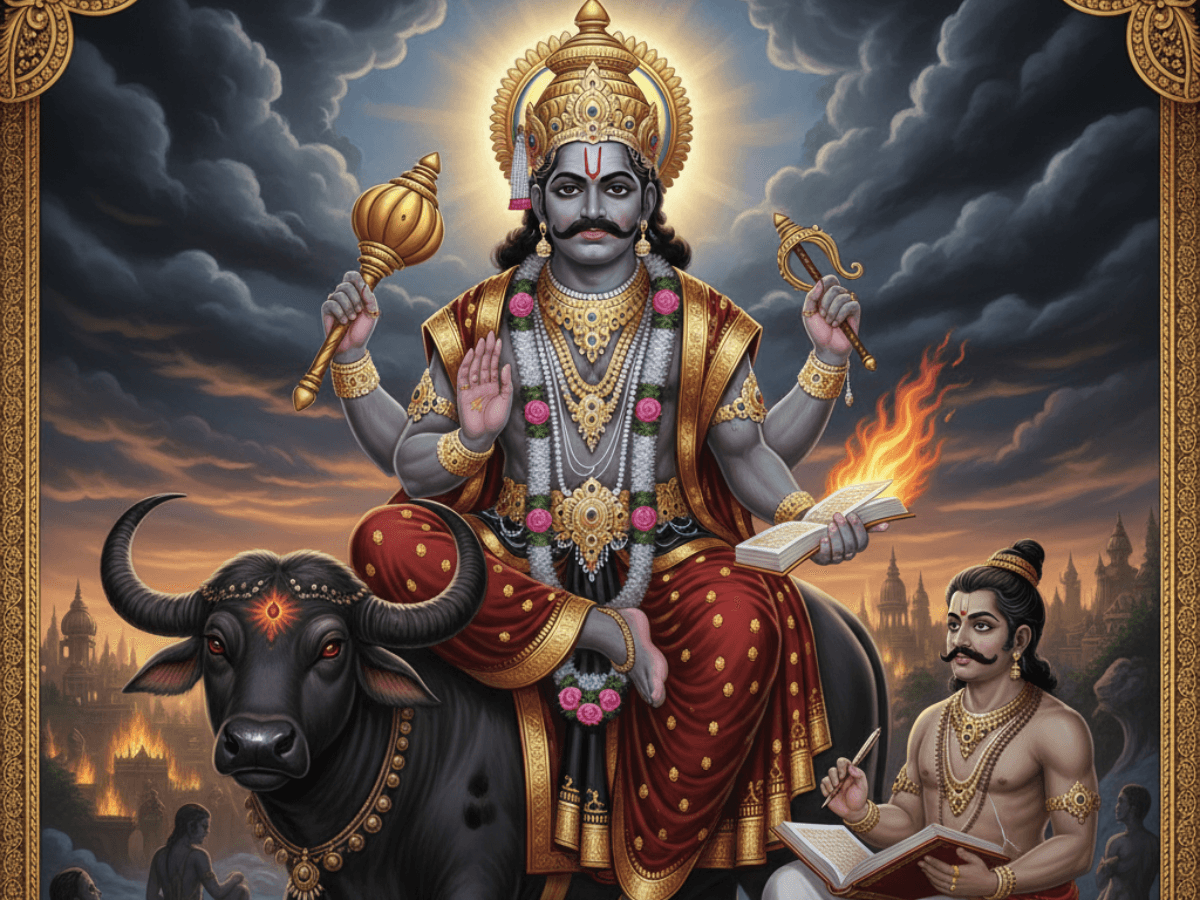
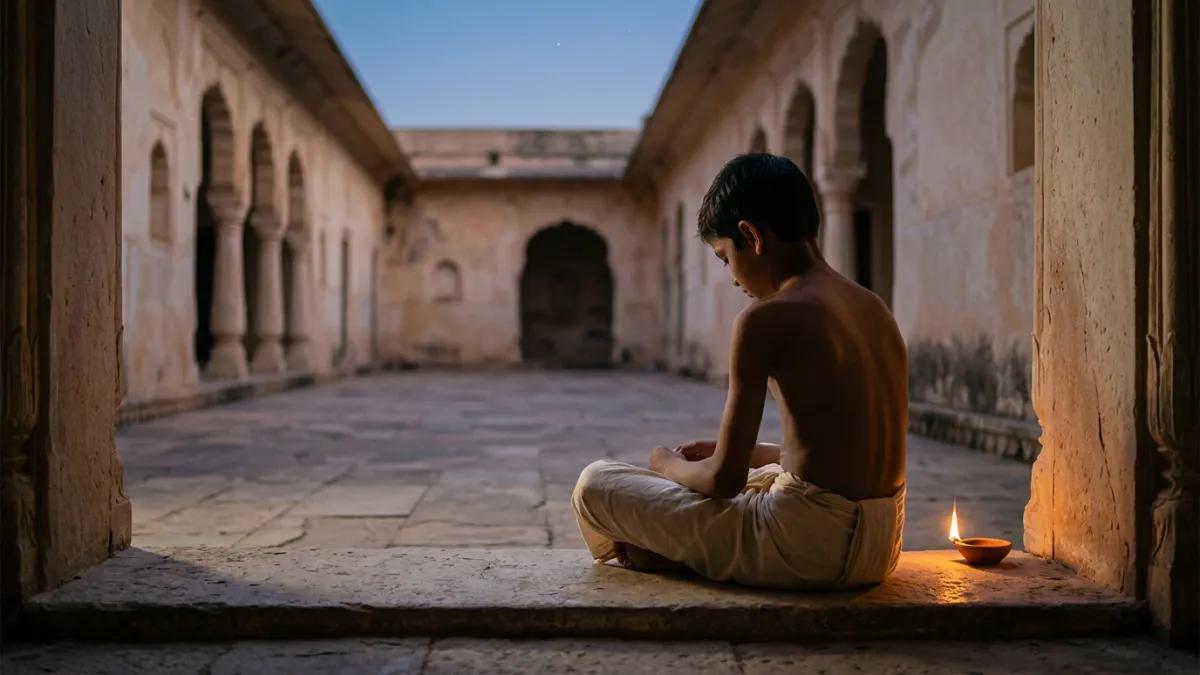
Nobody was there to receive Nachiketa when he reached the house of Yama Dev, Deity page on Tirth . Muller gives that detail in a bracketed note at 1.1.7, and Shankara’s commentary reads it as Yama Dev being away from home.
No one came, and the boy stayed on for three nights.
Fire, his household told Yama Dev on his return, is what enters a house when a Brahmin comes as a guest. Leave a guest like that unwelcomed and he takes away the householder’s hopes, his possessions, even his sons and cattle (1.1.7 to 1.1.8).
The rule is water for a guest, and food. This one had got nothing.
Yama Dev’s reply was to count the nights. The boy had gone three of them in his house without eating, he said, and for that he could choose three boons (1.1.9).
You will see “without food or water” in a lot of retellings. I’d rather stay with the verse, which says without eating and says nothing about water.
Nachiketa’s three boons, from his father’s anger to death itself
| Boon | What Nachiketa asked | Verse |
|---|---|---|
| First | That his father be calm and free from anger towards him, and know him and greet him when he came back | 1.1.10 to 1.1.11 |
| Second | The fire sacrifice that leads to heaven | 1.1.12 to 1.1.19 |
| Third | What happens to a man after he dies: is he, or is he not? | 1.1.20 |
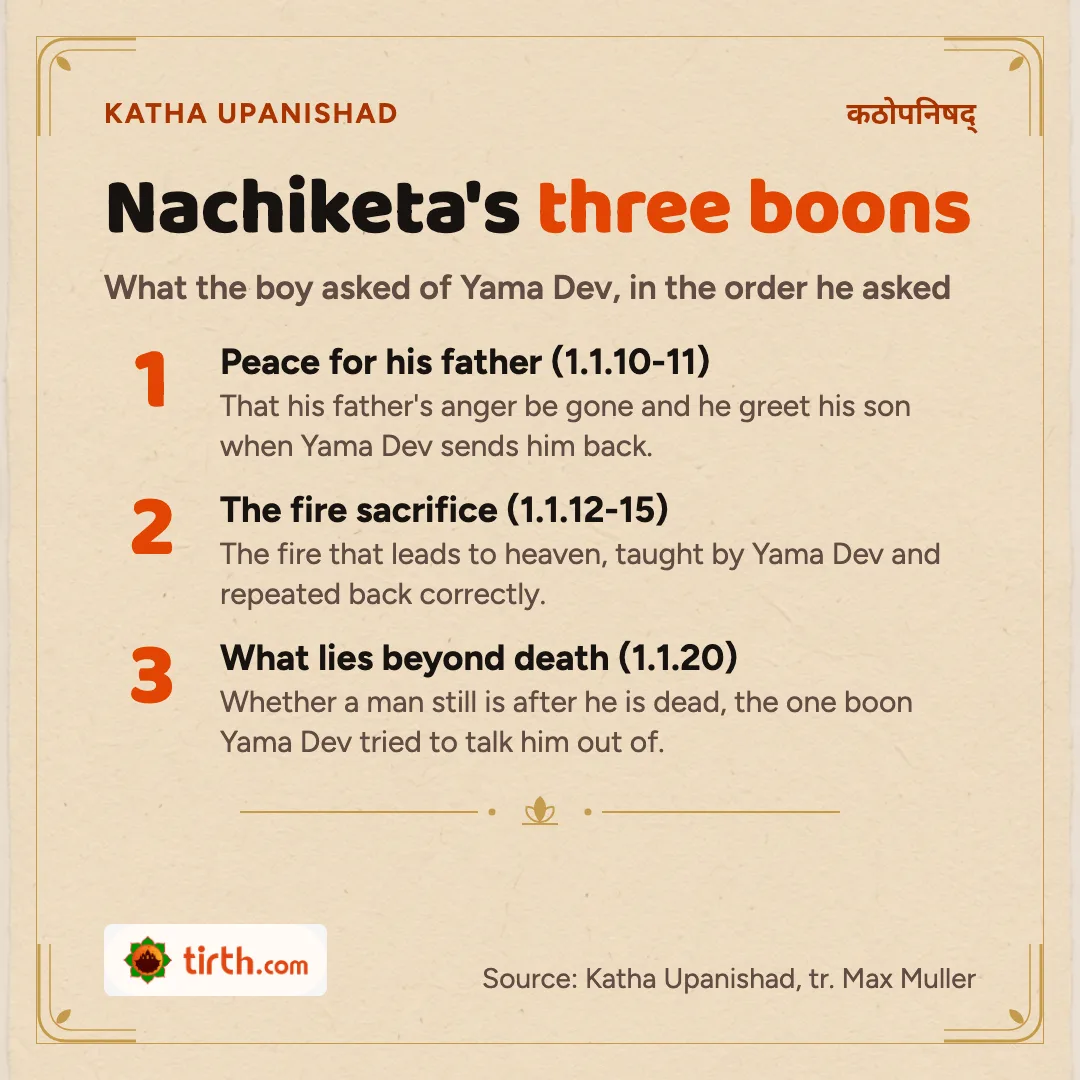
Nachiketa spent the first boon on his father. He wanted him calm, his anger gone, and wanted to be known and greeted by him once Yama Dev let him go home (1.1.10).
His father was the one who had sent him to Yama Dev. Still, his father’s peace is what the boy asked for before anything else.
Yama Dev said yes. Once the father had seen his son freed from the mouth of death, he would know him, lose his anger and sleep in peace again (1.1.11).
Boon two was about fire. Nachiketa wanted the fire sacrifice that leads to heaven, a world with no fear in it, he said (1.1.12 to 1.1.13). Yama Dev went through it with him then and there. The altar bricks, how many, how they go. The boy repeated the lot back without a mistake (1.1.14 to 1.1.15).
The fire got the boy’s name after that, the text says, along with a many-coloured chain from Yama Dev (1.1.16). Which makes it the Nachiketa fire. Hold that part a little loosely, though, because in Max Muller’s view verses 16 to 18 seem to be a later addition.
The third boon was the big one. About a man who has died there is a doubt, Nachiketa said. Some people say he is. Others say he is not, and which side is right was what Nachiketa wanted to hear from Yama Dev himself (1.1.20).
What Yama Dev offered Nachiketa instead of an answer
Yama Dev tried to back out. The gods themselves had their doubts about it long ago, he told Nachiketa, and it is hard to understand. He asked the boy to pick some other boon and let him off (1.1.21). Nachiketa held firm. No other teacher like Yama Dev could be found, he answered, and no other boon was like this one (1.1.22).
Then came the offers. Yama Dev’s list started with sons and grandsons who would live a hundred years, then cattle in herds, elephants, horses and gold. Then the wide earth, and life for as many years as he liked. Wealth too, long life with it, kingship on earth, and fair maidens with their chariots and musical instruments (1.1.23 to 1.1.25). All of it his, if he would only stop asking about dying.
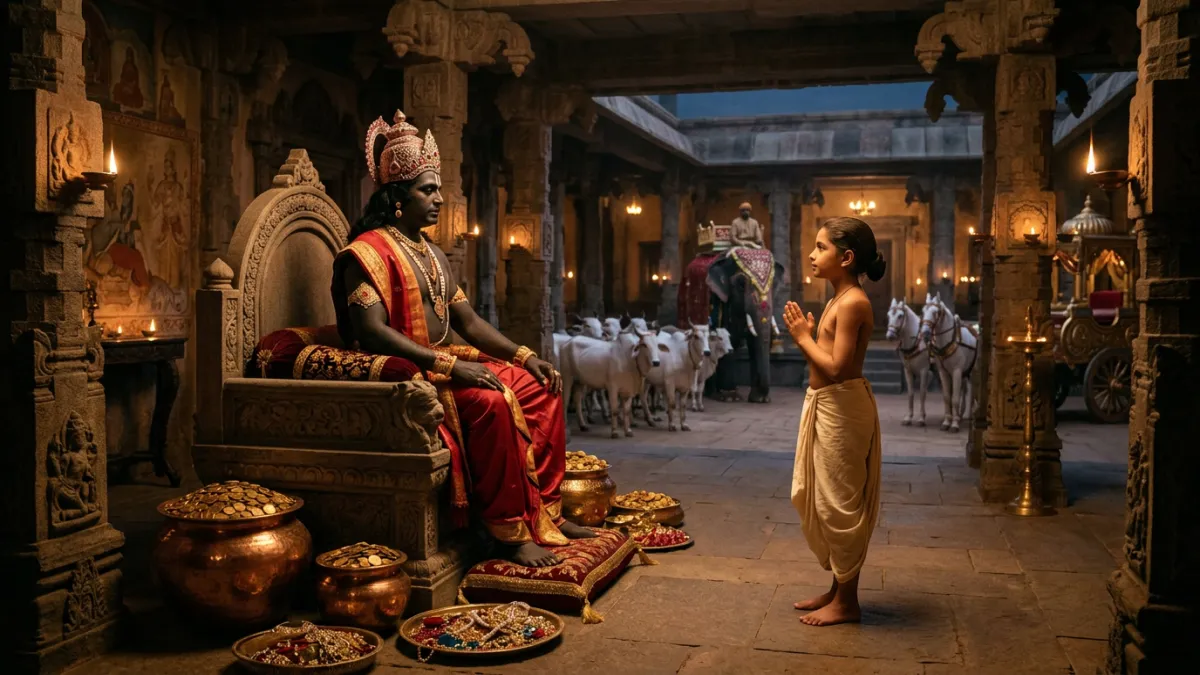
He turned every bit of it down, and what he told Yama Dev, as Max Muller prints it, was “These things last till to-morrow, O Death, for they wear out this vigour of all the senses” (1.1.26).
Wealth makes no man happy, he went on (1.1.27), and he asked again for the answer about what comes after death (1.1.29).
What Yama Dev taught him from there on fills the rest of the Upanishad. On Tirth, Karma Meaning in Hinduism: Not Fate, Not Punishment is the place to read more.
What I take from Nachiketa’s three nights
I keep coming back to the order of his asking. The first boon went to the father who had given him away in anger, and the last to the one question Yama Dev wanted most to avoid.
To read more about the deity Nachiketa waited three nights for, go to Yama Dev on Tirth, Deity page on Tirth.
Frequently asked questions
Nachiketa appears in the text as a boy, Vajasravasa’s son. The Katha Upanishad opens with his story. His father gives him to Yama Dev in anger, and he spends his third boon on asking what happens after death.
Because Nachiketa kept asking whom he would be given to (1.1.4). At that sacrifice the father was handing over old, barren cows, and he said angrily that he would give him to Yama Dev. According to Muller’s note, he then had to keep his word.
His first was peace for his father and an end to his anger, and his second the fire sacrifice that leads to heaven. The third was the answer to whether a man still is after death (1.1.10 to 1.1.20).
Not quite. The verse has him spend three nights without eating (1.1.9). It does not mention water, so “without food or water” says more than the text does.
It is the fire sacrifice Yama Dev taught Nachiketa as his second boon. According to the text Yama Dev named it after the boy (1.1.16), but Max Muller treats verses 16 to 18 as a later addition.
Continue on Tirth
- Yama Dev on Tirth, Deity page on Tirth, the page for the deity Nachiketa waited three nights for.
- Dharmaraj Aarti on the Tirth blog.
- Chitragupta ji’s story, one related katha.