On this page9 sections
- Narada’s portrait of Ram, from ocean to moon
- Born under Punarvasu, and the bow that broke at Mithila
- How the coronation fell through
- From the Dandaka forest to Lanka, with Hanuman ji
- A man or Bhagwan Vishnu: what Ram says about himself
- Maa Sita’s fire test, her later years and Ram’s end at the Sarayu
- Ram in Ayodhya today
- Frequently asked questions
- Continue on Tirth
- Sources and review
The epic opens with a question to the sage Narada: who in the world today is virtuous, valiant, grateful and truthful, who keeps his vows and is kind to every living being?
Narada replies with a single name, Ram of the Ikshvaku line, and then a list of what makes him so.
Devotees call him Maryada Purushottam, the ideal man. The Dashavatara tradition counts him as the seventh avatar of Bhagwan Vishnu.
| Family | Role | Appears in | Known for |
|---|---|---|---|
| Son of Dasharatha and Kausalya. Brothers Bharata, Lakshman and Shatrughna. Wife Maa Sita. | Prince of Ayodhya, later its king | Every kanda of the Valmiki Ramayana | Keeping his father’s word, fourteen years of exile, the end of Ravan |
Everyone else is on Ramayana characters. This post stays with Ram and follows the order in which Valmiki tells his life.
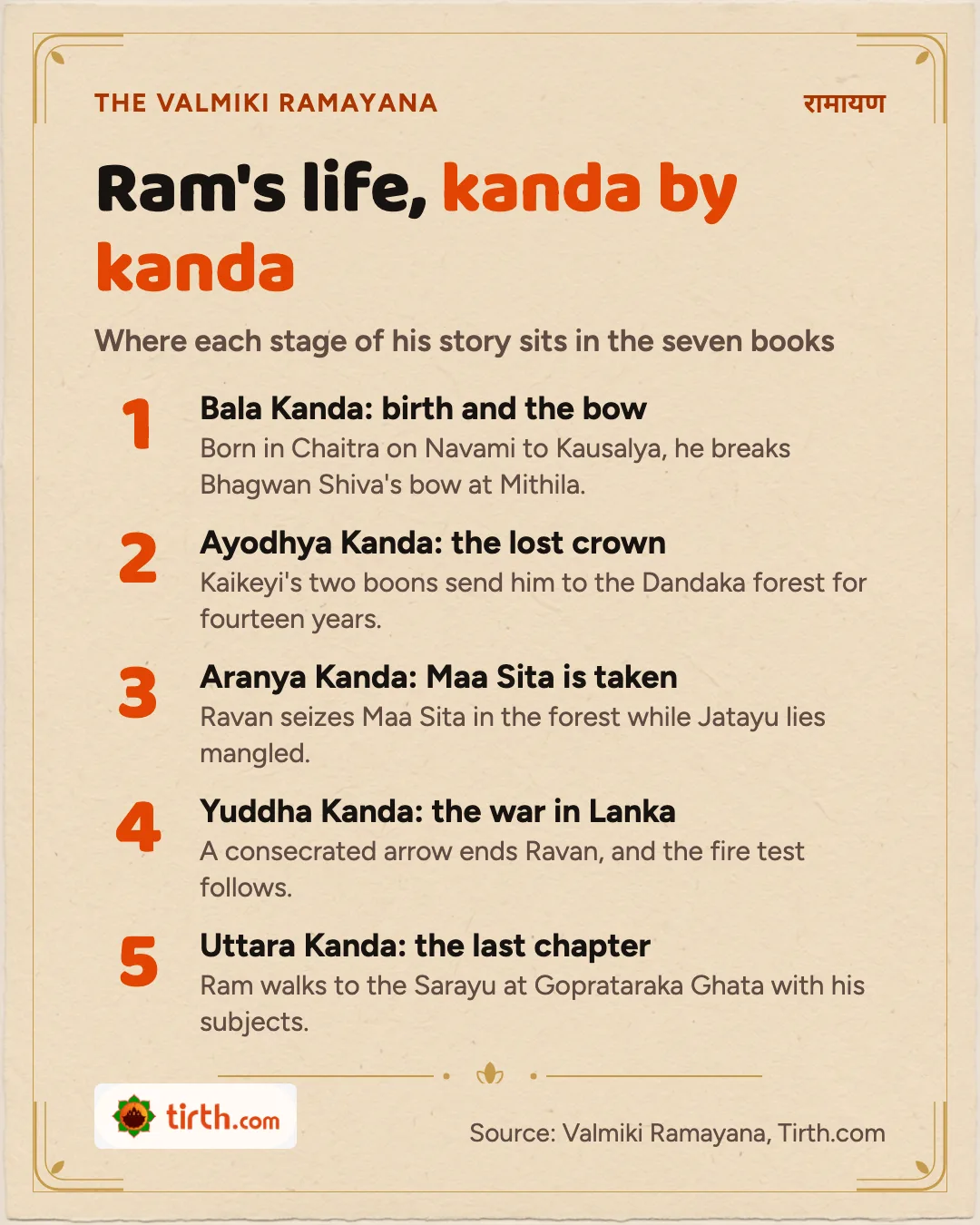
In short
Narada replies with a single name, Ram of the Ikshvaku line, and then a list of what makes him so. Devotees call him Maryada Purushottam, the ideal man. The Dashavatara tradition counts him as the seventh avatar of Bhagwan Vishnu.
Narada’s portrait of Ram, from ocean to moon
Narada says a good deal more than the name (Bala Kanda, sarga 1). Ram is as deep as the ocean, as steady as the Himalayas, and in valour he equals Bhagwan Vishnu, and the list keeps going.
Narada also calls him lovely as the moon and forgiving as the earth. In giving he matches Kubera Dev, and in truthfulness Dharma Dev. Kausalya, his mother, delights in him. Good people reach him the way rivers reach the sea.
One traditional commentary counts sixteen qualities in the list and ties them to the sixteen phases of the moon. What I notice is that the epic answers “who is he?” with his character.
Born under Punarvasu, and the bow that broke at Mithila
Kausalya bears Ram after Dasharatha’s putreshti sacrifice, in Chaitra, on the ninth day of the bright fortnight, under the nakshatra Punarvasu. Kaikeyi’s son Bharata comes under Pushya. Sumitra’s sons Lakshman and Shatrughna are born the next day under Ashlesha (Bala Kanda, sarga 18).
The family guru Vasishtha names all four on the eleventh day. Lakshman is devoted to Ram from childhood, and Ram will not sleep or eat without him. The same is true of Bharata and Shatrughna.
That ninth day is Ram Navami. The Tirth Spiritual Calendar, Spiritual Calendar on Tirth keeps the festival date for each city.
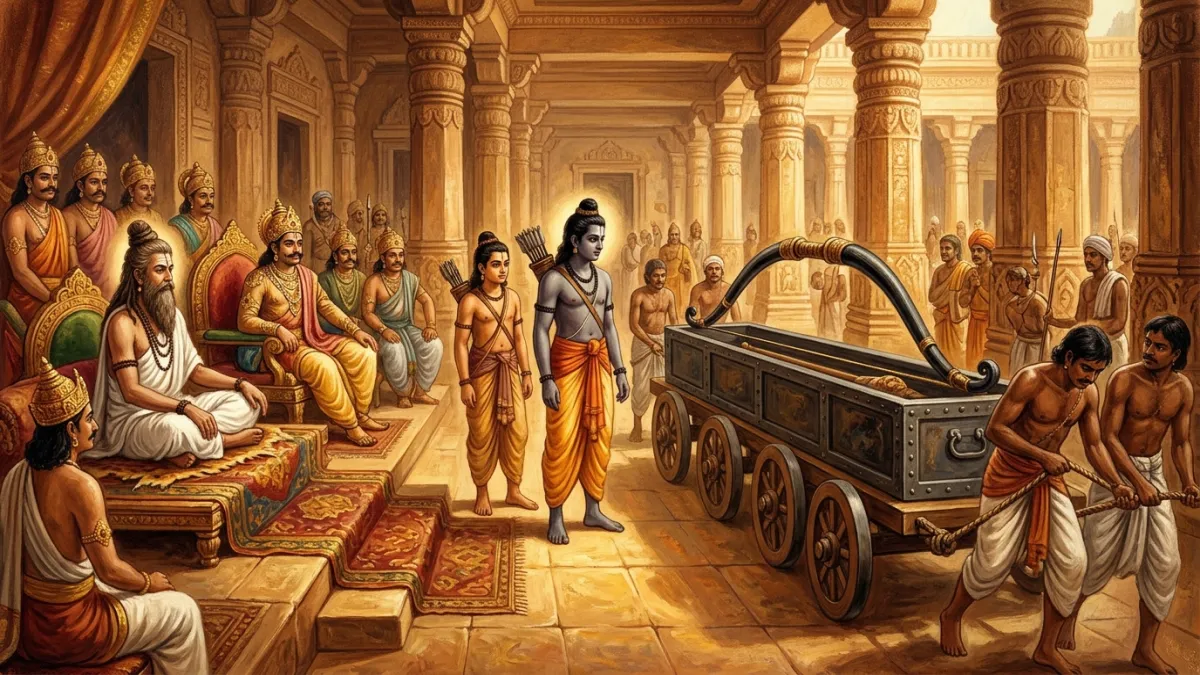
At Mithila, Janaka’s court has Bhagwan Shiva’s bow wheeled in, in an iron coffer on eight wheels, and Janaka has made it the test for Maa Sita, a bride to be won by valour. Ram asks to handle it. He lifts it, strings it, and as he draws, the bow breaks in the middle with a thunderous sound (Bala Kanda, sarga 67).
How the coronation fell through
Dasharatha is tired of ruling and tells the assembly he wants Ram made crown prince. The kings, Brahmins and citizens all agree. They praise Ram as truthful, patient, grateful and master of his senses, a man who looks after the people as a father looks after his children.
Then Kaikeyi claims the two boons Dasharatha once gave her. One is Bharata’s coronation. The other sends Ram to the Dandaka forest for fourteen years, in matted hair and bark garments. Her side of the story is in why Kaikeyi asked for the exile.
Ram stays calm. According to the text, her harsh words did not touch him with sorrow, and he tells her that a father is a visible god and that on his father’s command he would even enter fire.
At Chitrakuta, Bharata finds him and asks him to come back and rule. Ram says no. He will never break his father’s word.
So Bharata asks Ram to step onto a pair of sandals. Bharata takes them, vows to live in bark garments outside the city for fourteen years, and rules in Ram’s name through those sandals, a younger brother holding a throne for someone else. Ram asks only that Bharata treat Kaikeyi with respect.
From the Dandaka forest to Lanka, with Hanuman ji
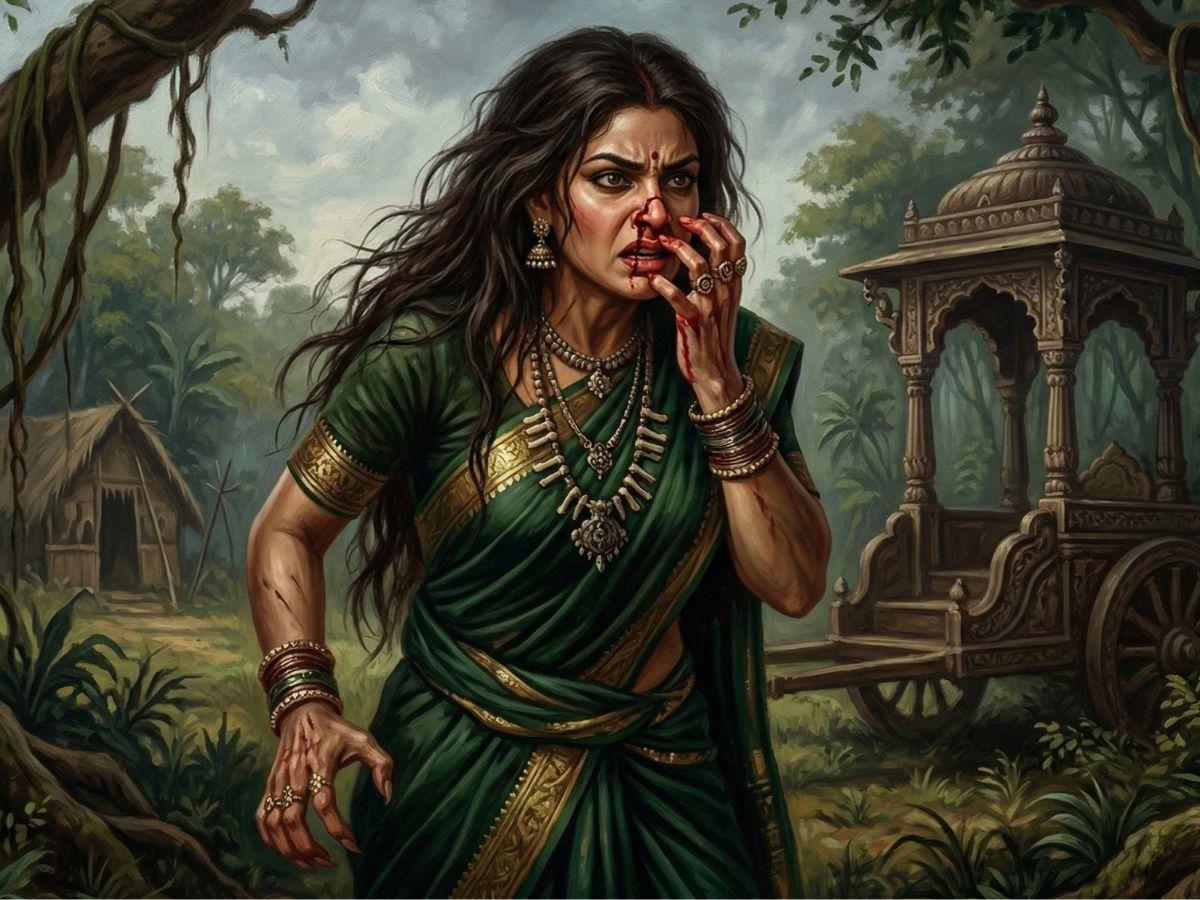
Sages come to Ram in the Dandaka forest and ask for his protection. Shurpanakha is disfigured, Khara, Dushana and Trishira are killed, and then Ravan, using Maricha, takes Maa Sita. The Aranya Kanda gives that moment a chapter to itself.
Jatayu is left mangled. Maa Sita, carried through the sky by Ravan, calls out for Ram and Lakshman and drops her ornaments. Ram kills Kabandha and honours Shabari. Next, in the Kishkindha Kanda, Hanuman ji meets Ram and Lakshman at Rishyamukha in the form of an ascetic, and Ram is so struck by the flawless way he speaks that he tells Lakshman a king with such an envoy will reach his aims.
Ram makes a friend of Sugriva, kills Vali, and bridges the sea, while Hanuman ji crosses the ocean and finds Maa Sita. In the Yuddha Kanda Ram sets a consecrated arrow, the Brahmastra, to his bow, and Ravan dies when it strikes his chest. Back it goes into Ram’s quiver. The gods sound drums and shower flowers. Vibhishana is crowned, and Ram returns to Ayodhya by the Pushpaka.
A man or Bhagwan Vishnu: what Ram says about himself
If someone asks me what Ram himself thought, I point to this passage, because it is his own answer. Indra Dev, Bhagwan Shiva and Bhagwan Brahma come and ask him why he ignores Maa Sita’s fall into the fire. Ram tells them he thinks of himself as a human being, Ram, son of Dasharatha, and asks them to tell him who he is.
Bhagwan Narayan, says Bhagwan Brahma: Bhagwan Vishnu, who took a human body to destroy Ravan, and Maa Sita is Maa Lakshmi (Yuddha Kanda).
What the title Maryada Purushottam asks of a person has its own post, what Maryada Purushottam means.
Maa Sita’s fire test, her later years and Ram’s end at the Sarayu
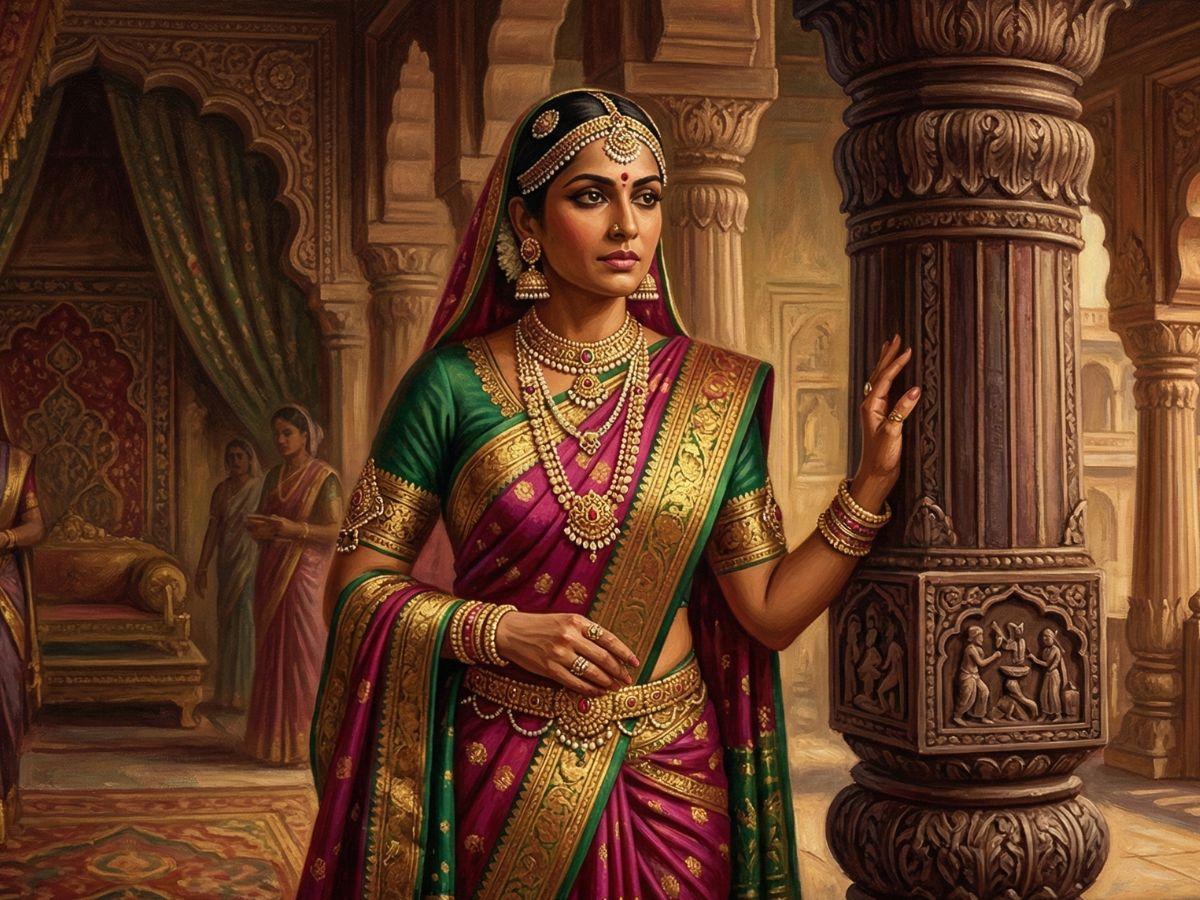
In front of the assembly Ram speaks harshly to Maa Sita. She answers that he speaks to her like a common man to a common woman, asks Lakshman for a pyre, and walks into the fire with Agni Dev as her witness. Agni Dev brings her back unharmed and declares her faithful in word, mind and glance. Ram explains that she had to be proved before the three worlds, since otherwise people would call him foolish and ruled by lust. How readers have weighed that scene is in Maa Sita’s fire test.
Not every retelling keeps this scene as Valmiki tells it. As many tell it, Tulsidas and the Adhyatma Ramayana keep the real Maa Sita in Agni Dev’s keeping while a Maya Sita is taken by Ravan. Valmiki has no such substitute. Among the major retellings are Kampan in Tamil, Tulsidas in Hindi and Krittibas in Bengali.
The Uttara Kanda is the last book. Many scholars see it, and the Bala Kanda, as later additions, though printed editions and traditional readers keep all seven kandas.
As that book tells it, talk among the people about Maa Sita leads Ram to have Lakshman leave her beyond the Ganga, near Valmiki’s hermitage. On the far bank Lakshman weeps and tells her the truth. Valmiki’s disciples find her and Valmiki takes her in, and it is at his hermitage that Lava and Kusha are born.
The book closes at the Sarayu. With his subjects around him, Ram walks to Goprataraka Ghata, where Bhagwan Brahma and the gods appear and call him Bhagwan Vishnu. Ram then enters Bhagwan Vishnu’s abode in his body, together with his brothers.
Ram in Ayodhya today
In Ayodhya, Destination on Tirth, the Shri Ram Janmabhoomi Mandir held the Pran Pratishtha of Shri Ram Lalla on 22 January 2024. The city also stands on the Sarayu, the river where the Uttara Kanda ends Ram’s life, and how Ayodhya lives with Ram’s name covers the daily life around it.
For the deity himself, mantras and stotram included, see the Bhagwan Rama page, Deity page on Tirth. If you are thinking of going, Tirth has Ayodhya yatras and Ram pujas, linked below.
Frequently asked questions
He was the prince of Ayodhya and the hero of the Ramayana, and devotees call him Maryada Purushottam, the ideal man. In the Dashavatara tradition he is the seventh avatar of Bhagwan Vishnu.
Both answers are in Valmiki’s Ramayana. Ram calls himself a human being, the son of Dasharatha, and in the same text Bhagwan Brahma names him Bhagwan Narayan. Believers hold both, and this post does not try to settle it for anyone.
King Dasharatha was his father and Kausalya his mother. His brothers were Bharata, the son of Kaikeyi, and Lakshman and Shatrughna, the sons of Sumitra.
Kaikeyi asked for two boons Dasharatha had once given her, Bharata’s coronation and Ram’s exile to the Dandaka forest for fourteen years. Ram accepted the exile on his father’s word.
Maa Sita. The bow Janaka had set as her test was Bhagwan Shiva’s, and Ram broke it at Mithila.
Continue on Tirth
- Bhagwan Rama on Tirth, Deity page on Tirth, the deity page with mantras and stotram.
- Ayodhya on Tirth, Destination on Tirth, the city guide.
- Pujas on Tirth, Pujas on Tirth, including the Sundarkand path and Ram Raksha Stotram in Ayodhya.
- Ayodhya yatra packages, Yatra on Tirth, one day and two days.