On this page8 sections
- What sat and sanga mean, and why sanga also means clinging
- Why does Bhagwan Krishna put satsang above yoga and vows?
- What is one moment of satsang worth in the Ramcharitmanas?
- Where does satsang lead in Bhaja Govindam verse 9?
- What actually happens when you go to a satsang?
- Do you need a guru for satsang?
- Frequently asked questions
- Continue on Tirth
- Sources and review
It is built from two Sanskrit words, sat (real, true, good) and sanga (company, association), and Tulsidas holds that heaven and liberation piled together do not equal a single moment of it.
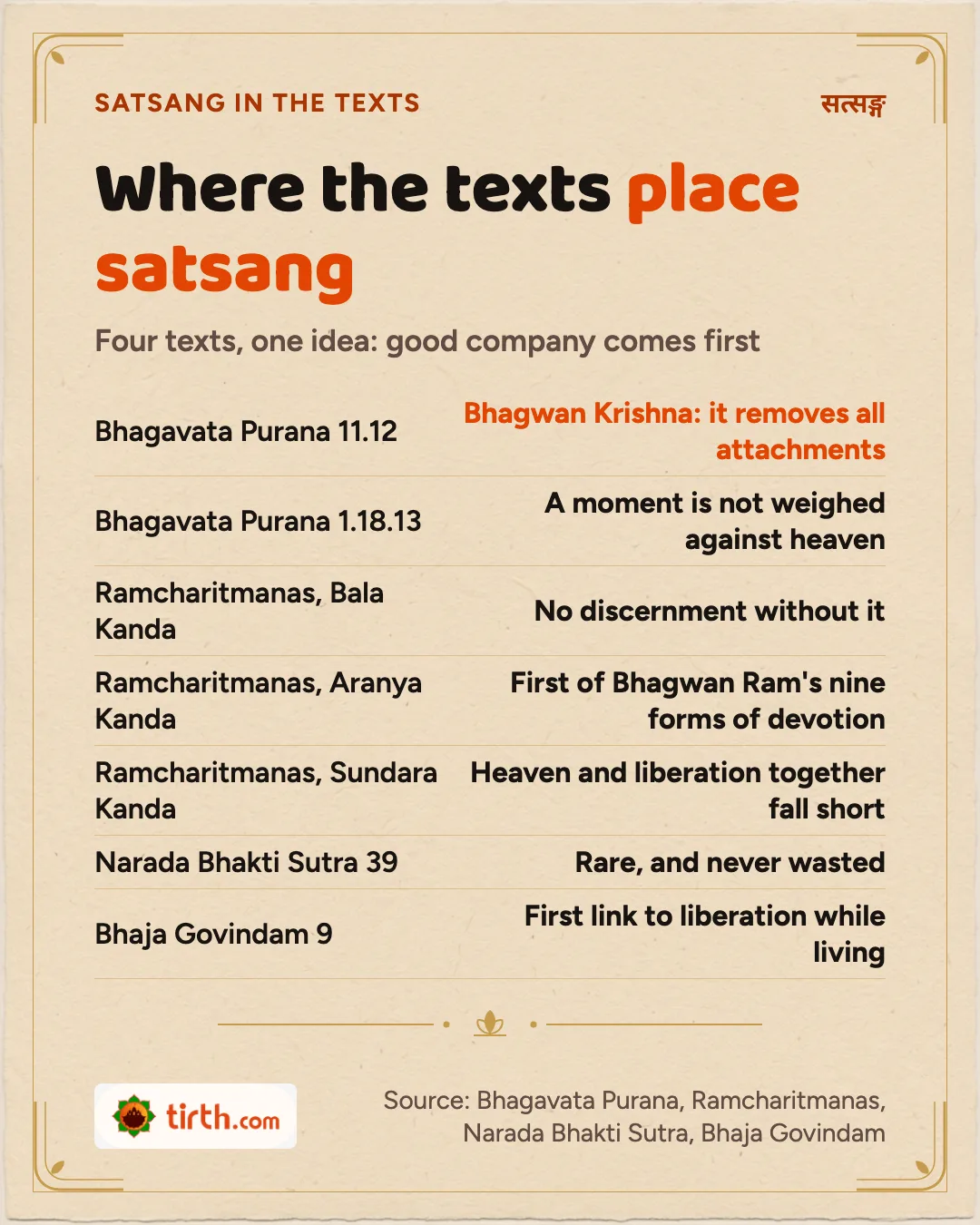
Nor is he alone. In the Bhagavata Purana, Bhagwan Krishna ranks satsang above yoga, study, austerity, charity and vows. The Narada Bhakti Sutra calls the company of great souls rare and never wasted, and Bhaja Govindam makes it the first link in a chain that ends in liberation while living.
| Text | Where | What it says about satsang |
|---|---|---|
| Bhagavata Purana | 11.12.1-2 | Bhagwan Krishna tells Uddhava it removes all attachments and brings him within reach more than yoga, study, charity or vows do |
| Bhagavata Purana | 11.26.26 (Aila Gita) | A wise person gives up bad company and attaches to the good |
| Bhagavata Purana | 3.25.25 | In good company, faith, attachment and devotion follow in that order |
| Bhagavata Purana | 1.18.13 | A moment of it is not weighed against heaven or release from rebirth |
| Narada Bhakti Sutra | Sutra 39 (common numbering) | The company of great souls is rare and never goes to waste |
| Ramcharitmanas | Bala Kanda, chaupais after Doha 2 | No discernment without it |
| Ramcharitmanas | Aranya Kanda, chaupai before Doha 35 | The first of the nine forms of devotion Bhagwan Ram gives Shabari |
| Ramcharitmanas | Sundara Kanda, Doha 4 | Heaven and liberation together do not equal a moment of it |
| Bhaja Govindam | Verse 9 | The first link in a chain that ends in liberation while living |
In short
Nor is he alone. In the Bhagavata Purana, Bhagwan Krishna ranks satsang above yoga, study, austerity, charity and vows. The Narada Bhakti Sutra calls the company of great souls rare and never wasted, and Bhaja Govindam makes it the first link in a chain that ends in liberation while living.
What sat and sanga mean, and why sanga also means clinging
The Monier-Williams Sanskrit-English dictionary has satsaṅga as a word in its own right. Its gloss is “association with the good”, and it cites uses from Varahamihira’s Brihat Samhita, the Panchatantra and the Puranas. Sat on its own gets a wide spread in the same pages, from being and real to true, good, right, wise and venerable.
Sanga means association. The same entry carries sticking and clinging to as well, along with worldly or selfish attachment. So one short word names both the company a person keeps and the clinging that ties that person down.
The word has also grown wider with time. In the older, narrower sense it meant a gathering in the presence of a satguru (the true teacher), while now it covers nearly any gathering for spiritual talk, reflection, meditation or teaching. Tulsidas spells it satasaṅga and satasaṅgata in his Awadhi. Online you will meet satsanga, satsangh, sat sang etc., and every one of them is the same word. See also Sanatan Dharma meaning.
Why does Bhagwan Krishna put satsang above yoga and vows?
Satsang goes for attachment at its root. In Skandha 11, chapter 12, Bhagwan Krishna, Deity page on Tirth tells Uddhava that satsang removes every attachment. He says it brings him within a devotee’s reach more surely than yoga, sankhya, dharma, study, austerity, charity, vows or rites. Company outranks every item on that list. The same Skandha comes back to it fourteen chapters later, this time as advice. A wise person, says the Aila Gita (11.26.26), drops bad company and attaches to the good, and in that same verse it is the saints whose words cut the mind’s attachments.
The verb it uses is sajjeta, to attach.
Skandha 3 gives the order in which it works, at 3.25.25, where Kapila Muni is teaching Devahuti. In the company of the devoted, he says, talk of Bhagwan’s deeds turns sweet to heart and ear. From that hearing come śraddhā (faith), rati (attachment) and bhakti (devotion), in that order. Company stands first. Faith comes after the hearing and before devotion.
In sutra 39 of the Narada Bhakti Sutra (common numbering; editions number it differently), the company of great souls is rare and hard to fathom, and it is never wasted.
What is one moment of satsang worth in the Ramcharitmanas?
Both heaven and liberation, stacked in one pan, and they still fall short. The line belongs to Lankini in the Sundara Kanda, who says it to Hanuman ji, and Tulsidas gives her a whole doha for it.
tāta svarga apabarga sukha dharia tulā eka aṅga; tūla na tāhi sakala mili jo sukha lava satasaṅga
Put the delights of heaven and the bliss of liberation in one pan of the scale. Together they do not equal the joy of a moment’s satsang. (Ramcharitmanas, Sundara Kanda, Doha 4)
Two words carry the image, lava (a moment) and tulā (the scale). The Bhagavata Purana had already put that same pair to work in Sanskrit, at verse 1.18.13, in the chapter where a brahmin boy has cursed Parikshit. There a lava of company with a devotee is not weighed (tulayāma) against heaven, nor against release from rebirth. Tulsidas, writing in Awadhi, reaches for the same balance.
Tulsidas returns to satsang in two other places. Right at the opening of the Bala Kanda, in the chaupais that follow Doha 2, he writes that without satsang there is no bibeka (discernment), and that satsang in turn is hard to come by without Bhagwan Ram’s grace. The same lines call it the root of joy and welfare. It is the fruit, he says, and every other practice is only the flower before it.
The third is in the Aranya Kanda, in the chaupai just before Doha 35, where Bhagwan Ram teaches Shabari nine forms of devotion. First comes the company of saints, then delight in his stories. Service at the guru’s feet is only third. Families who read the Manas at home may like Ram Naam in Ayodhya.
Where does satsang lead in Bhaja Govindam verse 9?
It leads, one link at a time, to liberation while living. Bhaja Govindam is traditionally attributed to Adi Shankaracharya. Its verse 9 moves in five steps (editions differ in number, order and wording, so verse numbers can vary). Satsang comes first. Out of it grows nissaṅgatva, having no clinging, and out of that nirmohatva, freedom from delusion. Then niścalatattva, a steady hold on what is true. At the end of the chain stands jīvanmukti, liberation while still living.
Good sanga is the first rung, and the very next one is no sanga at all. In the end it is good company that lets a person put company down. Where the chain ends is the subject of moksha and liberation in life, while what Advaita means turns to the teacher the verse is credited to.
What actually happens when you go to a satsang?
It depends on the sampradaya and the place, so read the table as three examples rather than a set of rules.
| Setting | What usually happens |
|---|---|
| Temple | Bhajans, kirtan and katha (a telling of a sacred story), then aarti and prasad |
| Ashram or centre | Bhajans (repeated chanting of a word or verse) with stretches of silence between them, and a talk or time for reflection |
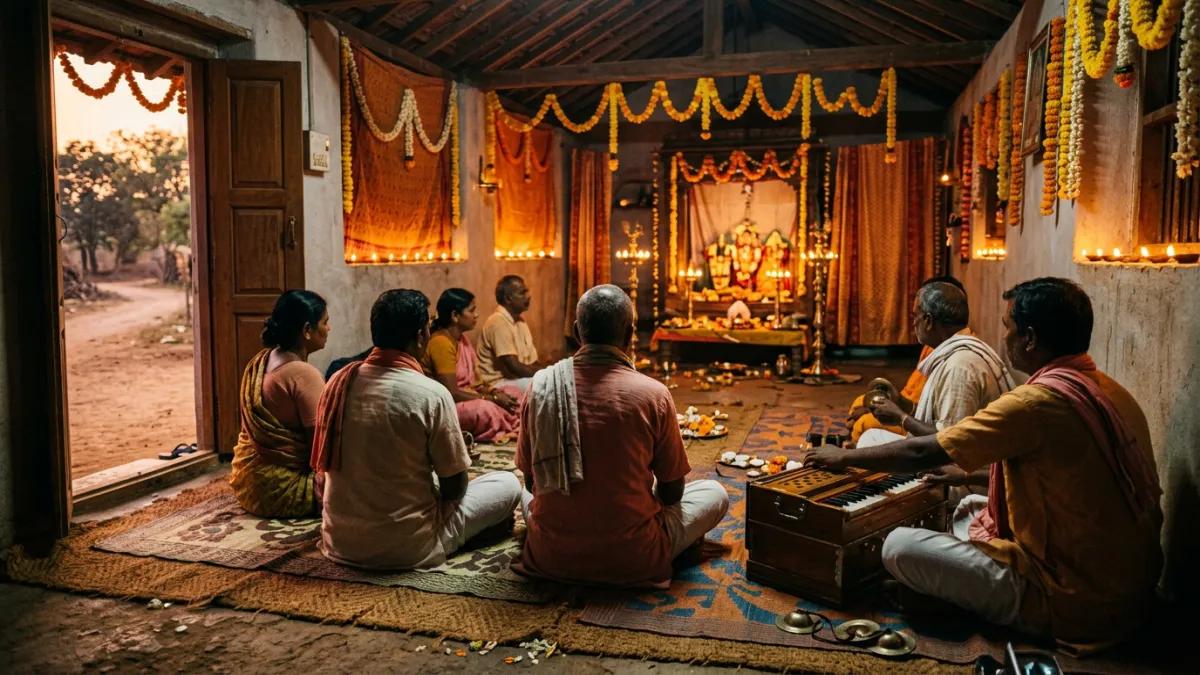
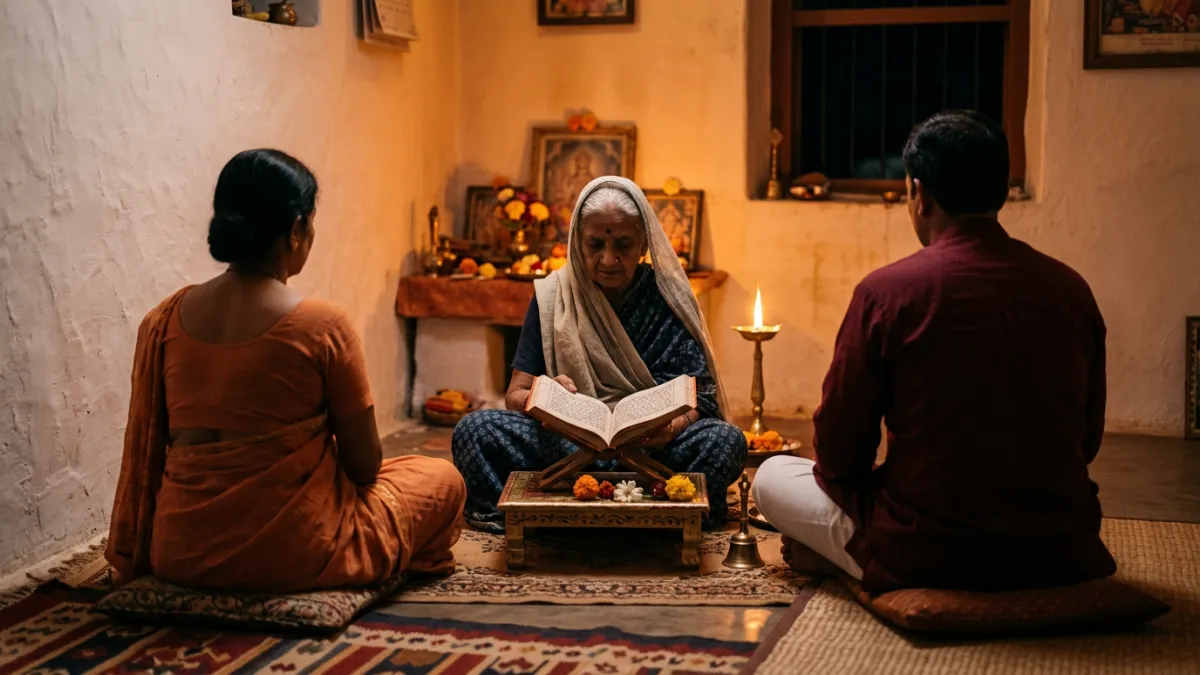
| Home (one Vaishnava format) | A welcome and the lighting of a lamp, kirtan and bhajans, an optional short talk on the Gita or the Bhagavatam, aarti, prasad |
The songs may be in a language you don’t follow. That is fine. One centre’s own description of its satsang says so too.

For your own town, find a temple near you, Temple page on Tirth and ask when its kirtan or katha runs. Tirth also has a post on Evening bhakti in Ayodhya.
Do you need a guru for satsang?
Not on the evidence of these texts. Between them they stretch the word across a guru’s presence, a gathering of devotees and the hearing of sacred stories. One Sant line goes further, to an inner sitting with the Name.
Say your mother can no longer travel to an ashram. A weekly reading of the Manas at home, with two neighbours, still sits inside the broad sense of the word. For making room for it in an ordinary household, see Ram bhakti through the day.
For choosing a gathering, the Aila Gita verse hands you a working test. It says the good cut attachments with their words, so after a gathering ask yourself whether you are holding on to less, or to more. That test is our own reading, and the verse sets no such rule.
If you can manage only one kind, we would pick a gathering where a katha is read aloud. That is this post’s own suggestion, not the verse’s. Kapila Muni’s order in the Bhagavata Purana at 3.25.25 begins with talk of Bhagwan’s deeds in good company, and only then brings faith, then attachment, then devotion.
Frequently asked questions
From sat (true, good) and saṅga (company) comes the Sanskrit satsaṅga, “association with the good”. In Hindi the word stays satsang. It names the company of good people, and also a gathering with bhajans, katha or a spiritual talk.
Kirtan is what you sing. Satsang is the company you sing it in, and it often holds bhajans, katha, aarti and prasad alongside the kirtan.
Yes. In one tradition’s home format, a home satsang means lighting a lamp, then kirtan, a short reading, aarti and prasad. Alone is harder to fit to the word. Still, one Sant line does call simran (repeating the Name) a personal satsang.
It says there is no discernment without it (Bala Kanda) and that it is the first of nine forms of devotion (Aranya Kanda). Heaven and liberation together, it adds, do not equal a moment of it (Sundara Kanda, Doha 4).
No, that is a place, established in Deoghar, Jharkhand, in 1946 as the headquarters of the Satsang movement; Tirth’s Satsang Ashram, Deoghar page covers it.
Continue on Tirth
- Temples on Tirth, Temple page on Tirth, to find one near you.
- Evening bhakti in Ayodhya.
- Moksha meaning, where Bhaja Govindam’s chain ends.