On this page9 sections
- Who is talking in Gita chapter 1?
- Chapter 1 from the first verse to the last
- Eight key verses and how to find them
- Why don’t two copies of chapter 1 match?
- What the king already knows when he asks
- Who is Govinda, and who is Partha?
- Where the reading goes after 1.47
- Frequently asked questions
- Sources and further reading
- Sources and review
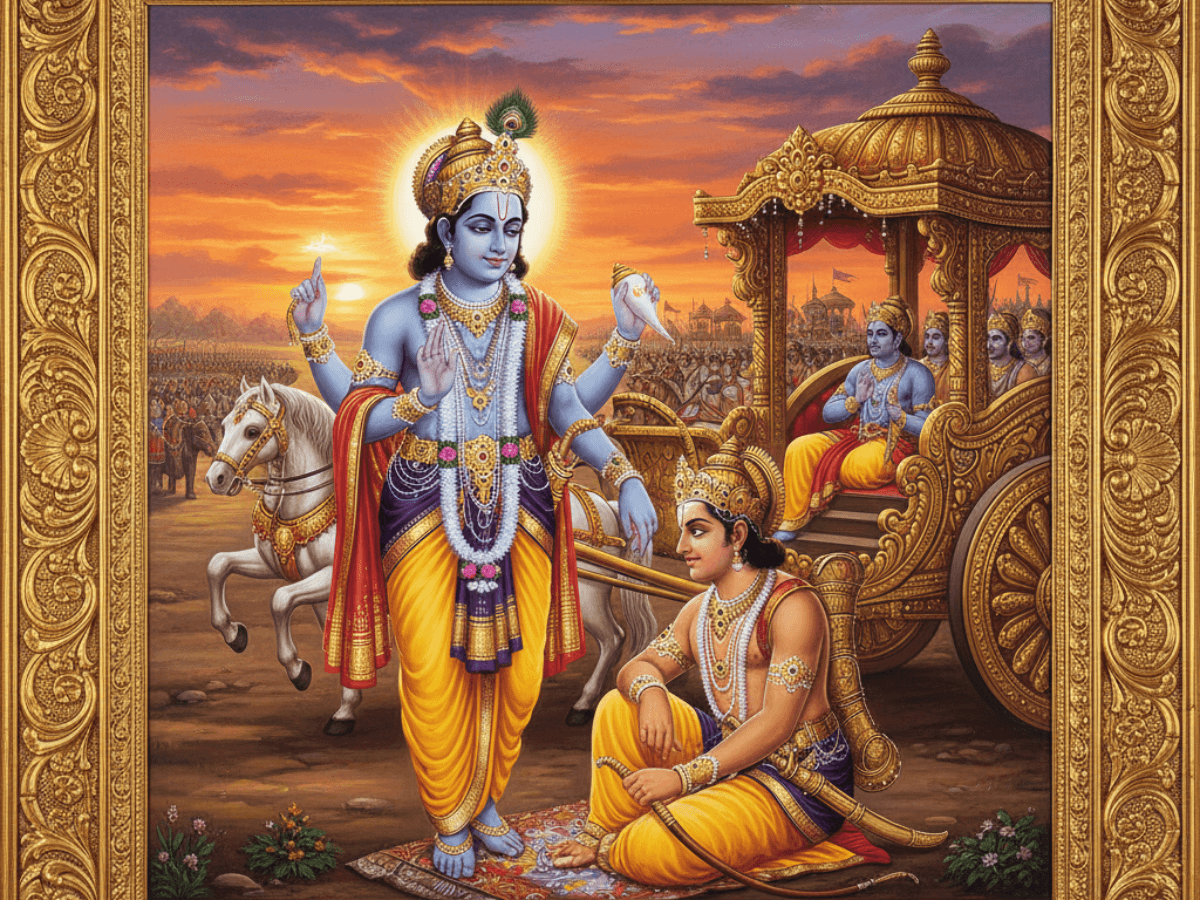
So the king asks him what happened at Kurukshetra, and Sanjaya goes back to the start, to the conches and to Arjuna asking Krishna to drive his chariot between the two armies, where Arjuna sees his own family on both sides, sinks down and lets his bow fall.
Its 47 verses go by the name Arjuna Vishada Yoga, which in English is the despondency of Arjuna.
| Chapter 1 at a glance | |
|---|---|
| Name | Arjuna Vishada Yoga (“The Despondency of Arjuna” in Annie Besant’s 1904 edition) |
| Verses | 47 in the standard numbering (46 in the Bhaktivedanta Book Trust edition) |
| Speakers | Dhritarashtra, Sanjaya, Duryodhana and Arjuna; Krishna’s words are reported once, in 1.25 |
| Where it sits | Bhishma Parva (book 6) of the Mahabharata: chapter 25 in the common numbering, 6.23 in the Pune critical edition |
| Key verses | 1.1, 1.10, 1.21, 1.25, 1.29, 1.30, 1.32, 1.47 |
Who is talking in Gita chapter 1?
Dhritarashtra hears all of this at second hand. Sanjaya’s report is all that reaches him, so the whole chapter is a story told to a king who was not there, by a man who could see it anyway. Sanjaya is the son of Gavalgana and a minister at Dhritarashtra’s court. That he can see it at all is Vyasa’s doing. The Bhishma Parva lists what Vyasa granted him, sight beyond the range of the visual sense, hearing from a great distance and knowledge of past and future.
Krishna is one of five speakers, and all he gets is a single sentence. Twice the speaker changes halfway through a verse. Which is why the table gives half-verses and not only whole ones.
| Speaker | Verses | What he does |
|---|---|---|
| Dhritarashtra | 1.1 | Asks what happened at Kurukshetra. It is his only verse in the whole Gita. |
| Sanjaya | 1.2, 1.12 to the first line of 1.21, 1.24 to the first line of 1.28, 1.47 | Narrates: Duryodhana, the conches, the chariot, Arjuna sitting down |
| Duryodhana | 1.3 to 1.11 | Speaks to his teacher Drona about the two armies |
| Arjuna | second line of 1.21 to 1.23, then the second line of 1.28 to 1.46 | Asks for the chariot to be placed, then gives his reasons for not fighting |
| Krishna | 1.25 | One sentence, reported by Sanjaya: “behold these Kurus gathered together” |
If you came to chapter 1 expecting Bhagwan Krishna, Deity page on Tirth to teach from the first page, he doesn’t. Not once in these 47 verses does he get a speaker line of his own. That label, “śrībhagavān uvāca” (the Blessed Lord said), first turns up at 2.2.
Chapter 1 from the first verse to the last
Read by verse, the chapter breaks into ten parts. Those breaks are ours. The Gita prints none, so we start a new part wherever the speaker changes or something happens.
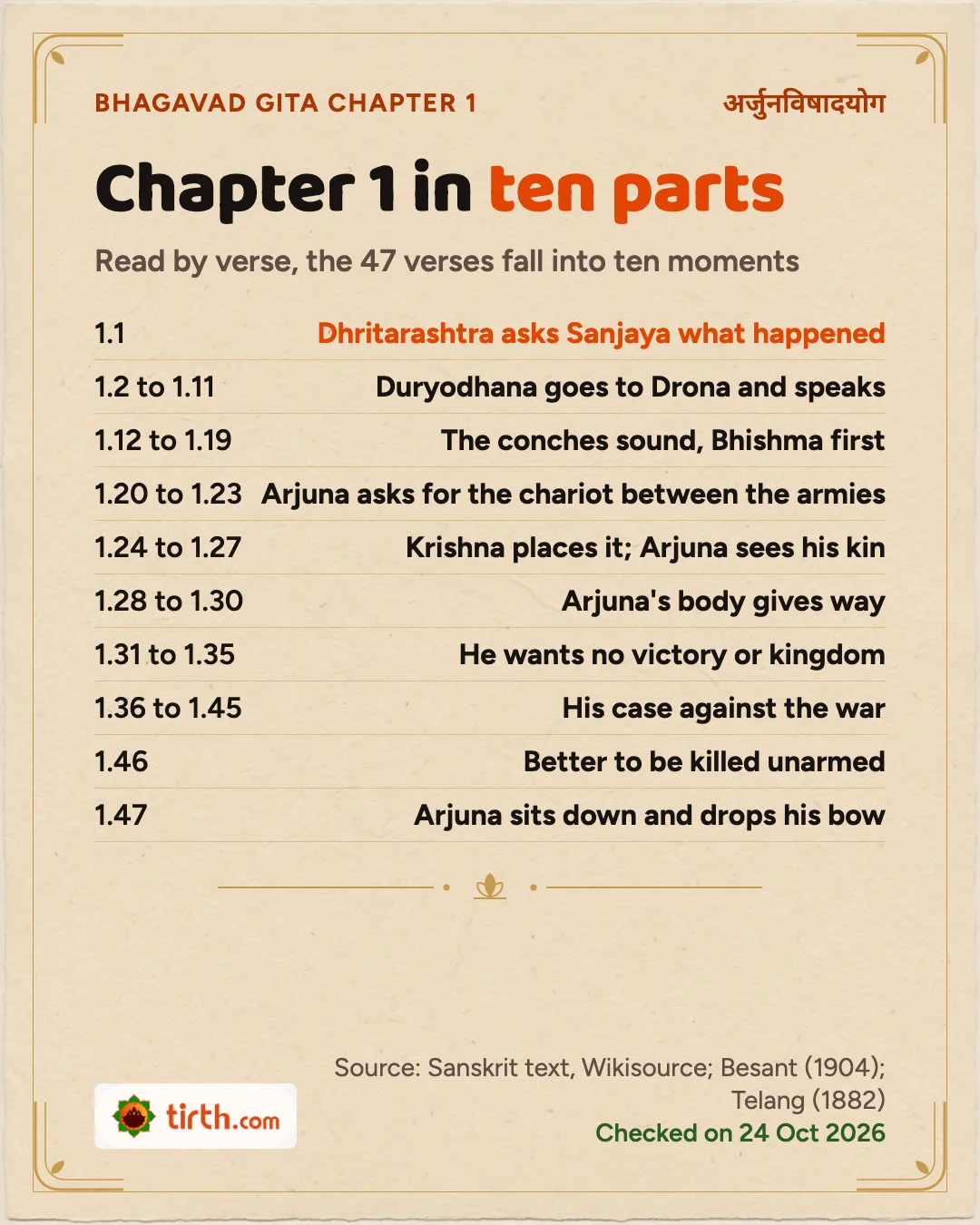
The old king asks (1.1)
| Devanagari | Transliteration |
|---|---|
| धृतराष्ट्र उवाच | dhṛtarāṣṭra uvāca |
| धर्मक्षेत्रे कुरुक्षेत्रे समवेता युयुत्सवः । | dharmakṣetre kurukṣetre samavetā yuyutsavaḥ |
| मामकाः पाण्डवाश्चैव किमकुर्वत संजय ॥१-१॥ | māmakāḥ pāṇḍavāś caiva kim akurvata saṃjaya |
Besant has it like this (1904, p. 15). “On the holy plain, on the field of Kuru, gathered together, eager for battle, what did they, O Sanjaya, my people and the Pandavas?” K. T. Telang (1882, p. 37) opens with the question instead, “What did my (people) and the Pandavas do, O Sañgaya! when they assembled together on the holy field of Kurukshetra, desirous to do battle?”
Listen to how he asks. His own side are “my people”, the other side are simply the Pandavas, and so the two camps are already split in the first line of the Gita, well before anyone blows a conch.
Duryodhana counts the warriors (1.2 to 1.11)
Sanjaya’s report opens on Duryodhana. He looks at the Pandava army drawn up for battle and goes over to his teacher Drona (1.2), and his first remark has an edge to it. That army, he says, was arrayed by Drupada’s son, Drona’s own pupil (1.3). Then he names the Pandava warriors in 1.4 to 1.6, and it is a long list. Yuyudhana, Virata and Drupada come first. After them he names Dhrishtaketu, Chekitana, the king of Kashi, Purujit, Kuntibhoja and Shaibya, and he ends on Yudhamanyu, Uttamaujas, Subhadra’s son and the sons of Draupadi.
His own leaders come second, in 1.7 to 1.9, beginning with Drona himself and going on to Bhishma, Karna, Kripa, Ashvatthama, Vikarna, Somadatta’s son etc. And then 1.10, which commentators still argue about.
| Devanagari | Transliteration |
|---|---|
| अपर्याप्तं तदस्माकं बलं भीष्माभिरक्षितम् । | aparyāptaṃ tad asmākaṃ balaṃ bhīṣmābhirakṣitam |
| पर्याप्तं त्विदमेतेषां बलं भीमाभिरक्षितम् ॥१-१०॥ | paryāptaṃ tv idam eteṣāṃ balaṃ bhīmābhirakṣitam |
To Besant (1904, p. 17) this is a worried man. “Yet insufficient seems this army of ours, though marshalled by Bhishma, while that army of theirs seems sufficient, though marshalled by Bhima.” Telang (1882, p. 38) hears a boast. “Thus our army which is protected by Bhishma is unlimited; while this army of theirs which is protected by Bhima is very limited.” Why the two part ways is taken up under the editions heading.
Whichever reading you take, 1.11 closes the speech, and what Duryodhana wants there is for every commander to guard Bhishma.
Bhishma’s conch, and then the rest (1.12 to 1.19)
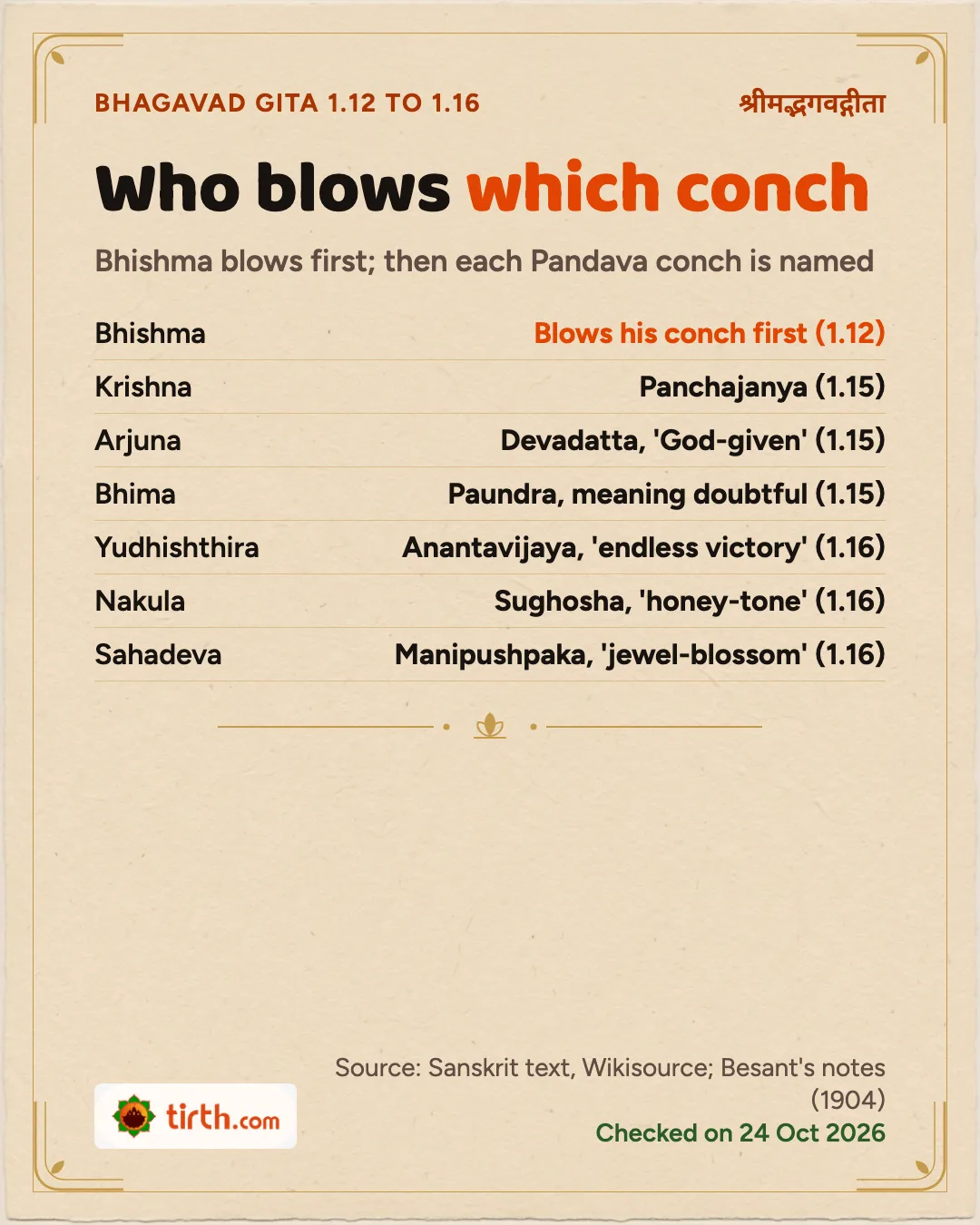
The first conch is Bhishma’s (1.12). From the other side come Krishna and Arjuna, in a great chariot yoked to white horses, and they blow theirs (1.14). Every Pandava conch has its own name. Even Bhima’s, though Besant calls the meaning of that one doubtful.
| Who | Conch | Verse | Besant’s note on the name |
|---|---|---|---|
| Krishna (called Hrishikesha) | Panchajanya | 1.15 | Made from the bones of the giant Panchajana, slain by Krishna |
| Arjuna (called Dhananjaya) | Devadatta | 1.15 | “God-given” |
| Bhima | Paundra | 1.15 | Meaning doubtful |
| Yudhishthira | Anantavijaya | 1.16 | “Endless victory” |
| Nakula | Sughosha | 1.16 | “Honey-tone” |
| Sahadeva | Manipushpaka | 1.16 | “Jewel-blossom” |
“Stay my chariot” (1.20 to 1.23)
Arjuna raises his bow in 1.20. The verse calls him kapidhvaja, which Besant renders “he whose crest is an ape”, and then he has something to ask of Krishna.
| Devanagari | Transliteration |
|---|---|
| हृषीकेशं तदा वाक्यमिदमाह महीपते । | hṛṣīkeśaṃ tadā vākyam idam āha mahīpate |
| सेनयोरुभयोर्मध्ये रथं स्थापय मेऽच्युत ॥१-२१॥ | senayor ubhayor madhye rathaṃ sthāpaya me ‘cyuta |
Two voices share this verse. Sanjaya still has the first line, and he is talking to the king (“O lord of earth”). Arjuna’s own words start only at senayor, and Besant (1904, p. 20) shows the change by putting “Arjuna said” in the middle of the verse. “And spake this word to Hrishikesha, O Lord of earth: Arjuna said: In the midst, between the two armies, stay my chariot, O Achyuta.” Telang (1882, p. 39) has “O undegraded one! station my chariot between the two armies”. (Achyuta is the name Arjuna uses for Krishna here, and Besant’s note glosses it as “the changeless, the immovable”.)
Krishna’s one line (1.24 to 1.27)
Krishna does as Gudakesha (Arjuna, here) asks. He places the chariot in front of Bhishma and Drona and says the only sentence he has in the chapter.
| Devanagari | Transliteration |
|---|---|
| भीष्मद्रोणप्रमुखतः सर्वेषां च महीक्षिताम् । | bhīṣmadroṇapramukhataḥ sarveṣāṃ ca mahīkṣitām |
| उवाच पार्थ पश्यैतान्समवेतान्कुरूनिति ॥१-२५॥ | uvāca pārtha paśyaitān samavetān kurūn iti |
Besant (1904, pp. 20 to 21) has it as “Over against Bhishma, Drona and all the rulers of the world, said: ‘O Partha, behold these Kurus gathered together.'”
So Arjuna looks. On both sides, in Telang’s list (p. 40), he sees fathers, grandfathers, preceptors, maternal uncles, brothers, sons, grandsons, companions, fathers-in-law and friends, and Telang’s note says the words take in everyone who stands in such a relation, which makes the list wider than it reads. Notice where the chariot was stopped, too. Right in front of Bhishma and Drona. That is the spot Arjuna is looking out from when he takes in both armies.
Limbs failing, the bow slipping (1.28 to 1.30)
The long speech starts in the second line of 1.28, and once more Besant prints “Arjuna said” in the middle of the verse. He does not open with reasons. He opens with his body.
| Devanagari | Transliteration |
|---|---|
| सीदन्ति मम गात्राणि मुखं च परिशुष्यति । | sīdanti mama gātrāṇi mukhaṃ ca pariśuṣyati |
| वेपथुश्च शरीरे मे रोमहर्षश्च जायते ॥१-२९॥ | vepathuś ca śarīre me romaharṣaś ca jāyate |
| गाण्डीवं स्रंसते हस्तात्त्वक्चैव परिदह्यते । | gāṇḍīvaṃ sraṃsate hastāt tvak caiva paridahyate |
| न च शक्नोम्यवस्थातुं भ्रमतीव च मे मनः ॥१-३०॥ | na ca śaknomy avasthātuṃ bhramatīva ca me manaḥ |
In Besant (1904, p. 21) 1.29 reads “My limbs fail and my mouth is parched, my body quivers, and my hair stands on end,” and 1.30 reads “Gandiva slips from my hand, and my skin burns all over, I am not able to stand, my mind is whirling.” Telang’s version of that line (1882, p. 40) is “the Gandiva (bow) slips from my hand; my skin burns intensely.”
Gandiva is his own bow, and he can’t keep hold of it.
No wish for victory or a kingdom (1.31 to 1.35)
| Devanagari | Transliteration |
|---|---|
| न काङ्क्षे विजयं कृष्ण न च राज्यं सुखानि च । | na kāṅkṣe vijayaṃ kṛṣṇa na ca rājyaṃ sukhāni ca |
| किं नो राज्येन गोविन्द किं भोगैर्जीवितेन वा ॥१-३२॥ | kiṃ no rājyena govinda kiṃ bhogair jīvitena vā |
Besant’s English (1904, p. 22) is “For I desire not victory, O Krishna, nor kingdom, nor pleasures; what is kingdom to us, O Govinda, what enjoyment, or even life?” He wants none of the three things he names, victory, kingdom and pleasure. By 1.34 he is going through his kin all over again, with brothers-in-law and other relatives on the list this time.
Sin, family dharma and the ancestors (1.36 to 1.46)
From here on it is an argument. The other side, Arjuna grants in 1.36, are ātatāyinaḥ. Besant’s word for that is “desperadoes” and Telang’s is “felons”, and Telang’s note lists six kinds of ātatāyin, among them the incendiary, the poisoner and the man who attacks weapon in hand. Killing them would still bring sin, he says.
Between 1.38 and 1.45 he stops talking about the battle and starts talking about the family. He blames greed. Their greed, he says, keeps the other side from seeing that destroying a family is wrong. Destroy one and its age-old family dharma perishes. Besant’s note calls dharma “a wide word”, one that takes in duty, religious rites, customs and righteousness. After that comes lawlessness, then the women of the family going astray, then varṇasaṅkara (Besant’s “caste-confusion”, Telang’s “intermingling of castes”), and with it the offerings of rice-balls and water to the ancestors are cut off. And there is something he has heard, which he brings up in 1.44. People whose family dharma is destroyed dwell in hell.
Keep in mind whose words these are. They are Arjuna’s, spoken in grief, and Krishna answers them from chapter 2 onward, so we would rather you read them as one side of a conversation than as the Gita’s teaching.
| Devanagari | Transliteration |
|---|---|
| यदि मामप्रतीकारमशस्त्रं शस्त्रपाणयः । | yadi mām apratīkāram aśastraṃ śastrapāṇayaḥ |
| धार्तराष्ट्रा रणे हन्युस्तन्मे क्षेमतरं भवेत् ॥१-४६॥ | dhārtarāṣṭrā raṇe hanyus tan me kṣemataraṃ bhavet |
He ends, in Besant’s version (1904, p. 25), with “If the sons of Dhritarashtra, weapon-in-hand, should slay me, unresisting, unarmed, in the battle, that would for me be the better.”
The bow is put down (1.47)
| Devanagari | Transliteration |
|---|---|
| एवमुक्त्वार्जुनः संख्ये रथोपस्थ उपाविशत् । | evam uktvārjunaḥ saṃkhye rathopastha upāviśat |
| विसृज्य सशरं चापं शोकसंविग्नमानसः ॥१-४७॥ | visṛjya saśaraṃ cāpaṃ śokasaṃvignamānasaḥ |
The last verse goes back to Sanjaya. Besant (1904, p. 25) gives “Having thus spoken on the battle-field, Arjuna sank down on the seat of the chariot, casting away his bow and arrow, his mind overborne by grief.” In Telang (1882, p. 42) Arjuna “sat down in (his) chariot, with a mind agitated by grief.”
Krishna gives no reply, and the chapter stops there.
Eight key verses and how to find them
All eight are printed in full in the story above. To find one in a printed index, the first words are usually enough (the table gives them in transliteration).
| Verse | First words | What it says |
|---|---|---|
| 1.1 | dharmakṣetre kurukṣetre | Dhritarashtra asks what his sons and the Pandavas did at Kurukshetra |
| 1.10 | aparyāptaṃ tad asmākaṃ | Duryodhana compares the army guarded by Bhishma with the one guarded by Bhima |
| 1.21 | hṛṣīkeśaṃ tadā vākyam | Arjuna asks Krishna to place the chariot between the armies |
| 1.25 | bhīṣmadroṇapramukhataḥ | Krishna’s one sentence: “behold these Kurus” |
| 1.29 | sīdanti mama gātrāṇi | Arjuna’s limbs fail, his mouth dries |
| 1.30 | gāṇḍīvaṃ sraṃsate hastāt | The Gandiva bow slips from his hand |
| 1.32 | na kāṅkṣe vijayaṃ kṛṣṇa | He wants no victory, kingdom or pleasure |
| 1.47 | evam uktvārjunaḥ saṃkhye | Arjuna sits down in the chariot and lets go of his bow and arrows |
Our advice to anyone opening the Gita for the first time is to read all of chapter 1 before starting chapter 2, where the teaching begins. Arjuna sets out his doubts here, about kin, sin and family dharma, and Krishna’s words from chapter 2 onward answer them. An answer makes far more sense once you have heard the question.
Why don’t two copies of chapter 1 match?
Put two books side by side and three things will not line up. Neither book has made a mistake.
Is Duryodhana worried or boasting in 1.10?
It comes down to one word, aparyāptam, which can be taken either way. According to Besant’s note the commentators split on it, with Anandagiri reading “insufficient” and Shridhara Svami “unlimited”. Besant takes the first meaning, and K. M. Ganguli’s Mahabharata translation does too. Read either and Duryodhana sounds anxious about his army. Telang goes the other way, and his Duryodhana sounds confident. The text supports either. Keep both in mind.
Some copies count 46 verses
Count 47 and you are with the standard numbering, the critical edition and Besant. The Bhaktivedanta Book Trust edition (Bhagavad Gita As It Is) has 46. Its Text 28 takes the second half of standard 1.28 and the first half of standard 1.29 and makes them one verse, so every number after that runs one behind, right down to its last verse, Text 46, which is standard 1.47. No verse has gone missing. (So with a 46-verse copy in hand, add one to every verse number after 1.28 to find the same verse in another edition.)
Which Bhishma Parva chapter is it?
Two sets of numbers apply, the Gita’s own and those of the Mahabharata around it. Gita 1.1 is Bhishma Parva 25.1 in the commonly used numbering, because there the Gita fills chapters 25 to 42. Pune’s critical edition counts differently. The same verse there is 6.23.1, and the Gita runs from chapter 23 to 40, ending at 6.40.78.
The two texts also differ slightly in a handful of lines of chapter 1, 1.28 and 1.37 among them. Which is why we quote only verses that read the same in both.
What the king already knows when he asks
Most summaries begin at 1.1 and skip the frame, so go back to Section XIII of the Bhishma Parva in Ganguli’s translation. Sanjaya returns from the field and tells Dhritarashtra that Bhishma has fallen, after protecting the Kaurava army for ten days. The king wants to know how (Section XIV). Sanjaya starts the battle over from the beginning in Section XV, and ten sections on, in XXV, comes the Gita’s first chapter.
Which puts 1.1 in a different light. The old king’s “what did they do?” comes from a man who already knows how the first ten days ended. Or rather, the result is known to him, and the story is what he is asking for.
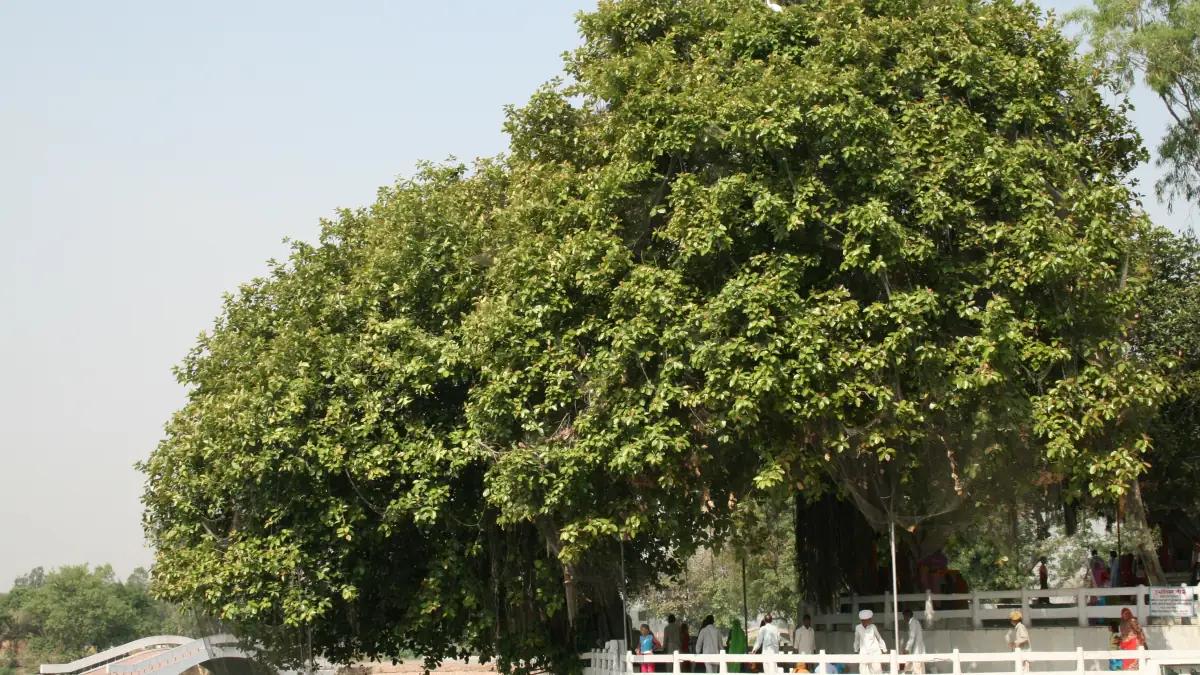
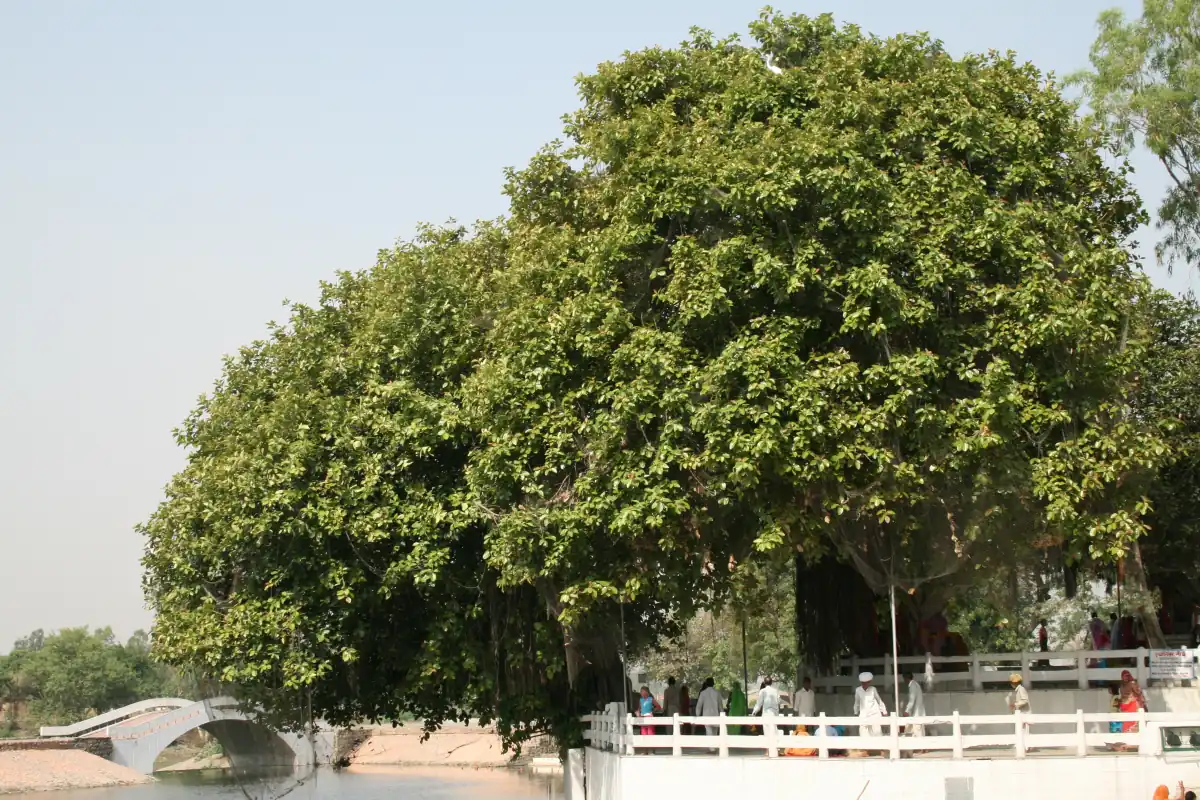
On a map today, Kurukshetra is a district of Haryana. Its district administration says two things about it. This is the place named in the first verse of the Gita, “Dharmakshetra Kurukshetra”, and Jyotisar is where Krishna taught Arjuna.
Who is Govinda, and who is Partha?
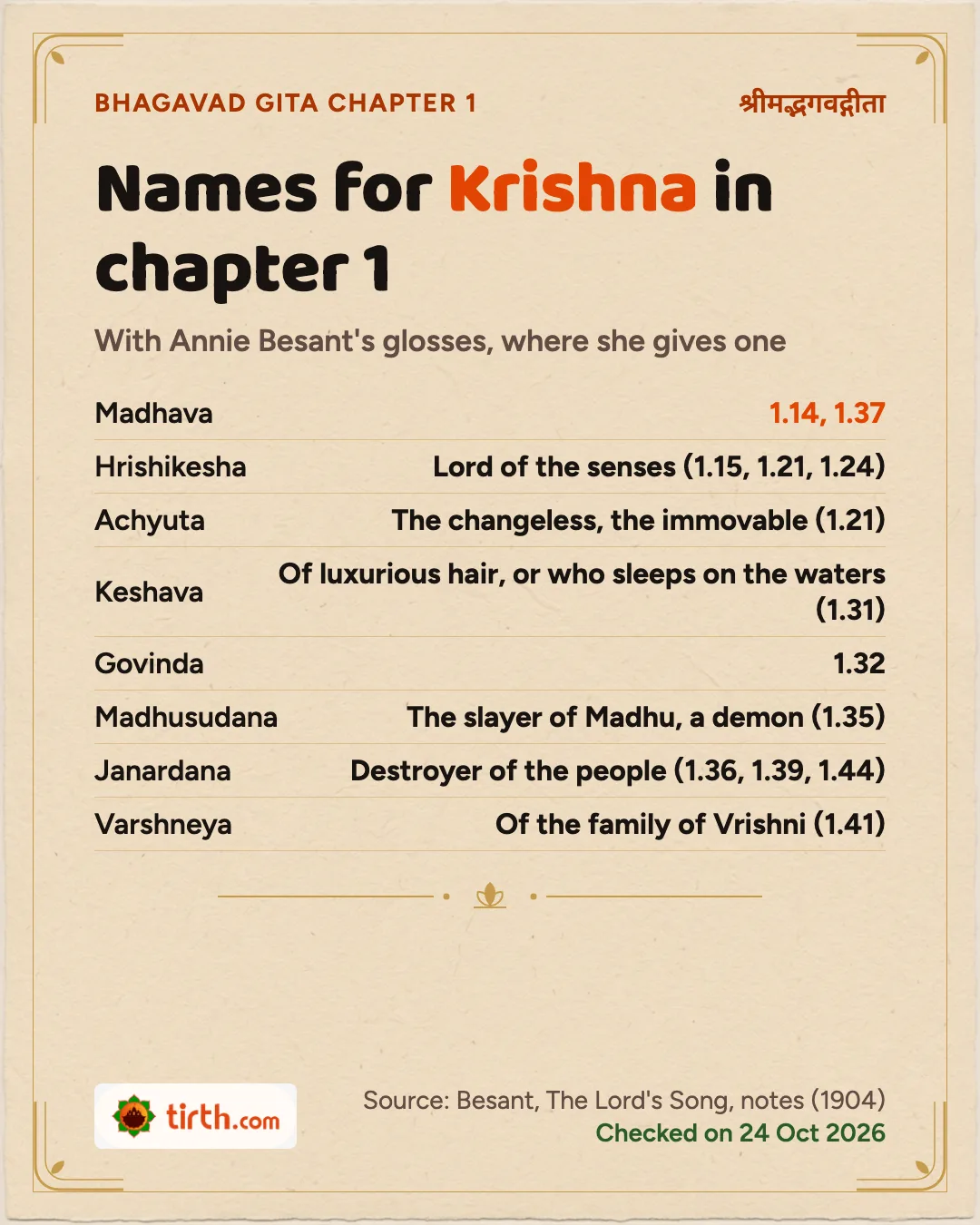
New readers get lost in the names more than in any hard verse. Krishna and Arjuna are called something different in nearly every verse, and in 1.32 alone Krishna is Krishna in one line and Govinda in the next. So keep the table open while you read (the glosses come from Besant’s 1904 notes, where she gives one).
| Name | For | Verses | Besant’s gloss |
|---|---|---|---|
| Madhava | Krishna | 1.14, 1.37 | none given |
| Hrishikesha | Krishna | 1.15, 1.21, 1.24 | “Lord of the senses” |
| Achyuta | Krishna | 1.21 | “the changeless, the immovable” |
| Keshava | Krishna | 1.31 | “he who has luxurious hair” or “he who sleeps on the waters” |
| Govinda | Krishna | 1.32 | none given |
| Madhusudana | Krishna | 1.35 | “the slayer of Madhu, a demon” |
| Janardana | Krishna | 1.36, 1.39, 1.44 | “destroyer of the people” |
| Varshneya | Krishna | 1.41 | “belonging to the family of Vrishni” |
| Dhananjaya | Arjuna | 1.15 | “conqueror of wealth” |
| Kapidhvaja | Arjuna | 1.20 | “he whose crest is an ape” |
| Gudakesha | Arjuna | 1.24 | “the lord of sleep” |
| Partha | Arjuna | 1.25, 1.26 | none given |
| Kaunteya | Arjuna | 1.27 | “the son of Kunti” |
Telang, following the commentator Nilakantha, reads Gudakesha a second way too, as “of thick hair”.
Mantras that call on Krishna by these names and others are on the Krishna mantra page, and there is the aarti of Shri Krishna to sing.
Where the reading goes after 1.47
Arjuna is seated, and silent, when chapter 1 ends. People often remember him saying “I will not fight” at this point. He does say it, but in the next chapter, in Sanjaya’s report at 2.9, na yotsya iti (worth checking before you quote it in a talk or a post). Chapter 2 opens with Sanjaya (2.1). Then, in 2.2 to 2.3, Krishna speaks for the first time and says klaibyaṃ mā sma gamaḥ pārtha.
Even Arjuna’s grief gets the word yoga. The chapter’s closing line calls it Arjuna Vishada Yoga, and so if you read the Gita at home for Gita Jayanti, or end each sitting with the Bhagavad Gita aarti, you begin here, with Arjuna’s despondency, before any of the teaching that answers it.
Looking for a Vishnu Sahasranam path or a puja for your family? See the puja page, Pujas on Tirth.
Frequently asked questions
The king has asked, so Sanjaya tells Dhritarashtra what happened at Kurukshetra. Duryodhana goes to Drona first. Then the conches sound and Arjuna asks Krishna to place his chariot between the armies. There he sees his own kin on both sides. He argues against the war, then lets go of his bow and arrows and sits down (1.47).
That is chapter 1’s own name, from its closing line. In Besant’s 1904 edition it is “The Despondency of Arjuna”. The 1905 edition by Besant and Bhagavan Das has “The Yoga of the Despondency of Arjuna”.
In the standard numbering there are 47. The Bhaktivedanta Book Trust edition makes one verse, its Text 28, out of parts of standard 1.28 and 1.29, so it counts 46 and its numbers run one behind from there. Nothing is left out.
The question in 1.1 is Dhritarashtra’s, his only verse in the Gita. Everything after it is narrated by Sanjaya, son of Gavalgana and a minister at the king’s court, using the sight Vyasa granted him. Inside that report Duryodhana has 1.3 to 1.11. Twice it is Arjuna’s turn. The first runs from the second line of 1.21 to 1.23, and the second, much longer, starts at the second line of 1.28 and goes on to 1.46.
His teachers, grandfathers, uncles, brothers, sons and friends were standing in both armies. A victory or a kingdom won by killing them was not something he wanted. It would bring sin, he said, and destroy family dharma, and being killed unarmed would be better (1.46). Those words, “I will not fight”, are not in chapter 1 at all. They come at 2.9.
Once, and only in Sanjaya’s report: “O Partha, behold these Kurus gathered together” (1.25). His conch, Panchajanya, is heard in 1.15. A speaker line of his own does not come until 2.2.
Sources and further reading
- Wikisource (Sanskrit): Bhagavad Gita, Arjuna Vishada Yoga, the full Devanagari text of chapter 1
- GRETIL, University of Göttingen: Mahabharata, Bhishma Parva, the Pune (BORI) critical edition text
- Internet Archive: Annie Besant, The Bhagavad-Gita or The Lord’s Song, fourth revised edition, Theosophical Publishing Society, 1904, First Discourse pp. 15 to 25
- Sacred Books of the East, vol. 8: K. T. Telang, The Bhagavadgita, Clarendon Press, Oxford, 1882, Chapter I pp. 37 to 42
- ibiblio: K. M. Ganguli, The Mahabharata, Bhishma Parva, Section XIII, and Section XXV (Gita chapter 1)
- Vedabase: Bhagavad Gita As It Is, chapter 1, for the Bhaktivedanta Book Trust verse numbering
- District Administration Kurukshetra: About District