On this page7 sections
Sanskrit builds the word on the root sṛ, to run or flow. That gives “wandering through”, a self passing from one body into the next.
Arjuna hears the hard part from Bhagwan Krishna, Deity page on Tirth in the Bhagavad Gita (8.16): every world, up to the worlds of Bhagwan Brahma’s own, is a place a self comes back from. The Gita draws it as an ocean. In 12.7 Bhagwan Krishna lifts his devotees out of it.
Reincarnation, as English speakers loosely use it, names one step: a self entering a new body. Samsara is wider. It takes in the wheel itself, whatever keeps it turning, and the hope of getting off.
In short
That gives “wandering through”, a self passing from one body into the next. Arjuna hears the hard part from Bhagwan Krishna, Deity page on Tirth in the Bhagavad Gita (8.16): every world, up to the worlds of Bhagwan Brahma’s own, is a place a self comes back from.
Where does the teaching of rebirth first appear?
The early hymns of the Rigveda leave it out. Scholars mostly place the first teaching of rebirth in the Upanishads, with the Brihadaranyaka and the Chandogya, both early ones, the best known.
The Brihadaranyaka has a small, exact picture of death: a grass-leech (some translations say caterpillar) reaches the tip of a blade, grips the next blade and draws itself across. The self, the text says, does likewise at death. It takes a new support. By the numbering most editions use, the passage sits in the fourth chapter, at the third verse of the fourth section. Editions differ in numbering, so check the one on your shelf.
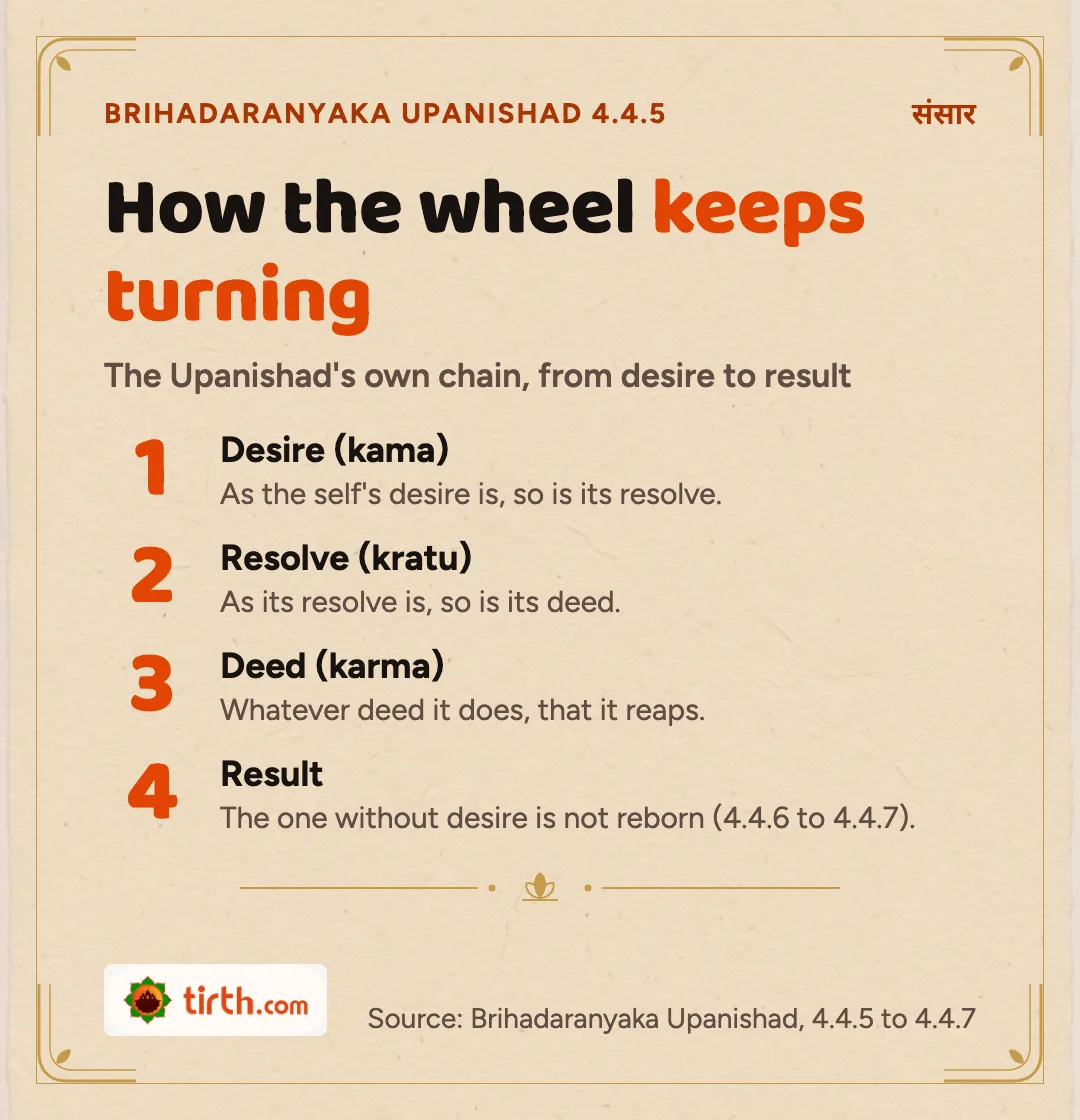
Two verses on, the same Upanishad brings in karma (4.4.5): a self’s desire shapes its resolve, its resolve shapes its deed, and the deed bears fruit for that same self. Desire, resolve, deed, result. Taken like this, samsara is cause and effect, a long ledger of everything a self has wanted and done.
What do three Gita verses say about the cycle?
Rebirth comes up in several chapters of the Gita. Three verses carry the argument. Verse 2.22 reaches for clothes: a person puts off the worn ones and puts on new ones, and the self likewise leaves worn-out bodies for new. Verse 8.16 calls the worlds up to Bhagwan Brahma’s own places of return, and says reaching Bhagwan Krishna means no return. Verse 12.7 is the exit. Bhagwan Krishna lifts his devotees out of the ocean of death and samsara, and the devotion road is named in that single line.
This page cites verses by number and never prints them, so open your own copy (a Gita Press edition will do) at 2.22, 8.16 and 12.7. Tirth also has the Bhagavad Gita Aarti.
The Gita has words of its own for the cycle. Of the worlds, 8.16 says “returning” (punarāvartinaḥ); 12.7 says “death-and-samsara” (mṛtyu-saṃsāra). Put together, the two words show samsara as a doctrine to accept and as something a person is lifted out of.
How do the schools read the way out?
On one point the texts agree: there is a way out. They part over what holds a person in and what opens the door. Usually three schools are set side by side, and each row below is one school’s reading, so no row speaks for all of Hinduism.
| School | Way out as the school reads it |
|---|---|
| Advaita | Samsara rests on ignorance (avidyā) of the self being Brahman, and knowledge ends it. |
| Dvaita | The self stays distinct from Bhagwan Vishnu, and release comes by his grace. |
| Vishishtadvaita | Devotion and surrender lead to the presence of Bhagwan Vishnu. |
Back in the Brihadaranyaka, the answer runs through desire. The usual rendering says someone without desire, being Brahman, goes to Brahman and is not reborn (4.4.6 to 4.4.7). Advaita takes that ending of desire to be knowledge.
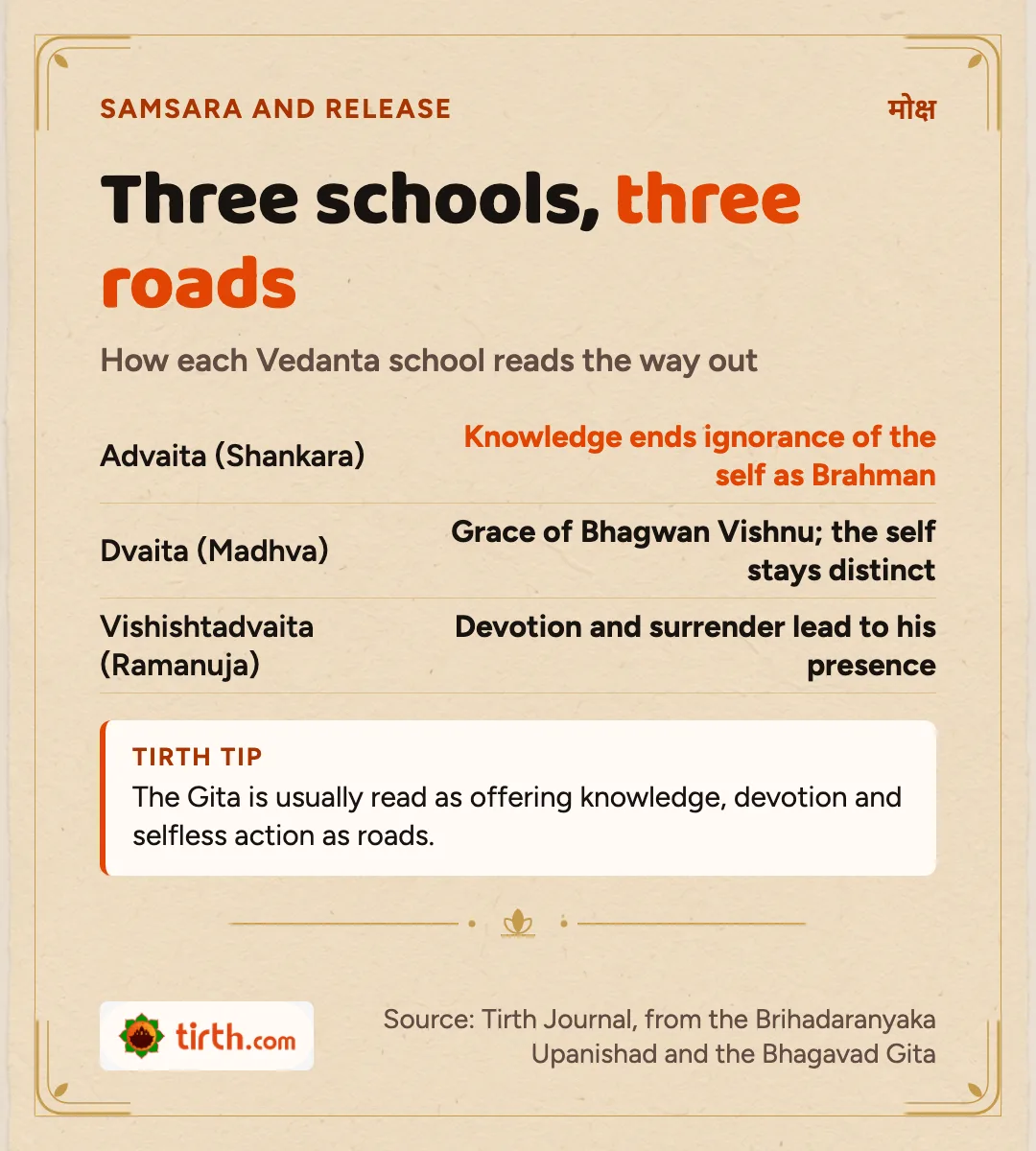
For the Gita, the usual reading lists three roads, knowledge, devotion and selfless action.
Do Buddhism and Jainism use the word samsara too?
Hindu, Buddhist and Jain thought all talk of a cycle, and the argument starts at what goes round. The Hindu texts have a self that gets released. Buddhist teaching rejects a lasting self (anattā), so a sentence like “the soul is reborn” misdescribes Buddhism, even though loose English keeps pairing the two.
Does everyone come back as a human?
No. Even the heavens sit inside the cycle by Gita 8.16, so a self that rises to a high world can still return.
One popular figure counts 84 lakh (8.4 million) forms of life, among them water creatures, plants, insects, birds, animals and humans. Which book first gave that count is something sources split on.
The Chandogya Upanishad (5.10) describes two routes after death. Those who know, and live in faith and austerity, take the path of the gods, while ritual and giving lead to the path of the fathers, which ends in a return to earth and so makes the second route one more turn of the wheel. Accounts differ on who qualifies for which. That is why a printed edition beats any summary of the two routes.
Kashi carries a belief of its own about liberation. Devotees hold that dying there frees the self from the cycle; the liberating name is said to come from Bhagwan Shiva, Deity page on Tirth.
Frequently asked questions
Samsara is the going-round of birth, death and rebirth. According to the texts nobody can name its beginning, and the Gita speaks of a person being lifted out of it.
In the loose English sense, no. Reincarnation covers a single turn, the self taking a new body. Samsara covers the full wheel, what drives it and the road off it.
The Brihadaranyaka names a chain that starts with desire and runs through resolve and deed to the result. Advaita goes deeper and finds the root of the whole cycle in ignorance (avidyā) of the self being Brahman.
The Gita argues that it is. In 2.27 Bhagwan Krishna tells Arjuna that death is certain for whoever is born and birth is certain for whoever has died, and that grief over what cannot be avoided is misplaced.
Gita 8.6 holds that whatever state of being a person remembers at the end, while leaving the body, is the state that person reaches.