On this page8 sections
He asks his charioteer and guide, Bhagwan Krishna, what the right thing to do is. The word for what he is asking about is dharma.
Dharma meaning starts with its Sanskrit root, dhri, “to hold” or “to support”, and in practice it means duty and right conduct. In Bhagavad Gita 3.35 it becomes a rule for a single life. Better to do your own duty imperfectly than another’s duty well.
In short
The word for what he is asking about is dharma. Dharma meaning starts with its Sanskrit root, dhri, “to hold” or “to support”, and in practice it means duty and right conduct. In Bhagavad Gita 3.35 it becomes a rule for a single life.
What the word dharma means: to hold
Most accounts trace dharma to dhri. A word built on holding can stretch to cover duty, conduct and the way a community keeps itself together.
The Mahabharata puts it almost the same way. In the Karna Parva (Section 69 in Ganguli’s translation), dharma is what protects and preserves the people, and the learned conclude that whatever maintains them is dharma. The definition is about what dharma does, which is to hold people together.
Britannica counts dharma among the four ends of life, the purusharthas: dharma, artha, kama and moksha.
Manu 6.92 and its ten marks
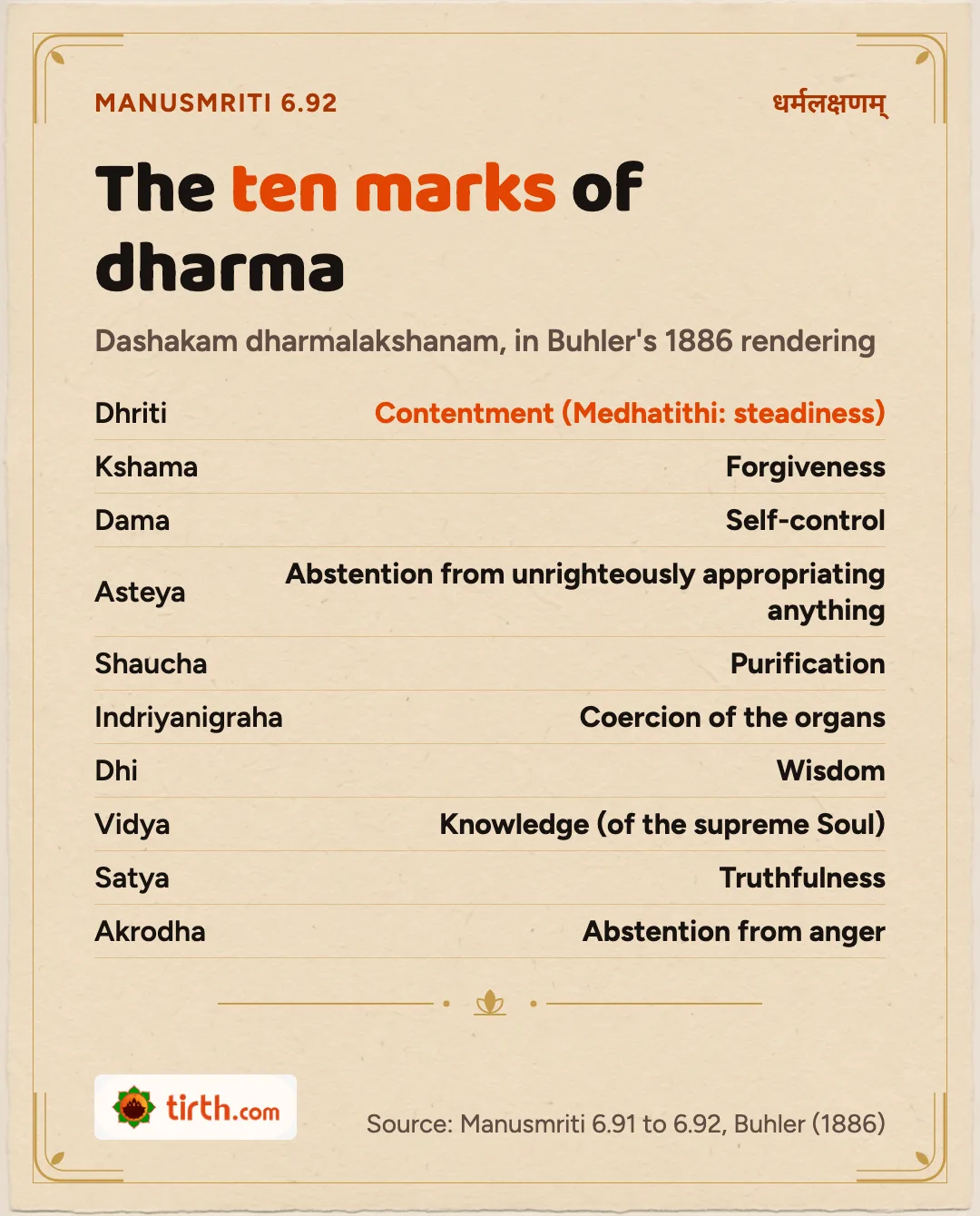
The Manusmriti turns the word into a list. Manu 6.91 speaks of the tenfold law, and 6.92 gives the ten marks of dharma (dharmalakshanam).
Translators render the ten terms differently. The graphic below gives Buhler’s 1886 rendering of them. Medhatithi, the commentator on Manu, reads the first mark, dhriti, as steadiness: contentment even at the loss of property. The graphic gives Buhler’s word for it, contentment, with that reading beside it.
Svadharma, and the verse Arjuna heard
Bhagwan Krishna’s answer to Arjuna is svadharma, dharma that belongs to you alone (sva means one’s own). Gita 3.35 says your own duty done imperfectly beats another’s done well. The verse adds that to die in one’s own duty is better still, and that another’s duty is full of danger.
Gita 18.47 shares that opening half-line and then turns elsewhere, ending on work that fits one’s own nature and brings no sin (napnoti kilbisham), where 3.35 ended on danger (bhayavahah).
Britannica splits dharma in two. Truthfulness, non-injury and generosity are general duties that fall on everyone, whereas svadharma, the specific kind, depends on class, station and stage of life.
Readers disagree about that second kind. In the standard accounts, specific duty follows varna and stage of life. Some modern readers reinterpret svadharma as a matter of one’s own nature, and critics, for their part, see the Gita backing the caste system. No side is taken here.
Is dharma the same as religion?
Not exactly. The table sets the two side by side.
| Point | Dharma | Religion in everyday English |
|---|---|---|
| What it centres on | Duty and right conduct | Belief and worship |
| How far it reaches | Duty, ethics, law, family, work and the order of nature | The faith a person follows |
Hinduism has neither a single founder nor a central doctrinal authority. Some scholars argue that religion is a broad enough word to take dharma in, so the boundary is debated. Sanatana Dharma, the eternal dharma, is a name for Hinduism, and Hinduism is also called a religion. Buddhism, Jainism and Sikhism each have their own meaning for the word (dhamma in some).
Saying flatly that dharma is not religion goes beyond the sources.
Adharma, and how hard right is to see
Adharma is the other side. The Gita sets the two together, and verse 4.7 has Bhagwan Krishna, Deity page on Tirth speaking of a decline of dharma (dharmasya glanih) and a rise of adharma, and 4.8 carries his promise to be born age after age to establish dharma.
Yudhishthira’s reply in the Yaksha Prashna episode of the Vana Parva is that the truth of dharma lies hidden in a cave. So the path to follow is the one the great have walked.
For dharma through a life rather than a verse, try Maryada Purushottam Ram meaning or the guide to the Ramayana characters.
Dharma on a Tuesday afternoon
On a weekday the ten marks shrink to acts that last a few minutes. A student who admits to copying homework is showing satya, truthfulness. A parent who stays calm over a spilled glass is showing akrodha, freedom from anger, and a colleague who will not pass off a teammate’s idea as his own is showing asteya, not taking what is not rightly yours.
In the Taittiriya Upanishad (Shikshavalli 1.11) a teacher gives his leaving students a last instruction, satyam vada, dharmam chara. Speak the truth, practise dharma.
The examples show the ten marks as ordinary conduct, small enough to fit into a day.
Frequently asked questions
The word is built on the root dhri, “to hold”. In use it covers duty and right conduct, from general duties such as truthfulness down to the specific duty of one’s own station.
Sanskrit dhri, “to hold” or “to support”, is the root usually given. The Mahabharata’s Karna Parva has it as: what maintains is dharma.
Religion is about belief and worship, while dharma stretches further, over duty, ethics, law, family and work. Scholars still debate the boundary.
Svadharma is one’s own individual duty (sva means one’s own). Gita 3.35 says that doing it imperfectly is better than doing another’s duty well. Britannica sets it against the general duties, such as truthfulness and non-injury, that fall on everyone.
Adharma, which the Gita names in 4.7 as rising while dharma declines.
Manu 6.92 lists ten. Buhler’s rendering gives contentment, forgiveness, self-control, abstention from unrighteously appropriating anything, (obedience to the rules of) purification, coercion of the organs (restraint of the senses), wisdom, knowledge of the supreme Soul, truthfulness and abstention from anger.
Sanatana Dharma means the eternal dharma. It is a name for Hinduism, which is also called a religion.
No, the word is used in Buddhism, Jainism and Sikhism too, each with a meaning of its own.
Continue on Tirth
- See festival dates for your city on the Tirth Spiritual Calendar, Spiritual Calendar on Tirth.
- Find the temple nearest your family on Tirth temples, Temple page on Tirth.
- Read about Gita Jayanti on the Tirth Gita Jayanti page.
- Read Chitragupta, keeper of every deed for another way the texts talk about action and account.