On this page9 sections
- Was Ravana born with ten heads?
- Nine heads in the fire for Bhagwan Brahma
- Did Ravana offer his heads to Bhagwan Shiva?
- The Jain Ravana had one face and a necklace
- Did Ravana’s heads grow back when Bhagwan Ram cut them?
- Ravana’s ten heads, text by text
- So what do the ten heads stand for?
- Frequently asked questions
- Continue on Tirth
- Sources and review
He is born with ten necks in chapter 9 of the Uttara Kanda, and his father, the sage Vishravas, names him Dashagriva for them, the ten-necked.
Maybe you grew up with a different version. The Bhagwan Shiva one, say, where the heads are cut off and come back to him. Or the one where the ten heads are ten vices. Each of those has a source too. Just not the same source, and somewhere along the way they got stirred together into one story.
In short
Maybe you grew up with a different version. The Bhagwan Shiva one, say, where the heads are cut off and come back to him. Or the one where the ten heads are ten vices. Each of those has a source too.
Was Ravana born with ten heads?
He is, in Valmiki. Chapter 9 of the Uttara Kanda names his parents as the sage Vishravas and Kaikasi, and the ten necks are there the day their son is born.
Valmiki has two names for him that keep coming back. Dashagriva is for the ten necks. Dashanana, for the ten faces. Across the whole of the Uttara Kanda, both of them turn up over and over again.
Nine heads in the fire for Bhagwan Brahma
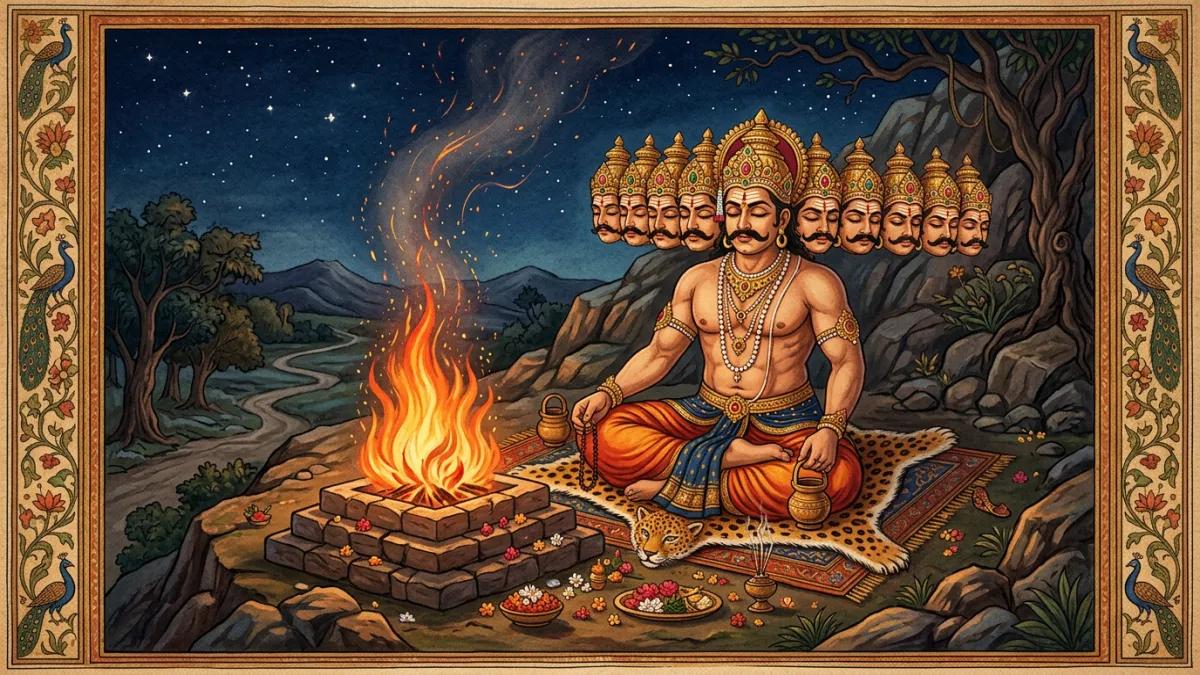
The first head offering is Valmiki’s, in Uttara Kanda chapter 10, where Dashagriva goes into tapas along with his brothers Kumbhakarna and Vibhishana. His part is a fast. Ten thousand years of it. A thousand years pass and one head goes into the fire. By nine thousand years nine heads are gone. The tenth is on its way to the fire when Bhagwan Brahma, Deity page on Tirth appears. Each head he had given is returned to him, as it was.
His boons come later in the same chapter, and what he did once he had them is told in how Kubera Dev became keeper of wealth and lost Lanka to Ravana.
So the fire is not where the ten heads come from, not in Valmiki. They were his from birth. All Bhagwan Brahma does is hand back what went into it.
The story of how he got the name Ravana is in chapter 16, when Dashagriva tries to uproot the mountain where Bhagwan Shiva sits and cries out as Bhagwan Shiva presses it down with his toe. Bhagwan Shiva names him for that cry, the one who makes the worlds cry out, and no head is offered in that chapter.
Did Ravana offer his heads to Bhagwan Shiva?
He does, though you have to leave Valmiki for it. The Shiva Purana tells this one, in chapter 28 of its Koti Rudra Samhita.
Ravana’s tapas here is aimed at Bhagwan Shiva, and he starts cutting off his heads in worship, one by one. Nine go this way. He is down to his last head when Bhagwan Shiva appears, and the heads are put back without any pain, and Ravana is granted strength.
The story of the Vaidyanatheshvara jyotirlinga follows in the same chapter, and the temple pages on Tirth, Temple page on Tirth are where to look up a temple.
Now compare that with Valmiki. In Valmiki the heads feed a fire, and it is Bhagwan Brahma who stops him at the tenth. The Shiva Purana sends nine of them to Bhagwan Shiva, who comes when one is left.
Which god comes depends on which book is doing the telling.
The Jain Ravana had one face and a necklace
The Jain telling has a different answer altogether. The scholar K. R. Chandra, summing up Vimalasuri’s Paumacariya, gives Ravana a natural human form, with only the one face.
The other nine come from a necklace. When he is a baby his mother, Kekasi in this telling, puts a family heirloom on him, a necklace with nine gems. His face is reflected in the gems, nine images of it on top of the real one, and he gets called Dasamukha for it. Ten-faced.
I’ll admit I like this version a lot. It explains the name and you never have to picture ten heads at all.
Did Ravana’s heads grow back when Bhagwan Ram cut them?
They did, and this one is Valmiki again. Look in the Yuddha Kanda at chapter 110, which is the number in the usual printed text. The Critical Edition counts its chapters another way. Bhagwan Ram cuts a head off, and straight away an equal one grows in its place. A hundred heads fall this way and the fight carries on regardless.
The end comes in chapter 111. It is Matali who prompts Bhagwan Ram to use the Brahma weapon, a flaming shaft made by Bhagwan Brahma for Indra Dev and given to Bhagwan Ram by the sage Agastya, and it pierces Ravana’s breast.
Nothing in that chapter about Vibhishana telling a secret. No nectar in the navel either. If that’s how you heard it, your version came from somewhere other than this chapter of Valmiki.
For Bhagwan Ram’s own story, read who Bhagwan Ram was, the prince of Ayodhya as Valmiki tells it, and for everyone else in the epic, who is who in the Ramayana, through one Valmiki scene each.
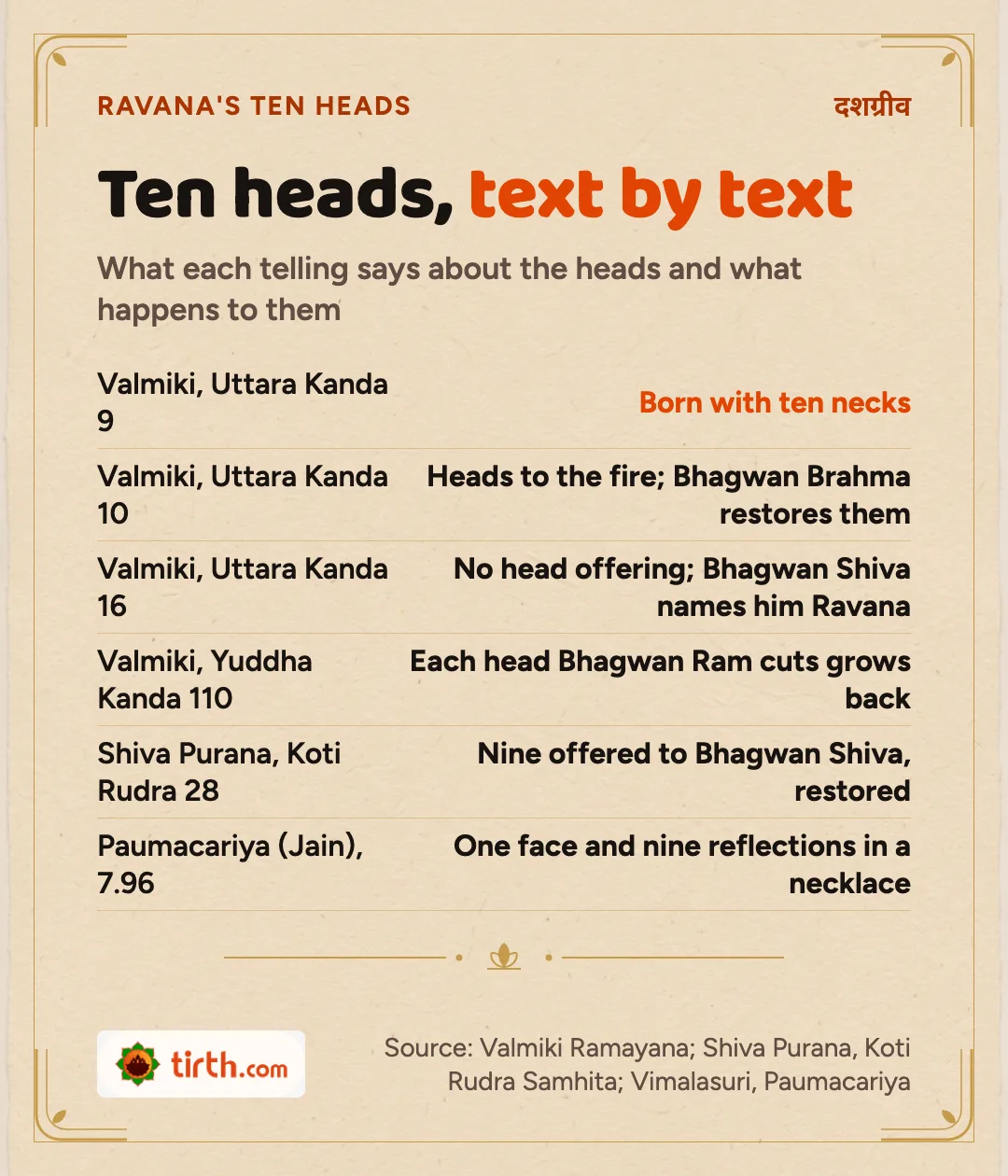
Ravana’s ten heads, text by text
The six versions above, side by side.
| Text and section | How many heads | What happens to them |
|---|---|---|
| Valmiki Ramayana, Uttara Kanda 9 | Ten, from birth | Born with ten necks, named Dashagriva by his father |
| Valmiki Ramayana, Uttara Kanda 10 | Ten | One offered to the fire every thousand years. Bhagwan Brahma appears at the tenth and returns them |
| Valmiki Ramayana, Uttara Kanda 16 | Ten | None offered. Bhagwan Shiva names him Ravana after he cries out under the mountain |
| Valmiki Ramayana, Yuddha Kanda 110 (common printed numbering) | Ten | Each head Bhagwan Ram cuts grows back at once |
| Shiva Purana, Koti Rudra Samhita 28 | Ten | Nine offered to Bhagwan Shiva, who appears and restores them |
| Vimalasuri’s Paumacariya (Jain), 7.96 | One face | A nine-gem necklace shows nine more images of his face. Called Dasamukha |
So what do the ten heads stand for?
Here the chapters above go quiet, and not one of them says what the heads mean. The meanings come from teachers and devotees, telling the story over again.
Learning is one common reading. Four Vedas, six shastras. Ten vices is another, among them kama (desire), krodha (anger), lobha (greed) and moha (delusion), and whoever is telling it may swap a few of those out. Some count the five senses and the five organs of action instead. And some see one mind pulled ten ways at once.
Tell a child whichever one you like, I think that’s fine, just don’t say Valmiki said it, because he never did, and once we hang a meaning on a text that didn’t give it we stop seeing what that text actually says.
So keep the readings if they help you, and bring them out at Dussehra as well. Only leave the label on.
Frequently asked questions
Valmiki says yes, and he is born with ten necks in Uttara Kanda chapter 9. Not so in the Jain Paumacariya, where there is one face and a necklace of nine gems reflects it nine more times.
His father names him Dashagriva at birth, for his ten necks. Dashanana, the other name, is about the faces, ten of them. Ravana is a different matter. Bhagwan Shiva gives him that name in Uttara Kanda chapter 16, after he cries out under the mountain.
Twice, in Valmiki. In Uttara Kanda 10 Bhagwan Brahma gives back the heads offered to the fire, and in Yuddha Kanda 110 every head Bhagwan Ram cuts off grows again at once. Then there is the Shiva Purana, where the nine offered to Bhagwan Shiva are put back by him.
Neither Valmiki nor the Shiva Purana gives him nine. The nine is a count of offered heads, the ones he gives Bhagwan Shiva in the Shiva Purana, and every one comes back. From birth, Valmiki gives him ten.
The Brahma weapon did it. Matali prompts him to use it in Yuddha Kanda chapter 111, and the flaming shaft pierces Ravana’s breast.
Continue on Tirth
- Bhagwan Ram on Tirth, Deity page on Tirth, whose Brahma weapon ends the duel.
- Bhagwan Shiva on Tirth, Deity page on Tirth, who named Ravana and, in the Shiva Purana, gave his heads back.
- Dussehra on the Tirth Spiritual Calendar, Spiritual Calendar on Tirth, for the day and timings in your city.