On this page7 sections
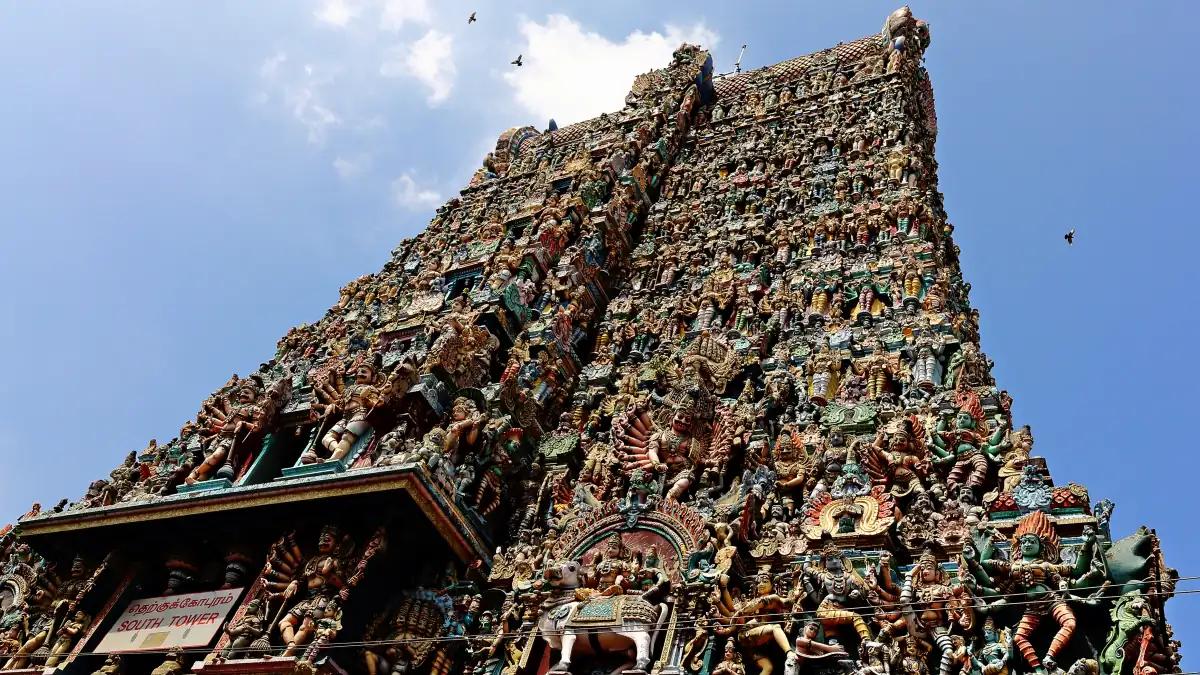
That gate is where the gopuram meaning starts: a gopuram (also written gopura) is the gateway tower in a South Indian temple’s enclosure wall.
The vimana is the other tower, the one over the garbhagriha (the sanctum). Under the Vijayanagara and Nayaka rulers, Tamil temples were built with so many massive gopurams that the gates came to dwarf the vimana.
In short
The vimana is the other tower, the one over the garbhagriha (the sanctum). Under the Vijayanagara and Nayaka rulers, Tamil temples were built with so many massive gopurams that the gates came to dwarf the vimana.
Rajaraja’s five-storey gate at Thanjavur, 1010 AD
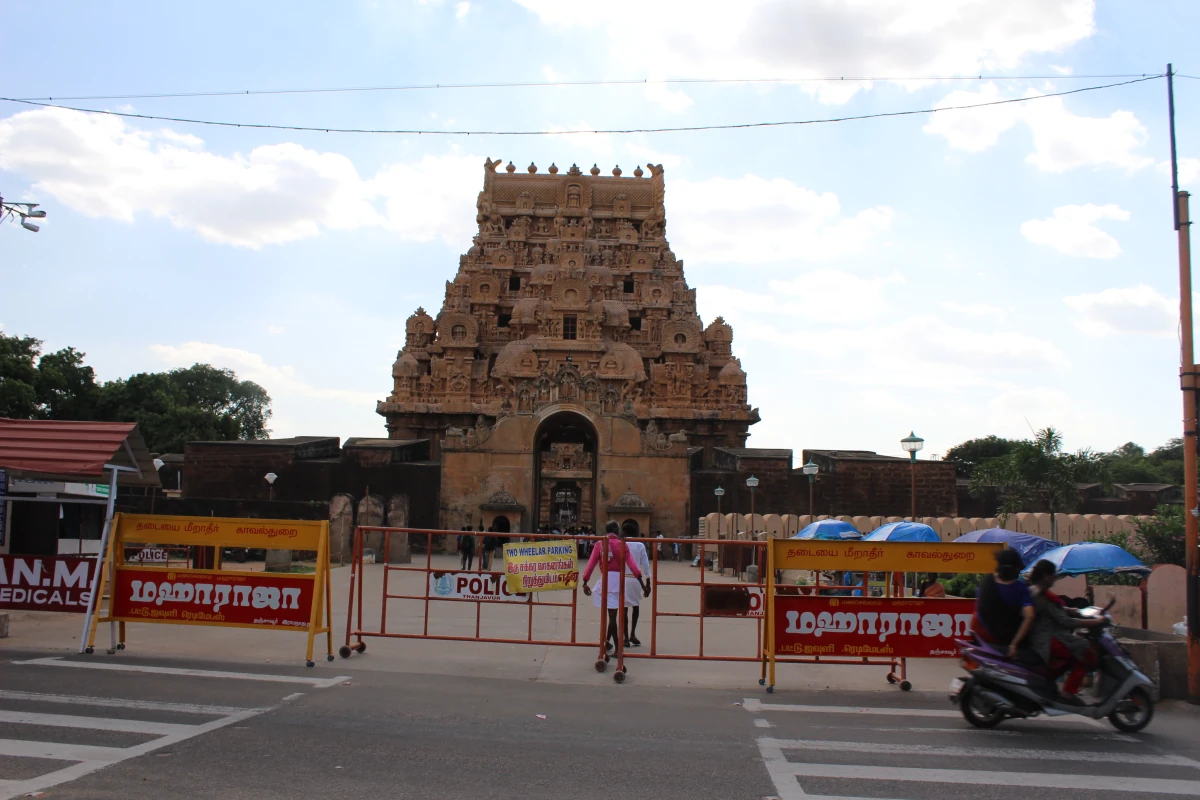
Begin at the Brihadeeswara temple, whose outer gopuram has both a name and a year. It is called Keralantakan vasal. According to the Indira Gandhi National Centre for the Arts, Rajaraja Chola built it in 1010 AD, five storeys high, with granite for the first three and brick and mortar for the storeys above.
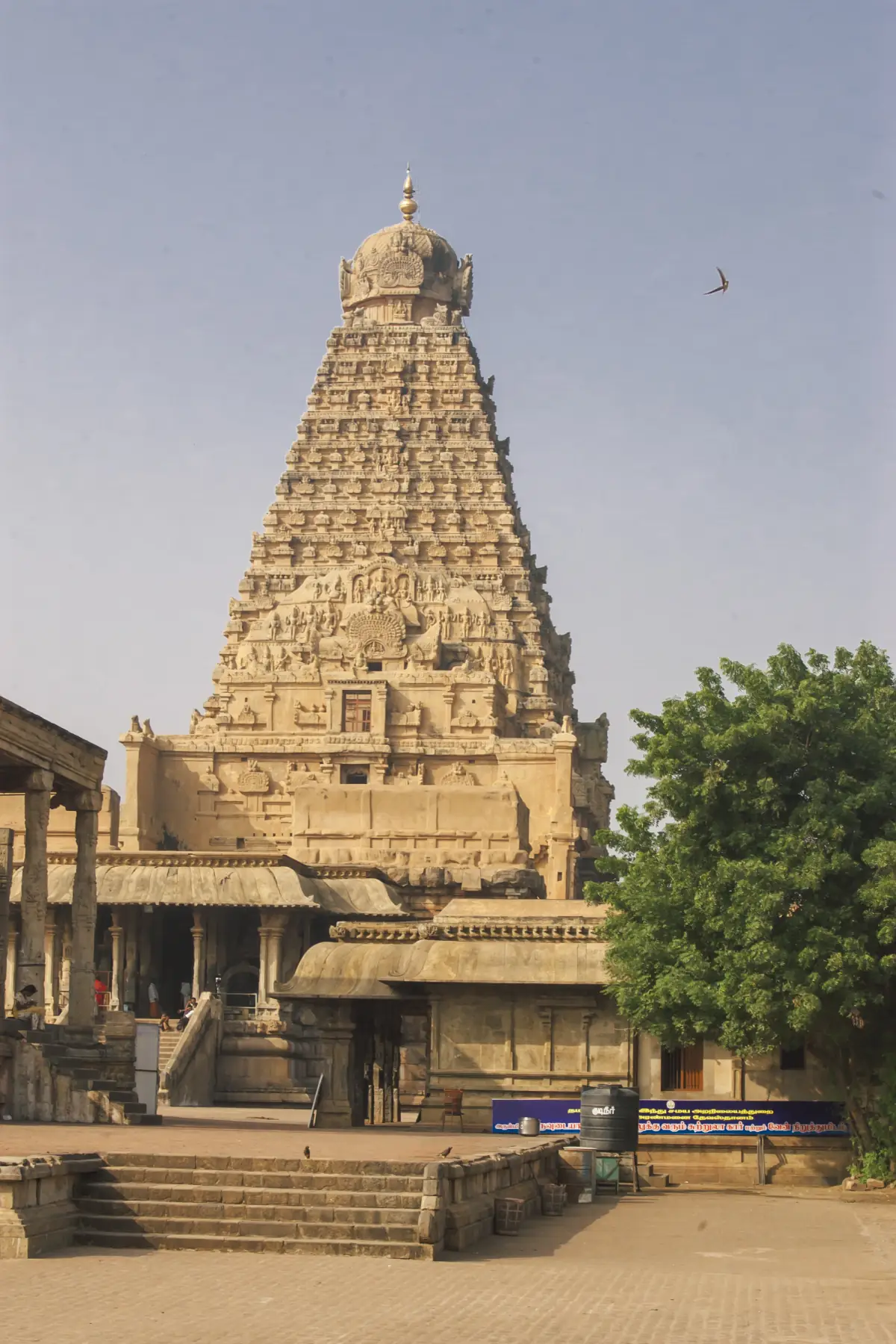
The temple’s vimana does have a figure. An art historian’s essay on the Chola temples, published by the Sahapedia heritage archive, puts it at slightly under 60 m, which makes “about 60 m” the safe figure to quote. The Archaeological Survey of India dates the consecration to 1009 to 1010 CE, the same years as the gate, and records the temple’s inscription in 1987 as a World Heritage site, one of the Great Living Chola Temples.
In the later temples it was the gates, not the sanctum tower, that kept growing. Carrying a phone or camera? Read temple rules for phones and photos before you go in.
Is that tower a gopuram or the vimana?
On a first visit to a temple town the two get mixed up all the time, since both rise in storeys and from the street they can look like the same kind of tower (after a full day of darshan, most towers do). If temple words are new to you altogether, start with the meaning of Sanatan Dharma, or with what a jyotirlinga means if one of Bhagwan Shiva’s shrines is next on your list. For these two towers, a few plain checks settle it.
- You walk through a gopuram, because it sits over a gateway in the enclosure wall; the sanctum is what lies under the vimana.
- A temple’s sanctum has one vimana over it, yet a big temple may have many gopurams (14 at Madurai, 21 at Srirangam).
- Madurai’s temple site counts 14 gopurams.
- By the principle fixed at Thanjavur, the tallest gateways stand furthest from the main shrine, on the same axis.
Then there is the word rajagopuram, a title you will run into for the grand gateway towers. The Government of India’s portal uses it for the main tower of Bhagwan Ranganatha’s temple at Srirangam. Karnataka’s tourism department uses it for the gate tower at Murudeshwar, and the Tamil Nadu government’s Chidambaram page uses it for all four of that temple’s towers. It is a name in use, and we have not found a source that sets a rule for which gate earns it.
From Pallava shrines to seven-storey gates at Chidambaram
So where did the form begin? The gopura, says a historian of South Indian temple art, goes back to barrel-vaulted shrines that stood at the cardinal points around some Pallava temples at Mamallapuram and Kanchipuram.
In that same account, Thanjavur fixed one principle: the tallest gateways are the ones furthest from the main shrine, on the same axis.
From the 12th century, Tamil temples were built with numerous massive gopurams set in concentric enclosures. The Vijayanagara and Nayaka rulers built most of them. In the end the gopurams dwarfed the vimanas they were built to lead to.
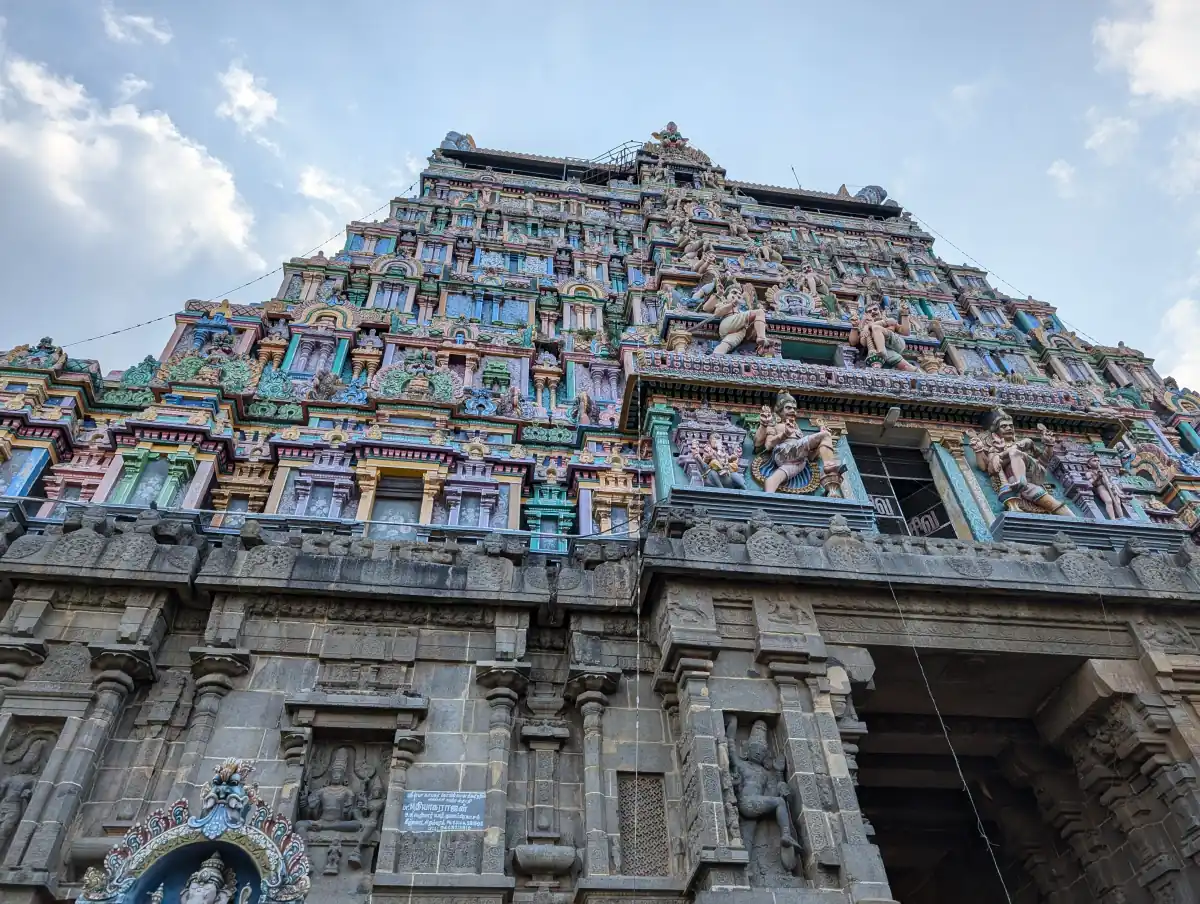
You can see where that ends up at the Thillai Nataraja temple at Chidambaram. According to the Tamil Nadu government’s portal it went up over a long period, built by Pallavas, Pandyas, Cholas, Vijayanagara rulers and Nayaks. It has four gopurams, one at each entrance, each of them seven storeys high, against Thanjavur’s five (visiting details are on the Chidambaram page).
Madurai’s 14 gates, and who has the tallest gopuram
For the Meenakshi Amman temple, home of Maa Meenakshi and Bhagwan Sundareswarar, the temple’s own site lists 14 gopurams, and the southern gopuram is the tallest of them at 51.9 m (170 ft). Planning the visit itself? The Madurai page covers the town.
Set side by side, the five towers show how far the gates went. Gaps show as “Not stated”.
| Temple and town | Gopurams | Gateway | Height as published | Storeys |
|---|---|---|---|---|
| Brihadeeswara, Thanjavur | Not stated | Keralantakan vasal, the outer gate (1010 AD) | Not stated (the temple’s vimana is about 60 m) | 5 |
| Thillai Nataraja, Chidambaram | 4 | One at each entrance | Not stated | 7 |
| Meenakshi Amman, Madurai | 14 | Southern gopuram, the tallest of the 14 | 51.9 m (170 ft) | Not stated |
| Sri Ranganathaswamy, Srirangam | 21 | Rajagopuram | About 72 m | Not stated |
| Murudeshwar, Karnataka | Not stated | Rajagopuram | Not stated (published figures differ) | 20 |
Heights and storeys as published by the Madurai temple’s own site, the Government of India’s tourism portal, the Tamil Nadu and Karnataka governments and the Sahapedia heritage archive. Checked on 27 Nov 2026.
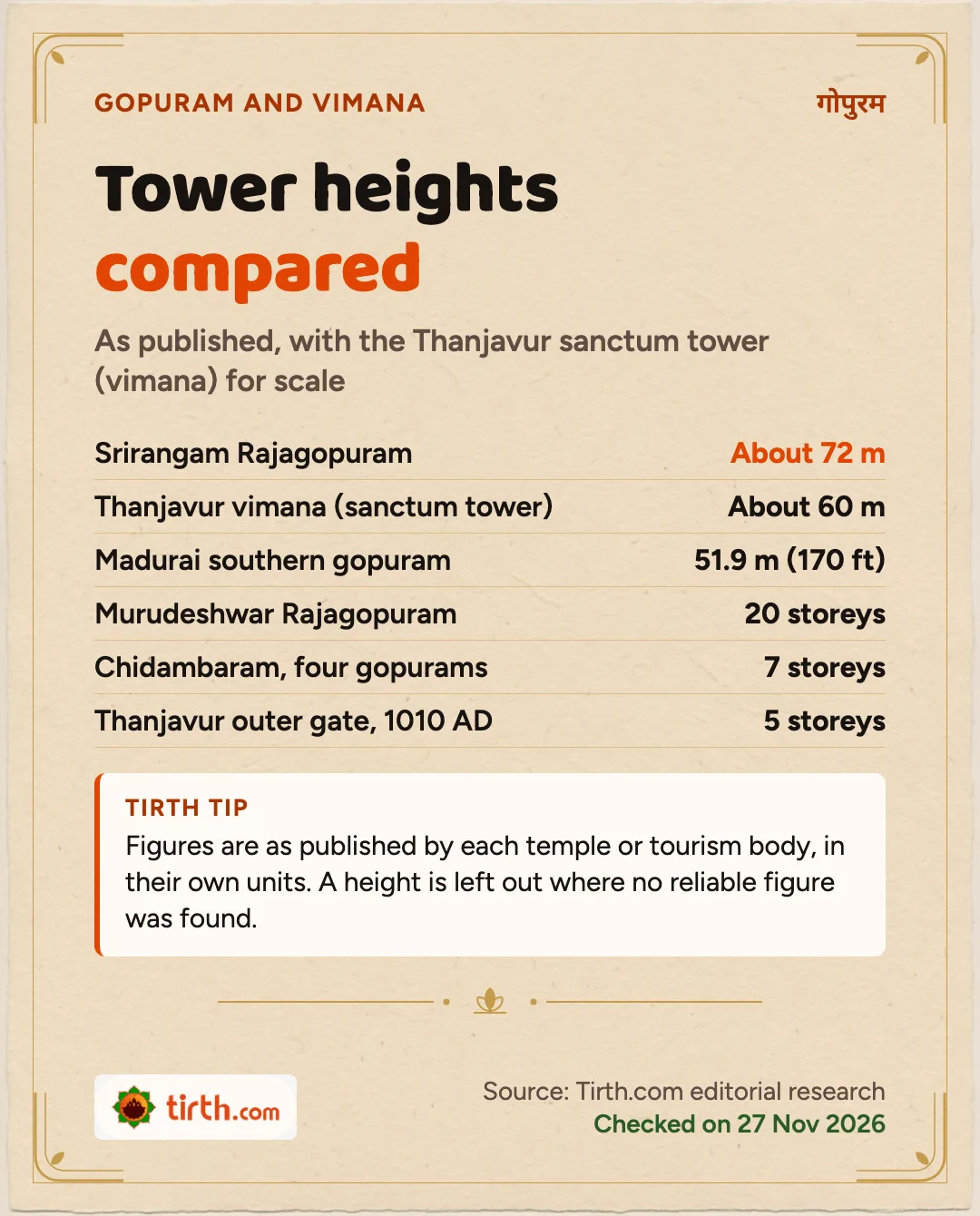
Srirangam has seven granite enclosure walls, 21 gopurams and a rajagopuram of 72 m, says the Government of India’s tourism portal for Bhagwan Ranganatha’s temple, though other figures put it a little higher, so “about 72 m” is the fair way to say it.
Karnataka’s tourism department describes Murudeshwar’s rajagopuram as 20 storeys high, with a lift to the top. Published heights for it differ from one source to the next, so we give no figure.
Who holds the title of “tallest gopuram in India” is a question of which figure, and which source, you trust. We have found no single official ranking, and we would rather call Srirangam, and Murudeshwar with its 20 storeys, both among the tallest in India than crown either one.
Why would a gate outgrow the sanctum?
We have not found the reason written down by the builders themselves.
What the sources do give is the when and the how. Gopurams multiplied in concentric enclosures from the 12th century, most of them built under the Vijayanagara and Nayaka rulers, and by the principle set down at Thanjavur the tallest stood furthest from the main shrine.
Our own reading, and it is only an interpretation, ties the height to that growth. The vimana was fixed over a sanctum that could not move, so the gateway on the newest outer wall was the one part a later ruler could add to, and the first part of the temple the town saw.
If you hear a grander reason for the height, it is fair to ask where it is written down, because we have not found one in the sources we checked.
Frequently asked questions
Also written gopura, it is the tower over a gateway in the enclosure wall of a South Indian Hindu temple. The sanctum has its own tower, the vimana, and the two are separate.
You pass through a gopuram, which stands over a gateway in the temple’s outer wall. The vimana rises above the garbhagriha, which is the sanctum. From the 12th century the massive gopurams of Tamil temples came to dwarf their vimanas.
It is a title used for a temple’s grand gateway towers. Srirangam’s rajagopuram is about 72 m high, and Karnataka’s tourism department describes Murudeshwar’s as 20 storeys with a lift.
No single figure settles it. Srirangam’s rajagopuram is about 72 m, Murudeshwar’s has 20 storeys but published heights differ, and the fair answer is to call both among the tallest in India.
Nobody recorded a reason that we have found. The documented part is that from the 12th century Tamil temples were built with numerous massive gopurams in concentric enclosures, most of them under the Vijayanagara and Nayaka rulers, and that the gopurams came to dwarf the vimanas.
Continue on Tirth
- Meenakshi Amman Temple, Madurai: the temple page for the temple of the 14 gopurams.
- Brihadeeswara Temple, Thanjavur: the Chola temple with Rajaraja’s five-storey gate of 1010 AD.
- Thillai Nataraja Temple, Chidambaram: four gateways, one at each entrance.
- All temples on Tirth, Temple page on Tirth
 : find the next temple for your yatra.