On this page9 sections
- Where does the word Brahman come from?
- Why couldn’t Agni Dev burn one straw?
- How did Indra Dev find out the yaksha was Brahman?
- What does the Kena mean by “the ear of the ear”?
- Is Brahman the same as Atman?
- Can you pray to Brahman like a god?
- Brahman, Brahma or Brahmin: which word means what?
- Frequently asked questions
- Continue on Tirth
- Sources and review
That scene in the Kena Upanishad is its whole answer on Brahman meaning. Brahman is what the fire’s power rests on, the one reality behind the gods and behind our own senses too.
To learn it, the gods first had to lose.
We take our verse numbers throughout from Swami Gambhirananda’s translation (Eight Upanishads, Volume 1, Advaita Ashrama). Some printings count the closing verses of the story a little differently (so if yours is a verse out near the end, do not hunt for a missing line).
In short
Brahman is what the fire’s power rests on, the one reality behind the gods and behind our own senses too. To learn it, the gods first had to lose. We take our verse numbers throughout from Swami Gambhirananda’s translation (Eight Upanishads, Volume 1, Advaita Ashrama).
Where does the word Brahman come from?
The root is brh. Growth, or expansion, is the literal sense Monier-Williams gives for it in his Sanskrit-English Dictionary of 1899. Its first use in the Vedas was for a prayer. The one self-existent, impersonal Spirit, the one universal Soul, is a later sense of the same word.
One more line from him is worth reading slowly. Brahman, he writes, is “not generally an object of worship but rather of meditation and knowledge”.
The Kena makes that point with a story instead, and in it fire and wind both lose to a straw.
Why couldn’t Agni Dev burn one straw?
The gods had just beaten the asuras (the demons), and they were sure the win was theirs. It was not. Brahman had won it for them (Kena 3.1), and to take the conceit out of them it stood before them as a yaksha, a venerable, shining being that none of them could make out. Shankara’s commentary says it came by its own power of maya.
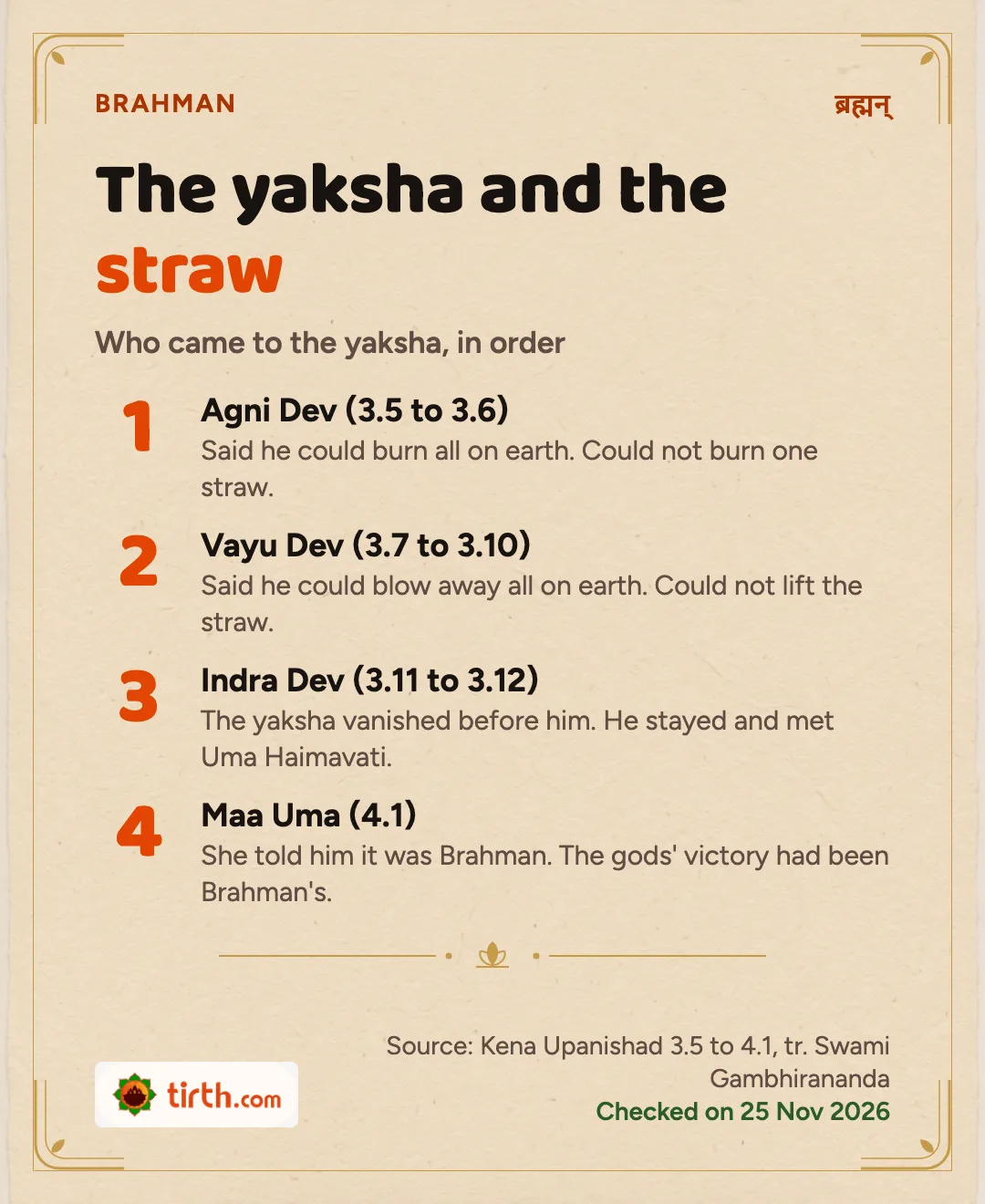
Agni Dev went first. He gave the stranger both his names, Agni and Jataveda, and then his boast: he could burn up everything on earth. The yaksha set one straw down in front of him (trna in the Sanskrit, a blade of grass). He rushed at it with all his speed. It would not catch, and he walked back to tell the gods he had no idea what the thing was.
Vayu Dev, called Matarishva here, boasted that he could blow away all that is on earth. He could not lift the straw.
Fire beaten by a straw, and then wind.
How did Indra Dev find out the yaksha was Brahman?
Then the king of the gods went himself, and the yaksha did not wait for him. It vanished. Shankara reads that as a check on Indra Dev’s pride, since he was not granted so much as an interview.
He did not go back.
In that same space stood a radiant woman, Uma Haimavati, and he asked her what the yaksha had been. Maa Uma, Deity page on Tirth told him it was Brahman, “sa brahmeti hovaca” (Kena 4.1), and that the victory the gods were so pleased with had been Brahman’s all along. In Gambhirananda’s note she is the knowledge of Brahman itself, and also the daughter of Himavat, the Himalaya.

So the text ranks these three above the other gods, with Indra Dev highest as the first to know it as Brahman (4.2 to 4.3). The god who stayed and asked comes first.
Part 4 then offers two images for Brahman as it shows itself among the gods. A flash of lightning. The wink of an eye (4.4). Gambhirananda’s name for this is “instruction through analogy”, and the yaksha fits both, there for a moment and then gone.
What does the Kena mean by “the ear of the ear”?
Part 1 says all of this well before the yaksha turns up, with no story at all. In verse 1.2 Brahman is “the ear of the ear”, and the same pattern then goes through the mind, speech, breath and eye. Different from the known and above the unknown is how verse 1.4 puts it, and the pupil speaking says this came to him from the teachers before him. Then comes the famous one, 1.5. Speech cannot utter it, yet speech itself is uttered by it, and that is Brahman, the verse says, adding in Gambhirananda’s words “not what people worship as an object”. Verses 1.6 to 1.9 bring the refrain back for mind, eye, ear and breath, each and every one of them.
Read Part 1 and Part 3 side by side. Agni Dev’s fire had its power from something, and that something was not a thing he could set alight. Speech is the same: it cannot utter the very thing by which it is uttered.
If Om is how your morning puja starts, read these verses next to Tirth’s piece on Om, the sound and the silence.
Is Brahman the same as Atman?
Shankara’s commentary on verse 1.5 is where the two meet. For him the “speech” of that verse means the power of speech. In essence that power is the light of Consciousness, the Self in its true nature, and read his way this Upanishad’s teaching on Brahman and its teaching on Atman come together.
Tirth’s post on Advaita and “that you are” takes that reading further.
Can you pray to Brahman like a god?
Not the way people pray to Agni Dev or Indra Dev. In the Kena the gods get tested. Brahman does the testing. It shows itself for a moment and withdraws.
Verse 1.5 had already said as much. Whatever people worship as an object, Brahman is not that; it is what lets the worshipper speak the prayer at all.
Brahman, Brahma or Brahmin: which word means what?
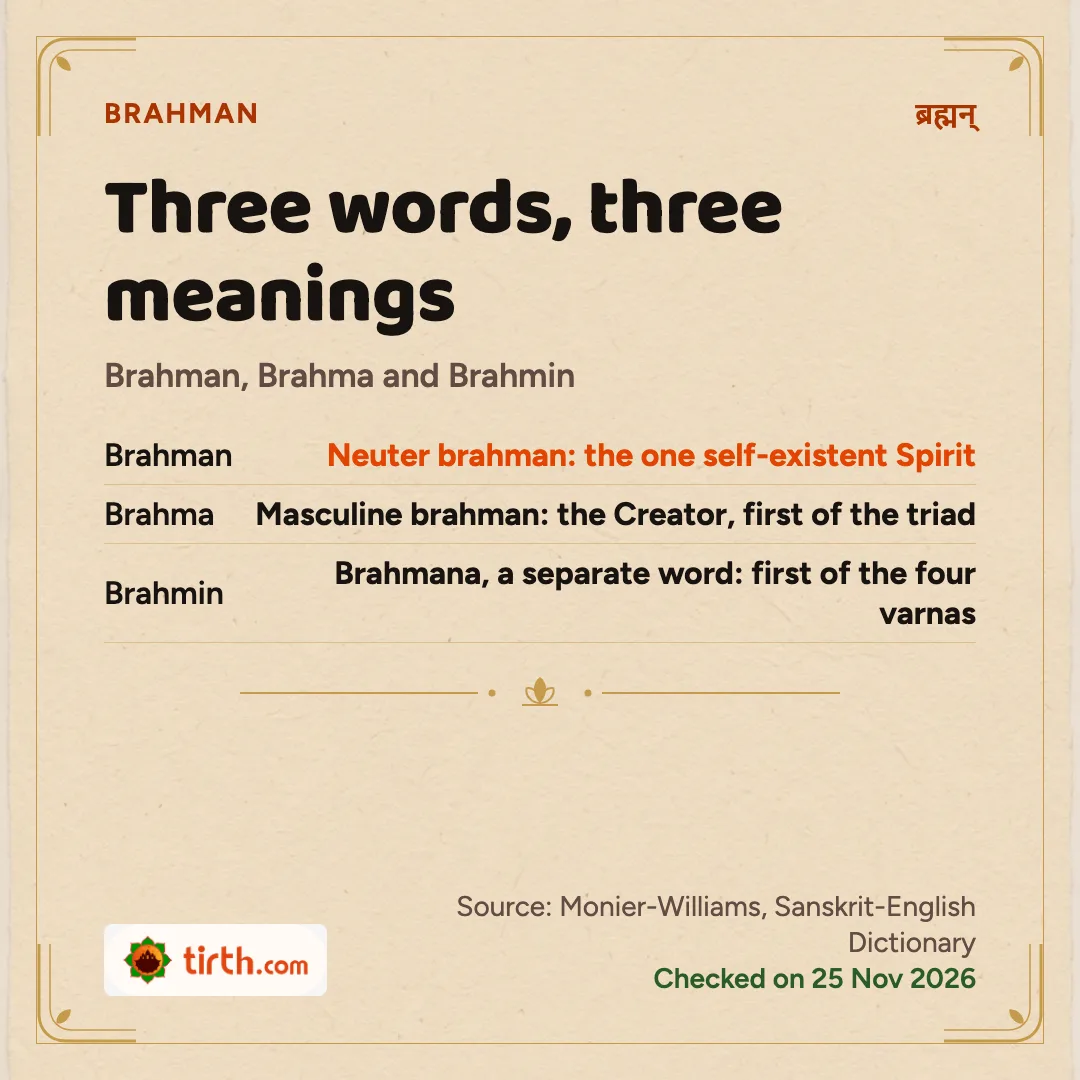
Monier-Williams gives brahman two entries, one neuter and one masculine. Brahmin is under neither. It has a headword of its own.
| Word in English | Sanskrit form | What it names |
|---|---|---|
| Brahman | brahman, neuter | The one self-existent Spirit, and earlier the sacred word and prayer of the Vedas |
| Brahma | brahman, masculine (nominative brahma) | The Creator, first of the triad of gods, the impersonal Spirit shown as a personal Creator |
| Brahmin | brahmana, masculine, a separate word | A member of the first of the four varnas, “strictly only applicable to one who knows and repeats the Veda” |
If a child at home needs this for a school project, start them on the last column. The masculine form, Brahma, is Bhagwan Brahma, the Creator, while the word for a Brahmin Pandit or Purohit comes from somewhere else again, from brahmana.
The Bhagwan Brahma page, Deity page on Tirth has his stories and how he is worshipped. The Brahma Gayatri gets a post to itself. (Reading only goes so far. If you would rather stand in front of him, the Brahma Temple at Pushkar is where to begin.)
Frequently asked questions
The single reality behind everything, whatever it is that lets fire burn and lets the senses work. The Kena calls it “the ear of the ear”.
In the neuter, brahman names the one self-existent Spirit of the Upanishads. Its masculine form, Brahma, is Bhagwan Brahma, the Creator, first of the triad of gods. A Brahmin takes the name from a separate word, brahmana, meaning a member of the first of the four varnas.
Not if you mean one deity alongside the rest. In the Kena it is the gods who get tested, and for Monier-Williams Brahman is a matter of meditation and knowledge more than of worship.
For Shankara, in his commentary on Kena 1.5, what stands behind speech is the light of Consciousness, the Self in its true nature. On that reading the two are a single subject.
As these texts present it, Brahman is not something made. Monier-Williams’s word for it is self-existent.
Continue on Tirth
- Bhagwan Brahma, Deity page on Tirth: the Creator.
- What moksha means: liberation, in plain words.
- Karma in the Gita and Upanishads: action and its fruit, as the Gita and the Upanishads describe them.
- Book a puja on Tirth, Pujas on Tirth: pujas at temples across India.