On this page7 sections
- How did Virochana end up worshipping the body?
- Three doubts that kept Indra Dev at Prajapati Dev’s door
- So what is atman, by Prajapati Dev’s last answer?
- Yama Dev and Bhagwan Krishna on the self that is never born
- Where atman meets Brahman in Prajapati Dev’s own words
- Frequently asked questions
- Continue on Tirth
- Sources and review
That is where the Chandogya Upanishad ends up. It gets there late, after one student has already gone home with the wrong answer.
Virochana was that student. To him the word meant the body, the very one he had just watched in a pan of water in fine clothes, and that is the meaning he carried away from Prajapati Dev’s house.
Indra Dev heard the same answer and started for home, then turned back. He did that three times. The atman meaning this story is built to reach came only once he had lived as Prajapati Dev’s student for 101 years and refused three answers that each looked good enough to keep.
The story fills Chandogya Upanishad 8.7 to 8.12, and the lines we quote are from Swami Nikhilananda’s translation.
In short
It gets there late, after one student has already gone home with the wrong answer. Virochana was that student. To him the word meant the body, the very one he had just watched in a pan of water in fine clothes, and that is the meaning he carried away from Prajapati Dev’s house.
How did Virochana end up worshipping the body?
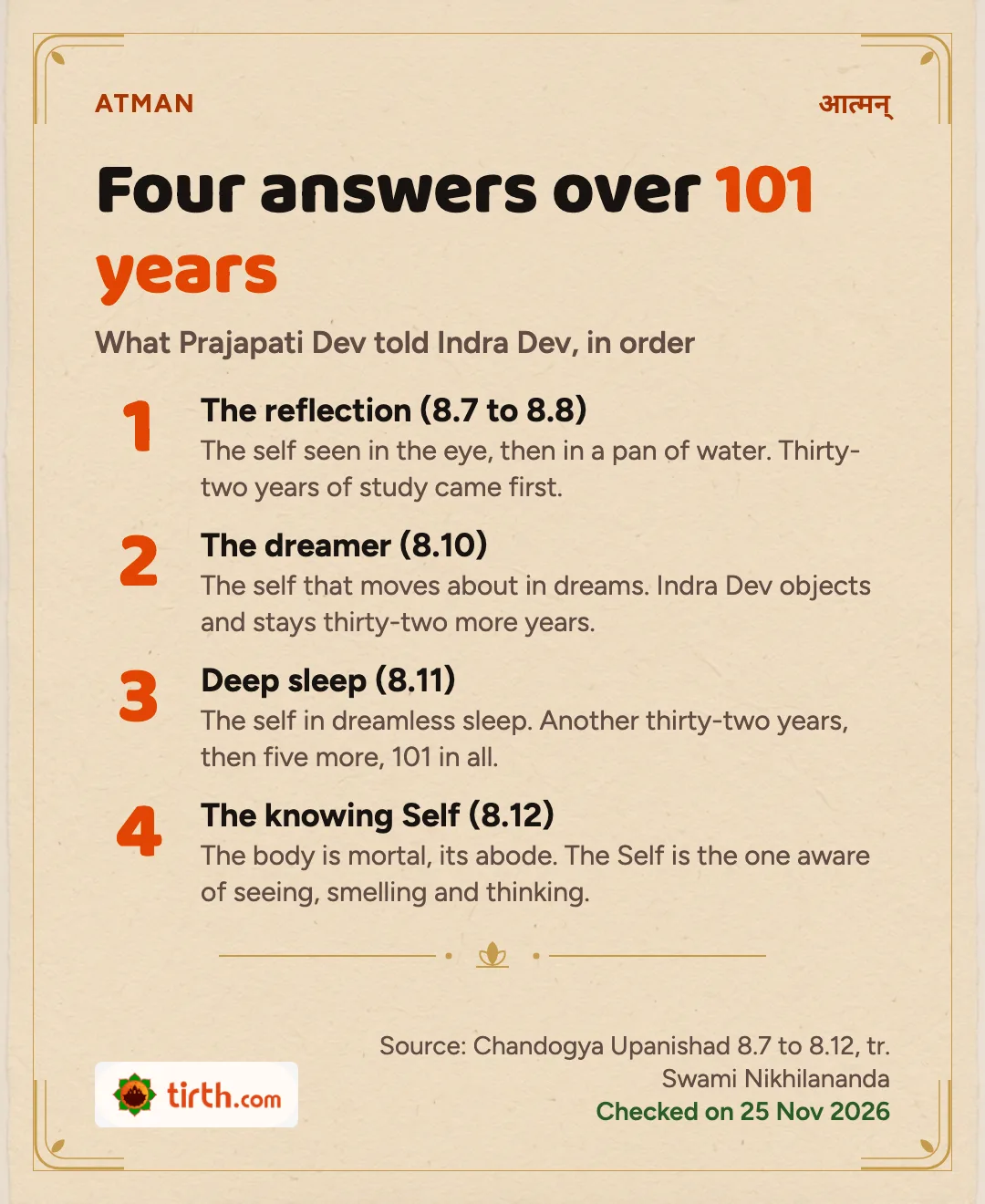
It began with a promise. Prajapati Dev spoke of a Self untouched by sin, old age, death, grief, hunger and thirst, a Self whose wishes and thoughts come true. Whoever knew it, he said, would win all worlds and all desires (8.7.1).
Indra Dev came for the gods and Virochana for the demons, each on his own and each carrying fuel. Prajapati Dev kept them as students for thirty-two years before he even asked what they wanted (8.7.2 to 8.7.3).
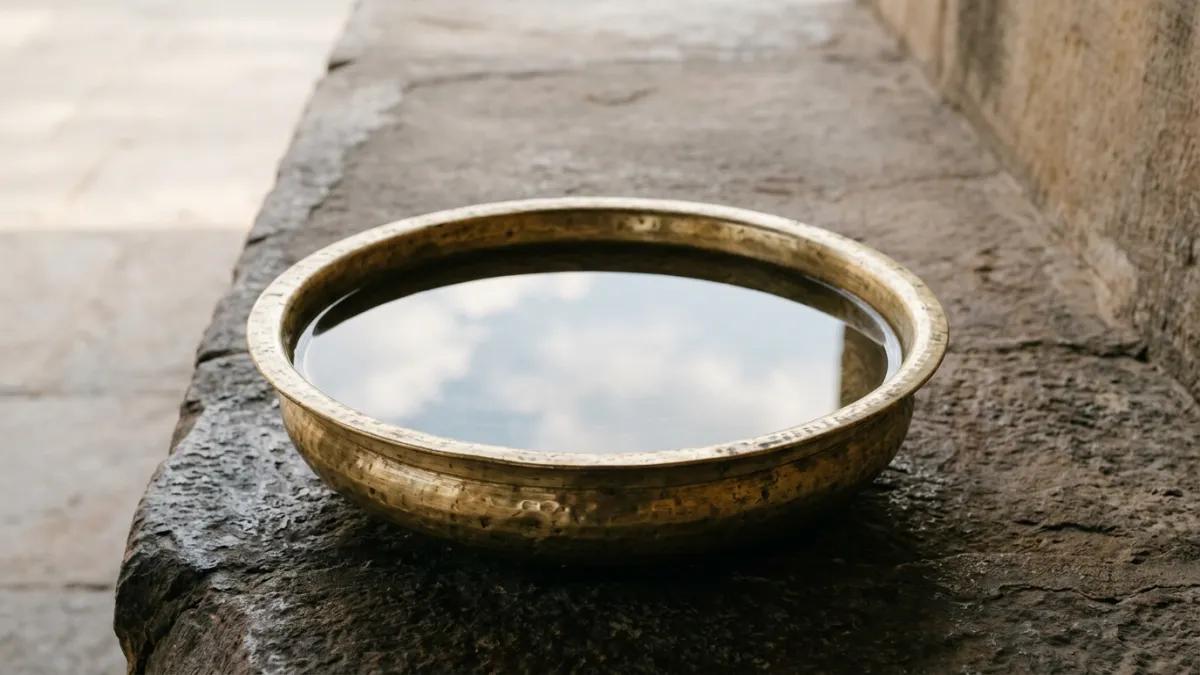
His first answer pointed at the person seen in the eye, and the two asked whether the one seen in water or a mirror was the same. So he sat them in front of a pan of water, had them put on their best clothes and ornaments, and let them look again. The reflections were dressed up too. Prajapati Dev called that the Self and closed with a line he would repeat after each of his first three answers: “This is immortal, fearless. This is Brahman” (8.7.4 to 8.8.3).
Both walked off satisfied. As they went, he said they were leaving without having known the Self, and that anyone who followed that doctrine, god or demon, would perish (8.8.4).
Virochana never looked back. He taught the demons that the body is the self, to be worshipped and served, and the Upanishad traces that teaching into a custom of dressing the dead in garlands, perfume and fine clothes to win the world beyond (8.8.4 to 8.8.5). A person who does not give, has no faith and offers no sacrifice is still called a demon, the text adds. If you have ever checked a mirror before a wedding, you know how easy that answer is to believe.
Three doubts that kept Indra Dev at Prajapati Dev’s door
Indra Dev saw the flaw before he reached the gods: a reflection is well dressed when the body is well dressed, so it must also go blind when the body goes blind, and die when the body dies. He could see no good in a self like that, and he went back with fuel in hand (8.9.1 to 8.9.2).
Prajapati Dev agreed. He gave him thirty-two more years, and then a second answer, the self that moves about in dreams. A dreamer does not go blind when the body is blind, so this looked better for a while. Indra Dev turned back again all the same, because in dreams the dreamer is still chased, still hurt and still in tears (8.10.1 to 8.10.4).
Another thirty-two years.
The third answer was the self in dreamless sleep, and Indra Dev’s reply to it is the sharpest of the three. A sleeper does not know that he exists, does not know anyone else either, and is as good as wiped out. This time Prajapati Dev asked for only five more years. He stayed. That brings the stay to 32, 32, 32 and 5, or 101 years in all (8.11.1 to 8.11.3).
If you read only one Upanishad passage on the self, our pick is this one, because each wrong answer fails on something you can test for yourself. The reflection goes blind with the body. The dreamer still suffers, and the sleeper does not even know it exists.
So what is atman, by Prajapati Dev’s last answer?
Prajapati Dev starts the last teaching with the body. It is mortal and always in the grip of death, yet it is the house where the deathless, bodiless Self lives. As long as a person takes himself to be the body, pleasure and pain keep landing on him, and they cannot touch the one who has stopped (8.12.1).
Then comes the answer Indra Dev waited 101 years for. The Self is whoever is aware of the wish to smell, to speak, to hear or to think. The nose, tongue, ear and eye are its instruments, and the mind is its divine eye (8.12.4 to 8.12.5).
So atman here means the knower who stands behind the senses, the one that lives in the body and uses the eye and ear as tools, though the self is whoever notices the wish to see or hear in the first place. Where knowing that self is meant to lead has a page of its own, what liberation means in each school.
Yama Dev and Bhagwan Krishna on the self that is never born
The Chandogya finds the self by crossing things off. The Katha Upanishad describes it outright, through what Yama Dev tells Nachiketa: the knowing self is not born and does not die, and it is not killed when the body is killed (1.2.18 to 1.2.19). Later he pictures it as the master of a chariot, with the body as the chariot, the intellect as the charioteer and the mind as the reins (1.3.3).
Bhagavad Gita 2.20 says much the same in Bhagwan Krishna, Deity page on Tirth ‘s words: the self is unborn, eternal and ancient, and it is not destroyed when the body is. Swami Mukundananda’s commentary on the verse notes how close it is to the Katha mantra.
Where atman meets Brahman in Prajapati Dev’s own words
Prajapati Dev’s refrain ties atman to Brahman in the text itself, before any school of Vedanta comments on the tie. How one school reads it is in Advaita, the not-two reading, and Brahman on its own is in Brahman meaning in the Upanishads. If the word maya comes up next, read Maya meaning and why illusion is only half the answer.
Frequently asked questions
It means the self, though the Monier-Williams Sanskrit dictionary lists “the breath” as its first sense, with soul and self after that.
Soul is a fair dictionary meaning, but we write self, because the Chandogya makes atman the one who knows rather than something known.
Atman is the self, and Brahman is the word Prajapati Dev sets beside it at the close of each of his first three answers, leaving the schools to say what the pairing means.
Besides its being unborn and undying, he told him it is hidden in the hearts of all living creatures, smaller than the smallest and greater than the greatest (Katha Upanishad 1.2.20).
The Chandogya comes close, since it names the self by what it does, being aware, and not by any part of the body.
Continue on Tirth
- Advaita, the not-two reading, for one school’s reading of the atman and Brahman tie.
- Om and the silence beyond speech, for the syllable and the quiet after it.
- Sanatan Dharma in the texts, the wider ground these Upanishads stand on.
- Indra Dev on Tirth, the page for the Indra Dev of this story.