On this page9 sections
- Who is actually speaking in the first skandha?
- What happens in Skandha 1, chapters 1 to 9
- What happens in chapters 10 to 19
- Which verses of Skandha 1 should you learn?
- Why does my edition give a different verse number?
- Can you visit the places in Skandha 1?
- Conclusion
- Frequently asked questions
- Sources and further reading
- Sources and review
Narada urges Vyasa to write it, and after that the story picks up where the Kurukshetra war ends and keeps going until King Parikshit, condemned to die in seven days, sits on the bank of the Ganga as Shuka arrives.
But we must know something first.
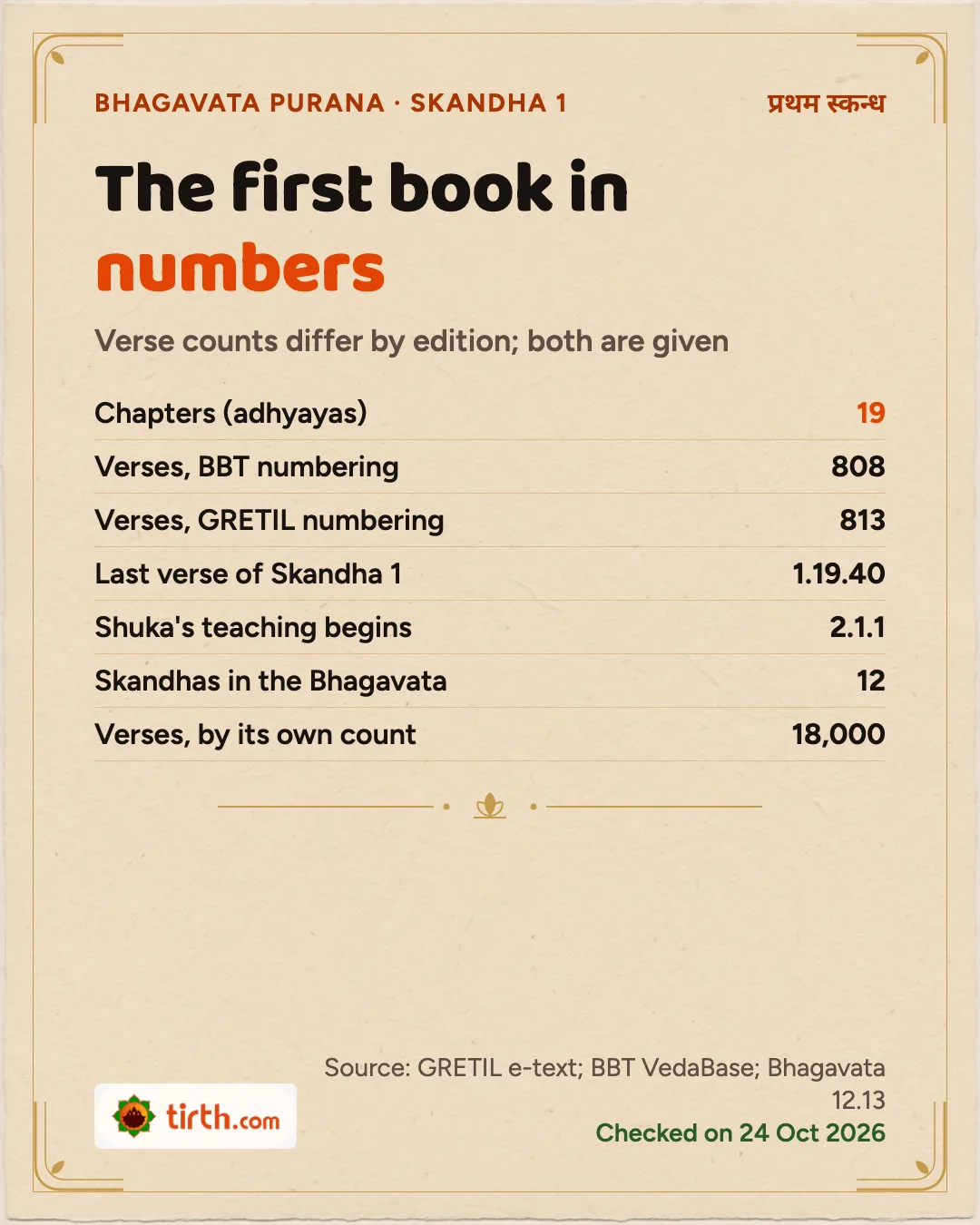
Count the chapters and you get 19. The verses come to just over 800, though that number shifts with the edition you hold. And Shuka doesn’t begin teaching until Skandha 2, at its very first verse, 2.1.1.
| Skandha 1 at a glance | |
|---|---|
| Place in the text | The first of 12 skandhas (books); by its own count the Bhagavata has 18,000 verses (12.13.5, 12.13.9) |
| Chapters | 19 (adhyayas), ending at 1.19.40 |
| Verses | Just over 800: 808 in the Bhaktivedanta Book Trust (BBT) numbering, 813 in the GRETIL and Sanskrit Wikisource numbering |
| Narrators and listeners | Suta, son of Romaharshana, speaks to the sages led by Shaunaka; inside his story, Narada counsels Vyasa, and Shuka comes to King Parikshit |
| Setting | Naimisharanya, where the sages sit for a thousand-year sacrificial session (1.1.4) |
| Known for | The opening verse 1.1.1; the ripe-fruit verse 1.1.3; 1.2.6 on the highest dharma; 1.3.28 on Krishna; Kunti’s prayer (1.8.25) |
In short
But we must know something first. Count the chapters and you get 19. The verses come to just over 800, though that number shifts with the edition you hold. And Shuka doesn’t begin teaching until Skandha 2, at its very first verse, 2.1.1.
Who is actually speaking in the first skandha?
The Bhagavata is a story inside a story. Skandha 1 is where its frames get put together, one inside the other.
On the outside sits Suta. It’s the sages at Naimisharanya who question him (1.1.5), and he gives his father’s name, Romaharshana, at 1.4.22. Everything else in the Purana, every story and every teaching from here on, reaches us through his mouth.
| Frame | Who speaks | To whom | Where in Skandha 1 |
|---|---|---|---|
| Outer | Suta | The sages led by Shaunaka, at Naimisharanya | From 1.1 to the end of the skandha |
| The making of the book | Narada | Vyasa, at his ashram on the Sarasvati | Chapters 4 to 7 |
| Inner | Shuka, son of Vyasa | King Parikshit, fasting on the bank of the Ganga | Shuka arrives at 1.19.25 to 1.19.26; he begins at 2.1.1 |
In 1.3.40 to 1.3.44 Suta lays out the whole chain himself.
Vyasa made this Purana called Bhagavata, equal to the Veda. He then had his son Shuka take it up, and it was Shuka who recited it to King Parikshit as the king sat fasting on the Ganga with sages all around him. Once Bhagwan Krishna, Deity page on Tirth had gone to his own abode, those verses go on, this Purana rose like the sun. And for people in Kali who have lost their sight, it gives light.
Before any of the stories start, get these three speakers straight in your head, because the text jumps from one to the next and never warns you. (Pencil an “S” for Suta, “N” for Narada and “Sh” for Shuka in the margin. It helps more than any summary.)
Which is also why the book feels slow to start. Nineteen chapters go on who is speaking before the main teacher says a word.
I wouldn’t skip them, though, even if you came only for Shri Krishna.
What happens in Skandha 1, chapters 1 to 9
Nothing is moved around. Chapters sit exactly as they do in the Sanskrit, and if the BBT edition and GRETIL agree on a verse number, that’s the number given here. If not, you get a note.
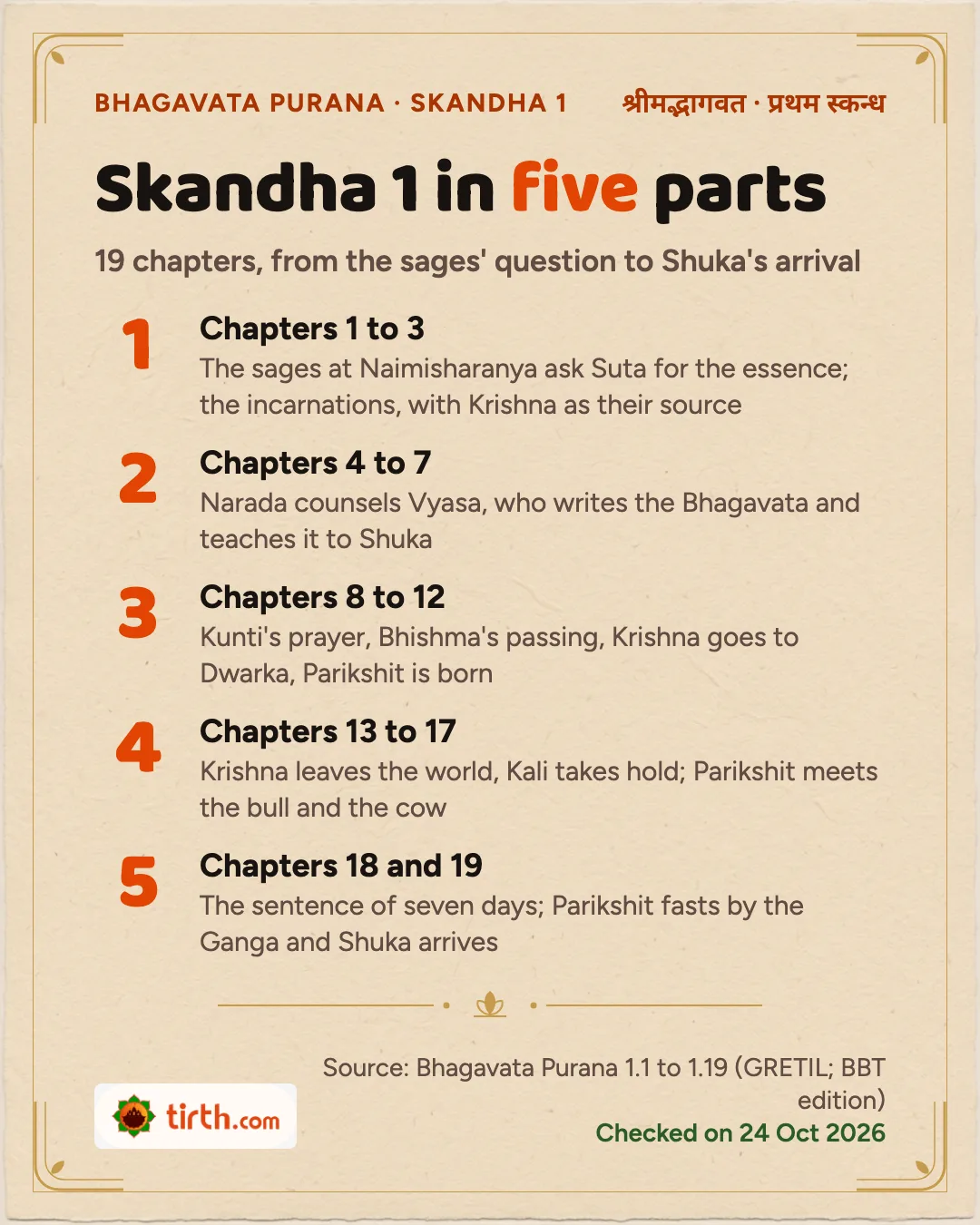
Chapters 1 to 3, the sages ask and Suta answers
It starts with praise. Verse 1.1.1. Above it the BBT edition prints the line “oṁ namo bhagavate vāsudevāya”. GRETIL and Sanskrit Wikisource don’t treat it as part of the verse at all.
| Devanagari | Transliteration |
|---|---|
| जन्माद्यस्य यतोऽन्वयादितरतश्चार्थेष्वभिज्ञ: स्वराट् | janmādy asya yato ‘nvayād itarataś cārtheṣv abhijñaḥ svarāṭ |
| तेने ब्रह्म हृदा य आदिकवये मुह्यन्ति यत्सूरय: । | tene brahma hṛdā ya ādi-kavaye muhyanti yat sūrayaḥ |
| तेजोवारिमृदां यथा विनिमयो यत्र त्रिसर्गोऽमृषा | tejo-vāri-mṛdāṁ yathā vinimayo yatra tri-sargo ‘mṛṣā |
| धाम्ना स्वेन सदा निरस्तकुहकं सत्यं परं धीमहि ॥ १ ॥ | dhāmnā svena sadā nirasta-kuhakaṁ satyaṁ paraṁ dhīmahi |
Meaning, in Manmatha Nath Dutt’s prose English translation (Calcutta, 1895): “Let us meditate upon the Most High, who is Truth, the light of whose countenance dispels the mists of illusion … from whom have sprung all existence, primary and derivative, who is intelligent and self-effulgent, whose nature even the wisest fail to apprehend, and who kindled the divine afflatus in the heart of the Prime Poet.” (1.1.1)
After the praise we get the setting. It’s the forest of Naimisha, where sages with Shaunaka at their head have gathered for a long sacrificial rite. A satra, in Sanskrit.
| Devanagari | Transliteration |
|---|---|
| नैमिषेऽनिमिषक्षेत्रे ऋषय: शौनकादय: । | naimiṣe ‘nimiṣa-kṣetre ṛṣayaḥ śaunakādayaḥ |
| सत्रं स्वर्गायलोकाय सहस्रसममासत ॥ ४ ॥ | satraṁ svargāya lokāya sahasra-samam āsata |
Meaning: sages led by Shaunaka sat for a thousand-year sacrificial session at Naimisha (1.1.4).
What they want from Suta is very practical. People of this Kali age, they say in 1.1.10 to 1.1.11, are short-lived, slow and troubled. So tell us the essence. The thing that leaves the self fully content, yenātmā suprasīdati.
Hold on to those words. Suta picks them up again in chapter 2.
| Devanagari | Transliteration |
|---|---|
| स वै पुंसां परो धर्मो यतो भक्तिरधोक्षजे । | sa vai puṁsāṁ paro dharmo yato bhaktir adhokṣaje |
| अहैतुक्यप्रतिहता ययात्मा सुप्रसीदति ॥ ६ ॥ | ahaituky apratihatā yayātmā suprasīdati |
Meaning: the highest dharma is the one that gives rise to devotion to the Lord, devotion without motive and without break, which fully contents the self (1.2.6).
Look at 1.2.11 too, a few verses later. The one non-dual reality, it says, is called Brahman, Paramatma and Bhagavan by those who know the truth.
Chapter 3 is the list of the incarnations of Vishnu, Deity page on Tirth, and the text counts them off as it goes, from 1.3.6. Balarama and Shri Krishna come nineteenth and twentieth (1.3.23). Buddha follows at 1.3.24, Kalki at 1.3.25. That makes 22.
Then 1.3.26 says the incarnations can’t be counted at all. Like streams flowing from a lake that never runs dry. Which is where 1.3.28 comes in.
| Devanagari | Transliteration |
|---|---|
| एते चांशकला: पुंस: कृष्णस्तु भगवान् स्वयम् । | ete cāṁśa-kalāḥ puṁsaḥ kṛṣṇas tu bhagavān svayam |
| इन्द्रारिव्याकुलं लोकं मृडयन्ति युगे युगे ॥ २८ ॥ | indrāri-vyākulaṁ lokaṁ mṛḍayanti yuge yuge |
Meaning: these are portions and parts of portions of the Purusha, but Krishna is Bhagavan himself. They comfort the world troubled by Indra’s enemies, age after age (1.3.28).
Chapters 4 to 7, why Vyasa wasn’t at peace
By now Vyasa has already composed the Mahabharata. That’s the epic with the Bhagavad Gita inside it (the aarti of the Bhagavad Gita has a page of its own here). His reason is right there in 1.4.25, in the text’s own words. Compassion for women, shudras and dvija-bandhus (literally, kin of the twice-born), who could not hear the three Vedas.
He still isn’t at peace, though. Or rather he feels the work is incomplete, and that’s when Narada comes to see him.
Narada puts his finger on the gap in 1.5.8 to 1.5.9. You have described dharma and the other aims of life, he tells Vyasa. But the spotless glory of the Lord, the greatness of Vasudeva, you have hardly described.
Then Narada tells his own past life, in chapter 6. He was the only son of a maidservant who loved him deeply (1.6.6). Grew up serving visiting sages (1.6.5).
The actual writing happens in chapter 7.
Vyasa sits in meditation at his ashram (1.7.2 to 1.7.3). It’s called Shamyaprasa, and it stands on the western bank of the Sarasvati, with badari (jujube) trees around it. He compiles the Satvata Samhita, which is the Bhagavata, to give bhakti-yoga to people who didn’t know it. Then he teaches it to Shuka. His own son, who was devoted to renunciation (1.7.6 to 1.7.8).
And then, still in chapter 7, the war comes back. Draupadi’s sons are asleep. Ashvatthama kills them. He is Drona’s son, and the text calls him Drauni at 1.7.14. Arjuna catches him. The punishment stops short of death.
Chapters 8 and 9, Kunti prays and Bhishma passes
Chapter 8 has two things going on in it. Ashvatthama’s weapon goes for the child in Uttara’s womb (she is named at 1.8.8), and Shri Krishna protects it. That unborn child is Parikshit.
Then Queen Kunti prays to Krishna. (There’s a separate page for the Shri Krishna aarti too.) One verse of her prayer actually asks for troubles.
Read that one twice.
| Devanagari | Transliteration |
|---|---|
| विपद: सन्तु ता: शश्वत्तत्र तत्र जगद्गुरो । | vipadaḥ santu tāḥ śaśvat tatra tatra jagad-guro |
| भवतो दर्शनं यत्स्यादपुनर्भवदर्शनम् ॥ २५ ॥ | bhavato darśanaṁ yat syād apunar bhava-darśanam |
Meaning: let those troubles come again and again, O teacher of the world, since in them we see you, and seeing you ends the seeing of rebirth (1.8.25).
Chapter 9 belongs to Bhishma. He lies at Vinashana in Kurukshetra (1.9.1), teaching dharma, and waiting. What he waits for is the uttarayana (the sun’s northward course), and when it finally comes at 1.9.29 he fixes his mind on the four-armed Krishna standing in front of him. Then he passes (1.9.30).
What happens in chapters 10 to 19
Chapters 10 to 12, Dwarka and a baby named Parikshit
In chapter 10 Shri Krishna leaves Hastinapur (1.10.7 to 1.10.8). Chapter 11 has him received in Dwarka, Destination on Tirth. Chapter 12 is Parikshit’s birth, and there’s one verse in it that explains his name.
| Devanagari | Transliteration |
|---|---|
| स एष लोके विख्यात: परीक्षिदिति यत्प्रभु: । | sa eṣa loke vikhyātaḥ parīkṣid iti yat prabhuḥ |
| पूर्वं दृष्टमनुध्यायन् परीक्षेत नरेष्विह ॥ ३० ॥ | pūrvaṁ dṛṣṭam anudhyāyan parīkṣeta nareṣv iha |
Meaning: he became known as Parikshit because, remembering the Lord he saw before birth, he would examine (parīkṣeta) people for him (1.12.30).
So his name is a memory, really. In everyone he met, that boy from chapter 8 would be looking for the Lord he remembered from the womb.
Chapters 13 to 15, everyone starts leaving
Vidura comes back to Hastinapur (1.13.1) and moves Dhritarashtra to leave home. So Dhritarashtra and Gandhari go to the Himalaya (1.13.30).
In chapter 14 Yudhishthira starts seeing ill omens, and then Arjuna comes back from Dwarka with the news. Krishna has left the world.
Verse 1.15.36 says Kali took hold when Krishna left the earth. The Pandavas crown Parikshit, and they retire.
Chapters 16 and 17, Parikshit meets Kali
A strange pair crosses King Parikshit’s path. A bull standing on one leg, who is Dharma, questioning a grieving cow, who is Earth. Kali is beating them, and Parikshit steps in and stops him.
(Some retellings online swap the two around. In the Sanskrit, Dharma is the bull and Earth is the cow.)
Kali asks for somewhere to live. The king gives him four places.
| Devanagari | Transliteration |
|---|---|
| सूत उवाच | Suta said |
| अभ्यर्थितस्तदा तस्मै स्थानानि कलये ददौ । | abhyarthitas tadā tasmai sthānāni kalaye dadau |
| द्यूतं पानं स्त्रिय: सूना यत्राधर्मश्चतुर्विध: ॥ ३८ ॥ | dyūtaṁ pānaṁ striyaḥ sūnā yatrādharmaś catur-vidhaḥ |
Meaning: Parikshit, petitioned by Kali, gave him four places: gambling, drink, illicit women (striyaḥ) and slaughter (1.17.38).
In the BBT edition striyaḥ here becomes prostitution. The verse is naming a vice either way, and no reading makes it a judgement on women in general.
Kali asks once more, and the king gives a second time. Gold (jātarūpa), and with it falsehood, intoxication, lust, passion and enmity (1.17.39).
Chapters 18 and 19, seven days and a sixteen-year-old
Parikshit is out hunting. Hungry, thirsty. He enters a hermitage, and inside, the sage is lost in deep meditation and no greeting comes, so the king uses his bow to lay a dead snake on the sage’s shoulder (1.18.24 to 1.18.30). The sage’s son hears of it. He pronounces the king’s death.
| Devanagari | Transliteration |
|---|---|
| इति लङ्घितमर्यादं तक्षक: सप्तमेऽहनि । | iti laṅghita-maryādaṁ takṣakaḥ saptame ‘hani |
| दङ्क्ष्यति स्म कुलाङ्गारं चोदितो मे ततद्रुहम् ॥ ३७ ॥ | daṅkṣyati sma kulāṅgāraṁ codito me tata-druham |
Meaning: the sage’s son says Takshaka, sent by him, will bite the king on the seventh day (1.18.37).
Notice the Bhagavata never names the sage or his son. Just “the sage” and “his son” (1.18.32). Most retellings call them Shamika and Shringi, and those names are from the Mahabharata (the Astika Parva, inside the Adi Parva).
Chapter 19. Parikshit hears of it, and on the bank of the Ganga he begins prayopavesha (1.19.5 to 1.19.6). A fast until death. Atri, Vasishtha, Bhrigu, Parashara, Vishvamitra, Parashurama, Agastya, Vyasa and Narada are among the sages who come and gather around him (1.19.9 to 1.19.10).
And then, by chance, Shuka arrives. Vyasa’s son. He’s wandering as an avadhuta (a renunciant who lives outside all social rules), and children are following him. Sixteen years old, the text says (1.19.25 to 1.19.26).
Parikshit asks him what a person about to die should do (1.19.37 to 1.19.38). And Skandha 1 ends at 1.19.40, just as Shuka starts his reply.
Which verses of Skandha 1 should you learn?
Only got time for a few lines? Learn these. They’re the verses from the walk-through above, all in one place. Each starts with its first words in transliteration, so you can track it down in any edition. (Best read with your own copy open beside the table.)
| Verse | First words (IAST) | What it says |
|---|---|---|
| 1.1.1 | janmādy asya yato ‘nvayād itarataś cārtheṣv abhijñaḥ svarāṭ | The opening verse: in Manmatha Nath Dutt’s translation, “Let us meditate upon the Most High, who is Truth” |
| 1.1.3 | nigama-kalpa-taror galitaṁ phalaṁ | The Bhagavata is the ripe fruit fallen from the wish-tree of the Vedas, made sweeter by passing through Shuka’s mouth; drink it again and again |
| 1.1.4 | naimiṣe ‘nimiṣa-kṣetre ṛṣayaḥ śaunakādayaḥ | Sages led by Shaunaka sat for a thousand-year sacrificial session at Naimisha |
| 1.2.6 | sa vai puṁsāṁ paro dharmo yato bhaktir adhokṣaje | The highest dharma is the one that gives rise to devotion to the Lord, devotion without motive and without break, which fully contents the self |
| 1.2.11 | vadanti tat tattva-vidas tattvaṁ yaj jñānam advayam | Knowers of truth call the one non-dual reality Brahman, Paramatma and Bhagavan |
| 1.3.28 | ete cāṁśa-kalāḥ puṁsaḥ kṛṣṇas tu bhagavān svayam | These are portions and parts of portions of the Purusha, but Krishna is Bhagavan himself |
| 1.8.25 | vipadaḥ santu tāḥ śaśvat tatra tatra jagad-guro | Let those troubles come again and again, O teacher of the world, since in them we see you |
| 1.12.30 | sa eṣa loke vikhyātaḥ parīkṣid iti yat prabhuḥ | Why the king is called Parikshit |
| 1.18.37 | iti laṅghita-maryādaṁ takṣakaḥ saptame ‘hani | Takshaka will bite the king on the seventh day |
And one more, because 1.1.3 talks about the Bhagavata itself.
| Devanagari | Transliteration |
|---|---|
| निगमकल्पतरोर्गलितं फलं | nigama-kalpa-taror galitaṁ phalaṁ |
| शुकमुखादमृतद्रवसंयुतम् । | śuka-mukhād amṛta-drava-saṁyutam |
| पिबत भागवतं रसमालयं | pibata bhāgavataṁ rasam ālayam |
| मुहुरहो रसिका भुवि भावुका: ॥ ३ ॥ | muhur aho rasikā bhuvi bhāvukāḥ |
Meaning: the Bhagavata is the ripe fruit fallen from the wish-tree of the Vedas, made sweeter by passing through Shuka’s mouth. Drink it again and again (1.1.3).
Why does my edition give a different verse number?
Two people holding two different books can quote different numbers for the same line. Both can be right.
BBT numbering gives Skandha 1 a total of 808 verses. Count by GRETIL or Sanskrit Wikisource and it’s 813. All of the gap comes from four chapters, 1.3, 1.6, 1.11 and 1.16. In those, a verse kept whole in one edition is split in the other.
Two spots matter here. The lines about the Purana rising like the sun are a single verse, 1.3.43, in the BBT edition. In GRETIL and Wikisource they run across 1.3.43 and 1.3.44. Which is why this page gives the range 1.3.40 to 1.3.44 for them.
Chapter 16 drifts too. By up to two verses. Easier, then, to cite the bull and the cow as chapters 16 and 17 and leave it there.
Sometimes it’s a word that changes. Take the last word of 1.2.6. The BBT edition and GRETIL read suprasīdati, Sanskrit Wikisource reads samprasīdati, and this page goes with suprasīdati.
Then two things that aren’t from the Bhagavata at all. One is the pair of names, Shamika and Shringi, which are the Mahabharata’s. The other is Shukratal. People locally believe that is where Shuka spoke to Parikshit, but the Bhagavata itself says only “the bank of the Ganga”.
Can you visit the places in Skandha 1?
Yes. There are two, both in Uttar Pradesh. The first is Naimisharanya, Destination on Tirth, in Sitapur district, which is identified with the Naimisha forest where the frame story is set.
The Sitapur district administration lists Chakra Tirth (which it calls the holiest spot in Naimisharanya) and Vyas Gaddi near Chakra Tirth. Then the Lalita Devi temple of the presiding goddess. And Soot Gaddi, where by local account Suta and Shaunaka held their discourse.
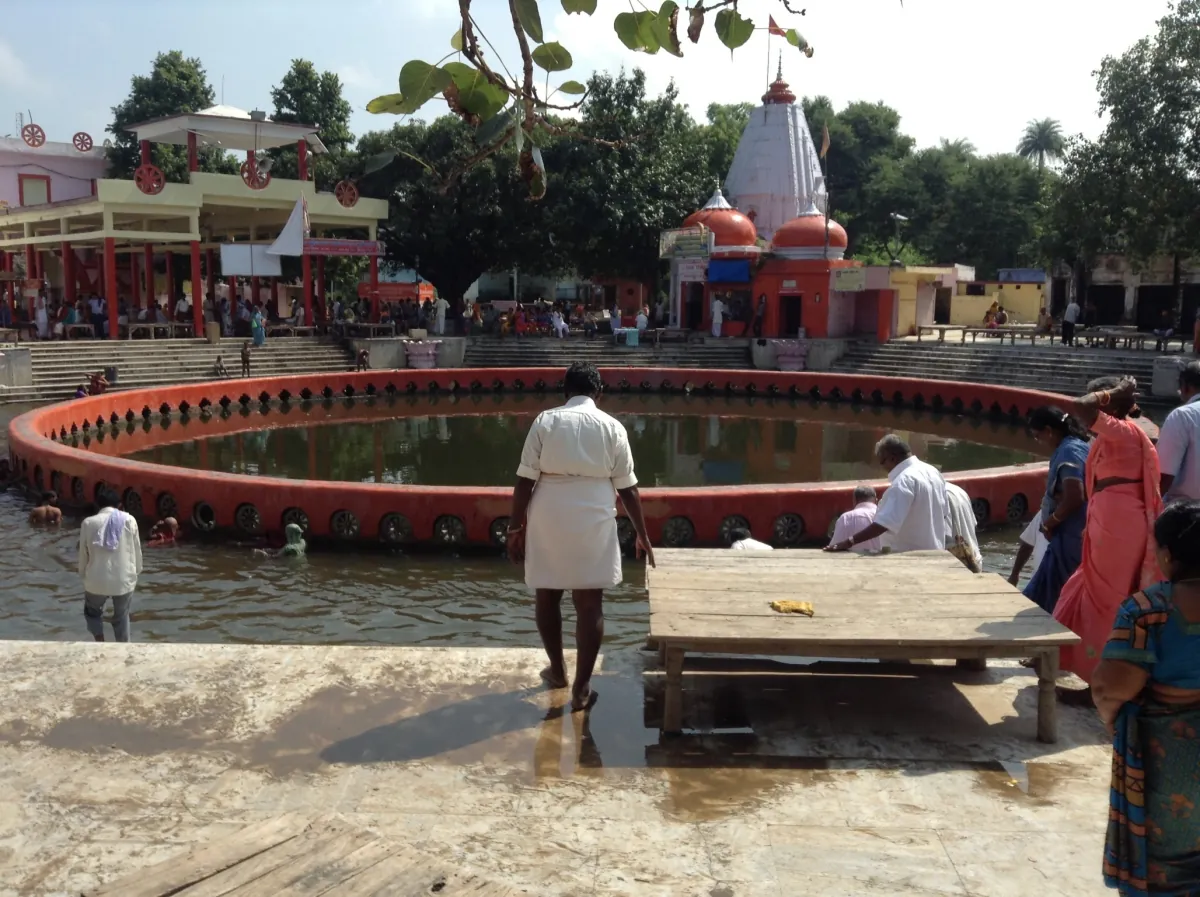
The second, Shukratal, sits on the banks of the Ganga in Muzaffarnagar district. Long-held tradition puts Shuka’s recital to Parikshit right there, under a banyan tree (vat vriksha), though the Bhagavata names no village. Just the river.
If that’s your reason for going, know the difference before you stand under the tree.
Conclusion
From 2.1.1, the opening of Skandha 2, it’s Shuka who speaks. And every word of it goes to a king with seven days left. That deadline was set in 1.18.37.
If you came for Shri Krishna, he’s mostly at the edges. Guarding the unborn Parikshit, hearing Kunti and Bhishma, and leaving the world by chapter 15.
The first book stops with you sitting where Parikshit sits at 1.19.40. Shuka is just beginning to speak. And the Bhagavata’s own invitation is in 1.1.3, to drink it again and again.
If Kunti’s prayer has pulled you towards Krishna, start at home with a Krishna mantra for daily chanting. You can book a puja, Pujas on Tirth on Tirth whenever your family wants one of its own.
I hope this helps when you sit down with the first skandha yourself.
Frequently asked questions
It sets the whole Bhagavata up. The sages at Naimisharanya question Suta, and Narada counsels Vyasa, who writes the Bhagavata and teaches it to Shuka. After that the book runs from the end of the Kurukshetra war through Kunti’s prayer, Bhishma’s passing, Krishna’s departure and Kali’s arrival, to King Parikshit fasting by the Ganga as Shuka arrives.
Nineteen chapters. The verse count is just over 800 and depends on the numbering. BBT gives 808, while GRETIL and Sanskrit Wikisource give 813, since four chapters are divided differently.
Suta, son of Romaharshana, is the outer narrator, and his listeners are the sages at Naimisharanya with Shaunaka at their head. Then, within what Suta tells, there’s Shuka, Vyasa’s son, speaking to King Parikshit by the Ganga from 2.1.1 on.
Because Narada told him something was missing. Narada’s point, in 1.5.8 to 1.5.9, is that Vyasa had written about dharma and the other aims of life but had hardly described the glory of the Lord, and Vyasa already felt that his work was incomplete. Out of that came the Bhagavata, which Vyasa compiled so that people without bhakti-yoga would have it (1.7.6).
He was out hunting, hungry and thirsty, and walked into a hermitage where the sage, deep in meditation, did not greet him. Parikshit put a dead snake on the sage’s shoulder. For that, the sage’s son declared that on the seventh day Takshaka would bite the king (1.18.37).
Vyasa’s son. His father taught him the Bhagavata (1.7.8). At sixteen, an avadhuta, he comes to Parikshit (1.19.25 to 1.19.26). From Skandha 2 on, the rest of the Purana is his to speak.
Sources and further reading
- Bhagavata Purana, Sanskrit e-text, GRETIL (Göttingen Register of Electronic Texts in Indian Languages), used for verse text and numbering.
- Shrimad Bhagavata Mahapurana, Skandha 1, Sanskrit Wikisource, chapter by chapter.
- A Prose English Translation of Shrimadbhagabatam, translated by Manmatha Nath Dutt (Calcutta, 1895; public-domain scan, Internet Archive), for the English meaning of 1.1.1.
- Srimad Bhagavatam, Canto 1, Bhaktivedanta VedaBase (Bhaktivedanta Book Trust edition), used for verse text and numbering only.
- The Mahabharata, Adi Parva, Astika Parva, sections XLI and XLII, translated by Kisari Mohan Ganguli (public-domain text, ibiblio mirror), for the names of the sage and his son.
- Religious places of Sitapur and holy places at Naimisharanya, Sitapur district administration, Government of Uttar Pradesh.
- Shukratal, Incredible India, Ministry of Tourism, Government of India.