On this page7 sections
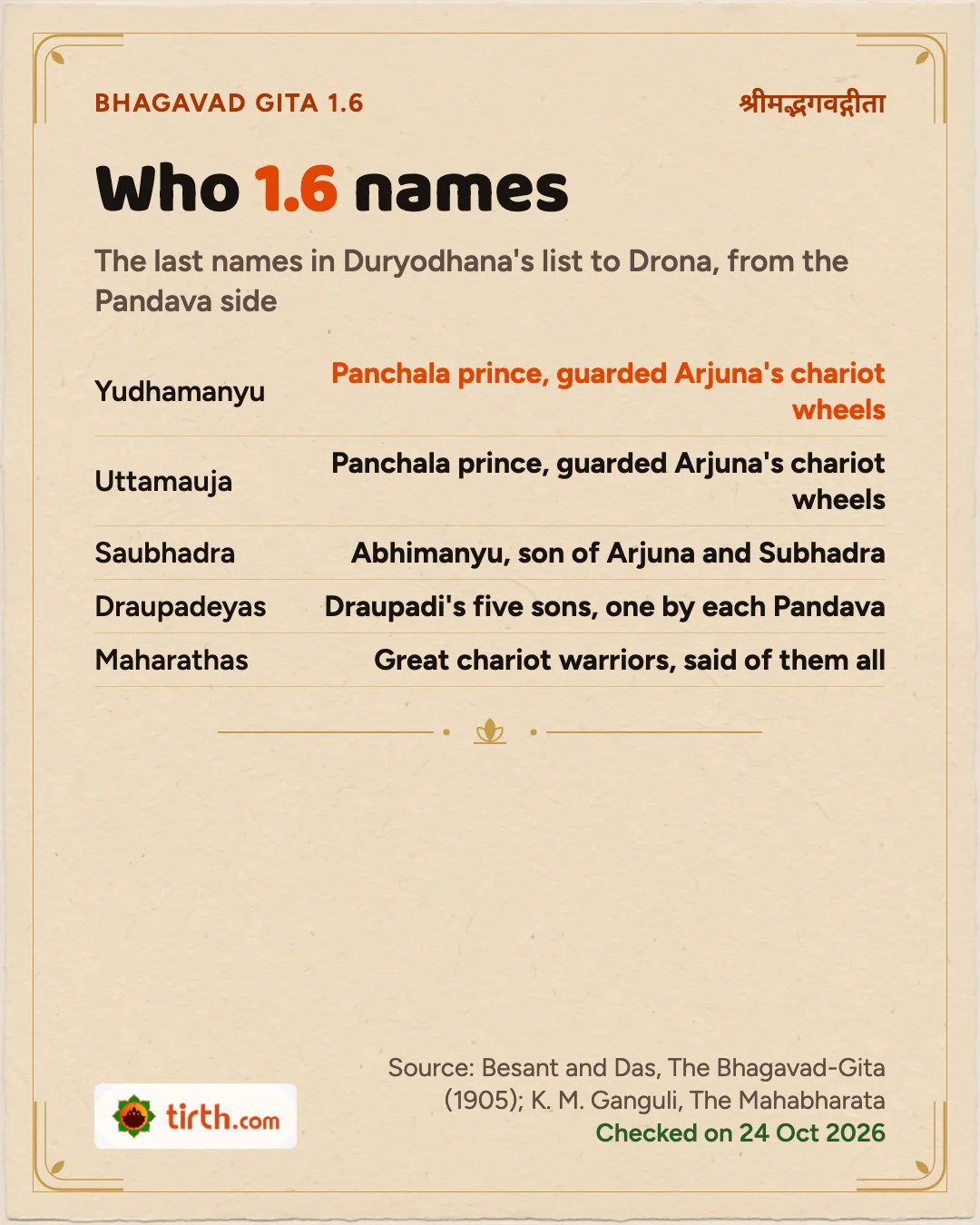
It calls him Saubhadra, the son of Subhadra, and puts him in the closing line of the roll call Duryodhana gives his teacher Drona, after Yudhamanyu and Uttamauja and beside the sons of Draupadi, “all of them maharathas”, great chariot warriors.
The list began in verse 1.4 and stops here. From 1.7 on, Duryodhana is talking about his own side instead, the leaders of his army. All of it is chapter 1, Arjuna Vishada Yoga.
If it is the sung text you want, the Bhagavad Gita Aarti has a page of its own.
In short
The list began in verse 1.4 and stops here. From 1.7 on, Duryodhana is talking about his own side instead, the leaders of his army. All of it is chapter 1, Arjuna Vishada Yoga. If it is the sung text you want, the Bhagavad Gita Aarti has a page of its own.
The verse
युधामन्युश्च विक्रान्त उत्तमौजाश्च वीर्यवान् ।
सौभद्रो द्रौपदेयाश्च सर्व एव महारथाः ॥१-६॥
yudhāmanyuś ca vikrānta uttamaujāś ca vīryavān |
saubhadro draupadeyāś ca sarva eva mahārathāḥ || 1.6 ||
Every letter here matches the Wikisource text of chapter 1, and the IIT Kanpur Gita Supersite prints the same. A danda, the single bar, closes the first half. The double bar closes the verse. If you are saying it aloud for the first time, the “c” of this transliteration is the “ch” in “church”, which makes ca (and), there three times in the verse, a plain “cha”.
Two old translations of Bhagavad Gita 1.6
Start with Annie Besant and Bhagavan Das, whose 1905 book also gives the word list further down this page. Their free translation is on page 3 of The Bhagavad-Gita (Theosophical Publishing Society, 1905).
“Yudhamanyu the strong, and Uttamauja the brave; Saubhadra and the Draupadeyas, all of great cars.”
Saubhadra and the Draupadeyas get a footnote of their own in that 1905 book, and it gives them plainly as “Abhimanyu, the son of Subhadra and Arjuna, and the sons of Draupadi.”
The older rendering belongs to K. T. Telang. You will find it on page 37 of The Bhagavadgita, Sacred Books of the East volume 8, printed in 1882 by the Clarendon Press, Oxford.
“the heroic Yudhamanyu, the valiant Uttamaugas, the son of Subhadra, and the sons of Draupadi, all masters of great cars.”
Uttamaugas is Uttamauja. His spelling scheme puts a “g” wherever the Sanskrit has a “j”, and that is the whole of it. Both books print accent marks on the names, which we have dropped in both quotations, and Telang sets a dash before “all masters” that shows above as a comma. He never numbers his verses either (the Gita runs as continuous prose in his book), so this one sentence of his starts back at verse 1.4 and ends with 1.6.
Put into everyday English, the verse praises the bold Yudhamanyu and the valiant Uttamauja, then the son of Subhadra and the sons of Draupadi, and calls every one of them a great chariot warrior.
One small snag. Their free translation calls Uttamauja “the brave”. The word list in the same book glosses vīryavān as “valiant” instead, and we have quoted each exactly as printed (if you are matching sounds to meanings, go by the word list).
Bhagavad Gita 1.6, one word at a time
The third column below is the word list Besant and Das printed in 1905 (pages 3 to 4), copied as they wrote it. The plain gloss in the last column is ours.
| Sanskrit | Transliteration | Besant and Das (1905) | Plain gloss |
|---|---|---|---|
| युधामन्युः | yudhāmanyuś | Yudhamanyu | A Panchala prince’s name |
| च | ca | and | And |
| विक्रान्तः | vikrānta | the strong | Strong, bold; it describes Yudhamanyu |
| उत्तमौजाः | uttamaujāś | Uttamauja | A Panchala prince’s name |
| च | ca | and | And |
| वीर्यवान् | vīryavān | valiant | Full of valour; it describes Uttamauja |
| सौभद्रः | saubhadro | Saubhadra | The son of Subhadra, that is Abhimanyu |
| द्रौपदेयाः | draupadeyāś | Draupadeyas | The sons of Draupadi |
| च | ca | and | And |
| सर्वे | sarva | all | All of them |
| एव | eva | even | Indeed; it stresses “all” |
| महारथाः | mahārathāḥ | great car-warriors | Great chariot warriors |
Some rows will look mismatched. Or rather, the two columns are doing different jobs. The Devanagari gives each word on its own, the way a dictionary lists it, while the transliteration gives the word as it sounds inside the recited line, where an ending can change to meet the word after it. Take yudhāmanyuḥ. Put ca after it and you hear yudhāmanyuś. Vikrāntaḥ drops its last sound before the “u” of uttamaujāḥ, saubhadraḥ becomes saubhadro before a “d”, and sarve before eva is sarva.
How strong was a maharatha?
Mahārathāḥ is the last word of 1.6, and it covers every warrior named since 1.4. Besant and Das give it as “great car-warriors” in their word list (a car, in these old translations, is a war chariot). On the numbers, though, the two editions part ways. Besant and Das had already explained the word in a footnote back at verse 1.4, where they put it as “Technically, one able to fight alone ten thousand bowmen”, and that is the higher of the two figures. Telang’s own footnote, on page 37, treats “master of a great car” as only the literal rendering. Its technical sense, he says, is a warrior proficient in military science who can fight single-handed a thousand archers.
Ten thousand or a thousand, we would rather print both than choose.
Who these names are
Four names and a little praise is all the Gita gives. For anything more you need the Mahabharata. Every line quoted below is from the English translation by K. M. Ganguli, and each one carries its book and section number so that you can open the epic and check it.
Yudhamanyu and Uttamauja, the wheel guards
The epic keeps these two together as well. In Section CXXIX of the Drona Parva, Ganguli has them as “The two protectors of the wheels of Arjuna’s car, viz., the Panchala princes, Yudhamanyu and Uttamaujas”, so the pair Duryodhana praises in one breath rode guard on Arjuna’s own chariot. Ashvatthama, Drona’s son, killed them both once the war was over, when he attacked the Pandava camp by night (Sauptika Parva, Section 8).
Saubhadra is Abhimanyu
Read Saubhadra as “son of Subhadra” and you have it. Her son by Arjuna was Abhimanyu, and Subhadra herself was the sister of Vasudeva, Krishna (Adi Parva, Section XCV). He married Uttara, Virata’s daughter, according to that same section. Our page on Bhagwan Krishna, Deity page on Tirth has more on Krishna himself.
Draupadi’s five sons
Draupadi had five sons, one by each Pandava, and Section CCXXIII of the Adi Parva names them.
| Son | Father |
|---|---|
| Prativindhya | Yudhishthira |
| Sutasoma | Bhima (Vrikodara) |
| Srutakarman | Arjuna |
| Satanika | Nakula |
| Srutasena | Sahadeva |
Go back to Section XCV of the same book and two of the names change. There Arjuna’s son is Srutakriti and Sahadeva’s is Srutakarman. Ganguli’s translation prints both lists, and we have left the difference alone rather than guess which is right (if you need a name for a school project or a katha, write down which section you took it from). Ashvatthama’s night attack killed all five as well (Sauptika Parva, Section 8).
How 1.6 closes the Pandava roll call
The Gita has 18 chapters, and the first, Arjuna Vishada Yoga (प्रथमोऽध्याय: अर्जुनविषादयोगः, the yoga of Arjuna’s despondency), has 47 verses. Verses 1.4, 1.5 and 1.6 are one roll call of the Pandava side, and 1.6 ends it. In 1.7 Duryodhana says to Drona, in the Besant and Das wording, “Know further all those who are our chiefs, O best of the twice-born, the leaders of my army”.
The whole Gita sits inside the Mahabharata, in the Bhishma Parva, the sixth book (handy to know if you ever go looking for this verse in a full Mahabharata rather than a Gita). For Ganguli, Gita chapter 1 is Section XXV of that book. Where it reaches these names he writes “and Yudhamanyu of great prowess, and Uttamaujas of great energy; and Subhadra’s son, and the sons of Draupadi, all of whom are mighty car-warriors.” Further on, the same section brings back the sons of Draupadi and “the mighty-armed son of Subhadra”. They are among those who blow their conches, the scene of Gita 1.18.
Read it with 1.4 and 1.5, in one go. Telang runs all three together as one sentence, and that is how they make sense. Cut loose from them, 1.6 is just four names with a word of praise at the end.
Those new to Devanagari can follow the italic line under it.
A short prayer after reading? The Krishna mantra page gives mantras with their meanings. If you would like more than a prayer, a priest can perform a Vishnu Sahasranam path on your family’s behalf, and Tirth’s puja booking, Pujas on Tirth is where to arrange it.
Related reading, if you want it, is the Krishna Aarti, our page of Vishnu mantras and a separate page on Gita Jayanti.
Frequently asked questions
It names four more warriors on the Pandava side, Yudhamanyu, Uttamauja, Saubhadra (Abhimanyu) and the sons of Draupadi, and calls all of them maharathas, great chariot warriors. Besant and Das translate it as “Yudhamanyu the strong, and Uttamauja the brave; Saubhadra and the Draupadeyas, all of great cars.”
Duryodhana does, and he is talking to his teacher Drona. His list of the Pandava warriors starts at verse 1.4 and finishes at 1.6.
Yes, though only as Saubhadra, “son of Subhadra”, in verse 1.6. A footnote in the Besant and Das edition explains that Saubhadra is Abhimanyu, the son of Subhadra and Arjuna.
Five, one by each Pandava. Adi Parva Section CCXXIII lists them as Prativindhya, Sutasoma, Srutakarman, Satanika and Srutasena. Section XCV differs on two of those names.
Verse 1.7, and with it Duryodhana moves from the Pandava army to the leaders of his own side. Besant and Das open that verse with “Know further all those who are our chiefs, O best of the twice-born”.
Sources and further reading
- Wikisource (Sanskrit): भगवद्गीता, अर्जुनविषादयोगः, the Sanskrit text of chapter 1
- IIT Kanpur Gita Supersite: chapter 1, verse 6, Sanskrit text
- Annie Besant and Bhagavan Das, The Bhagavad-Gita, Theosophical Publishing Society, London and Benares, 1905 (Internet Archive), Sanskrit text with word-for-word and free translation
- K. T. Telang, The Bhagavadgita, Sacred Books of the East volume 8, Clarendon Press, Oxford, 1882 (Internet Archive)
- K. M. Ganguli, The Mahabharata, Bhishma Parva, Section XXV (ibiblio)
- K. M. Ganguli, The Mahabharata (ibiblio): Drona Parva, Section CXXIX, Sauptika Parva, Section 8, Adi Parva, Section XCV and Adi Parva, Section CCXXIII
The translations quoted on this page are in the public domain. The Besant and Das edition was published in 1905; Besant died in 1933 and Bhagavan Das in 1958, so under Indian copyright (the author’s life plus 60 years) it entered the public domain on 1 January 2019. Telang’s translation was published in 1882, and he died in 1893.