On this page6 sections
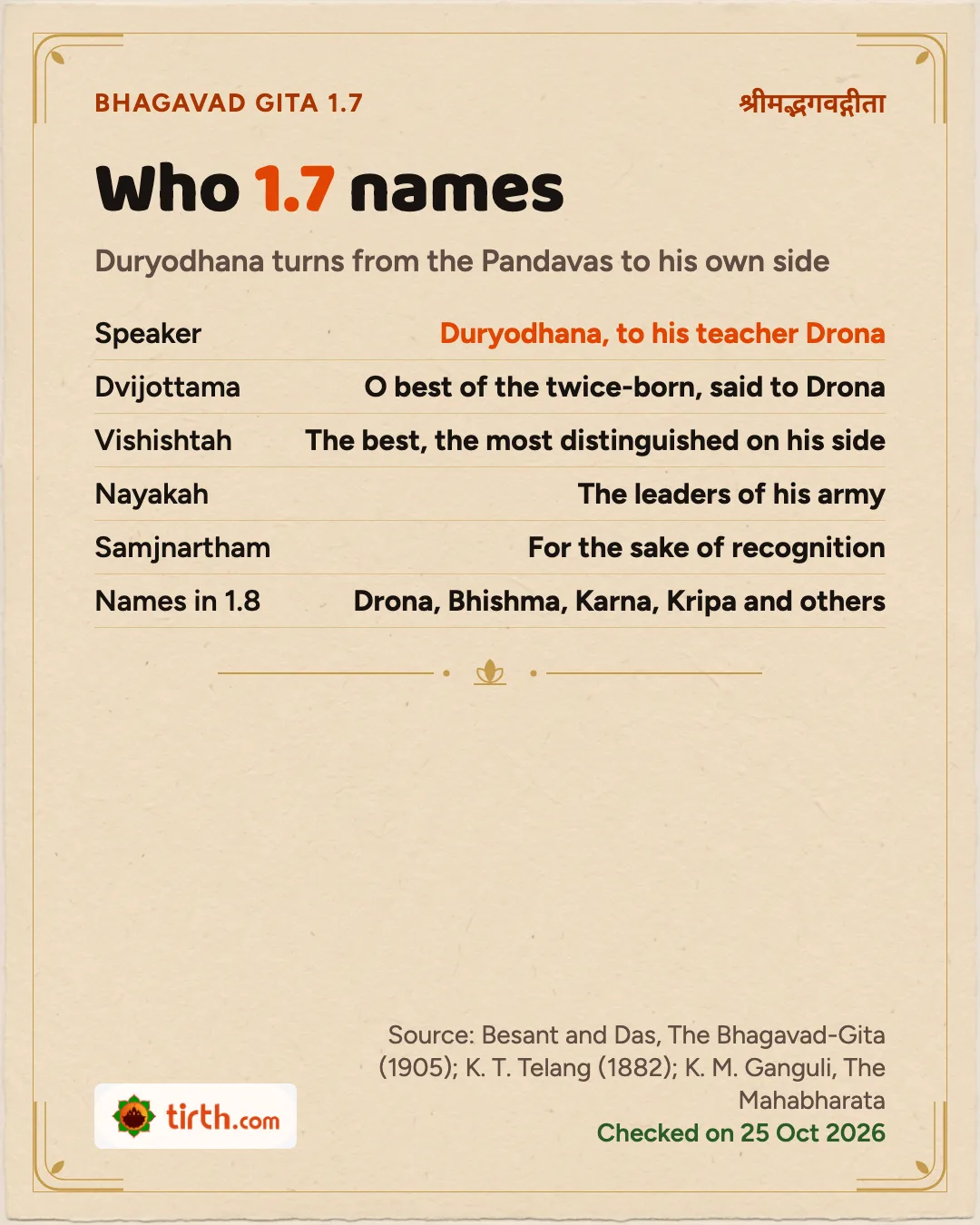
Duryodhana wants his teacher Drona, whom he addresses as dvijottama (“best of the twice-born”), to take note of the leaders of his own army, the most distinguished men on his side, and he promises to name them.
He has just gone through the Pandava heroes in verses 1.4 to 1.6. The names of his own men wait for 1.8.
If it is the sung text you are after, the Bhagavad Gita Aarti has a page of its own.
In short
He has just gone through the Pandava heroes in verses 1.4 to 1.6. The names of his own men wait for 1.8. If it is the sung text you are after, the Bhagavad Gita Aarti has a page of its own.
The verse
अस्माकं तु विशिष्टा ये तान्निबोध द्विजोत्तम ।
नायका मम सैन्यस्य संज्ञार्थं तान्ब्रवीमि ते ॥१-७॥
asmākaṃ tu viśiṣṭā ye tān nibodha dvijottama |
nāyakā mama sainyasya saṃjñārthaṃ tān bravīmi te || 1.7 ||
The Sanskrit follows the Wikisource text of the chapter, character for character, and the IIT Kanpur Gita Supersite prints the same letters. The single bar (a danda) ends the first half of the verse; the double bar ends the verse. The Devanagari joins tān to the word after it twice, as तान्निबोध and तान्ब्रवीमि. The transliteration writes them apart (tān nibodha, tān bravīmi), so each word is easier to pick out when you read the line aloud for the first time.
We would rather you say 1.7 and 1.8 together. One announces the names and the other gives them. Anyone still learning the script can read off the italic line underneath instead (the same verse, written out in Roman letters), taking a breath at the single bar that follows dvijottama.
What each word in Bhagavad Gita 1.7 means
Read across the table and the third column is Annie Besant and Bhagavan Das, word for word (page 4 of their 1905 edition, in their own wording). The last column is ours. Plain words, from no edition.
| Sanskrit | Transliteration | Besant and Das (1905) | Plain gloss (our rendering) |
|---|---|---|---|
| अस्माकम् | asmākaṃ | ours | Of us, on our side |
| तु | tu | indeed | But, now |
| विशिष्टाः | viśiṣṭā | the best | The most distinguished |
| ये | ye | who | Who (are) |
| तान् | tān | those | Them |
| निबोध | nibodha | know (thou) | Know, take note of |
| द्विजोत्तम | dvijottama | among the twice-born, O best | O best of the twice-born, said to Drona |
| नायकाः | nāyakā | the leaders | The leaders |
| मम | mama | my | My |
| सैन्यस्य | sainyasya | of army | Of the army |
| संज्ञार्थम् (= संज्ञायाः अर्थं) | saṃjñārthaṃ | of recognition, for the sake | So that you recognise them |
| तान् | tān | these | Them |
| ब्रवीमि | bravīmi | (I) speak | I name, I tell |
| ते | te | of (to) thee | To you |
Two words lose their final sound in the recited line. Viśiṣṭāḥ before ye becomes viśiṣṭā, and nāyakāḥ before mama becomes nāyakā. For that reason the Devanagari column (each word on its own, as a dictionary gives it) and the transliteration column do not match letter for letter. Our Devanagari column also writes अस्माकम् and संज्ञार्थम् with a final “m”; the verse line, and Besant and Das in their word list, print the nasal dot instead. That dot is the Devanagari anusvara (ं), which the transliteration writes as ṃ. Notice too that tān comes twice (Besant and Das gloss it “those” the first time and “these” the second), though it is the same word both times.
The two hard words are dvijottama, Duryodhana’s title for Drona, and saṃjñārtham, his reason for naming anyone at all.
The turn from the Pandavas to his own men
Duryodhana has been talking to Drona since verse 1.3, and the speech does not stop until 1.11. Verses 1.4 to 1.6 belong to the other side, a list of the heroes of the Pandava army. Then the hinge.
In 1.7 he turns from their men to his own, to the most distinguished of them, the leaders of his army. He gives no names yet. He only tells Drona to take note of them and promises to name them, so that his teacher will know each one when he hears it. Which is exactly what the word saṃjñārtham is doing in the second half of the verse.
Drona first: the names 1.8 gives
The Gita has 18 chapters. This is the first of them, Arjuna Vishada Yoga, 47 verses long, and 1.7 comes early, well inside Duryodhana’s speech.
He keeps his promise at once. Drona himself is the first name in 1.8. Bhishma follows, then Karna, Kripa, Ashvatthama and Vikarna, with Saumadatti (the son of Somadatta) last, and 1.9 closes the list with “many others”. Ganguli’s version of that list ends on Saumadatta and Jayadratha instead, while Besant and Das and Telang both stop at the son of Somadatta. That difference belongs to the next verse.
In Ganguli’s English Mahabharata, Gita chapter 1 sits inside the Bhishma Parva, Section XXV, so that is where to look if your copy is the whole epic and not a Gita on its own (the same turn from the Pandava list to “the distinguished ones among us” is there too).
Dvijottama, a title used to Drona’s face
Duryodhana speaks, Drona listens, and the leaders of the army are talked about without a single name. Drona does get a title, though. Or rather a form of address, used to his face.
Dvijottama joins dvija, “twice-born”, and uttama, “best”, and Duryodhana uses it to address Drona directly. Besant and Das explain it in their word list as द्विजेषु उत्तम, “among the twice-born, O best”. Drona is a brahmana, one of the twice-born, the son of the sage Bharadvaja, and the teacher of both the Kuru and the Pandava princes, Duryodhana among them. So the title names his birth and his standing as a guru in one go.
Each of the three old translations has its own English for the title. Besant and Das keep close to the Sanskrit with “O best of the twice-born”, Ganguli has “O best of regenerate ones”, and Telang, alone of the three, names the caste with “O best of Brahmanas”. Ganguli’s “regenerate” and the “twice-born” of Besant and Das both keep a second birth in the picture. As for why he picked this way of addressing his teacher, the verse is silent. Guessing at Duryodhana’s motive is something we would rather not do.
Bhagavad Gita 1.7 in English
Page 4 of The Bhagavad-Gita by Besant and Bhagavan Das (Theosophical Publishing Society, 1905) gives it like this:
“Know further all those who are our chiefs, O best of the twice-born, the leaders of my army; these I name to thee for thy information:”
They print that colon themselves and let the sentence run on into verse 1.8, where the names start.
Telang’s 1882 version is in volume 8 of the Sacred Books of the East (The Bhagavadgita, Clarendon Press, Oxford), across pages 37 to 38:
“And now, O best of Brahmanas! learn who are most distinguished among us, and are leaders of my army. I will name them to you, in order that you may know them well.”
His exclamation mark stays. The marks he prints in “Brahmanas”, a circumflex and an italic letter, are left out of our quotation. Telang sets the Gita out as continuous prose with no verse numbers at all, and this particular sentence happens to break across his pages 37 and 38 (hence the two page numbers above).
The third is K. M. Ganguli, from the Bhishma Parva of his English Mahabharata, Section XXV:
“Hear, however, O best of regenerate ones, who are the distinguished ones among us, the leader of army. I will name them to thee for (thy) information.”
Ganguli really does print “the leader of army”, in the singular and with no “the” before “army”. We copied it as it stands.
Put the three side by side and the last few words are where they part company.
Saṃjñārtham is the reason Duryodhana gives for naming his leaders. Besant and Das open it up in their word list as संज्ञायाः अर्थं, saṃjñāyāḥ artham, and gloss it “of recognition, for the sake”. Put back into order, that is “for the sake of recognition”. In their free translation the same pair write “for thy information”; Telang has “in order that you may know them well”, and Ganguli “for (thy) information”.
Telang’s is the one we would keep in mind on a first reading. His “in order that you may know them well” carries the “recognition” of the word list over into plain English, and that is the sense of the line, that Duryodhana names his leaders so that Drona will know them. The word the other two use, “information”, is right enough. Flatter, though.
Our Krishna mantra page has mantras with their meanings, for anyone who likes to end a reading with a short prayer. Or, for the whole family, book a Vishnu Sahasranam path through Tirth’s puja booking, Pujas on Tirth and a priest does it for you.
Read next: the Krishna Aarti, sung to Krishna, our Vishnu mantras, the page on Bhagwan Krishna, Deity page on Tirth and the one on Gita Jayanti.
Frequently asked questions
Drona is being told to take note of the most distinguished men on Duryodhana’s side, the leaders of his army, whom Duryodhana is about to name, or as Besant and Das have it, “Know further all those who are our chiefs, O best of the twice-born, the leaders of my army; these I name to thee for thy information”.
Duryodhana says it to Drona, his teacher, in a speech that starts at verse 1.3 and ends at verse 1.11.
“Best of the twice-born”, which is how Duryodhana addresses Drona, a brahmana, though in Telang’s English it comes out as “O best of Brahmanas” and in Ganguli’s as “O best of regenerate ones”.
Verse 1.8 opens with Drona himself and goes on to Bhishma, Karna, Kripa, Ashvatthama and Vikarna, ending on Saumadatti, the son of Somadatta, and verse 1.9 puts “many others” after them.
The three verses before it, 1.4 to 1.6, are Duryodhana running through the heroes of the Pandava army for Drona, and with 1.7 he leaves them and turns to the leaders on his own side.
Sources and further reading
- Wikisource (Sanskrit): भगवद्गीता, अर्जुनविषादयोगः, the Sanskrit text of chapter 1
- IIT Kanpur Gita Supersite: chapter 1, verse 7, Sanskrit text
- Annie Besant and Bhagavan Das, The Bhagavad-Gita, Theosophical Publishing Society, London and Benares, 1905 (Internet Archive), Sanskrit text with word-for-word and free translation
- K. T. Telang, The Bhagavadgita, Sacred Books of the East volume 8, Clarendon Press, Oxford, 1882 (Internet Archive)
- K. M. Ganguli, The Mahabharata, Bhishma Parva, Section XXV (ibiblio)
The Besant and Das and the Telang translations quoted on this page are in the public domain. The Besant and Das edition was published in 1905; Besant died in 1933 and Bhagavan Das in 1958, so under Indian copyright (the author’s life plus 60 years) it entered the public domain on 1 January 2019. Telang’s translation was published in 1882, and he died in 1893.