On this page8 sections
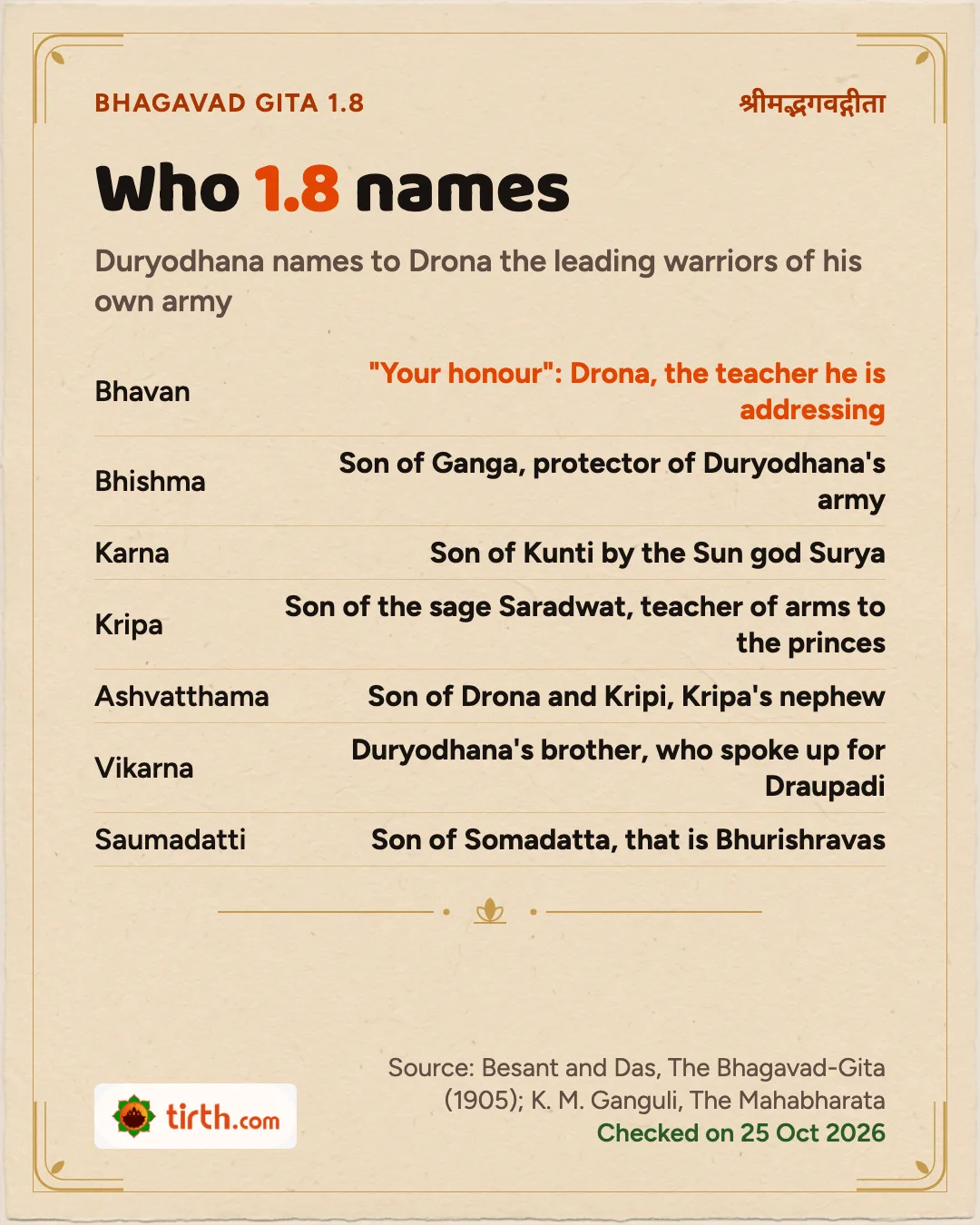
Then he runs through the other men at the head of his own army, Bhishma, Karna, Kripa, Ashvatthama, Vikarna and Saumadatti, the son of Somadatta, so the teacher he is talking to ends up first on his own list.
Seven names, and not one verb among them.
Verse 1.7 is where Duryodhana promises the names, and 1.9 rounds them off with many others ready to give their lives for him. Chapter 1 of the Gita, Arjuna Vishada Yoga, is where all of this happens. If it is the sung text you are after, the Bhagavad Gita Aarti is on a separate page.
In short
Seven names, and not one verb among them. Verse 1.7 is where Duryodhana promises the names, and 1.9 rounds them off with many others ready to give their lives for him. Chapter 1 of the Gita, Arjuna Vishada Yoga, is where all of this happens.
Bhagavad Gita 1.8 in Sanskrit
भवान्भीष्मश्च कर्णश्च कृपश्च समितिंजयः ।
अश्वत्थामा विकर्णश्च सौमदत्तिस्तथैव च ॥१-८॥
bhavān bhīṣmaś ca karṇaś ca kṛpaś ca samitiñjayaḥ |
aśvatthāmā vikarṇaś ca saumadattis tathaiva ca || 1.8 ||
The Sanskrit follows the Wikisource text of the chapter, character for character, and the 1905 Besant and Das edition prints the same. The IIT Kanpur Gita Supersite differs in one spelling only: it writes the nasal in samitiñjayaḥ as ञ्ज, where Wikisource uses a dot above the letter. The sound and the meaning do not change, and the transliteration writes it as “ñ”.
Look for the bars. A single one (the danda) marks the halfway point, and two together close the verse.
Reading the italic line aloud for the first time, take every “c” as the “ch” of “church”, which means ca (and) is said “cha”, and you will say it five times before this short verse is over.
Bhagavad Gita 1.8 in English
Annie Besant and Bhagavan Das gave this rendering on page 4 of The Bhagavad-Gita, printed by the Theosophical Publishing Society in 1905.
“Thou, lord and Bhishma, and Karna, and Kripa, conquering in battle; Ashvatthama, Vikarna, and Saumadatti also;”
A footnote on that page glosses Saumadatti as “The son of Somadatta.” Notice there is no comma after “lord”. That is how the book has it, so we have not added one.
Telang is older. His version came out in 1882 as volume 8 of the Sacred Books of the East (Clarendon Press, Oxford), and verse 8 is on page 38.
“Yourself, and Bhishma, and Karna, and Kripa the victor of (many) battles; Asvatthaman, and Vikarna, and also the son of Somadatta”
Neither translator stops at the end of verse 8. Their sentences carry straight on into verse 9, so we have cut both quotations where the verse itself ends, and we have dropped the accent marks the books print over the names.
Telang never numbers the verses at all. He writes the whole Gita as running prose.
Put plainly, the line says you yourself, and Bhishma, Karna and Kripa, victorious in battle, and Ashvatthama, Vikarna and the son of Somadatta as well. Who earns that “victorious in battle”, Kripa alone or more of the names, is something the old commentators read differently (see one word, two readings, below).
Word by word
Read each row across. The Besant and Das column is copied from page 4 of the 1905 book exactly as they printed it, while the plain gloss at the end is ours and is not quoted from any edition.
| Sanskrit | Transliteration | Besant and Das (1905) | Plain gloss (our rendering) |
|---|---|---|---|
| भवान् | bhavān | your honour | You, said with respect; here, Drona |
| भीष्मः | bhīṣmaś | Bhishma | Bhishma, son of Ganga |
| च | ca | and | And |
| कर्णः | karṇaś | Karna | Karna, son of Kunti |
| च | ca | and | And |
| कृपः | kṛpaś | Kripa | Kripa, the teacher |
| च | ca | and | And |
| समितिंजयः | samitiñjayaḥ | = समितिं जयति assemblage, conquers | Victorious in battle |
| अश्वत्थामा | aśvatthāmā | Ashvatthama | Ashvatthama, Drona’s son |
| विकर्णः | vikarṇaś | Vikarna | Vikarna, a brother of Duryodhana |
| च | ca | and | And |
| सौमदत्तिः | saumadattis | Saumadatti | The son of Somadatta, Bhurishravas |
| तथा | tathā | thus | Likewise |
| एव | eva | even | Even |
| च | ca | and | And |
Some words change their ending when they meet the next word, so the two columns do not always match. The Devanagari column gives each word on its own, as a dictionary would, while the transliteration column gives it as it sounds in the recited line. Bhīṣmaḥ, karṇaḥ, kṛpaḥ and vikarṇaḥ each become -ś before ca. Saumadattiḥ before tathā becomes saumadattis, and tathā and eva join into tathaiva. The same joining makes the Devanagari line run bhavān and bhīṣmaḥ together as भवान्भीष्मश्च, while the transliteration keeps them apart.
What is happening on the field
Duryodhana is talking to Drona about the men his army leans on. All the Gita gives is their names. For who these men were you need the Mahabharata, and for each one we quote K. M. Ganguli’s English translation with the book and section, which makes every passage easy to look up and check for yourself.
Drona, the “you” of the verse
The first word, bhavān, is the polite “you”. Duryodhana is speaking to Drona, whom he calls “O best of the twice-born” in verse 7 in the Besant and Das wording, and Shridhara Svami glosses the word plainly as Drona (भवान्द्रोणः). Besant and Das render it “Thou, lord”, and Telang “Yourself”.
Bhishma, son of Ganga
Section CXXXVI of the Adi Parva, in Ganguli, gives him as “the wise son of Ganga”. Watch for him again in 1.10 to 1.11. There Duryodhana says Bhishma is the one protecting his army, and in the same breath he tells every leader to protect Bhishma.
Karna, Kunti’s son
His mother was Kunti and his father Surya, the Sun god. She had him prior to her marriage, in the years she lived as the daughter of King Kuntibhoja. Born “with natural armour and with face brightened by ear-rings”, runs the Adi Parva, Section CXI.
Kripa and Ashvatthama, uncle and nephew
Kripa had a twin, his sister Kripi. Their father was the sage Saradwat, a son of Gautama, and it was King Shantanu who raised the pair and named them from kripa (pity), “in allusion to the fact that he brought them up from motives of pity” (Adi Parva, Section CXXX). Kripi married Drona. Ashvatthama is their son (Section CXXXI).
Which makes Kripa Ashvatthama’s maternal uncle, and Drona’s brother-in-law into the bargain, with Drona, Kripa and Ashvatthama all inside this one verse.
Vikarna, who spoke for Draupadi
A son of Dhritarashtra (Adi Parva, Section CXVII), and so a brother of Duryodhana. The commentator Madhusudana Sarasvati is more exact. He calls him Duryodhana’s own younger brother. He is remembered for one scene, the dice hall in the Sabha Parva. Speaking up for Draupadi, he said “Reflecting upon all these circumstances, I regard Draupadi as not won.”
Saumadatti, or Bhurishravas
Saumadatti means “son of Somadatta”. Besant and Das give exactly that in their footnote, and Shridhara and Nilakantha both name him as Bhurishravas (भूरिश्रवाः), a Kuru warrior. Ganguli’s Drona Parva (Section CXLI) calls Bhurisravas “Somadatta’s son” in the same way.
One word, two readings
Kripa gets an extra word in the first line, and the commentators do not agree on how far it reaches.
The word samitiñjayaḥ sits right after Kripa, and readers have taken it two ways. Telang ties it to Kripa alone: “Kripa the victor of (many) battles”. Madhusudana Sarasvati reads it the same way, as Kripa’s epithet (समितिंजय इति कृपविशेषणं), and Ganguli’s Mahabharata also gives “Kripa who is ever victorious”.
Purushottama spreads the title over everyone named. Gopalananda leaves it open both ways, either all four in the first line or Kripa by himself. Dhanapati has an answer of his own, the “middle gem” rule. A gem strung in the middle belongs to both halves of the string, and in the same way, he says, the word serves Kripa before it and Ashvatthama after it.
Which leaves Besant and Das. They put “conquering in battle” straight after Kripa and never say which reading they mean, and we would not count them on either side.
Does your Gita say Jayadratha here?
Some do. Or rather some Sanskrit texts do. Our text closes on saumadattis tathaiva ca, “and Saumadatti also”, but in those texts a name stands in that spot.
Ganguli’s English Mahabharata follows that reading. His list in Bhishma Parva, Section XXV, ends “and Aswatthaman and Vikarna, and Saumadatta, and Jayadratha”, Saumadatta being his spelling. Then the footnote, “For Jayadratha some texts read tathaivacha.”
The old commentators saw the same fork in the text. Nilakantha records that some read tathaiva ca where the word Jayadratha would be, and Gopalananda says plainly that some read Jayadratha. Madhusudana Sarasvati goes a step further. Jayadratha, he says, is Sindhuraja, the king of the Sindhus, and some texts have sindhurājas tathaiva ca instead.
We print the verse without Jayadratha, the way Wikisource, the Supersite and the 1905 edition have it, so if your own copy names him, it is simply following the other reading.
Before and after this verse
Chapter 1, Arjuna Vishada Yoga (प्रथमोऽध्याय: अर्जुनविषादयोगः), has 47 verses, and the Gita as a whole has 18 chapters. In 1.7 Duryodhana says “these I name to thee for thy information”, in the Besant and Das wording. This verse is the list. And 1.9 closes it with “And many others, heroes, for my sake renouncing their lives”.
Hunting for the verse inside a complete Mahabharata? Go to the Bhishma Parva, the sixth book, which holds the whole Gita. Ganguli puts Gita chapter 1 in Section XXV.
We would never read 1.8 by itself.
Take 1.7 to 1.9 in one sitting, because on its own the verse is a list with no verb of its own, and both the 1905 and the 1882 translations run verse 8 into verse 9 as a single sentence. If the Devanagari is still new to you, keep your eye on the italic line under it (and slow down for the five ca sounds, which get swallowed at speed).
Want a short prayer to close with? The Krishna mantra page lists mantras along with what each one means, and through Tirth’s puja booking, Pujas on Tirth a priest can perform a Vishnu Sahasranam path on your family’s behalf.
Related reading: the Krishna Aarti, our Vishnu mantras, the page on Bhagwan Krishna, Deity page on Tirth, and Gita Jayanti.
Frequently asked questions
Duryodhana is listing the chief warriors on his own side. He starts with Drona, the man he is talking to, and goes on to Bhishma, Karna, Kripa, Ashvatthama, Vikarna and Saumadatti, the son of Somadatta. In Telang’s words, “Yourself, and Bhishma, and Karna, and Kripa the victor of (many) battles; Asvatthaman, and Vikarna, and also the son of Somadatta”.
Duryodhana does, and his teacher Drona is the one listening. The list is promised in 1.7 and closed in 1.9.
It means Drona. Bhavān is a polite “you” (“your honour” in the Besant and Das gloss), and in Shridhara Svami’s commentary the word is explained as Drona.
He is Bhurishravas. Saumadatti simply means “son of Somadatta”, which is what the 1905 footnote says as well, and when Shridhara and Nilakantha explain the name, the man they give is Bhurishravas.
Uncle, on his mother’s side. Kripi, mother of Ashvatthama and wife of Drona, was Kripa’s twin sister (Mahabharata, Adi Parva, Sections CXXX and CXXXI).
Sources and further reading
- Wikisource (Sanskrit): भगवद्गीता, अर्जुनविषादयोगः, the Sanskrit text of chapter 1 with the commentaries
- IIT Kanpur Gita Supersite: chapter 1, verse 8, Sanskrit text
- Annie Besant and Bhagavan Das, The Bhagavad-Gita, Theosophical Publishing Society, London and Benares, 1905 (Internet Archive), Sanskrit text with word-for-word and free translation
- K. T. Telang, The Bhagavadgita, Sacred Books of the East volume 8, Clarendon Press, Oxford, 1882 (Internet Archive)
- K. M. Ganguli, The Mahabharata, Bhishma Parva, Section XXV (ibiblio)
- K. M. Ganguli, The Mahabharata (ibiblio): Adi Parva, Section CXI, Section CXVII, Section CXXX, Section CXXXI and Section CXXXVI; Sabha Parva, the dice hall; Drona Parva, Section CXLI
The translations quoted on this page are in the public domain. The Besant and Das edition was published in 1905; Besant died in 1933 and Bhagavan Das in 1958, so under Indian copyright (the author’s life plus 60 years) it entered the public domain on 1 January 2019. Telang’s translation was published in 1882, and he died in 1893. The short phrases from the Sanskrit commentators are given in our own words.