On this page8 sections
- Where does the name Budh come from?
- Mithuna, Kanya and the 15-degree line
- Does jyotish count Budh as a benefic?
- Speech, Vishnu and the colour of durva grass
- Why does Budh sit so close to Surya in every kundli?
- How many years does Budh mahadasha run?
- Frequently asked questions
- Sources and further reading
- Sources and review
Budh graha is simply Mercury. In the classical list of nine grahas it comes fourth, after Surya, Chandra and Mangal.
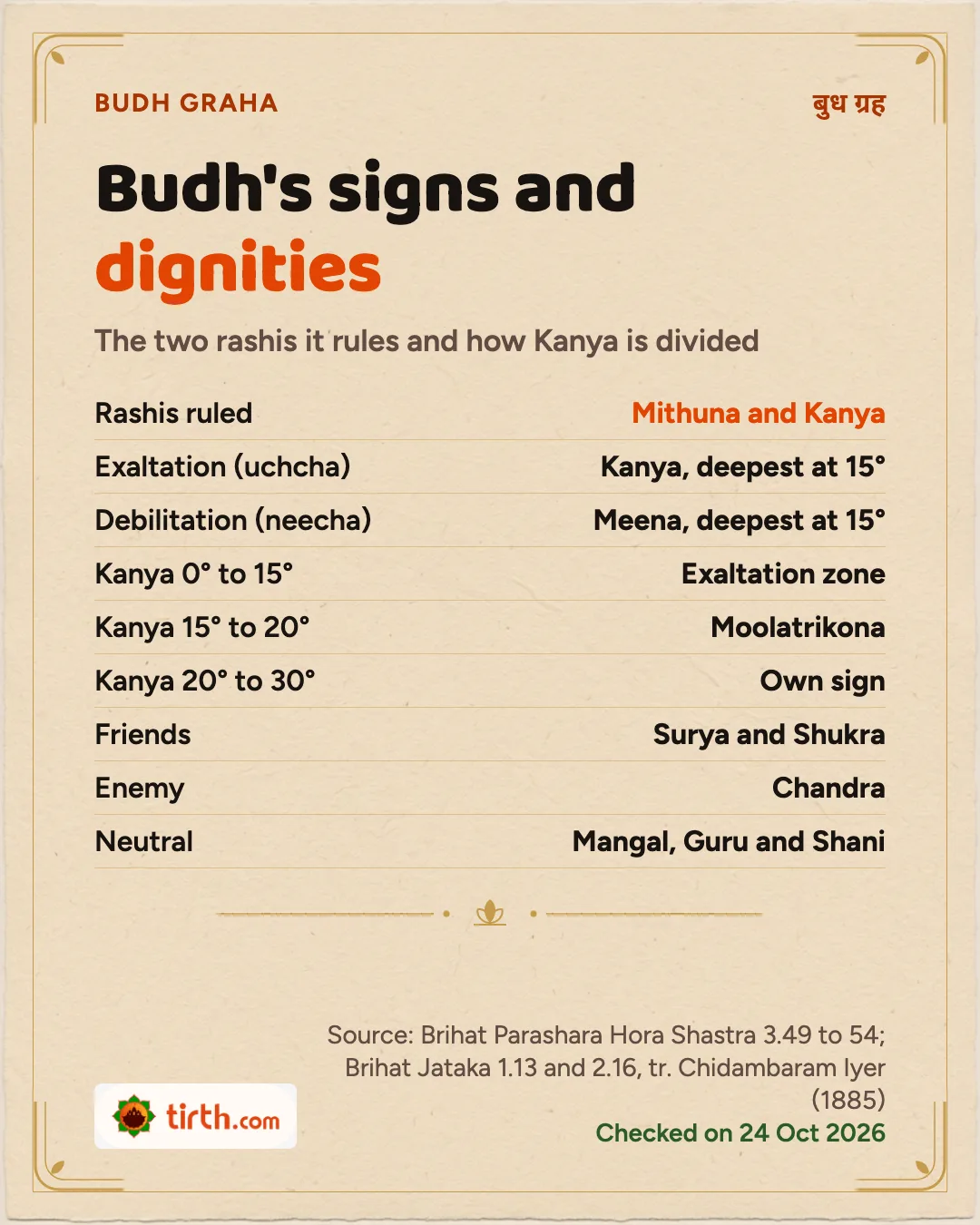
Two rashis belong to it, Mithuna (Gemini) and Kanya (Virgo). Its exaltation is at 15 degrees of Kanya and its debilitation at 15 degrees of Meena (Pisces). Speech is its province among the grahas. And when its turn comes round in the Vimshottari dashas, Budh holds it for 17 years.
Nothing here has to be taken on trust. Each point names its text with chapter and verse, nearly always the Brihat Parashara Hora Shastra (BPHS from here on) or Varahamihira’s Brihat Jataka, and if you want Budh standing beside the other eight there is a separate post on the nine grahas and their mantras.

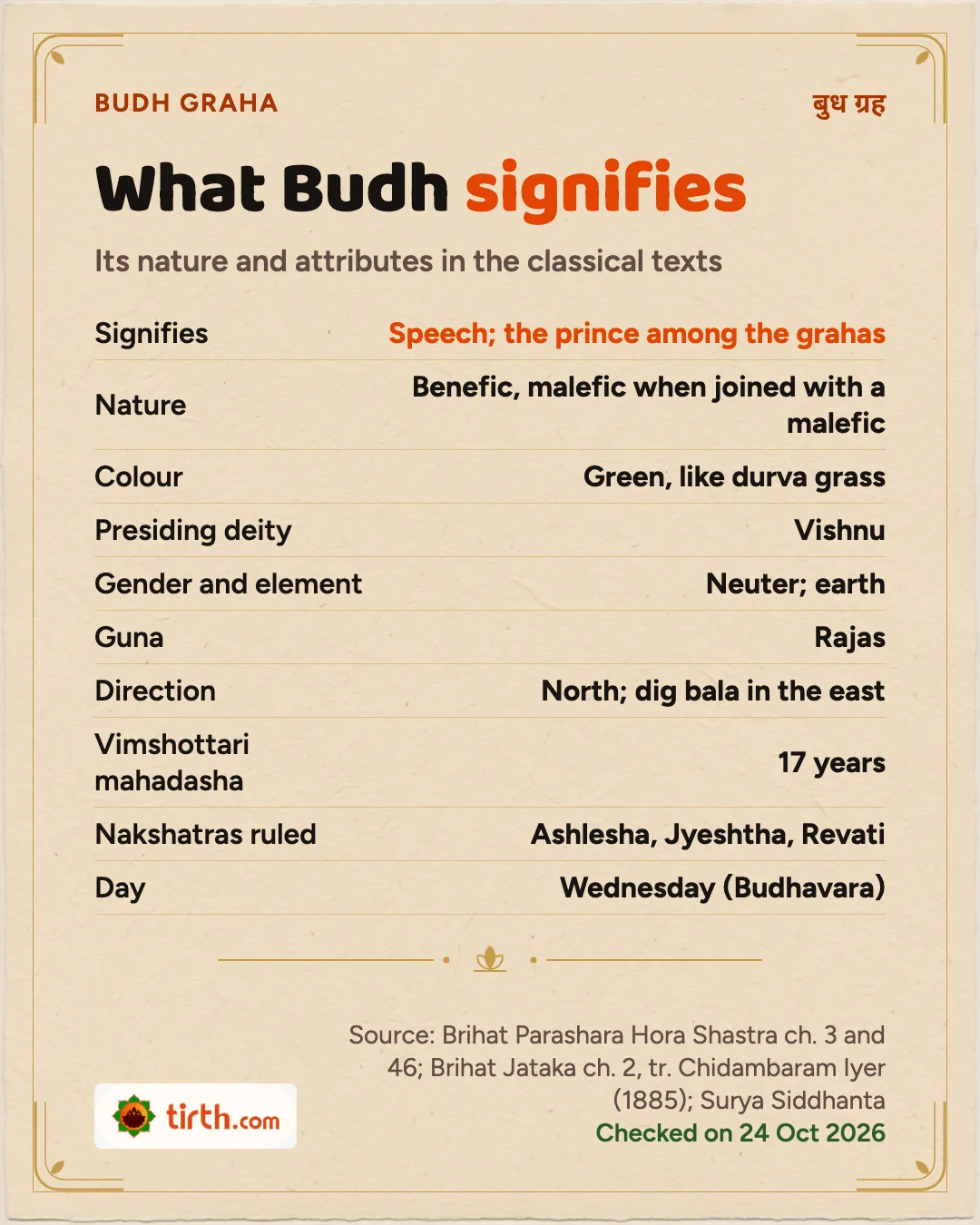
| Attribute | Budh | Source |
|---|---|---|
| Place among the nine grahas | Fourth | BPHS 3.10 |
| Rashis ruled | Mithuna and Kanya | BPHS ch. 4; Brihat Jataka 1.6 |
| Exaltation (uchcha) | Kanya, deepest at 15° | BPHS 3.49 to 50; Brihat Jataka 1.13 |
| Debilitation (neecha) | Meena, deepest at 15° | BPHS 3.49 to 50; Brihat Jataka 1.13 |
| Moolatrikona | Kanya, 15° to 20° | BPHS 3.51 to 54 |
| Friends | Surya and Shukra | Brihat Jataka 2.16 |
| Enemy | Chandra | Brihat Jataka 2.16 |
| Neutral | Mangal, Guru and Shani | Brihat Jataka 2.16 |
| Nature | Benefic, but malefic when joined with a malefic | BPHS 3.11; Brihat Jataka 2.5 |
| Signifies | Speech; the prince among the grahas | BPHS 3.12 to 15; Brihat Jataka 2.1 |
| Colour | Green, like durva grass | BPHS 3.16 to 17; Brihat Jataka 2.4 |
| Presiding deity | Vishnu | BPHS 3.18; Brihat Jataka 2.5 |
| Gender and element | Neuter; earth | BPHS 3.19 to 20; Brihat Jataka 2.6 |
| Guna | Rajas | BPHS 3.22; Brihat Jataka 2.7 |
| Direction | North (direction ruled); strong in the east (dig bala) | Brihat Jataka 2.5; BPHS 3.35 to 38 |
| Vimshottari mahadasha | 17 years | BPHS 46.12 to 15 |
| Nakshatras ruled | Ashlesha, Jyeshtha, Revati | Counted from BPHS 46.12 to 14 |
| Day | Wednesday (Budhavara) | Surya Siddhanta 1.51 to 52 |
In short
In the classical list of nine grahas it comes fourth, after Surya, Chandra and Mangal. Two rashis belong to it, Mithuna (Gemini) and Kanya (Virgo). Its exaltation is at 15 degrees of Kanya and its debilitation at 15 degrees of Meena (Pisces).
Where does the name Budh come from?
The word is about waking. Monier-Williams’ Sanskrit-English Dictionary has “awaking” for budha, with “intelligent, clever, wise” listed alongside it. Varahamihira had other names for the planet too, and Bodhana and Induputra are two of those that Brihat Jataka (2.2) gives, the second of them translating as “son of the Moon”.
Which is where a Puranic story comes in.
The Vishnu Purana tells it in Book IV, chapter 6. Soma, the Moon, carried off Tara, who was Brihaspati’s wife, and Budh was born to the two of them. He later married Ila. Their son was Pururavas, and because of this birth a jyotish text can call Budh the Moon’s son without any further explanation. The father has a page of his own on Tirth, Chandra, Deity page on Tirth , and Brihaspati is sung in the Brihaspati Dev Aarti.
Mithuna, Kanya and the 15-degree line
Chidambaram Iyer’s note to Brihat Jataka (1.6) needs only one line for the rashis Budh rules (“Mercury is the lord of Mithuna and Kanya”), and the BPHS, going through the signs one by one, says “Its ruler is Budh” under each of the two.
Budh does not hold all of Kanya in the same way, though. Its first 15 degrees are exaltation, the next 5 degrees (15 to 20) are moolatrikona, and only the last 10 count as Budh’s own sign, a three-way split set out in BPHS 3.51 to 54. Now put the exaltation table of BPHS 3.49 to 50 next to the list of rashi lords. No other graha is exalted in a sign it also rules. Only Budh.
Debilitation falls in the seventh sign from exaltation, the same for every graha in that table, which puts Budh’s in Meena, deepest at 15 degrees. Varahamihira agrees on the sign and the degree, and on the opposite-sign rule as well (Brihat Jataka 1.13).
If your own kundli has Budh in Kanya, read the degree before you read anything into it. We think the degree matters more than the sign name here, because the name alone cannot tell you which of the three dignities you are looking at (all three of them say Kanya on the chart). Tirth’s kundli maker draws the same 0 to 15, 15 to 20 and 20 to 30 lines, and where exaltation and own sign meet it lets exaltation take precedence.
Does jyotish count Budh as a benefic?
Yes. Or rather, yes on its own, and a malefic once it sits with one.
The BPHS (3.11) places Budh among the benefics and then adds straight away, “Budh, however, is a malefic, if he joins a malefic.” Brihat Jataka (2.5) starts from the other end, listing the waning Moon, the Sun, Mars and Saturn as malefics, and Mercury too whenever it is in conjunction with any of them. Friendship is a different matter. The texts call it naisargika maitri (natural relationship), and Brihat Jataka (2.16) puts Budh’s side of it as “The Sun and Venus are the friends of Mercury; the Moon is his enemy, and the rest are his neutrals.” That leaves Mangal, Guru and Shani as the neutrals. The BPHS handles it differently. Its verse 3.55 names nobody and lays down a rule instead, worked from each graha’s moolatrikona, for arriving at the friendships.
Read the same stanza for the Moon, though, and the Sun and Mercury are named as its friends. So Chandra counts Budh a friend while Budh counts Chandra an enemy, a friendship that runs one way only in this stanza, which is worth keeping in mind if you know Chandra mainly through the Chandra Dev Aarti.
Speech, Vishnu and the colour of durva grass
Speech, before anything else. Ask the BPHS (3.12 to 15) and Budh is the “speech-giver”. Brihat Jataka (2.1) needs three words, “Mercury is speech”. When the grahas are arranged as a royal court Budh is the prince in both texts, “prince-apparent” to the BPHS and “the first prince” to Brihat Jataka.
Little else is on the classical list. Green is its colour, like durva grass (BPHS 3.16 to 17, Brihat Jataka 2.4), and its presiding deity is Bhagwan Vishnu, Deity page on Tirth, about which Brihat Jataka (2.5) is flat, “Mercury is Vishnu”, while the BPHS list of deities (3.18) puts Maha Vishnu in Budh’s place. As for gender, Budh is neuter, and the BPHS (3.19) gives it only one neuter companion, Shani. Earth is its element of the five (BPHS 3.20). On its guna, rajas, the BPHS (3.22) and Brihat Jataka (2.7) say the same thing.
Direction is the one that tangles people.
One word is doing two jobs. The first meaning is the quarter a graha rules, and for Budh that is the north in Brihat Jataka (2.5). Dig bala is the second. It is the strength a graha picks up from its place in a chart, and the BPHS (3.35 to 38) says of it, “Strong in the East are Budh and Guru”. In a chart that east is the lagna (the rising sign). BPHS 27.7, the rule for working dig bala out, puts Budh and Guru at their strongest in the first house.
Why does Budh sit so close to Surya in every kundli?
Mercury, as we see it from Earth, is always somewhere near the Sun. N. Chidambaram Iyer put the chart version of this in the introduction to his 1885 Brihat Jataka. Mercury, he wrote, “will occupy either that sign or the sign next after it or next before it”, meaning the sign the Sun is in.
Open any kundli and Budh will be in Surya’s rashi or one of the two on either side of it.
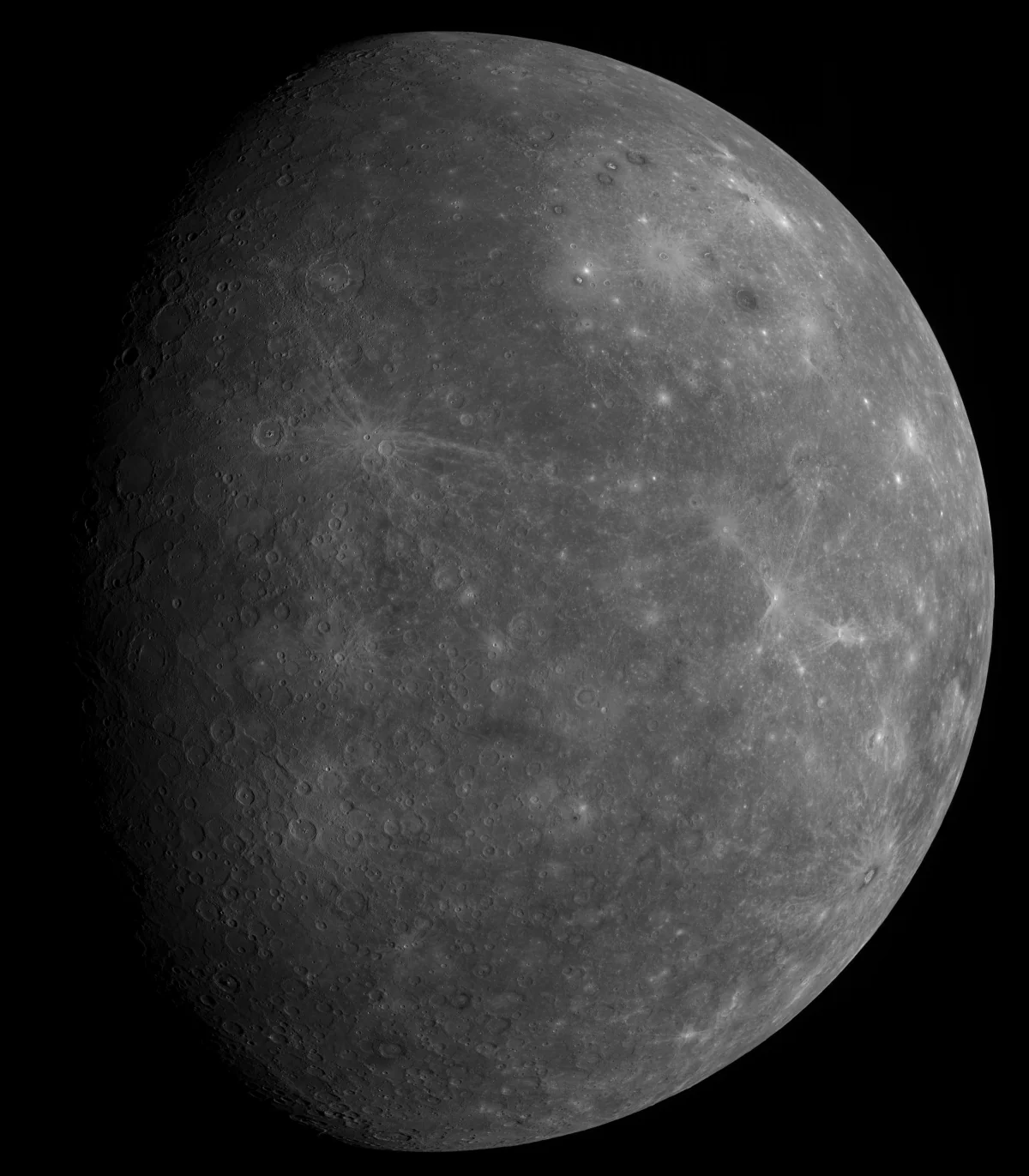
That close in, Budh can vanish in the Sun’s glare. The jyotish word for it is asta, which literally means “set” and is translated as combustion. In Burgess’s 1860 translation the Surya Siddhanta (9.8) has Mercury setting and rising “at a distance from the sun of twelve or fourteen degrees, according as he is retrograding or rapidly advancing”. Those are kalamsha in the original, degrees of time. Take the figures as approximate.
On Tirth’s kundli they become degrees of longitude. Budh gets marked asta when it is within about 14 degrees of Surya and moving forward, or within about 12 when vakri, and since it never leaves Surya’s rashi or the one next door it can come inside those limits. That tells you where Budh is and nothing more (what it means for a particular person is a question for your own jyotishi).
Why does Budh turn vakri about three times a year?
Vakri is the jyotish word for retrograde. For a few weeks Budh looks, from here, as if it is sliding back through the rashis. Then it stops and picks up its forward motion again. The planet itself never reverses, and what we see is the shape its path takes when it is watched from an Earth that is moving too.
The cause is the synodic period (the time between two identical alignments of Mercury, the Sun and Earth), which NASA’s Mercury fact sheet gives as 115.88 days. Which is why it happens about three times a year. Budh has three vakri periods in 2026, each lasting about three weeks.
| Year | Budh turns vakri | Budh turns direct (margi) |
|---|---|---|
| 2026 | Thursday, 26 February | Saturday, 21 March |
| 2026 | Monday, 29 June | Friday, 24 July |
| 2026 | Saturday, 24 October | Friday, 13 November |
| 2027 | Tuesday, 9 February | Wednesday, 3 March |
| 2027 | Thursday, 10 June | Monday, 5 July |
| 2027 | Thursday, 7 October | Thursday, 28 October |
Every date in the table is IST for New Delhi, worked out with the Lahiri ayanamsa and then checked against Drik Panchang. Times are left out on purpose (published panchangs disagree by a minute or two over the exact moment Budh stations, because on those days it hardly moves).
For where every graha stands on a given day, open today’s panchang, Panchang on Tirth.
A Western site will often name a different sign for the same vakri, and the reason is the zodiac. Western astrology counts signs in the tropical zodiac and Indian panchangs in the sidereal one, two frames that sat about 24 degrees 14 minutes apart in October 2026 (that gap is the Lahiri ayanamsa). The dates agree, and only the sign names differ.
How many years does Budh mahadasha run?
Seventeen years. That is out of 120 for the whole Vimshottari cycle, and the BPHS (46.12 to 15) lays the nine periods out in this order, Surya 6, Chandra 10, Mangal 7, Rahu 18, Guru 16, Shani 19, Budh 17, Ketu 7 and Shukra 20, so Budh’s period follows Shani’s and comes prior to Ketu’s.
Each nakshatra gets a lord in that passage too, starting the count at Krittika. If you write the nine lords in a column on a scrap of paper and go round (it is the easiest way to do it), Budh lands on the 9th, 18th and 27th nakshatras from Ashvini. Ashlesha, Jyeshtha and Revati. Every ninth one.
To see your own dashas and the date each one begins, use the free kundli with your dasha.
Frequently asked questions
Mercury. It is the fourth of the nine grahas of jyotish, and in both the BPHS and Brihat Jataka it is the graha of speech and the prince among the grahas, with Vishnu presiding over it.
Mithuna (Gemini) is one and Kanya (Virgo) the other. Inside Kanya it depends on the degree, with exaltation over the first 15 degrees, moolatrikona from 15 to 20 and own sign from 20 to 30, as BPHS 3.51 to 54 sets out.
Kanya for exaltation and Meena for debilitation, each deepest at 15 degrees. On those degrees the BPHS (3.49 to 50) and Brihat Jataka (1.13) agree.
Surya and Shukra are its friends and Chandra its enemy, says Brihat Jataka (2.16), while Mangal, Guru and Shani stay neutral. Chandra, looking back, counts Budh among its friends.
Seventeen years of the 120-year Vimshottari cycle, by BPHS 46.12 to 15. In the sequence it sits between Shani’s dasha, which comes first, and Ketu’s, which follows it.
Because it never leaves Surya’s rashi or the sign on either side, Budh can come inside the asta limits that the Surya Siddhanta (9.8) gives for Mercury, about 14 degrees, or 12 when it is vakri. The word describes where it is, nothing more.
Sources and further reading
- Brihat Parashara Hora Shastra, English translation with R. Santhanam’s notes (Internet Archive): chapters 3, 4 and 46.
- Varahamihira, Brihat Jataka, translated by N. Chidambaram Iyer, Madras, 1885 (Internet Archive): chapters 1 and 2 and the introduction.
- Translation of the Surya Siddhanta, Burgess, 1860 (Internet Archive): chapter 1, verses 51 to 52, and chapter 9, verse 8.
- Monier-Williams, Sanskrit-English Dictionary (1899), entry budha (University of Cologne, Cologne Digital Sanskrit Dictionaries).
- Vishnu Purana, Book IV, chapter 6, translated by H. H. Wilson, 1840 (Sacred Texts).
- Mercury Fact Sheet (NASA Space Science Data Coordinated Archive).
- Budha retrograde dates for New Delhi (Drik Panchang).
- For the grahas in prayer, the Navgrah Chalisa on Tirth.