On this page6 sections
When a family lights incense before a deity, what it offers is scent. Third among the five offerings of the short puja, it follows sandalwood fragrance and flowers and precedes the lamp.
The Sanskrit word is dhupa, and it does double duty, naming the act of offering and the incense that burns. So when a manual says dhupa, it may mean the offering or the incense itself.
In short
Third among the five offerings of the short puja, it follows sandalwood fragrance and flowers and precedes the lamp. The Sanskrit word is dhupa, and it does double duty, naming the act of offering and the incense that burns. So when a manual says dhupa, it may mean the offering or the incense itself.
Dhoop or agarbatti: what separates the two sticks
The difference sits inside the stick. Dhoop usually has no bamboo core and arrives as coreless sticks, cones or lumps of resin. Agarbatti is the one built around a bamboo core, usually.
| Dhoop | Agarbatti | |
|---|---|---|
| Core | Usually none | Usually bamboo |
| Forms | Coreless sticks, cones, resin lumps | A stick rolled around the core |
| Word | From dhupa, Sanskrit for incense | Agar (agarwood, a word traced to Tamil agil or agir) plus batti (a stick or wick, often traced to Sanskrit varti) |
The last row hints at a difference in meaning too. The two names lean differently: agarbatti joins agar and batti, a stick or wick, while dhoop comes from dhupa, which names both the offering and the incense. Word histories like these are often disputed, so the origins in the table are traced, not settled.
The split is a usual one, not an absolute one. Picking up a pack, look for the core. A coreless stick, a cone or a lump of resin is dhoop in the common sense; a stick rolled around a bamboo core is agarbatti.
Where dhoop falls in a puja: third of five, eleventh of 16
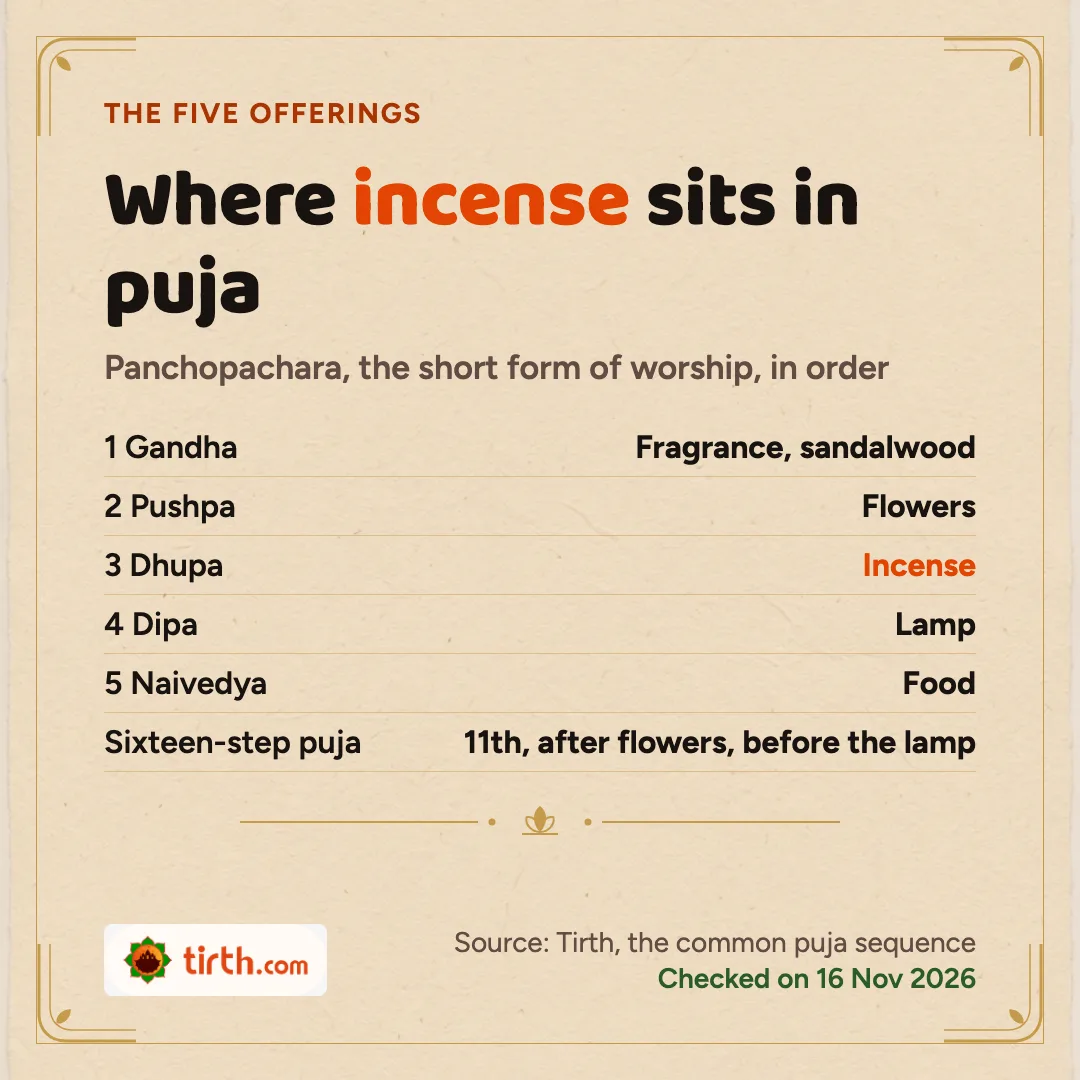
Take the short form first. Panchopachara means five offerings, and dhupa is the third of them. The longer form counts differently.
| Offering | What is offered | Element (one manual’s pairing) |
|---|---|---|
| Gandha | Fragrance, sandalwood | Earth |
| Pushpa | Flowers | Space |
| Dhupa | Incense | Air |
| Dipa | Lamp | Fire |
| Naivedya | Food | Water |
Only one manual gives the element column, so read it as that author’s scheme, not as something every family follows. That manual matches dhupa to air because its fragrance spreads through the space.
After incense comes the lamp; what a lit diya says in Hindu worship is covered on its own page. Food ends the five. The food offering, naivedya, has its own page.
Shodashopachara, the longer form, runs to 16 steps, and in the common list dhupa is number eleven, sitting between flowers and the lamp. Manuals do not all order the steps alike, so where your family’s book disagrees, go with the book.
The middle order agrees in both lists: dhupa sits between flowers and the lamp. Flowers come before incense and the lamp after it in the five offerings, and the sixteen steps keep the same neighbours. So a family that keeps the short form and one that keeps the long form make the same move here: flowers, then incense, then the lamp.
The line spoken at this step is short, just two words. Manuals give it as dhupam samarpayami, meaning “I offer incense”, and some add Om Shri and the deity’s name ahead of it.
Two texts, one with smoke and one without
In the Shrimad Bhagavata Purana (Book 11, chapter 27), Bhagwan Krishna, Deity page on Tirth tells Uddhava how he is to be worshipped, and incense and lamps are among the offerings he names.
Bhagavad Gita 9.26 sets the bar lower. Its list is a leaf, a flower, a fruit and water, given with devotion, and incense is not on it.
Read as rivals, the two clash, but they need not. One way to hold them together is to see the Bhagavata verse as the fuller worship, with a longer list of offerings, and the Bhagavad Gita verse as the plainest offering that still counts when it is given with devotion. The Bhagavata verse asks that the offering be made with faith. The edition read for this page is one translation, so take this as a reading, not a ruling.
How one tradition offers the smoke, and what to make of bamboo
Incense is not only a Hindu habit.
Hindu, Jain, Buddhist and Sikh worship all use it, and incense before images, in temples and during prayer is found in many parts of Asia.
One account of Shaiva temple practice describes the smoke being moved towards the deity, but not too close, and the incense shown along with the lamp. No text is named there, so treat it as one tradition’s habit, not a universal rule. For a fuller evening puja, see the Diwali Lakshmi puja vidhi and samagri and the Om Jai Jagdish Hare aarti.
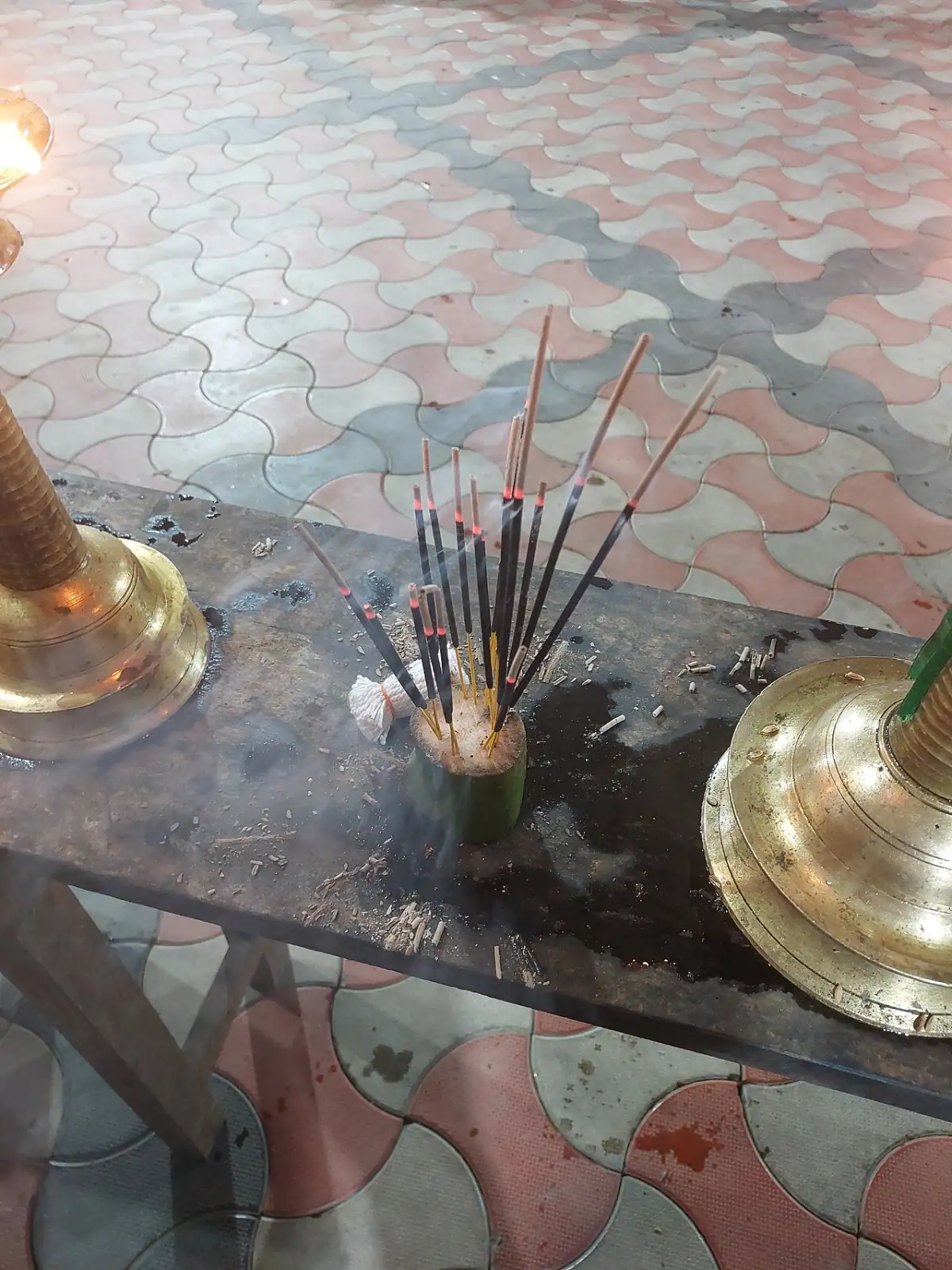
Then there is bamboo. A popular belief says it should not be burned in puja, because bamboo is used in weddings and other rites and burning it is thought inauspicious. We found no text behind this. One incense maker describes it as a cultural preference rather than a rule.
Our advice is to keep your own family’s habit and not argue the point, since it is a belief and a preference, not a rule. A family that avoids bamboo can buy dhoop, the coreless kind, or sticks sold without a bamboo core.
Frequently asked questions
Because fragrance is one of the offerings. In the short form of worship it is the third of five.
The core. Agarbatti usually has a bamboo one, with the stick rolled around it. Dhoop usually has none, and comes as coreless sticks, cones or lumps of resin.
Incense, in the common order. It follows the flowers and precedes the lamp.
A popular belief says so, though no text was found behind it, and one maker calls it a cultural preference. Families who avoid bamboo can use coreless dhoop.
The short form of worship. It has five offerings, namely fragrance, flowers, incense, lamp and food.
Not in verse 9.26. It names a leaf, a flower, a fruit and water, offered with devotion. The Bhagavata Purana (Book 11, chapter 27) does name incense.