On this page7 sections
In the Mahabharata’s telling, a Danava named Rahu, disguised as a god, was drinking the amrit when Surya Dev and Chandra Dev pointed him out. The nectar had reached only his throat when Bhagwan Vishnu’s discus took off his head.
The head that survived is Rahu, and the Rahu story runs on two tracks. The Puranas tell of an asura whose theft was stopped halfway, while jyotish counts him as one of the nine grahas, the point the texts tie to eclipses and to the full and new moon.
In short
The nectar had reached only his throat when Bhagwan Vishnu’s discus took off his head. The head that survived is Rahu, and the Rahu story runs on two tracks.
How Svarbhanu slipped into the gods’ row
By this point the churning is over. The amrit is out of the ocean, and Bhagwan Vishnu, in his Mohini form, has the asuras bewildered. If you want the churning from the first turn of the mountain, Tirth has the full Samudra Manthan story. This page stays with just one of the guests.
Svarbhanu is the name the Bhagavata Purana uses. Verse 8.9.24 dresses him as a deva and sends him into the gods’ row, where he drinks the nectar, and it is Chandra Dev, Deity page on Tirth and Surya Dev, Deity page on Tirth who point him out.
The verse never says why he, of all the asuras, was the one to try it. A well-known commentary supplies a reason. In its reading, Mohini had bewildered every asura except him. This one saw the cheating for what it was and swapped his dress to sit among the gods. That is the commentator speaking. The Sanskrit gives no reason, though the reading does make the disguise easier to follow.
And then the chakra. In verse 8.9.25, Hari (Bhagwan Vishnu) takes off the head of Rahu, mid-drink, with his razor-sharp chakra. The body drops, headless. No nectar had reached it.
What became of Rahu’s head, and was the body Ketu?
Everything that follows hangs on how far that one sip had travelled. The head had tasted amrit, so it could not die. Bhagavata 8.9.26 goes on to say that Bhagwan Brahma accepted it as a graha.
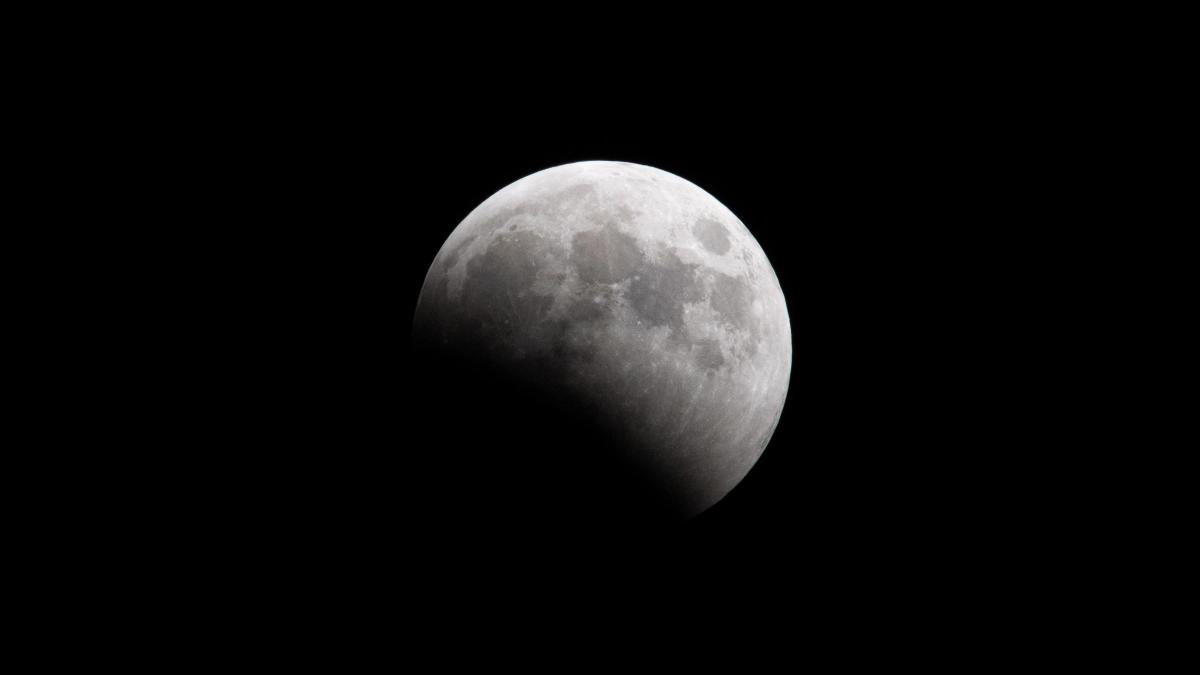
The same verse carries the grudge that drives the rest of the story. Out of enmity, the head chases the Moon and the Sun at the parva, meaning the full moon and the new moon.
The Mahabharata’s version is louder. In the Adi Parva (Astika Parva, Section XIX) the severed head rises and cries out, the trunk drops and shakes the earth, and from then on Rahu’s head keeps up a lasting quarrel with the Sun and the Moon and swallows them at eclipses. The name in that section is Rahu, not Svarbhanu.
Ask around today and many people will call the body Ketu, Rahu’s other half. The Bhagavata does not tell it that way. Its verses let the body fall dead and make a graha of the head alone, so if a child at home puts the Ketu question to you, the straight answer is that the verses which tell the beheading stop before they get there.
The Vishnu Purana has a churning of its own, in Book I Chapter IX, and the beheading is missing from it. A translator’s footnote to that chapter points this out, noting that the text takes no notice of the Rahu story.
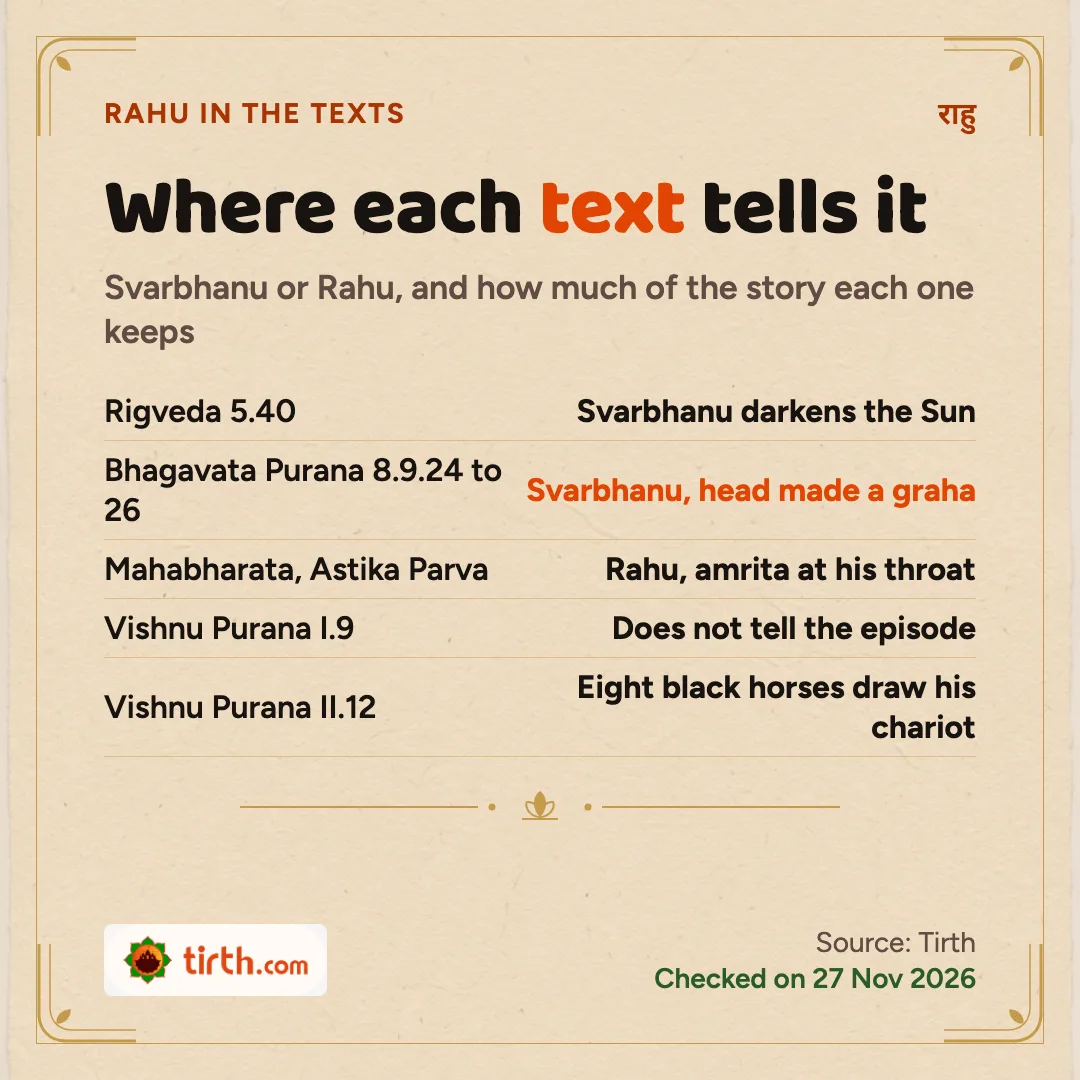
Svarbhanu is the older name of the two. The hymn at Rigveda 5.40 tells of Svarbhanu, an asura, piercing the Sun with darkness, and of the sage Atri finding the Sun again. Many modern readers hear an eclipse in it, though some scholars read Svarbhanu another way.
Rahu’s chariot and the Moon’s 5 degree tilt
A grudge gives Rahu his targets, the Sun and the Moon, but it keeps no calendar, and the timing has to come from somewhere else.
Here the texts leave the story and look up at the sky. Book II Chapter XII of the Vishnu Purana gives Rahu a dusky chariot pulled by eight black horses, and has it go from the Sun to the Moon and back again at the parvas. A translator’s footnote to the chapter points to the Matsya, Linga and Vayu Puranas, where Rahu takes up the earth’s round shadow during an eclipse.
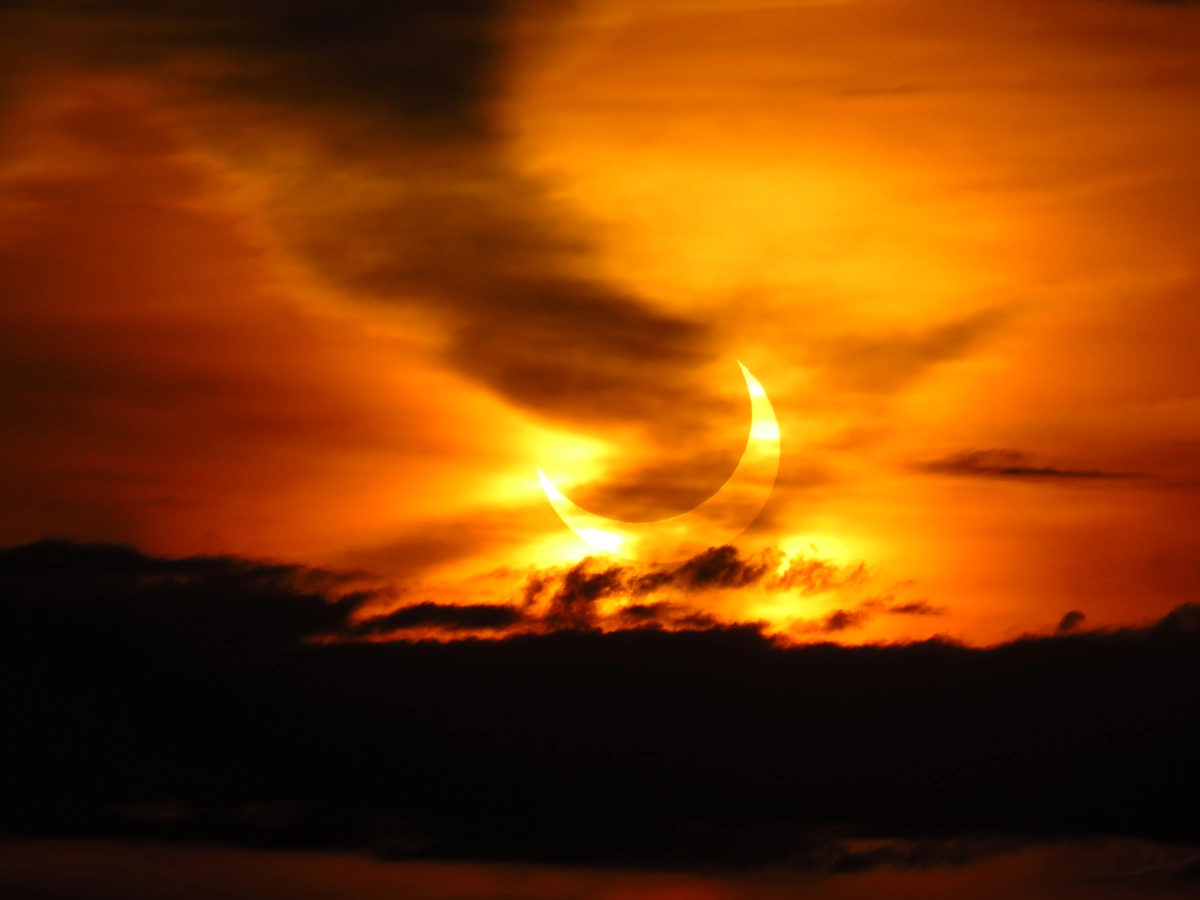
Jyotish has no use for the horses. Rahu and Ketu are the Moon’s north and south nodes, the two points where the Moon’s path cuts through the plane of the Sun’s apparent path, and you could not point a telescope at either one, since neither is a physical body.
Then there is the tilt. The Moon’s orbit is tipped about 5 degrees away from the plane in which the Earth goes round the Sun, and that small tilt is the reason eclipses do not come every month.
What is Rahu in astrology, going by Parashara?
A jyotishi who talks about “Rahu in your chart” is usually leaning on the Brihat Parashara Hora Shastra. The nine grahas are listed in its third chapter, at verse 10, as the Sun, the Moon, Mars, Mercury, Jupiter, Venus, Saturn, Rahu and Ketu. In verse 11 the English edition glosses Rahu and Ketu as the Moon’s ascending and descending nodes. An astronomer would say lunar nodes.
That chapter also builds the grahas a royal court. At the top sit the Sun and the Moon as royalty. Mercury is the prince, Jupiter and Venus serve as ministers, Mars commands the army and Saturn is the servant, while Rahu and Ketu are the army itself. Verse 30 gives Rahu a look and a nature, smoky with a bluish body, a forest-dweller, windy in temperament and intelligent. Ketu, the text adds, is like Rahu.
Verse 11 also splits the grahas into benefics and malefics. Rahu and Ketu land among the malefics, in company with the Sun, Saturn, Mars and the waning Moon. The verse is sorting the nine into two groups. The Sun sits in the same group as Rahu. For how the Rahu-Ketu axis is read in a chart, there is Kaal Sarp Dosh explained.
In the Vimshottari dasha (chapter 46, verses 12 to 15), Rahu’s period is 18 years of a 120-year cycle.
You will not find Rahu’s mantra on this page. It is written out in full, alongside the other eight, in Tirth’s Navagraha mantras.
Rahu Kaal: the slice of daylight that carries his name
For most families, the first Rahu they meet is Rahu Kaal (also written Rahu Kalam) in the daily panchang, long before anyone opens a kundli. The Tirth Spiritual Calendar cuts the daytime, sunrise to sunset, into eight equal parts, and the weekday decides which part carries his name. On Sunday it is the last of the eight, the 8th, and through the rest of the week it is the 2nd on Monday, the 7th on Tuesday, the 5th on Wednesday, the 6th on Thursday, the 4th on Friday and the 3rd on Saturday.
Against that window the panchang prints one short note, “avoid new work”. Read it as a convention about when to begin things. Because the window moves with sunrise and sunset, and those move with your city and the season, look up today’s panchang with Rahu Kaal, Panchang on Tirth for the hours where you live.
Frequently asked questions
According to the Bhagavata Purana (8.9.24 to 26), Rahu is the asura Svarbhanu. He drank the amrit in disguise, Bhagwan Vishnu’s disc took off his head, and the head, now immortal, was accepted as a graha. Jyotish counts him among its nine grahas.
Rahu is a graha, but he is not a physical body. Rahu and Ketu, in the English edition’s gloss on Brihat Parashara Hora Shastra (3.11), are the Moon’s ascending and descending nodes, where its path crosses the Sun’s.
He was given away by Surya Dev and Chandra Dev in the very moment he drank. Out of enmity, says the Bhagavata (8.9.26), his head chases them at the full and new moon. In the Mahabharata he swallows them at eclipses.
It is a common telling today, but the Bhagavata does not have it. Those verses let the headless body fall dead and make only the head a graha.
Rahu’s period runs 18 years, out of a 120-year cycle, in the Vimshottari dasha of the Brihat Parashara Hora Shastra.
Rahu Kaal is one-eighth of the daytime, sunrise to sunset, with the weekday deciding which eighth; on Sunday it is the 8th. The Tirth Spiritual Calendar gives each day’s window for your city on Tirth’s panchang.
Continue on Tirth
- Today’s panchang, Panchang on Tirth, with the Rahu Kaal window for your city.
- The Samudra Manthan story, the churning that ends at Rahu’s sip.
- Navgrah Chalisa, for the nine grahas together, Rahu among them.