On this page8 sections
It is said to form when all seven planets, Sun to Saturn, lie on one side of the Rahu and Ketu axis in a birth chart. Kaal is time and sarp is serpent, and astrologers disagree on whether the pattern is a dosh (a flaw in the chart) at all.
In short
Kaal is time and sarp is serpent, and astrologers disagree on whether the pattern is a dosh (a flaw in the chart) at all.
What is Kaal Sarp Dosh, in one rule?
Jyotish, Hindu astrology, works with nine grahas (planets), Sun, Moon, Mars, Mercury, Jupiter, Venus, Saturn, Rahu and Ketu. This rule counts the first seven only. Picture a straight line from Rahu to Ketu across the chart, and if Sun to Saturn all fall on one side of it, hemmed in between the two nodes, the chart is said to have Kaal Sarp yog or dosh.
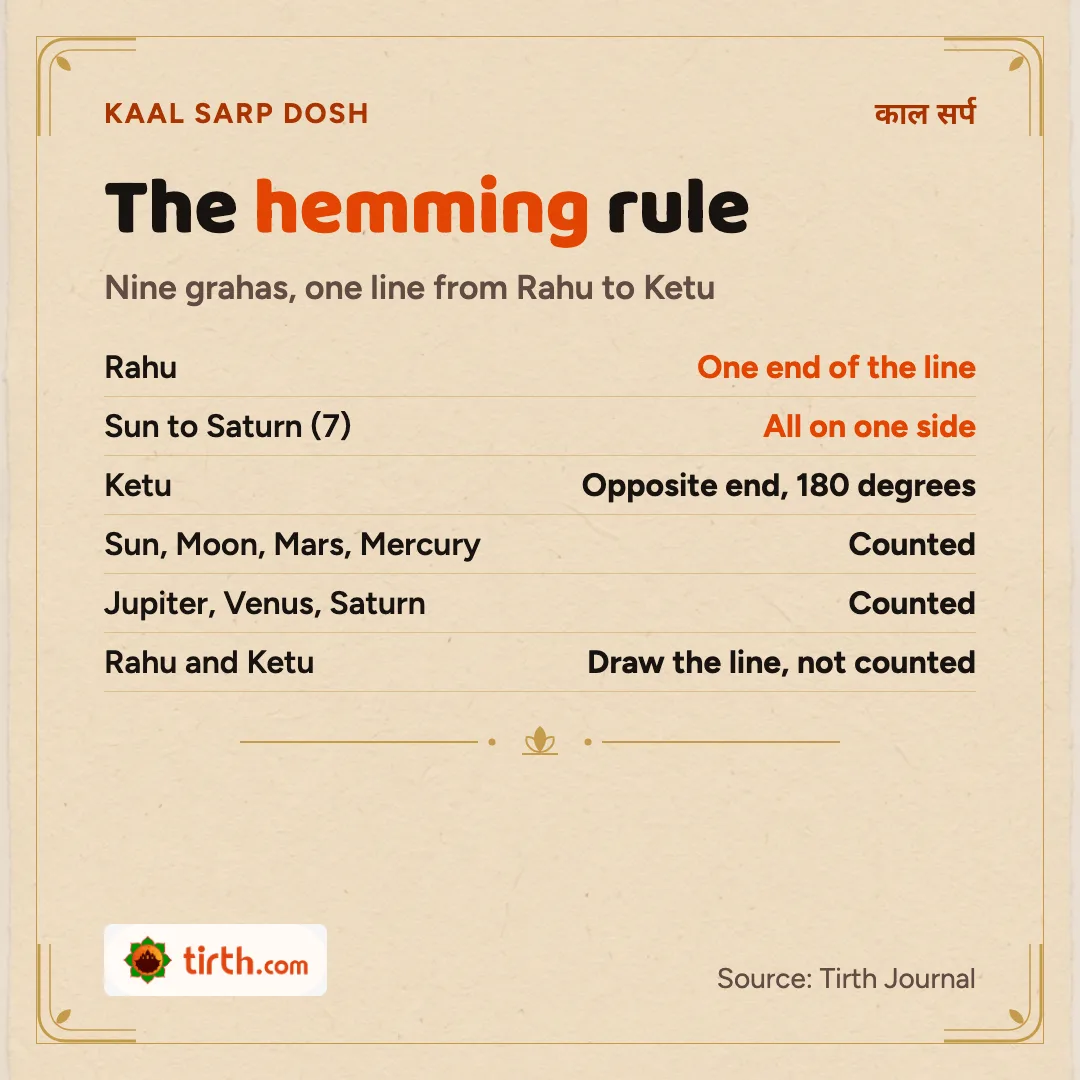
Even the name has more than one reading. Sources differ on the first word too. Some read kaal as time, others as death or destiny, and “serpent of time” is simply the usual rendering. Kal Sarp, Kala Sarpa, Kalsarp and Kaal Sarp Yog? Same idea. Before you meet the pattern itself, it helps to see how a graha is read in jyotish.
Why do Rahu and Ketu draw the line?
Neither is a body in the sky. They are the two lunar nodes, the points where the Moon’s path crosses the ecliptic (the Sun’s apparent path), and they always sit exactly opposite each other, 180 degrees apart. The pair drifts backwards through the zodiac and takes about 18.6 years to go once around.
Eclipses happen only when the Sun and Moon are near a node. The tradition calls Rahu and Ketu chhaya grahas, shadow planets that cause eclipses. For the eclipse itself, read our guide to the lunar eclipse; the Navagraha mantras page gives each of the nine its own section.
Is Kaal Sarp Dosh in the classical texts?
Brihat Parashara Hora Shastra is not known to name it. As of November 2026, sources that look into the point say the same of Phaladeepika, Brihat Jataka, Saravali and Jataka Parijata, although none of those sources is a scholarly edition.
Under this name the pattern does not turn up in the texts astrologers usually reach for first, and the people making the claim are modern astrology sites, not editions of the texts themselves.
The sources that discuss it do not find it under this name.
So scholars and astrologers ask whether Kaal Sarp is a true classical yoga or a later addition. One source says it seems to have grown out of later traditional practice, possibly within the last few centuries. No firm date is agreed. I would be wary of any page that offers one, since nobody has settled it.
The twelve types and their serpent names
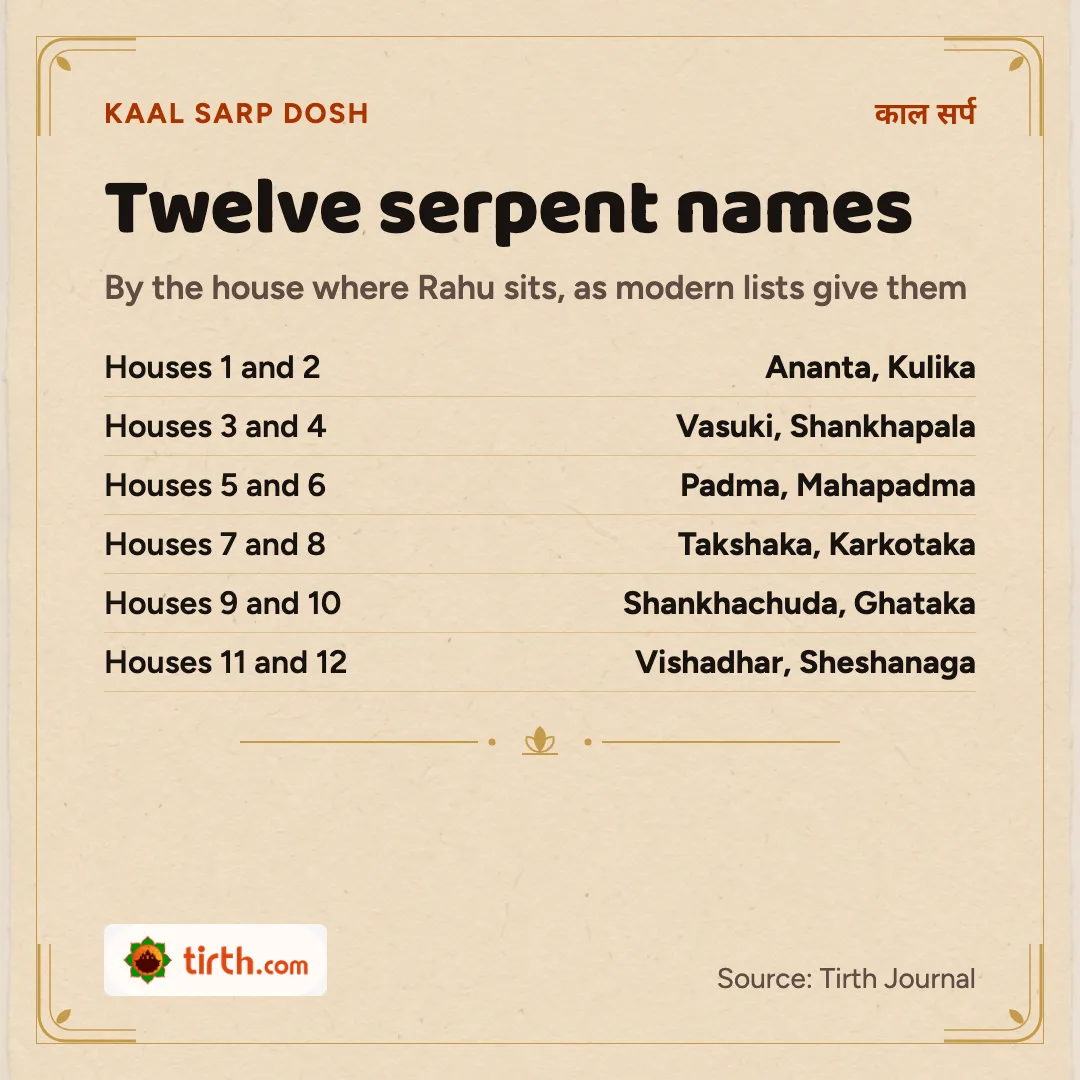
Modern lists split Kaal Sarp into twelve types. Each is named after a serpent and tied to the house where Rahu sits. No source consulted says when those names were first attached to the pattern, so take them as names in current use and not as a classification from the old texts.
Numbered by the house of Rahu, first to twelfth, the twelve are Ananta, Kulika, Vasuki, Shankhapala, Padma, Mahapadma, Takshaka, Karkotaka, Shankhachuda, Ghataka, Vishadhar and Sheshanaga.
Where astrologers part ways on Kaal Sarp Dosh
The table lists the main questions practitioners argue over, with each view put the way its holders usually put it, so the gaps between them show plainly.
| The question | One view | Another view |
|---|---|---|
| Is it a dosh at all? | It is a real pattern in the chart and worth weighing. | It is a later idea with no classical source, so it should not be called a dosh. |
| Partial or complete? | The planets must all lie between the nodes. | Some astrologers call a near miss, such as one planet just outside the axis, partial. Others say one planet outside means the pattern does not form. |
Since practitioners count it differently, two astrologers can read one chart and report different things. That is a fair reason to ask which rule a report used before you act on it.
If a report says you have it
The first thing to ask is which rule the report used. A report that counts a near miss as Kaal Sarp works from a different rule than one that needs all seven planets inside the axis, and you should know which of the two you are holding before you trust anything else in it.
Then look at the whole chart. Some sources say the effects depend on the full chart. A jyotishi (an astrologer) you trust can walk you through it, so ask for that and not just a verdict.
For the puja, our Trimbakeshwar temple guide describes the temple in Nashik, Destination on Tirth , a Jyotirlinga, a sacred shrine of Bhagwan Shiva, where pilgrims perform it. Arranging one starts at Tirth pujas, Pujas on Tirth.
Frequently asked questions
All seven planets, Sun to Saturn, on one side of the line joining Rahu and Ketu. Astrologers who use the idea call it a dosh or a yog. Some reject the label altogether.
Whether the seven planets lie between the nodes can be read straight off the chart. What the pattern means is where astrologers differ.
Brihat Parashara Hora Shastra is not known to name it. The sources that say so are modern astrology sites, so treat the point as reported, not settled.
Some astrologers use the word for a chart that almost fits the pattern, say with one planet just outside the axis. Practitioners differ on this, so ask what rule your report followed.
The absence of a classical source is the reason they give, together with the view that a whole chart says more than a single pattern. Others give the pattern weight.
A report that names it gives one reading under one rule. Ask which rule it used and have the whole chart read before you decide anything.
Continue on Tirth
- Trimbakeshwar temple guide: the Jyotirlinga at Nashik, where pilgrims perform this puja.
- Tirth Panchang, Panchang on Tirth: the panchang on Tirth.
- Navagraha mantras: a section for each of the nine grahas, Rahu and Ketu included.
- Tirth pujas, Pujas on Tirth: to arrange a puja with a Pandit.