On this page9 sections
- Where does the amrit pot first appear?
- How does Mohini get the jug back?
- Jayant and the twelve-day chase
- The four places, river by river
- Who carried the pot, telling by telling
- When did the four drops join the story?
- Telling the pot’s story at Haridwar in 2027
- Frequently asked questions
- Continue on Tirth
- Sources and review
In the Kumbh Mela, Yatra on Tirth story that grows from this, the pot is then carried off and drops of amrit fall at four places on four rivers, at Haridwar, Prayagraj, Ujjain and Nashik-Trimbakeshwar.
Ask who carried it and the answers split. Every telling has its own name for the carrier, and the Purana chapters that describe the churning never let a drop reach the earth at all. Walk the pot through one step at a time and you can find the very line where the verses stop and the mela picks the story up.
For a first look at the mela itself, the Kumbh in plain words is the easier read.
In short
Ask who carried it and the answers split. Every telling has its own name for the carrier, and the Purana chapters that describe the churning never let a drop reach the earth at all.
Where does the amrit pot first appear?
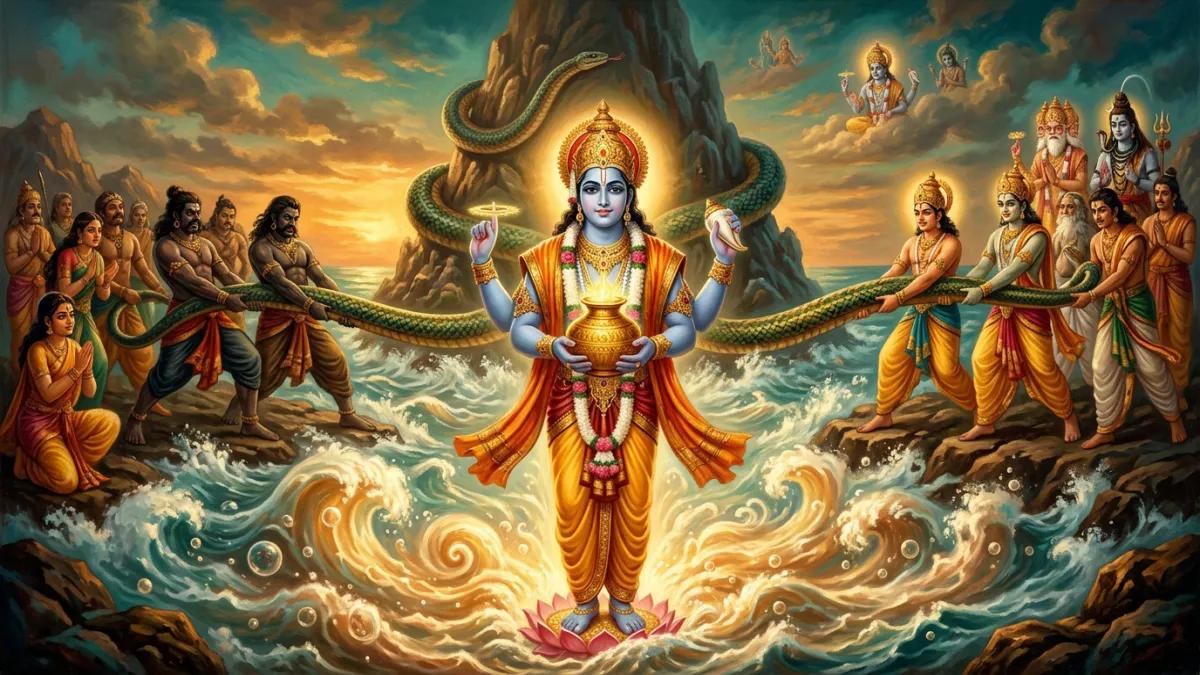
The Bhagavata Purana puts the moment at 8.8.31 to 35. In the middle of the churning a wonderful male figure comes up out of the water with a jug filled to the top with nectar, and verse 34 calls him a portion of Bhagwan Vishnu, the physician of the devas, Bhagwan Dhanvantari.
Then verse 35. The asuras see the jug and take it by force. The Vishnu Purana, Book 1, chapter 9, is briefer, and there the cup of amrit is seized from Bhagwan Dhanvantari as he rises.
The other things the ocean gave up are in the full Samudra Manthan story, with all its treasures.
How does Mohini get the jug back?
With the jug gone, the devas take shelter with Bhagwan Vishnu (Bhagavata 8.8.36 to 46). He promises to set the asuras quarrelling among themselves. Then he becomes Mohini, a woman of extraordinary beauty, and she captivates them.
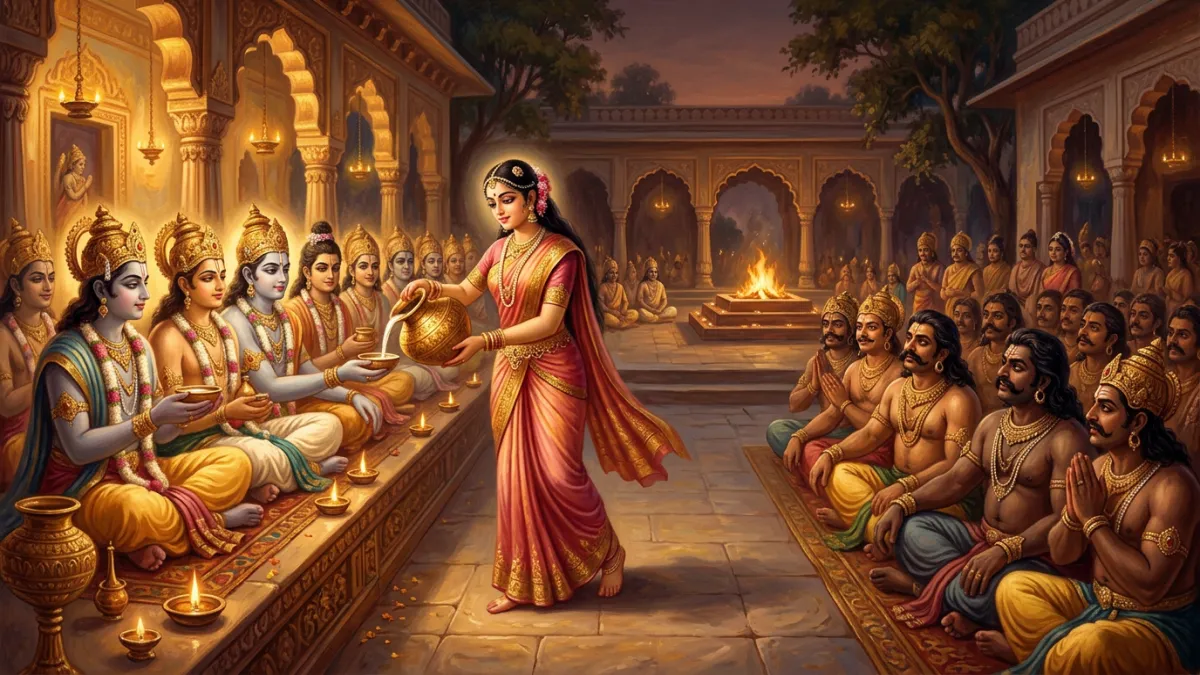
Chapter 9, verses 11 to 28, shows it working. The asuras hand Mohini the container of nectar and promise to accept whatever she decides. She seats devas and asuras in two separate lines and pours for the devas alone, so the asuras get none of it. Rahu’s drink is another episode altogether, with its own page in the story of Rahu.
And that is where the pot’s story stops, in Bhagavata 8.8 and 8.9 and in Vishnu Purana 1.9. Read those chapters through and you will not meet Jayant or Garuda, or twelve days of flight, or a drop of amrit falling anywhere near Haridwar, Prayagraj, Ujjain or Nashik. The amrit reaches the devas. That is all.
Jayant and the twelve-day chase
From here on the pot belongs to the Kumbh’s own telling. The Maharashtra government’s Simhastha pages tell it like this. Jayant, son of Indra Dev, takes the pot and runs, and the asuras chase him.
It goes on for twelve days of the gods, and one day of the gods equals one human year. So the chase counts as twelve human years. Uttar Pradesh’s Kumbh portal ties the mela’s twelve years to this count. Tirth also explains why the Kumbh comes back every twelve years.
A fuller version brings in guards. Bhagwan Vishnu, still in the form of Mohini, gives the pot to Jayant and orders Surya Dev, Chandra Dev, Brihaspati Dev and Shani Dev to protect it on the way. Uttar Pradesh’s Kumbh portal credits the twelve divine days to the Bhagavata Purana (spelt Bhagavad Purana there). The churning chapters, 8.8 and 8.9, count no days at all. We would keep Jayant, the twelve days and the four guardians with the mela and its cities, where they are told, and give them no verse number.
The four places, river by river
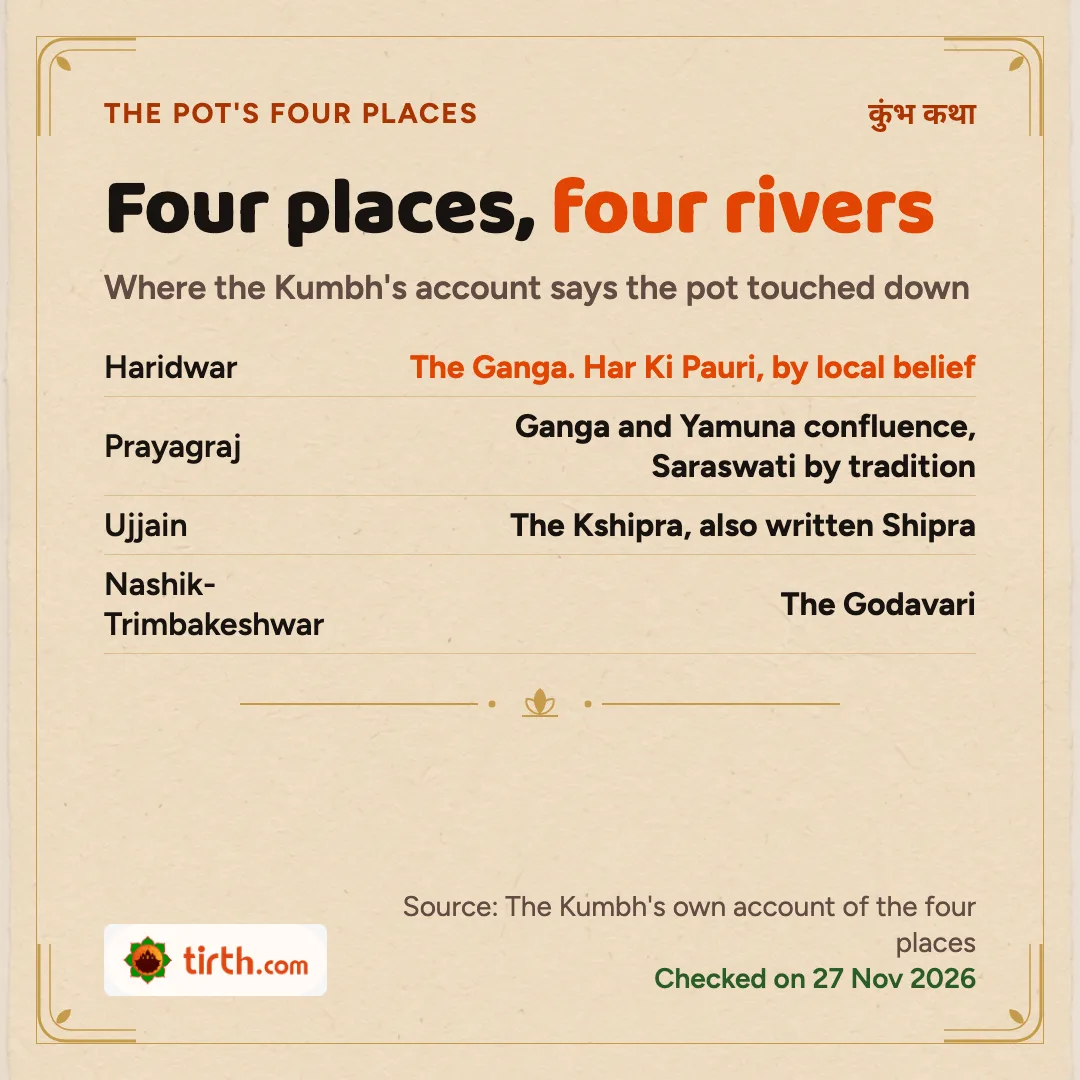
The drops fall, or the pot is set down, at four places. Each one is on a river.
| City | River | What the Kumbh’s account points to |
|---|---|---|
| Haridwar | The Ganga | Har Ki Pauri, with Brahmakund inside its complex, both linked with the Kumbh by local belief |
| Prayagraj | The confluence of the Ganga and the Yamuna, with the Saraswati by tradition | The confluence itself, no single named spot |
| Ujjain | The Kshipra (also written Shipra) | The river, no single named spot |
| Nashik-Trimbakeshwar | The Godavari | The river, no single named spot |
Haridwar is the only one of the four with a named place, Har Ki Pauri on the banks of Maa Ganga. For the other three the accounts vary in their details, and none points to a ghat you could be shown as the spot where a drop came down.
For a yatri the practical answer is simple. Go to the river. The four Kumbh cities compared goes through each one by river, bathing place and season. For the city itself, see Haridwar, Destination on Tirth.
Who carried the pot, telling by telling
Line the tellings up next to each other and the pot keeps changing hands.
| Who holds the pot | Where this version comes from |
|---|---|
| Bhagwan Dhanvantari | Lifts the jug from the ocean in the Bhagavata (8.8.31 to 35) and the Vishnu Purana (1.9), and is named as the carrier in some Kumbh accounts |
| Bhagwan Vishnu as Mohini | Takes the container and serves the devas in the Bhagavata (8.9.11 to 28), and is named as the carrier in some accounts |
| Jayant, son of Indra Dev | The Maharashtra government’s Simhastha pages and the Uttarakhand Kumbh page of India’s tourism ministry |
| Surya Dev, Chandra Dev, Brihaspati Dev and Shani Dev | Guardians of the pot, not carriers, in the fuller Kumbh account |
| Garuda | Ujjain’s own telling of its Simhastha, and other regional accounts |
| Indra Dev | Named in some accounts as the one who spilt it |
Garuda comes with a much older story. The Mahabharata’s Adi Parva has it (Astika Parva, section XXXIV in Ganguli’s English translation). Garuda offers to put the amrit down on kusha grass, and while the snakes are away bathing, Indra Dev carries it back to heaven. The snakes lick the grass where it lay, their tongues split in two, and the grass is sacred from then on.
That passage has no vessel in it and no Kumbh. Still, it is the closest the epic gets to amrit touching the earth, which may be why later retellings put the pot in Garuda’s hands.
When did the four drops join the story?
Scholars of the Puranas point out that the spilling at four places is missing from the earliest accounts of the Samudra Manthan, and that no ancient or medieval text ties the legend to a mela. As they read it, an older legend was adapted to explain a later practice. Nobody can put a firm date on that.
Telling the pot’s story at Haridwar in 2027
The next Kumbh is expected to begin at Haridwar in January 2027, on the Ganga, and the dates are provisional. Kumbh Mela 2027 has the full plan for that mela.
Save the story for the drive up, while the family is still listening. If you would rather Tirth handled the travel and the stay as well, see Tirth’s yatra packages, Yatra on Tirth.
Frequently asked questions
Bhagwan Dhanvantari rises from the churning with a pot of amrit. The asuras grab it, and Bhagwan Vishnu, as Mohini, wins it back for the devas. The Kumbh accounts then have Jayant run with the pot for twelve days of the gods, and drops fall at Haridwar, Prayagraj, Ujjain and Nashik-Trimbakeshwar.
Jayant, son of Indra Dev, in the Maharashtra government’s Simhastha pages. Other accounts name Garuda, Indra Dev, Bhagwan Dhanvantari or Bhagwan Vishnu as Mohini.
In the mela’s account the pot touched the earth at four places, each of them on a river. Haridwar is on the Ganga, Prayagraj at the confluence of the Ganga and the Yamuna, Ujjain on the Kshipra and Nashik-Trimbakeshwar on the Godavari.
Jayant runs for twelve days of the gods, and one day of the gods is one human year.
Partly. The churning and the pot are in the Bhagavata Purana (8.8 and 8.9) and the Vishnu Purana (Book 1, chapter 9). Jayant, the twelve-day run and the four drops are not in those chapters at all. They come from the Kumbh cities and the government Kumbh pages.
The pot of amrit at the heart of the story. Kalash and kumbh both mean a pot. The Bhagavata describes it as a jug filled to the top with nectar, which Bhagwan Dhanvantari carries up from the ocean.
Continue on Tirth
- The Haridwar Kumbh 2027 pilgrim’s guide, for the mela expected to begin in January 2027.
- Haridwar on Tirth, Destination on Tirth, the city where the telling names Har Ki Pauri.
- The churning of the ocean, for everything that rose before the pot.