On this page9 sections
- How long does Brihaspati Dev take to go round the rashis?
- Which rashi belongs to Haridwar, Prayagraj, Ujjain and Nashik?
- Where the legend’s 12 days come from
- Why did Haridwar’s 2021 Kumbh come a year early?
- Where the six-year Ardh Kumbh fits in
- Why Haridwar’s mela falls in 2027
- When will Jupiter be back in each city’s rashi?
- Frequently asked questions
- Continue on Tirth
- Sources and review
As the planet Jupiter, he takes about 12 years to go once round the twelve signs of the zodiac. Each Kumbh city waits for Jupiter to come back to its own sign, and for the Sun to move into the partner sign that goes with it.
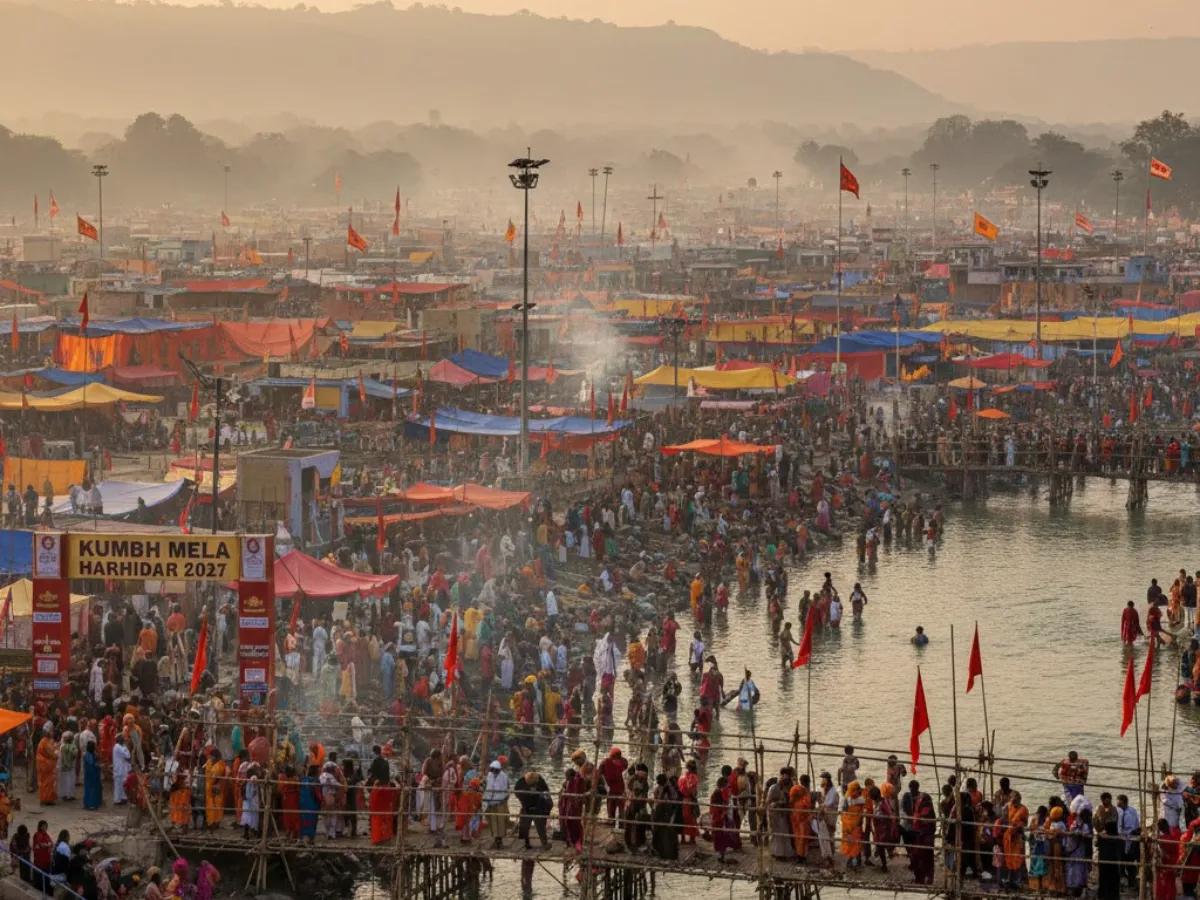
Haridwar, Destination on Tirth shows why. Its Kumbh came in 2021, and on Wednesday, 14 April that year, as the Sun crossed into Mesha, Jupiter was still sitting in Kumbha.
Twelve years is only the average. Look at Haridwar’s own record, where the 2021 mela came 11 years after 2010 and the 2027 mela comes six years after 2021, with Jupiter nowhere near Kumbha. Neither gap is twelve.
The Kumbh Mela in plain words covers the mela itself for newcomers. From here on it is the sky.
In short
Each Kumbh city waits for Jupiter to come back to its own sign, and for the Sun to move into the partner sign that goes with it. Haridwar, Destination on Tirth shows why. Its Kumbh came in 2021, and on Wednesday, 14 April that year, as the Sun crossed into Mesha, Jupiter was still sitting in Kumbha.
How long does Brihaspati Dev take to go round the rashis?
Brihaspati Dev is two things at once, and the Puranas make him the guru of the gods. In the sky he is Jupiter, a planet that takes about 12 Earth years over one trip round the Sun, which works out at roughly a year in each rashi (sign of the zodiac).
The true figure sits just under that, at approximately 11.86 years.
Nor does it always move forward. In 2021 Jupiter entered Kumbha in April and slipped back into Makara in September. It came into Kumbha again in November and then left for Meena in April 2022, so a single “Jupiter year” in one sign can have a gap in the middle.
Every planetary position here comes from the Tirth Spiritual Calendar’s panchang, which uses Lahiri sidereal signs. For 2027, watch the present loop. Jupiter entered Simha on 31 October 2026, dips back into Karka from 25 January to 26 June 2027 and stays in Simha again until the end of November 2027. Which puts Haridwar’s main 2027 bathing days under Jupiter in Karka, and Nashik’s under Jupiter back in Simha.
Which rashi belongs to Haridwar, Prayagraj, Ujjain and Nashik?
Each city has a pairing on the Uttar Pradesh government’s Maha Kumbh portal. Official pages do not all agree with it, and Garhwal district’s has Ujjain under Vrishchika (Scorpio), so read the table as the usual pairings and not the only ones.
| City | Jupiter’s sign, as the Maha Kumbh portal gives it | Sun’s sign | Real mela years, read in the Tirth panchang |
|---|---|---|---|
| Prayagraj | Vrishabha (Taurus), or Mesha (Aries) in the portal’s second reading | Makara (Capricorn) | 2013 and 2025, Jupiter in Vrishabha and the Sun in Makara |
| Haridwar | Kumbha (Aquarius) | Entering Mesha (Aries) | 2010 and 2021, Jupiter in Kumbha as the Sun entered Mesha in April |
| Nashik-Trimbakeshwar | Simha (Leo) | Karka (Cancer) or Simha (Leo), as accounts differ | 2015 and 2027, Jupiter in Simha, the Sun in Simha on the main days |
| Ujjain | Simha (Leo) | Mesha (Aries) | 2016 and 2028, Jupiter in Simha with the Sun entering Mesha |
Put the portal’s pairings next to the years the melas were actually held and Haridwar, Prayagraj, Destination on Tirth and Ujjain all fit. For Nashik, Jupiter lines up. The Sun is the loose end there. When Nashik’s first Amrit Snan of 2027 comes round on 2 August the Sun will still be in Karka. It joins Jupiter in Simha on 17 August 2027, before the Amrit Snans of 31 August and 11 September.

Then there is the Moon. Some bathing days hang on an Amavasya (new-moon day), which makes it a third clock. As for why Prayagraj claims first place among the four, that has a page of its own, why Prayagraj is called the main Kumbh Nagri.
Where the legend’s 12 days come from
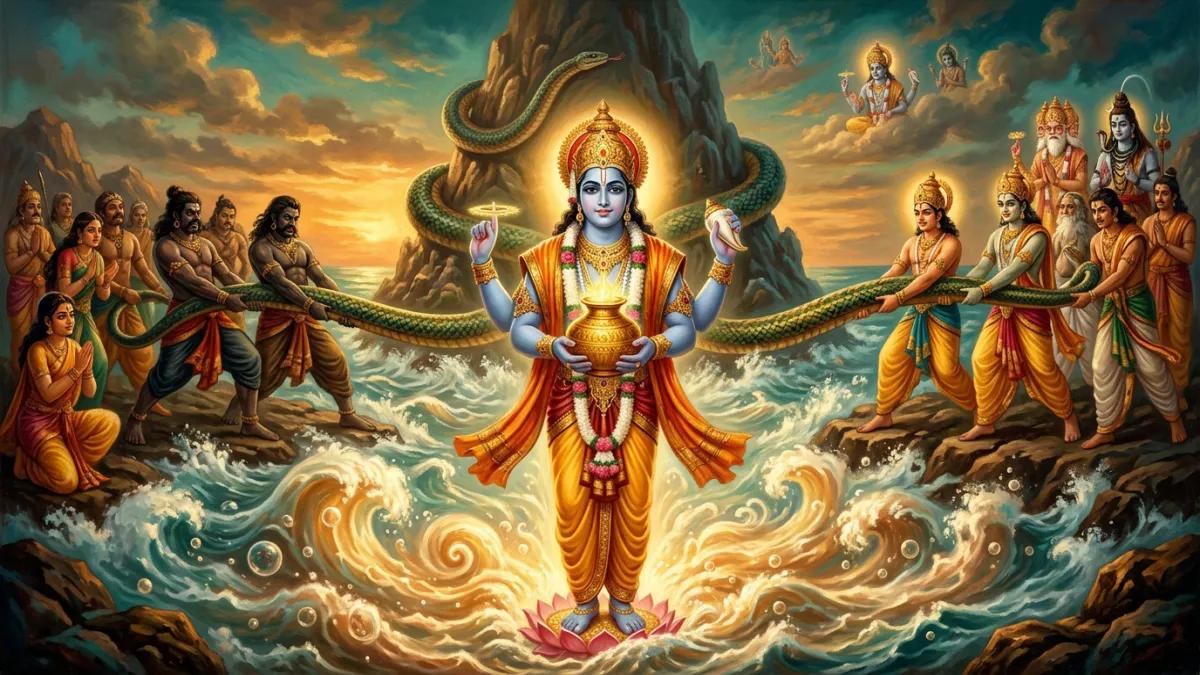
The Bhagavata Purana tells the churning in Canto 8. Gods and demons churned the Ksheer Sagara, the ocean of milk, for amrita, the nectar of immortality, and Bhagwan Dhanvantari rose from it carrying the pot, which the demons grabbed until Bhagwan Vishnu, Deity page on Tirth took the form of Mohini and got it back. Citing the Bhagavata, the Maha Kumbh portal says the amrita took 12 divine days to reach heaven. One day of the gods is one human year.
Twelve days for them, then, and twelve years for us.
The four cities belong to a later telling, and the Bhagavata does not have them. That later version has Jayant, son of Indra Dev, running with the pot for those 12 days. Surya Dev, Chandra Dev, Brihaspati Dev and Shani Dev guarded it as he went, and drops fell at Haridwar, Prayagraj, Ujjain and Nashik-Trimbakeshwar. Who carried the pot changes from account to account, and the portal, for its part, leaves out the four drops.
Look at the guards a second time. All four are bodies in the sky, yet the mela’s timing rests on only three of them, the Sun, the Moon and Jupiter; Shani Dev is not counted. Read the churning of the ocean for the full story.
Why did Haridwar’s 2021 Kumbh come a year early?
Between Haridwar’s Kumbh of 2010 and the next one, in 2021, the gap was eleven years. The round number says twelve.
Blame Jupiter’s round, which falls slightly short of 12 years. Each cycle it reaches each sign a few weeks sooner. Haridwar’s own reasoning, as reported, was that 2021 and not 2022 brought the Sun in Mesha and Jupiter in Kumbha together, and the Tirth Spiritual Calendar agrees. In the early hours of 14 April 2021 the Sun entered Mesha with Jupiter in Kumbha. A year on, Jupiter had left for Meena (13 April 2022).
If you are planning years ahead, never book on last Kumbh plus twelve alone.
Where the six-year Ardh Kumbh fits in
Half a round of Jupiter is six years, and ardh is the word for half. According to the Garhwal district page, only Haridwar and Prayagraj hold an Ardh Kumbh, once every six years. The page gives the rule and no reasoning. The logic appears to be the half-way point of Jupiter’s circuit.
Prayagraj makes the pattern easy to see. In its Kumbh years, 2013 and 2025, Jupiter stood in Vrishabha. In the Ardh year of 2019 it stood in Vrishchika, on roughly the opposite side of the zodiac, and around 2031 the next Prayagraj Ardh falls due. Haridwar’s spacing is the same, with Jupiter in Kumbha for 2021 and in Karka for 2027.
What the names Ardh, Purna and Maha stand for is set out in the full difference between Ardh, Purna and Maha Kumbh.
Why Haridwar’s mela falls in 2027
The Kumbh name comes from the state: on 12 October 2026 Uttarakhand launched the mela’s logo, website and anthem as Haridwar Kumbh Mela, Yatra on Tirth-2027. The Ardh Kumbh name comes from the Mela Officer’s April 2026 notice of bathing days, as the wire report carried it, and the Nagar Nigam uses it too. KumbhMela.info carries both.
So both names are in official use. Count by Jupiter and 2027 lands six years after Haridwar’s 2021 Kumbh, at the half-way mark, with Jupiter in Karka and not in Kumbha. That count explains the timing, but it does not settle which name is right.
The Sun, meanwhile, is on schedule. The Tirth Spiritual Calendar has it entering Makara on the evening of Thursday, 14 January 2027, the mela’s first bathing day. It moves into Kumbha on the morning of Saturday, 13 February 2027. On the afternoon of Wednesday, 14 April 2027 it enters Mesha, the day of the main Amrit Snan. That entry is what Mesh Sankranti means: the Sun’s entry into Mesha, or Aries.
The mela runs from 14 January to 20 April 2027. It has 11 bathing days, all provisional, and four Amrit Snans announced for 6 March (Mahashivratri), 8 March (Phalguna Amavasya, the new moon of the month of Phalguna), 15 March and 14 April (Mesh Sankranti). The full list is on the Haridwar Kumbh 2027 bathing days page. Haridwar’s Amrit Snan list has already grown from three to four since April 2026, so look at the dates again before you book trains.
Stays and the run of each day are covered in the Haridwar mela of 2027, and the Haridwar snan day planner helps you build a trip round one Amrit Snan. Kumbh Mela 2027 sets Haridwar, the Magh Mela and Nashik side by side.
When will Jupiter be back in each city’s rashi?
Jupiter’s return to each city’s sign can be worked out years in advance.
- First comes Nashik, Destination on Tirth-Trimbakeshwar in 2027, where Amrit Snans for the Simhastha (the Kumbh held when Jupiter is in Simha) are announced for 2 August, 31 August and 11 September at Ramkund and 12 September at Kushavarta. On Tuesday, 17 August 2027 the Sun joins Jupiter in Simha.
- Ujjain follows in 2028, its Simhastha reported for 27 March to 27 May 2028 with no bathing day announced so far. Jupiter’s stay in Simha runs from the end of February to 24 July 2028, and the Sun’s entry into Mesha is on Thursday, 13 April 2028.
- For Haridwar after 2027, Jupiter’s next entry into Kumbha is in March 2033. That is astronomy, and no Kumbh has been announced.
- For Prayagraj after 2025, Jupiter comes back to Vrishabha in April 2036 and stays there until April 2037, but for a short step back into Mesha. No date has been announced.
For a dated line-up, go to every Kumbh from 2027 to 2033, and for Nashik on its own there is the full guide, the Nashik Simhastha.
Frequently asked questions
Jupiter goes round the zodiac in about 12 years, and a city holds its full Kumbh once Jupiter is back in that city’s sign. The Maha Kumbh portal also points to the Bhagavata’s 12 divine days, each one equal to a human year.
Jupiter’s sign points to the city and the year. The Sun’s sign sets the season, and the Moon times some of the bathing days, an Amavasya for example.
Because six years is half of Jupiter’s round. The Ardh Kumbh marks that half-way point, and only Haridwar and Prayagraj hold one.
A full round of Jupiter takes a little under 12 years. In April 2021 the Sun entered Mesha with Jupiter in Kumbha, but by April 2022 Jupiter had moved on, so the Kumbh came a year early.
Both names are used. Uttarakhand launched it on 12 October 2026 as Haridwar Kumbh Mela-2027, while the Mela Officer’s April 2026 bathing-day notice, as reported, and the Nagar Nigam call it Ardh Kumbh. Counted by Jupiter, 2027 is the half-way mark, six years after the 2021 Kumbh, but that count does not settle which name is right.
Simhastha is the name Nashik-Trimbakeshwar and Ujjain use for the Kumbh held when Jupiter is in Simha (Leo). Nashik holds one in 2027. Ujjain’s is reported for 2028.
Continue on Tirth
- Haridwar, the Magh Mela and Nashik compared, for choosing a 2027 mela.
- The Tirth Spiritual Calendar, for Sankranti and Amavasya days in your city.
- Tirth’s Kumbh yatra packages, Yatra on Tirth, once the city and the bathing day are fixed.
- What the Kumbh Mela is, from the beginning, if you came for the sky first.