On this page7 sections
Naraka was king of Pragjyotisha and he wanted to marry Maa Kamakhya, and in this Assamese telling she gave him a single condition, a stair from the foot of Nilachal hill all the way up to her temple, built in one night and finished before the cock crowed.
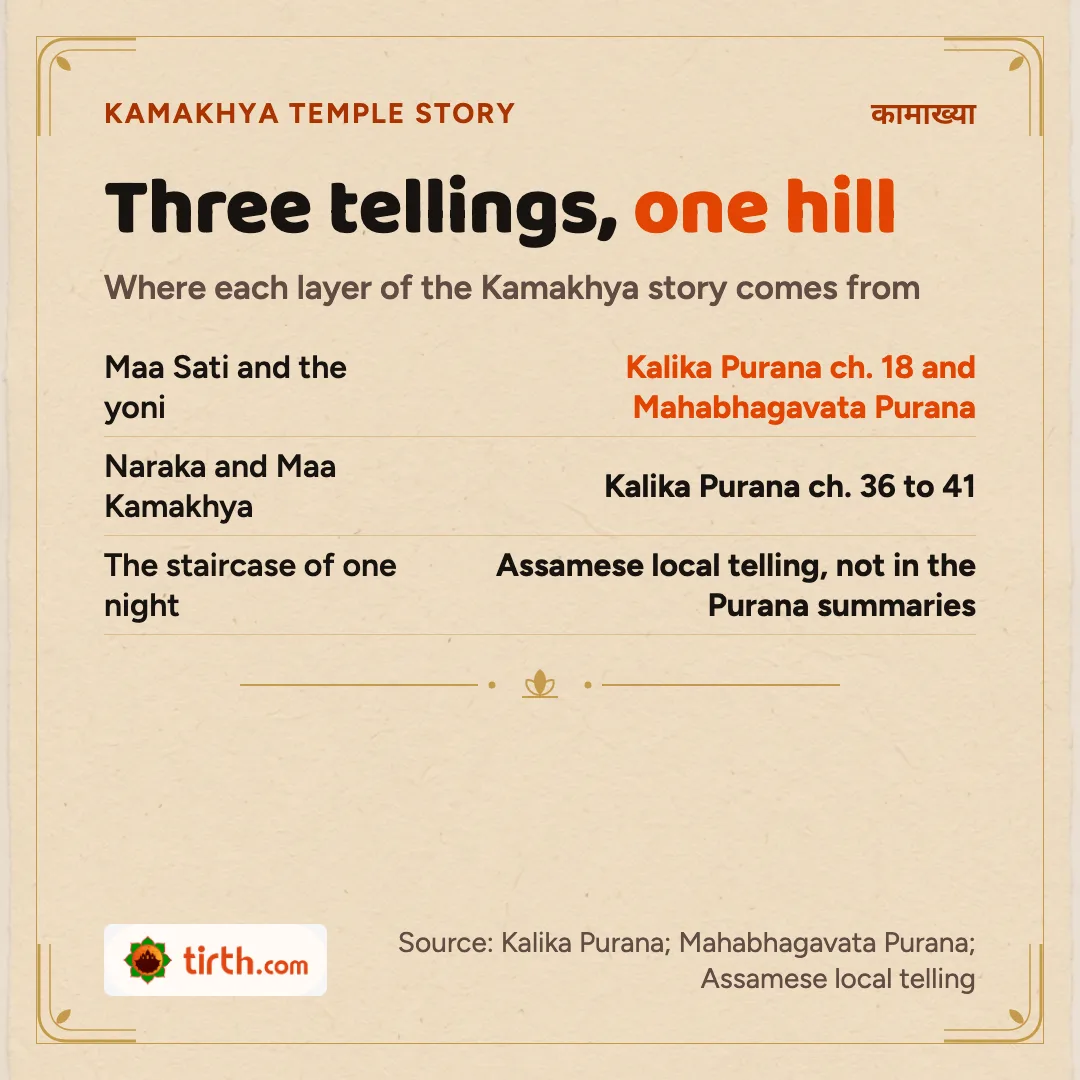
That folk tale is the smallest layer of the story. Under it is Maa Sati, whose yoni, the texts say, fell in Kamarupa on the hill the Mahabhagavata Purana calls Nilachala. Under her again sits the Kalika Purana’s account of Naraka. The folk tale doesn’t follow it at every turn. Ask which version is right, and you find the texts don’t agree on all of it.
In short
That folk tale is the smallest layer of the story. Under it is Maa Sati, whose yoni, the texts say, fell in Kamarupa on the hill the Mahabhagavata Purana calls Nilachala. Under her again sits the Kalika Purana’s account of Naraka.
How does Maa Sati’s story reach Nilachal hill?
Start with the Kalika Purana. R. C. Hazra summarises its chapter 18 in his Studies in the Upapuranas (1958), and there Bhagwan Brahma, Bhagwan Vishnu, Deity page on Tirth and Shani Dev enter Maa Sati’s dead body and cut it into pieces that fall at holy places. Her yoni lands on Kama-giri in Kamarupa, and the Devi, the goddess, is Kamakhya there. Only Bhagwan Vishnu does the cutting in other tellings.
The Mahabhagavata Purana tells the same fall but puts more weight on the hill itself, and Prabir Kumar Nanda Goswami translated and studied it in 1999. The yoni sinks down into the nether world in this text, and it is Bhagwan Shiva, Deity page on Tirth who holds the hill along with the yoni, doing his penance there. It names the hill Nilachala and calls the Devi Kamesvari or Kamakhya. Kamarupa comes 51st in its count of pithas, a pitha being a seat of the Devi. It even gives a reason for the name, that the Devi, it says, came to the hill in secret to be with Bhagwan Shiva.
The number of pithas differs depending on which text you open. Ask the Pithanirnaya or the Mahabhagavata and you get 51, the Devi Bhagavata and the Matsya say 108, and Bengal goes with 52. So a single fixed number is not something these texts give you.
Our post on 52 Shakti Peeth temples in India looks past this one hill.
All of this is a devotional account, the story of Maa Kamakhya as people tell it. The Kamrup Metropolitan district administration’s page itself lists the settling of her yoni here among the popular legends.
Who was Naraka, and why did Maa Kamakhya leave him?
Naraka’s beginnings take up chapters 36 to 40 of the Kalika Purana. His parents are Prithvi and Bhagwan Vishnu in his Varaha form, the boar avatar. King Janaka raises him. Later Bhagwan Vishnu himself makes him king of Pragjyotisha, with Maa Kamakhya as his principal deity.
Then Bana and Naraka become friends, and Naraka turns disrespectful towards Brahmins, towards Bhagwan Vishnu, even towards Maa Kamakhya. When the sage Vasishtha comes to see the Devi, Naraka refuses to let him in. Chapter 40 has Vasishtha’s doom fall on him, and Maa Kamakhya vanishes along with her retinue and stays away for as long as Naraka lives.
The end comes in chapter 41. Bhagwan Vishnu, in the form of Bhagwan Krishna, attacks Naraka at Pragjyotisha and kills him. Naraka is alarmed to see Maa Kalika, who is Kamakhya, standing beside Bhagwan Krishna. His son Bhagadatta becomes king after him.
Narak Chaturdashi remembers that death, and our Narak Chaturdashi story goes into it, including the question of who struck him last.
What is the staircase of one night?
Hazra’s summary doesn’t have the staircase. Nor does Dilip Kumar Goswami’s 1997 literary study of the Kalika Purana, because the stair belongs to an Assamese local telling. I think it should stay filed as a folk tale. Putting it on the Purana would give the Purana something those summaries don’t hold.
Naraka wishes to marry Maa Kamakhya, and her answer comes with a condition attached. He has to build a stair from the foot of Nilachal hill up to the temple, inside a single night and before the cock crows. He starts on it. The Devi has the cock crow early, though, and the stair stays unfinished.
Popular accounts, not any text, tie two places to the story. Kukurakata in Darrang district is where they set the cock’s end, and the Mekhelauja path is said to be the stair Naraka never finished, though no text or official page we could find names either place.
How Naraka ends depends on who is telling it. One telling has him run after the cock and kill it. The Kalika Purana’s own account is different, with Bhagwan Vishnu as Bhagwan Krishna killing Naraka.
What stands on the hill today?
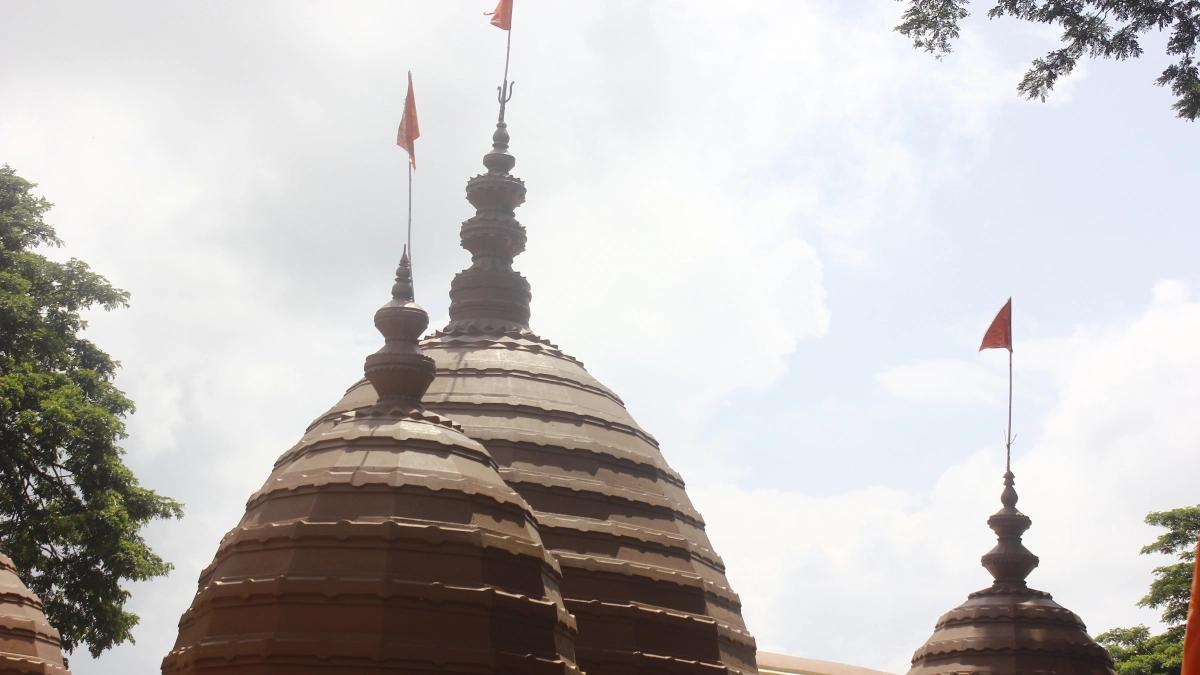
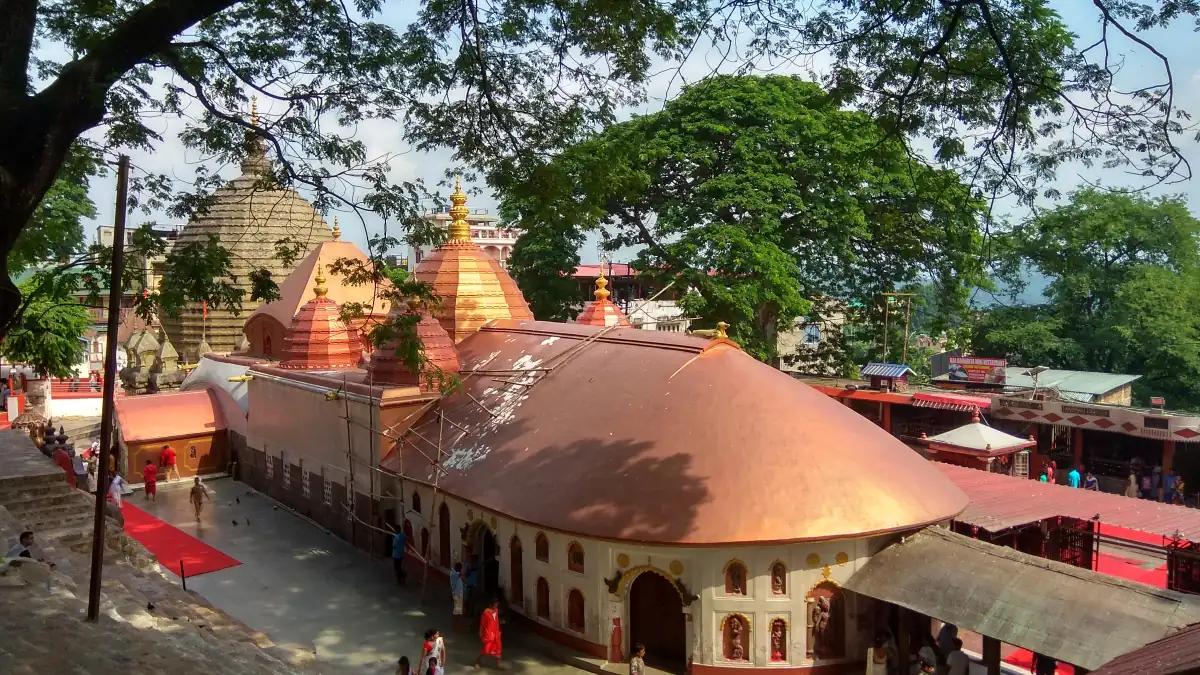
The Kamakhya temple stands on Nilachal hill, 7 km from Guwahati according to the Kamrup Metropolitan district page, which was last updated in December 2025. There is no image inside. What people worship is a yoni-shaped cleft in the rock, kept full by an underground spring, and the same page places it in the third chamber, a cave-like one.
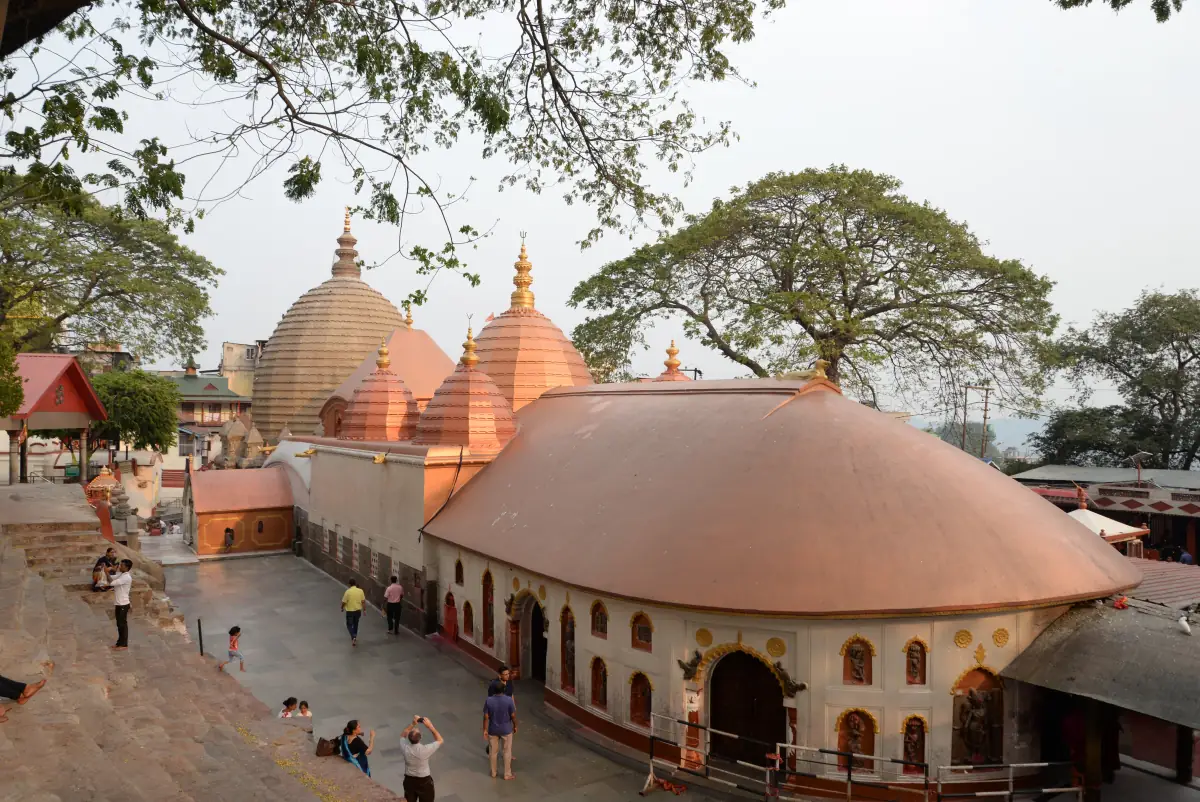
The building you see now comes from the Koch rebuilding, completed in 1565. We keep its history and the practical side of a visit on the Kamakhya Temple page.
What happens at Ambubachi?
Every June the temple has the Ambubachi Mela. In tradition the mela marks the Devi’s yearly menstruation. The temple is shut for three days, and some reports make it four because the doors open again on the fourth day.
For 2026, news reports quoting the temple authorities gave 9:08 pm on 22 June as the start. There was no darshan on 23, 24 and 25 June, and the doors opened again on the morning of 26 June, when devotees received Angodak, the sacred water, and Angabastra, a piece of red cloth, as prasad. The dates change every year, so check the Ambubachi Mela page before you plan a visit for late June.
Frequently asked questions
Her yoni. Two texts say so, the Kalika Purana (chapter 18, in R. C. Hazra’s summary) and the Mahabhagavata Purana, and this is the devotional account. Bhagwan Shiva, the Mahabhagavata Purana goes on, held the hill with the yoni and did penance there.
Because what is worshipped is a yoni-shaped cleft in the rock. An underground spring keeps it full, and you will find it in the third chamber, going by the Kamrup Metropolitan district page.
No. It is an Assamese local telling, and Hazra’s and Goswami’s summaries of the Kalika Purana don’t include it. The Purana gives Naraka’s death to Bhagwan Vishnu as Bhagwan Krishna.
What stands today is the Koch rebuilding, finished in 1565, and for the history you can see the Kamakhya Temple page.
That’s Ambubachi, which as the festival is told marks the Devi’s yearly menstruation. The temple stays closed for three days, four in some reports because it reopens on the fourth day. In 2026 the doors shut on the night of 22 June and opened again on the morning of 26 June.
In the staircase tale it is the path Naraka left half built, and the cock’s end is set at Kukurakata in Darrang district. The name comes from popular accounts, not from a text.
Continue on Tirth
- The temple’s own details are on the Kamakhya Temple page, so you need not lean on a story for them.
- Maa Kamakhya also has a page of her own on Tirth.
- For the wider circuit of peethas, read the 52 Shakti Peeth yatra guide.
- Anyone who would walk to the hill can use the Kamakhya Temple padayatra page.